By end of 2025, sub-Saharan Africa had 31.7 million internally displaced persons. At end of 2025, 29 million IDPs were displaced by conflict and violence and 2.7 million by disaster; during 2025, 14.5 million displacements resulted from conflicts and violence and 2.9 million from disasters, for 17.3 million in total. Conflicts are the primary measured driver of internal displacement in 2025, but they do not invalidate the joint role of climate shocks and institutional vulnerabilities. What the Mali-Senegal comparison reveals goes further: institutional fragility can increase vulnerability and displacement risks linked to drought, but it alone cannot predict permanent exodus.
The essentials
- In 2025, conflicts and violence triggered 14.5 million internal displacements, against 2.9 million for disasters—these are movements and not stocks of displaced persons.
- Institutional capacity is an important factor among interdependent environmental, economic, social and political determinants.
- In Mali, approximately 347,000 people were living displaced by conflict and violence at end of 2023 according to IDMC; in Senegal, migration flows in response to climate variability remain generally seasonal according to available data.
- Adaptation policies should be integrated with measures for development, social protection and institutional strengthening.
- The 2030-2050 horizon sharpens this tension: World Bank projections suggest that climate shocks will intensify in zones where state fragility is already structural.
17.3 million versus 2.9: the figures that reframe the question
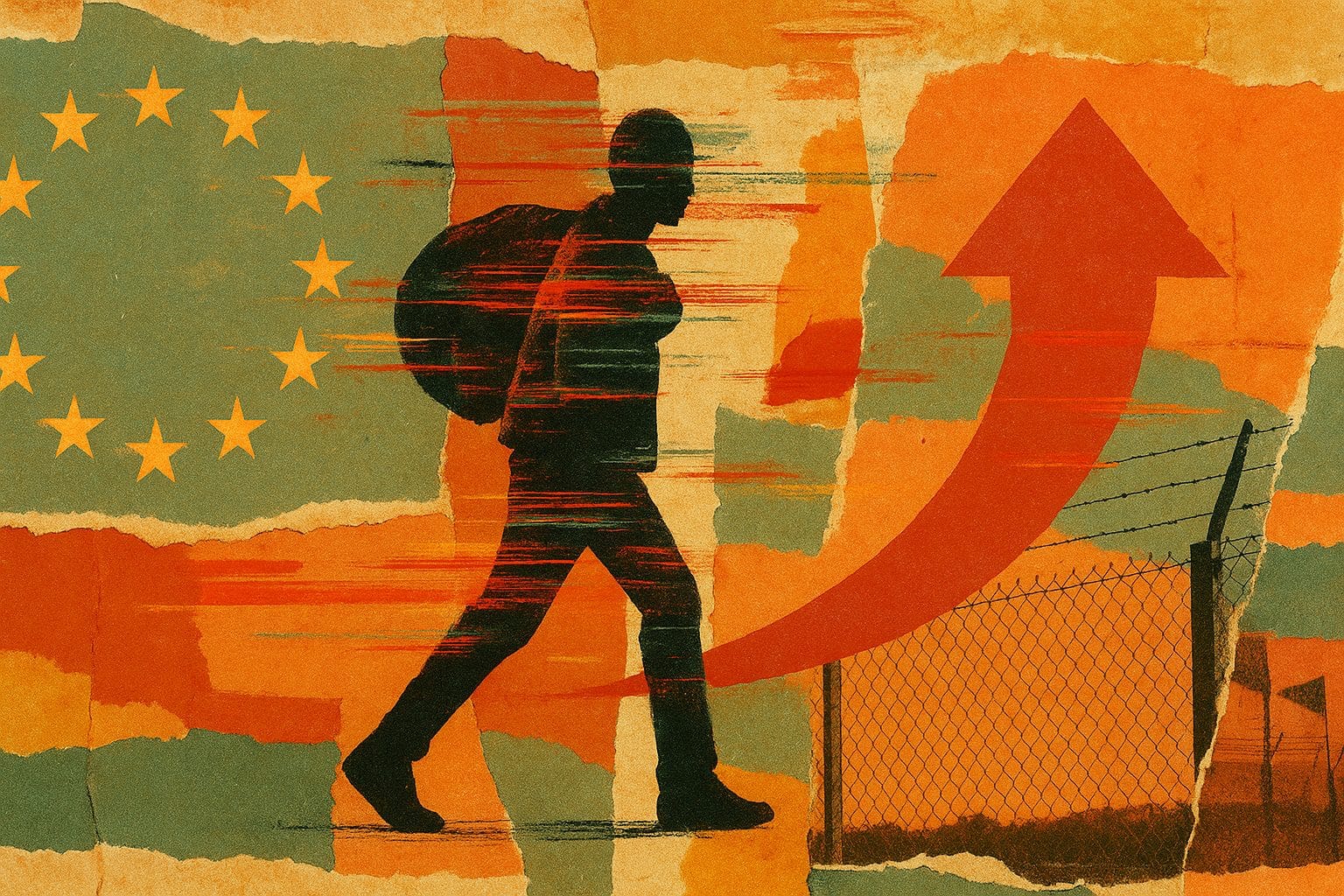
The IDMC publishes each year the most precise count of people displaced within their own borders. Its 2026 report covers the situation at end of 2025. The result for sub-Saharan Africa is clear: of the 31.7 million IDPs at end of 2025, 29 million were associated with conflicts and violence. Internal displacements reached 17.3 million in 2025, of which 14.5 million were linked to conflicts and violence. Disasters caused 2.9 million displacements in 2025; 2.7 million IDPs were living displaced because of disasters at end of 2025. The ratio is six to one.
This figure settles a debate that has dominated media and parts of diplomatic circles for the past decade. “Climate migration” has become a dominant explanatory framework for African flows. It captures a partial reality. Sahel droughts are worsening. Flooding in Mozambique or Somalia is documented.
But this framework, applied without hierarchy of causes, produces inaccurate diagnoses and, ultimately, inadequate policies.
Displacement linked to conflict does not concern only a few localized war zones. It extends from the Sahel to the Horn of Africa, from the Democratic Republic of Congo to Ethiopia. In the main conflict centers, many departures are directly linked to violence, but disasters and climate factors also contribute to displacements.
The same drought, two trajectories
The comparison between Mali and Senegal is the analytical core of this analysis. The two countries share the same Sahel climate zone. The same drought cycles affect them. The below-average rainfall of the 2010s and early 2020s weighed on both rural economies.
Displacement trajectories diverged markedly. According to IDMC, approximately 347,000 people were living displaced by conflict and violence in Mali at end of 2023; the figure of 336,000 is not the one published in the GRID 2024. This curve reflects a rupture, coinciding with the partial collapse of the Malian state after the 2012 coup and the armed groups’ takeover of the country’s north. Drought in Mali occurred in a context where state capacities to ensure security, social protection and resource management had weakened.
In Senegal, migration flows in response to climate variability remain generally seasonal according to available data. Nomadic herders move, farmers adapt, families send one member to seek income in the city before returning. Mobility exists, but it remains reversible. The Senegalese state maintains its institutions, preserves an administrative presence in rural zones, and has a minimal social safety net that absorbs part of the shocks.
This divergence extends beyond the particular case of the two countries. A systematic review published in Nature on West Africa confirms the mechanism at the regional scale: institutional fragility can amplify the effects of climate pressures on mobility, among other contextual factors. Drought can contribute to different forms of mobility and, depending on contexts, to forced displacement or immobility. In contexts of conflict or weak public capacities, drought can increase displacement risks without making exodus inevitable.
State fragility amplifies climate stress
Understanding this mechanism requires breaking down what a functioning state concretely provides to its rural populations facing climate variability.
First element: physical security. When drought forces herders to move their herds to less arid zones, cohabitation with sedentary farmers can become a source of tension. In a functioning state, these conflicts are mediated by local or national institutions. Variability can contribute to tensions in certain fragile contexts, where violence can in turn provoke displacement.
Second element: safety nets. A capable state can activate emergency transfers, distribute seeds, maintain access to water points. These mechanisms do not eliminate the climate shock, but they lower the threshold at which a family decides to leave without planned return. Lasting migrations can result from the interaction between variability, resources, social networks, adaptation possibilities and political context.
Third element: capacity for medium-term adaptation. Irrigation, collective water resource management, crop diversification—all these responses to climate change require functioning institutions. In the Sahel, regions where local communities maintained organizational capacity cushioned recent drought shocks measurably. Those where authority collapsed saw populations depart.
The imposition of the climate narrative and its limits
The climate framing of African migration was not born of deliberate bad faith. It was constructed on real observations and a convergence of interests: environmental organizations saw it as an argument for climate action, certain African governments as a means to mobilize international financing, and media as a readable narrative on a complex crisis.
The problem is that inaccurate framing produces inadequate responses. Climate adaptation funds in sub-Saharan Africa face significant governance challenges in zones of institutional fragility. Planting trees in the Sahel in a region where armed groups control territory produces neither wells nor resilience: it produces burned trees and development workers who leave again.
The governance question also sits at the center of other transitions this publication has documented. Emerging countries face a similar constraint in managing automation: without institutions capable of directing transitions, technological or climate shocks worsen inequality rather than reduce it. And the question of what democracy can accomplish without a capable state takes its most concrete form here: without a state, no adaptation is possible, climate-related or otherwise.
The requirements of adaptation policies
Reorienting the diagnosis has direct practical consequences.
The first is to treat conflict as a distinct variable in climate adaptation. Active conflicts complicate and limit the deployment of resilience funds, but do not necessarily prevent it. Stabilization, development and climate adaptation must be conceived jointly and tailored to context. In zones like central Sahel, Burkina Faso, Mali, Niger, this sequence requires accepting that some adaptation interventions be deferred until a minimum of security is restored.
The second is to invest in local institutional capacities, not just in physical infrastructure. A well built in a village whose local administration has disappeared will be monopolized, abandoned, or destroyed. The same well in a village whose community council functions will be maintained and managed. This apparently simple fact is regularly ignored by international aid architectures, which fund the object rather than the institution.
The third is to distinguish, in migration data, between reversible flows and permanent exodus. Seasonal mobility is an adaptation strategy that has weathered millennia of Sahel droughts. It deserves support, not obstruction by migration policies designed for permanent flows. Permanent exodus, meanwhile, signals an institutional failure that calls for a different response.
The World Bank projects an intensification of internal climate migration and the emergence of hotspots by 2030; it also emphasizes interactions with fragility, without establishing the precise geographic formulation advanced. Droughts can increase lasting displacement risks through their direct effects, modulated notably by public capacities and socioeconomic conditions.
The actors framing the problem correctly
Organizations have begun integrating this analysis into their operations.
The IDMC itself has evolved its methodology to isolate causes of displacement and avoid simplistic attributions. The report distinguishes displacements linked to conflicts and violence from those linked to disasters, while analyzing contexts where multiple risks may coexist. This is significant analytical progress: it allows decision-makers to see where humanitarian response must be primarily security-focused and where it can be directly climate-related.
The Intergovernmental Panel on Climate Change and several associated research teams are working on analytical frameworks that integrate institutional capacity as a mediating variable between climate stress and displacement. The systematic review published in Nature on West Africa, cited above, is part of this movement: it explicitly treats state fragility as a factor amplifying climate change effects, not as a separate problem.
At the operational level, certain African Union and Economic Community of West African States programs work to articulate security and development in the Sahel. The G5 Sahel force, despite recent difficulties, was an attempt to create this coupling. Regional organizations are seeking alternative formulas. The challenge is to find institutional architectures that allow climate adaptation to develop even in degraded security contexts, which requires local actors capable of carrying these programs without depending on central state presence.
The question that remains open is financing. The major international climate adaptation architectures—green funds, loss and damage mechanisms, bilateral financing—are designed for functioning states that can present projects, ensure their management and account for them. The most fragile states find it difficult to access international climate adaptation financing mechanisms. Designing mechanisms that circumvent this constraint, by working through local communities, civil society organizations or customary structures where they function, is the practical challenge before donors and multilateral agencies for the next ten years.
Sources
- IDMC Global Report on Internal Displacement 2026
- IOM World Migration Report 2026, International Organization for Migration
- Nature, systematic review on displacement and climate vulnerability in West Africa (2026)
- World Bank Climate Action, climate adaptation projections in sub-Saharan Africa