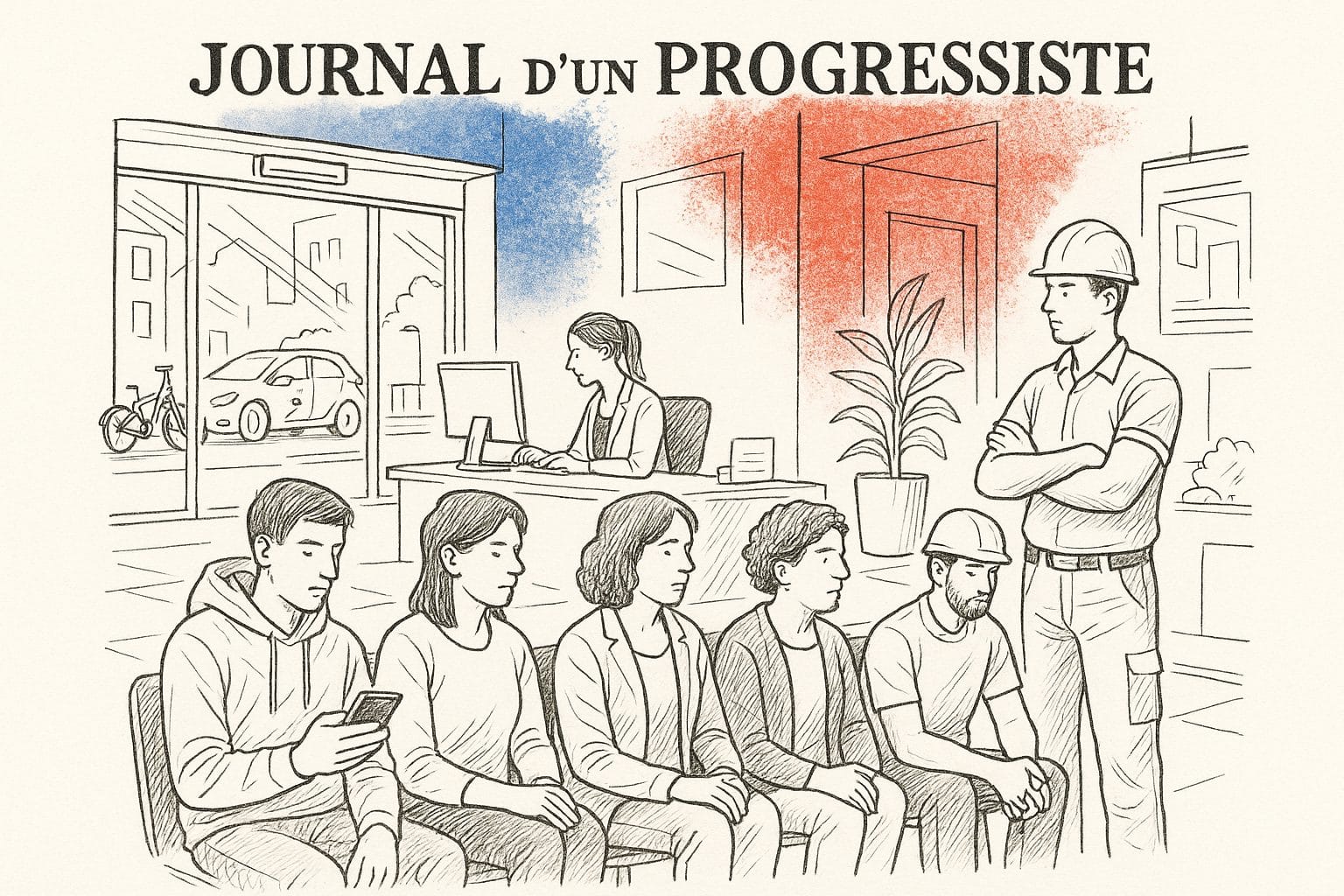
In 2024, the ILO and the World Bank estimate that between 26% and 38% of jobs in Latin America are exposed to generative AI. Approximately 17 million jobs capable of gaining in productivity remain blocked by gaps in digital access and infrastructure. The fastest digital transformation in the region’s history is underway even as roughly half of the jobs likely to benefit from AI-driven productivity gains cannot access it due to digital divides. The decisive gap will oppose equipped workers to excluded workers, and it is widening before algorithms even arrive.
The Essential Points
- Between 26% and 38% of Latin American jobs are exposed to generative AI, according to the ILO and World Bank (2024).
- Approximately 17 million jobs could gain in productivity through AI, but half remain hindered by lack of digital access and infrastructure.
- The first effect of AI in the region will not be massive job elimination, but acceleration of inequalities between equipped formal enterprises and excluded informal workers.
- The priority political lever is infrastructure: affordable broadband, workplace equipment, formalization of activities.
- Between 2030-2040, two trajectories face off: convergence through access or accelerated divergence, depending on public investment choices made now.
Exposure Does Not Predict Destiny
When one reads that between 26% and 38% of Latin American jobs are exposed to generative AI, the temptation is to calculate how many millions of positions are threatened. This is a misreading. Exposure to AI does not mean imminent automation. It means that the tasks in question can be augmented, accelerated, or transformed by artificial intelligence tools. For most jobs in the region, the probability of complete substitution remains low in the short term: the most exposed jobs are also those requiring relational skills, physical grounding, or contextual judgment difficult to automate.
What the ILO-World Bank study highlights is more precise and more uncomfortable. Of jobs capable of benefiting from AI-driven productivity gains, approximately half cannot access them today. These 17 million workers are not protected by distance from algorithms: they are simply deprived of the minimum conditions to benefit from them. Insufficient connection, missing equipment, informal activity that cuts access to digital platforms and services. AI is arriving, but for them, it is arriving elsewhere.
The usual reading of technological risk deserves to be turned on its head. Automation worries because it destroys jobs. In Latin America, the danger is different: AI will increase the productivity of those who have access to it and leave others at the same level, widening a gap with lasting consequences for wages, professional trajectories, and the very structure of the labor market.
Informality Blocks Digital Access
Latin America has a high informality rate, among the highest globally, even if sub-Saharan Africa generally shows higher levels. According to the ILO (Labour Overview 2024), the average regional informality rate in Latin America and the Caribbean was 47.6% in 2024. The range by country runs from approximately 27% (Uruguay) to 85% (Bolivia). This figure is not merely a social statistic: it is a technological entry barrier.
An informal worker generally has no access to digital tools provided by an employer, no professional account on productivity platforms, no company-financed training. They often pay dearly for internet access through prepaid mobile plans, insufficient for working with data-hungry AI applications. The absence of a formal contract also deprives them of public devices to support skills development, when they exist.
Formalization goes beyond issues of social protection or tax revenue: it becomes a prerequisite for digital transition. A construction tradesman in El Salvador or a street vendor in Lima first need a contract, a tax address, a bank account, and stable connection. These preconditions open access to the tools that follow.
Governments that bet on digital training without addressing formalization are investing in the wrong order. Training an informal worker without reliable connection and without equipment in AI use is like distributing driver’s manuals without a license and without a car.
Who Captures the Gains: The Institutional Question
Economist Daron Acemoglu built much of his work on a question directly applicable here: when technology advances, who captures the gains. His answer: it depends on institutions, not on the technology itself. An innovation can increase overall productivity while concentrating its benefits on a fraction of the population if the rules of economic play invite it. AI is no exception to this logic.
In Latin America, labor market institutions are fragmented. Large formal enterprises have the resources to equip their employees, negotiate AI tool licenses, train their teams, and absorb transition costs. Micro and small enterprises, self-employed workers, and informal employees have none of this. Without corrective public intervention, the productivity gained through AI will concentrate in the already best-equipped segments of the labor market. Existing inequalities will not simply be reproduced: they will be amplified by the speed gap between those accessing the tools and those who do not.
An alternative reading, advanced by economists more optimistic about technological diffusion, nuances this picture. The argument: digital technologies have historically tended to become accessible quickly and decrease in price. Mobile phones in sub-Saharan Africa, payment platforms in Kenya, microfinance applications in Southeast Asia reached populations that traditional banks had never served. AI could follow the same path, especially as lightweight models and mobile applications begin deploying on low-end terminals.
This reading is plausible, but it underestimates one point: the spontaneous diffusion of mobile technology took two decades and benefited from massive investments in telecommunications infrastructure, both public and private. Generative AI is more demanding in bandwidth, computing power, and usable interfaces. Making it accessible will not be automatic. It will require the same types of deliberate investments, at the same levels of political commitment.
The question posed by Acemoglu thus has no deterministic answer. But it forces a choice: either public institutions build the conditions for broad diffusion, or gains remain captured by formal enterprises that do not need help to adopt AI. This political choice must be made now, before the gap widens to the point of becoming irreversible. The same tension between technological diffusion and capture of gains plays out elsewhere in the world, as shown by the questions raised by agricultural automation or the unregulated deployment of AI agents in American firms.
Advances by Pioneer Countries
Several countries in the region have launched policies that, while not always framing it this way, attack the right priorities. Brazil launched in 2023 a rural connectivity program aiming to cover municipalities not served by fixed broadband, relying on the Fundo de Universalização dos Serviços de Telecomunicações. The objective is not explicitly linked to AI, but it creates the preconditions for any digital skills improvement.
Colombia integrated into its national digital transformation strategy specific components on equipping micro and small enterprises, including measures favoring enterprises beginning a formalization process. The coupling between formalization and technological access is precisely the lever the ILO-World Bank study identifies as a priority.
Mexico has meanwhile extended its Internet para Todos program, targeting rural and periurban areas without broadband coverage, with the ambition of connecting several million additional households. These initiatives remain insufficient at the scale of needs, but they signal that infrastructure priority is not an abstract idea: it is already policy in several countries, waiting to be accelerated and better financed.
At the regional level, the Inter-American Development Bank has financed for several years projects in digital infrastructure and SME formalization. The issue now is to coordinate these dispersed efforts in a logic explicitly oriented toward AI access, rather than letting each program operate in silos. South Africa’s experience with emerging technologies shows that it is possible to position oneself on advanced technologies without neglecting the lower layers of infrastructure, provided one plans in the correct order.
Two Paths Toward 2035: Access or Divergence
The ILO-World Bank study allows us to sketch two trajectories for the next decade, without either being inevitable.
In the first scenario, investments in digital infrastructure accelerate, driven by national public commitments and multilateral financing. Affordable broadband gradually reaches periurban and rural areas. Formalization programs are coupled with incentives for technological adoption: equipment subsidies, access to AI tools adapted to small structures, support for taking them in hand. Within this framework, a significant portion of the 17 million workers today excluded could access AI tools by 2030-2035. Productivity gained would be more widely shared.
The gap between formal and informal enterprises would shrink, without disappearing.
In the second scenario, investment in infrastructure remains insufficient or poorly targeted. AI continues spreading rapidly in large enterprises and well-connected urban areas, while informal and rural workers remain left out. The productivity of formal enterprises advances, their competitiveness increases, but the mass of workers without access sees their relative position degrade. Income inequalities, already among the highest in the world, deepen. The labor market segments further, and the political pressures accompanying this type of fracture become difficult to absorb.
These two scenarios are not predictions. They indicate where distinct choices lead, and they stress that signals to monitor are concrete: evolution of broadband coverage in informal zones, measured productivity gap between equipped and non-equipped enterprises, pace of formalization of micro and small enterprises. These indicators will show, in the coming years, which trajectory actually unfolds.
What is clear is that the 2030-2040 horizon plays out on investment decisions to be made now. Digital economies have cumulative logic: enterprises that equip early take an advantage that becomes structural. Workers who master tools from their initial deployment subsequently occupy positions where these tools are used. Waiting for technology to become accessible on its own amounts to accepting a decade of lag that will not be easily made up.
The Underestimated Lever of Training at the Right Level
Political temptation is to invest massively in training in advanced digital skills: prompt engineering courses, AI certifications, university programs in data science. These trainings are useful for a fraction of the working population. They resolve nothing for the 17 million workers whose access is blocked upstream.
The underestimated lever is more prosaic. It is training workers in the use of simple digital tools, adapted to their daily activities, on devices they already own or could own at low cost. A bookkeeper at a Peruvian SME who learns to use an AI assistant to draft quotes and manage billing gains productivity without having followed complex technical training. A Guatemalan seamstress who accesses a digital commerce platform via her mobile phone expands her market without going through data science training.
This type of gradual adoption assumes two conditions: reliable and affordable connection, and tools designed for simple use in Spanish or local languages. The second condition depends on enterprises developing these tools. The first depends entirely on public policy choices.
Several recent ILO studies on the impact of generative AI on productivity and work organization tend to confirm that the most significant productivity gains are observed among intermediate-skill workers who use AI as an amplification tool rather than as a substitute. This is precisely the dominant profile in Latin America: workers skilled in their domain, under-equipped in digital tools, whose productivity could advance substantially with simple and reliable access to the right tools.
The question that will remain open in coming years is whether governments in the region will treat digital infrastructure as an economic policy priority at the same level as roads or energy, or whether they will continue to see digital skills training as the main lever. Available data clearly argue for the first option. Actual budget arbitration will decide.
Sources
- ILO and World Bank, Generative AI and Jobs in Latin America and the Caribbean, July 31, 2024
- ILO, The impact of GenAI on jobs, productivity and work organization, June 2026
- Daron Acemoglu and Simon Johnson, Power and Progress: Our Thousand-Year Struggle Over Technology and Prosperity, PublicAffairs, 2023
- ILO – ILO Working Paper 121 (main ILO/World Bank study, July 31, 2024)
- ILO – Official Press Release, July 31, 2024
- World Bank – Official Publication Page
- ILO – Labour Overview 2025 Latin America and the Caribbean
- Ministry of Communications of Brazil – FUST Programme 2023
- DNP Colombia – Digital National Strategy 2023-2026
- Presidency of Mexico – Internet for All
- NBER Working Paper 33442 – Acemoglu, ‘Institutions, Technology and Prosperity’
- Primary ILO-World Bank Report on Generative AI and Employment in Latin America (July 2024)
- ILO Press Release – July 31, 2024
- World Bank – Official page of LAC GenAI report
- ILO – Labour Overview 2024, Executive Summary
- MIT Economics – Daron Acemoglu on the Economics of AI
- World Bank – Geography of High Inequality (2024)