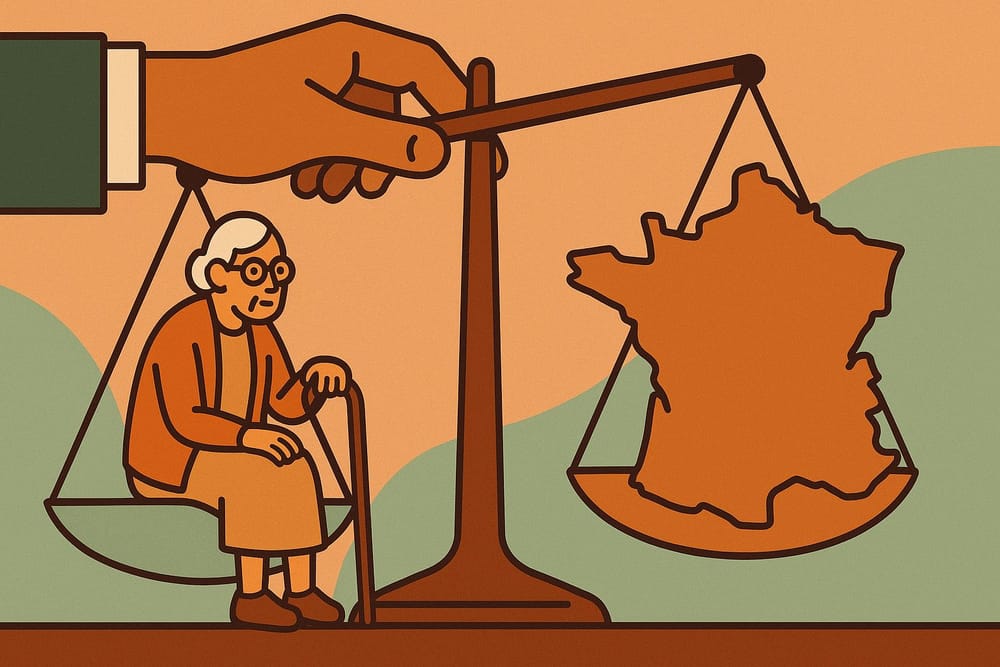
According to the OECD, nineteen OECD countries have staffing ratio requirements or guidelines in long-term care facilities. France has not. France does not impose staffing ratios in long-term care, and shortages are degrading working conditions, while the share of French people aged 65 and over is rising steadily toward 2040. A shortage of care workers is making this trade-off increasingly difficult to avoid.
The essentials
- France is absent from the group of 19 OECD countries that have legislated a minimum staffing ratio per resident in long-term care facilities (OECD Economic Surveys France 2026).
- France has no national requirement for staffing ratios in long-term care, while shortages and poor working conditions limit the supply of workers.
- The share of those aged 65 and over is estimated at 22.2% in 2026 and projected at 26.6% in 2040 according to INSEE’s central scenario. Aging increases needs and expected long-term care spending.
- A silent shift toward private or family solutions is already perceptible: solvent households are organizing without waiting, others see costs transferred to assets and legal guardians, or have access to public aid schemes.
- The OECD identifies staffing ratio requirements in 19 OECD countries. Documented levers include a legal staffing ratio, conversion funds, and measurement of closed beds.
France in the lower third of countries regulating long-term care
The OECD ranks its members based on whether or not they have staffing ratio requirements in housing facilities for dependent elderly people. Nineteen countries have adopted them. France is in the other group.
A legal staffing ratio produces three concrete effects: it gives facility directors an argument to oppose against budget authorities, it stabilizes working conditions by making any organization below a defined threshold illegal, and it creates a common measure allowing facilities to be compared to one another. Without this ratio, each director negotiates without shared reference points. Trade-offs are made locally, quietly, without national accounting.
The OECD’s report on France published in June 2026 documents this gap. France does spend a substantial share of its gross domestic product on long-term care, but has chosen to leave internal facility organization without a personnel floor. This choice has short-term budgetary logic: imposing a legal ratio costs immediately, the absence of a ratio costs later and more discretely.
Closing beds or exhausting caregivers: the two faces of the same shortage
When a facility lacks staff, it has two options. It can maintain the number of residents and operate its teams in chronic under-staffing. Or it can close beds to maintain a sustainable caregiver-to-resident ratio. Both strategies coexist, depending on the facilities and local pressure.
The first feeds a shortage of care workers. Working conditions deteriorate, sick leave increased during the health crisis then declined in 2023, and staff turnover and hiring accelerated until 2022, before a slight slowdown in 2023. It is a circle that facilities caught in it struggle to escape. The second reduces the supply of beds while the number of residents also decreases: families face waiting times that can exceed several months in certain regions.
These two mechanisms transfer risk to families. Those with means pay for a private facility or fund home care assistance. Others organize themselves, often at the expense of the caregiver, most often a woman between 45 and 65 years old, according to Eurocarers data on the profile of informal caregivers in France.
Accelerated population aging amplifies this mechanism. The more the share of elderly people increases, the more families are exposed to this trade-off. This tension has been rising gradually for ten years and is accelerating.
The 19 countries that legislated staffing ratios
Approaches vary by country, but the logic is consistent: setting a floor provides a common, measurable, and enforceable basis. Since October 2024, Australia requires an average sector standard of 215 minutes of care per resident per day, of which 44 minutes are delivered by a qualified nurse. The measure was accompanied by additional funding and a ramp-up timeline. Germany has enshrined its ratios in facility law and verifies them through regular inspections. Nordic countries combine staffing floors with ongoing training requirements.
In these cases, the legal ratio created a measurable and enforceable base: it made the personnel shortage visible at the national level, thus creating a foundation for political action. Before the law, the shortage remained a sum of local situations. After, it became a national indicator with assigned responsibilities.
A legal floor does not train 50,000 nurses and does not solve the caregiver shortage. It does, however, create institutional pressure that forces budget trade-offs to be explicit. In the absence of a ratio, France allows these trade-offs to happen in each management office, without aggregated record.
Comparisons with the social protection systems of neighboring countries, such as those found in analyses of structural inequalities in the United States, show that regulatory choices made in one decade often set trajectories for two or three generations.
2040 approaches, the trade-off closes
According to INSEE, the share of those aged 65 or over is 22.2% in 2026 and would be 26.6% in 2040 in the central scenario published. This trend has been documented since the 1990s.
What makes this a pressing matter in 2026 is that France has not yet defined a regulatory framework comparable to that of nineteen OECD countries with staffing ratio requirements. The shortage of care workers will not reduce without active policies for conversion and training. The demographic surge will mechanically increase demand for long-term care while supply stagnates or shrinks.
The horizon of 2040 is not distant for training policies. Training a nurse takes three years. Opening a facility or renovating premises takes five to ten years. Decisions that would have visible effect by 2035 must be made now. This time constraint is precisely what the debate on pensions brought to light: long-term trade-offs on the financing of dependency cannot be postponed indefinitely without the cost of adjustment increasing.
The OECD notes the absence of staffing ratios and emphasizes that their introduction is likely difficult in the current context of shortages.
The silent shift toward the private sector and families
Something is happening that is difficult to measure but real: a growing fraction of families faced with a relative’s dependency is bypassing the public system without having decided to. They do not find a place in a facility, or find the quality insufficient, and organize differently—private home care, family reorganization, sometimes relocation of the relative to a country with lower costs.
This shift is silent because it produces no visible aggregated data. Each family makes its decision privately. The public facility does not have to record refusals or departures to the private sector. INSEE measures the share of elderly people in facilities, but not the reasons why some are not.
The Eurocarers profile for France in 2026 describes millions of informal caregivers, predominantly women, who ensure a substantial share of informal care. Informal caregivers contribute to supporting people losing autonomy in a context of professional shortages, without pay and without status, with documented effects on their own health and career trajectory.
The risk that this shift becomes irreversible before 2040 is real. Beyond a certain point, a degraded public supply and a developed private supply create organized interests to maintain the status quo. Households that have invested in private solutions no longer have an interest in financing an alternative public option through taxes. The bifurcation becomes self-reinforcing.
Two trajectories before 2035: what distinguishes them
There is no certainty about the trajectory France will take. Two scenarios merit examination, not as predictions, but as frameworks for identifying signals that will distinguish them.
In the first, demographic pressure forces an explicit political trade-off before 2030. A legal staffing ratio is introduced, accompanied by targeted funding and a ramp-up timeline. This sequence worked in Australia and several Nordic countries. It assumes that bed closures become sufficiently visible to weigh in parliamentary debate, and that care worker unions, caregiver associations, and local authorities converge around the same demand. In this scenario, the shortage of 50,000 nurses gradually shrinks because working conditions become defensible and conversion programs are financed in specific employment basins.
In the second, France remains outside the group of countries with legal ratios. Degradation continues to occur locally, facility by facility. Solvent households accelerate their shift to private or family solutions. Households that cannot do so absorb degraded care conditions. Before the demographic surge of 2040 is fully reached, the bifurcation between an impoverished public system and a developed private market is sufficiently entrenched to become difficult to undo.
This second scenario has a particular characteristic: it does not produce a visible event. It unfolds in closed beds, silent resignations, family reorganizations, and private contracts. This is precisely why three signals merit annual monitoring: the evolution of the number of beds closed due to lack of staff in public facilities, the share of households aged 65 and over that resort exclusively to a private or family solution, and the evolution of the number of declared informal caregivers.
These three measures, today partial or absent from public statistics, are the leading indicators of the shift. Without them, France will not know which of the two scenarios it is in until it is too late to change.
The levers that exist, the conditions for them to work
Lucid optimism on this matter requires looking at what has worked elsewhere and not assuming it will automatically work here. Three levers are documented by comparable countries.
The first is a legal staffing ratio of caregivers per resident. Its introduction must be accompanied by explicit funding, a progressive timeline, and independent inspection. Without these three elements, the ratio remains unenforceable. Australia took four years between announcement and full implementation of 200 daily minutes.
The second is a national conversion fund toward care professions, directed to employment basins where the shortage is documented. France already has vocational conversion instruments, but they are not specifically oriented toward long-term care. Sectoral and geographic targeting is the condition for money to reach territories where the shortage is most acute.
The third is measurement. An annual registry of beds closed due to lack of staff and a measure of the share of households pushed toward the private sector would give the legislature the data to make trade-offs. The question of long-term care funding, linked as it is to the financing of dependency as a whole, deserves parliamentary debates grounded in national figures, not situations aggregated by hand by associations.
France has already shown it can legislate quickly on health matters when political pressure is sufficient. According to the OECD, nineteen OECD countries have staffing ratio requirements or guidelines in institutional care, unlike France. The demographics of 2040 do not change: the question is whether the trade-off will be explicit before or after the shift to the private sector becomes difficult to reverse.
Sources
- OECD, OECD Economic Surveys: France 2026, chapter on quality and efficiency of long-term care
- INSEE, Population projections to 2070, share of those aged 65 and over (data cited in the brief)
- Eurocarers, France Profile 2026: data on informal caregivers (no link: page not stable)
- Washington Monthly, July 2026, data on shortage of care workers (Health Resources and Services Administration)
- ScienceDirect, Study on shortage of care workers in France 2026 (no link: reference to confirm in database)
- Institut Montaigne, Work on dependency and long-term care financing (no link: corpus entry, page not stable)