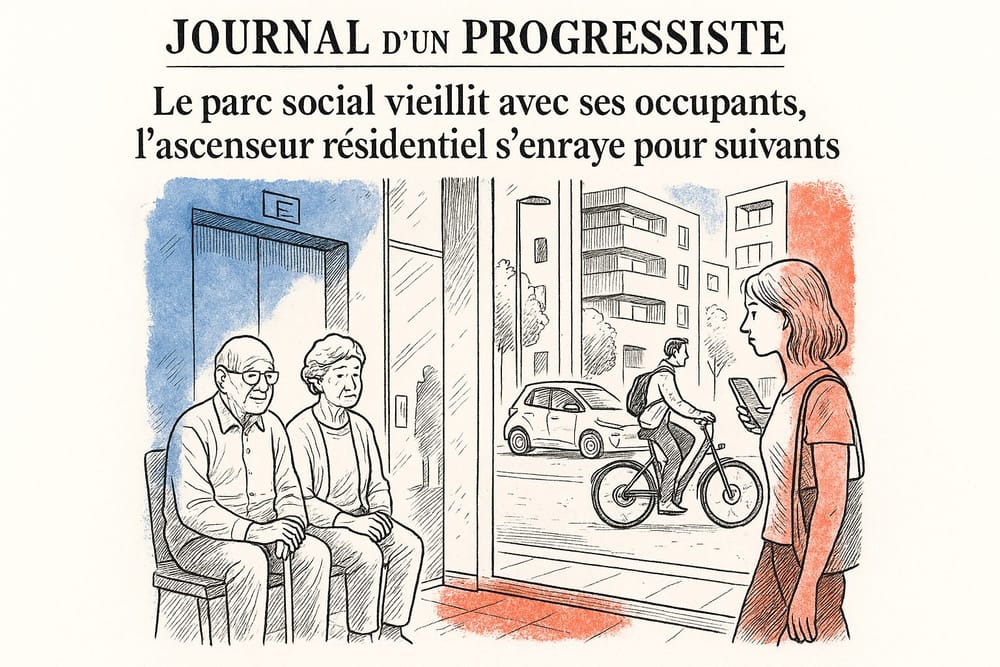
In 2025, 2.87 million households are waiting for social housing [11]. Only one applicant out of seven finds satisfaction each year [11]. The housing stock is freezing: the tenant mobility rate fell from 9.3% to 7.1% between 2019 and 2025 [10]. An additional percentage point of turnover would unlock up to 60% more housing units per year [15].
In 2024, 912 people died on the street [4]. That same year, only 82,000 social housing units were financed, the worst result in twenty years [4]. The waiting list has grown by 52% since 2015 [11]. Production collapsed over the same period. The choice facing 2027 is explicit: scale up affordable homeownership programs to reopen the residential ladder, adapt the housing stock to the massive aging that is coming, redirect public aid toward construction, or finally restore the municipal production requirement.
Five million housing units and a waiting list that doubled in twenty years
As of January 1, 2025, France’s social rental housing stock comprises 5,396,300 units [10]. Nearly one household in six lives in social housing. The stock grew by 0.5% between 2024 and 2025. Faced with exploding demand, this pace is insufficient [10].
As of June 30, 2025, 2.87 million households are waiting for housing [11]. This figure has doubled in twenty years. In 2024, 385,000 allocations were made for 2.8 million applications [11]. One applicant out of seven gets housing.
The gap between available stock and waiting list stems from a precise mechanism: turnover is slowing. The mobility rate of public housing tenants fell from 9.3% in 2019 to 7.1% in 2025 [10]. In the Paris region, this rate reaches about 5.5%. In Paris, it drops to 5.1%.
The long-term trajectory confirms the scale of the decline: the turnover rate was 10.3% in 2011. It was still 7.3% in 2023 [10]. In the private rental market, it exceeds 19% [10]. An additional percentage point of turnover would make available up to 60% more housing units each year [15].
This phenomenon is explained by the growing gap between social housing rents and those in the private sector. This gap encourages tenants to stay, even when their financial situation improves or the housing no longer fits their needs. The vacancy rate has also declined, from 2.9% to 2.1% between 2019 and 2025 [10]. Very few units remain available for emergencies.
At the other end of the chain, construction has collapsed. In 2024, 259,000 housing units of all types were put under construction [4]. The production of financed social housing reached 124,000 in 2016. It fell to 82,000 in 2024 [4].
On the international front, France presents a paradox. The Netherlands showed, according to the latest available OECD data (2020), a proportion of 34% social housing [14]. The United Kingdom had 21%. France stood at 20% [14]. The French model is very extensive, and this very extension is at the heart of the allocation problem.
Social rental housing represented on average about 6% of total real estate stock in OECD and EU countries in 2020 [14]. With very broad income ceilings, nearly 72% of households would meet the conditions to file an application, according to the Court of Accounts [3]. A quasi-universal stock with quasi-universal ceilings generates bottomless demand. It cannot, by definition, target the most acute needs.
Behind these figures lies the human context. In 2025, 350,000 people are homeless, compared to 300,000 in 2020 [4]. In 2024, 912 people died on the street, 16% more than in 2023 [4]. In total, 12.3 million people live in precarious housing conditions [4]. Among them, 4.2 million are considered non-housed or inadequately housed [4].
The aging that freezes the stock for a generation
The rupture transforming social housing fundamentally is demographic. By 2030, those over 60 will represent 30% of the French population, roughly 20 million individuals [4]. It is also today the share of tenants over 60 in social housing. The stock is aging alongside its occupants.
In 2022, between 14% and 15% of social housing residents were 65 or older [13]. Between 25% and 27% of lease holders fell into this age bracket [13]. Between 2020 and 2030, the number of people 75 and older is expected to increase by more than 34% [4].
This aging produces two simultaneous effects. Seniors occupy housing units long-term, often family-sized homes that have become too large, for lack of adapted alternatives. Their housing is poorly suited to loss of independence. The question is a priority for 80% of housing providers, but its treatment remains uneven across organizations [6]. As of January 1, 2023, social housing comprised approximately 350,000 adapted units, below estimated needs [6].
These senior tenants are mainly single women or disadvantaged persons. Nearly 75% of retirees in social housing are former workers or clerical employees [13]. In 2023, 40% of them reported a disability or daily difficulty [13]. Among the overall retiree population, this proportion barely exceeds 25% [13].
The causal chain is as follows. A stock that does not turn over ages with its tenants. Seniors occupy housing they cannot leave, lacking adapted housing or the means to access the private stock. Young families and modest-income workers—those the social housing stock is meant to free from the tight private market—remain in the waiting queue.
Dani Rodrik, in his work on the material conditions for shared prosperity, shows that stable, affordable housing is a condition for effective professional and social mobility [1]. When the stock locks up, it is entire upward mobility that stalls, not just shelter.
This blockage also stems from declining production, which creates a funnel effect. The less that is built, the fewer exits offered to existing tenants. The decline in first-time homeownership for households leaving social housing worsens the phenomenon. Without transition to ownership, one stays in public housing even as income rises.
Some analyses point to roughly 200,000 tenants exceeding income ceilings [4]. Raising evictions without building replacement housing liberates nothing. These tenants would swell waiting lists in the tight private market, feeding social demand through another channel. The constraint lies in the absence of credible alternative supply at each stage of the residential pathway.
Budget caught between levies on housing providers and collapsing construction
The state invested 32.8 billion euros in housing in 2024, more than three-quarters of the total envelope [2]. Housing allowances—APL, ALS, and ALF combined—alone represent roughly 16 billion euros per year [2]. These are taxes the state forgoes or direct transfers it pays so that modest-income households can afford their rent.
The solidarity rent reduction, created in 2018 to offset a 5-euro cut in housing allowances, subtracts approximately 1.3 billion euros annually from social housing provider resources. This levy reduces their investment capacity. Less investment means less new construction, so less turnover, so longer waiting lists. The Court of Accounts confirmed in 2025 that this mechanism did weigh on production [3].
The solidarity rent reduction was set at 1.1 billion euros for 2025 [3]. The budget law provided for a 200-million-euro cut. It was later reduced to 0.9 billion under the 2026 budget framework [3]. Housing providers recover partial margins for maneuver. The constraint remains structural.
The SRU law, adopted in 2000, was meant to require municipalities to build. In 2024, more than 1,100 municipalities remained deficient among the 2,196 subject municipalities [4]. Between 2020 and 2022, 64% of municipalities required to close their deficit failed to meet their legal production target [4]. In the previous three-year review, this failure rate was 47% [4]. Its progressive weakening through successive exemptions and tolerances is documented by the Foundation for Housing the Disadvantaged [4].
Four levers to get the stock moving again
Restore fluidity in the residential pathway
Reestablishing circulation among social housing, intermediate housing, and homeownership is the first condition. Residential stability is a condition for access to employment; residential instability is a cause of lasting precarity, as documented in Bruno Palier’s work on material prerequisites for stable employment [15]. The right policy is to offer tenants whose income has risen a viable exit rather than evict them.
The shared real estate covenant (bail réel solidaire), a mechanism that separates building ownership from land ownership to make purchase accessible to modest-income households, and the social rental-purchase loan (prêt social location-accession), which allows leasing a new unit with purchase option, are underdeployed existing tools. In 2025, public housing organizations were already selling 1 housing unit out of 6 to private individuals in France through these programs [11]. Scaling them up frees places without forced eviction.
Adapt the existing stock to aging before the wave arrives
The need to adapt social housing for seniors is massive and underfunded [5]. The stock comprised approximately 350,000 adapted units in early 2023, far below estimated needs [6]. Each adapted housing unit a senior can safely inhabit is, in some cases, housing he or she can leave for an independent living residence, thus freeing their family-sized unit. Building adaptation is an investment in turnover as much as an expenditure for dignity.
Redirect public spending toward construction
Most public aid passes through housing allowances, which enable modest-income households to pay rent without solving the supply problem. Redirecting part of the 16 billion annual euros toward building aid would be more effective long-term, provided protection is maintained for the most vulnerable households [2]. Financing demand without acting on supply nourishes a rent captured by incumbent actors. Philippe Aghion has shown, in his work on rents and innovation, that demand-side aid is captured by asset holders when supply remains constrained [7]. Part of the aid distributed ends up in landlords’ pockets rather than in tenants’ purchasing power.
Restore the municipal production requirement
The SRU law is eroding. The Foundation for Housing the Disadvantaged documents its weakening and calls for its strengthening, not loosening [4]. Making deficient municipalities financially responsible for the emergency housing demand they generate by failing to meet their quotas is the logical counterpart. Directing their penalties toward very social housing production in tight housing markets is the central territorial lever. Acemoglu and Johnson, in their work on institutional governance and the distribution of economic power, show that rents from position yield only under institutional constraint [8].
The cut in the solidarity rent reduction begun in 2025 is a useful signal. It must be accompanied by a verifiable requirement for offsetting housing production, with credible sanctions. A contractualized road map between the government and social housing providers for 2025 exists [9]. Its maintenance over time, across successive governments, remains the central challenge.
The choice facing 2027 is this: accept that social housing continues to freeze, or begin now the reform of its circulation so that the next generation finds its place there still. Both options have a cost. The status quo bears it on the 2.87 million waiting households. Reform bears it on public budgets and on municipalities that benefit today from residential self-segregation. The sequencing is common across the three housing articles in this series: supply first, regulation on a growing stock, then turnover and reorientation of housing allowances.
Sources
[1] Dani Rodrik, Shared Prosperity in a Fractured World, Harvard Kennedy School, 2025, https://drodrik.scholars.harvard.edu/publications (accessed 26/09/2026).
[2] DG Trésor / budget.gouv.fr, “Housing Access Aid: Program 109,” PLF 2024, https://www.budget.gouv.fr/documentation/file-download/18387 (accessed 26/09/2026).
[3] Court of Accounts, “Implementation of the Solidarity Rent Reduction (RLS): Follow-up on Recommendations,” S2025-0769, June 2025, https://www.ccomptes.fr/sites/default/files/2025-06/20250613-S2025-0769-Suivi-recommandations-dispositif-de-reduction-de-loyer-solidarite-RLS.pdf (accessed 26/09/2026).
[4] Foundation for Housing the Disadvantaged (formerly Abbé Pierre Foundation), 31st Report on the State of Poor Housing in France, February 2026, https://www.fondationpourlelogement.fr/31e-rapport-sur-letat-du-mal-logement-en-france-en-2026/ (accessed 26/09/2026).
[5] IGAS/IGEDD, Shared Housing Adapted to Aging: Mission Report, report no. 2025-057R / 016306-01, March 2026, https://solidarites.gouv.fr/sites/solidarite/files/2026-05/Mission-Habitat-partage-adapte-au-vieillissement-Rapport-Mars-2026-Tome1.pdf (accessed 26/09/2026).
[6] ANCOLS/CREDOC, Building Adaptation to Aging and Disability, August 2024, https://www.ancols.fr/publications/etudes/ladaptation-du-bati-au-vieillissement-et-au-handicap/telecharger-rapport (accessed 26/09/2026).
[7] Philippe Aghion, Resetting the Innovation Clock, testimony before the National Assembly, Economic Affairs Committee, 2025, https://www.assemblee-nationale.fr/dyn/17/comptes-rendus/cion-eco/l17cion-eco2526012_compte-rendu.pdf (accessed 26/09/2026).
[8] Daron Acemoglu and Simon Johnson, “Can A.I. Be Pro-Worker?,” New Yorker, 2026, https://www.newyorker.com/contributors/john-cassidy (accessed 26/09/2026).
[9] Ministry of Housing, “2024 Social Housing Review: Social Housing Providers’ Road Map,” 2025, https://www.ecologie.gouv.fr/presse/bilan-2024-du-logement-social-valerie-letard-souhaite-poursuivre-dynamique-relance (accessed 26/09/2026).
[10] SDES, “5.4 Million Social Rental Housing Units in France as of January 1, 2025,” January 2026, https://www.statistiques.developpement-durable.gouv.fr/54-millions-de-logements-locatifs-sociaux-en-france-au-1er-janvier-2025 (accessed 26/09/2026).
[11] USH, Demand and Allocations: Situation as of Mid-2025 and Outlook, USH Statistics no. 3, December 2025, https://www.union-habitat.org/centre-de-ressources/economie-financement/la-demande-et-les-attributions-situation-mi-2025-et (accessed 26/09/2026).
[12] National Assembly, written question no. 6458 (Guillaume Florquin), “Low Mobility in Social Housing Stock,” 17th Legislature, https://www.assemblee-nationale.fr/dyn/17/questions/QANR5L17QE6458.pdf (accessed 26/09/2026).
[13] ANCOLS, Social Housing Overview 2025, 2025, https://www.ecologie.gouv.fr/sites/default/files/documents/Panorama%20du%20logement%20social%202025%20ANCOLS.pdf (accessed 26/09/2026).
[14] OECD, “Social Housing: An Essential Element of Past and Future Housing Policy,” 2020, https://www.oecd.org/content/dam/oecd/en/publications/reports/2020/10/social-housing-a-key-part-of-past-and-future-housing-policy_ef96d6d9/94037dcc-en.pdf (accessed 26/09/2026).
[15] Bruno Palier, work on quality of work and social protection mobilized for analysis of material conditions of residential stability as a prerequisite for stable employment, cited jointly with Rodrik [1].