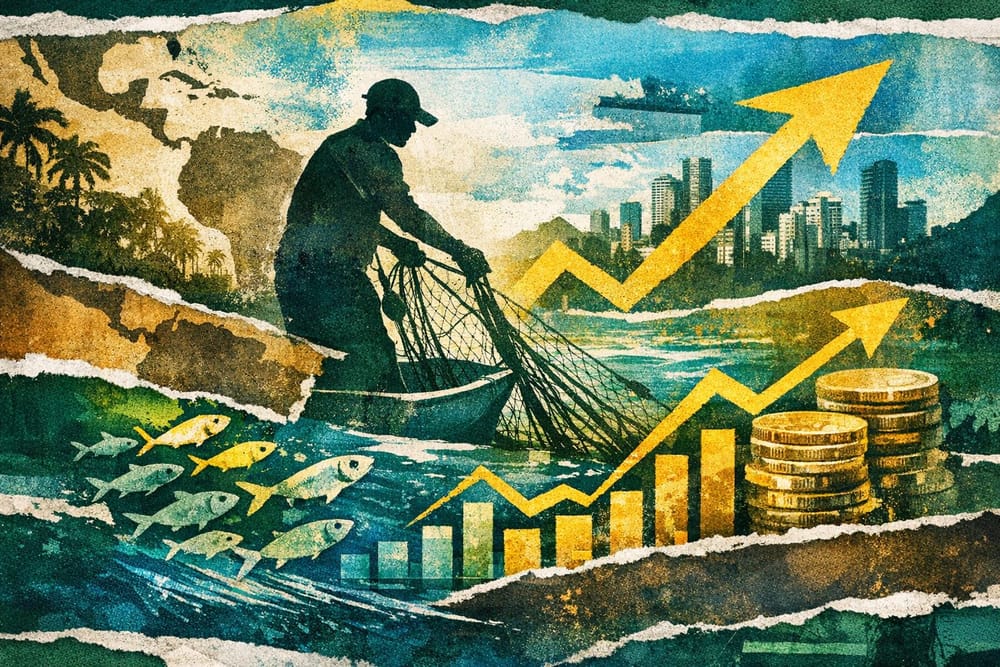
The seas of Latin America could produce far more fish and jobs if fishing rules changed. A study published in 2026 by the Inter-American Development Bank and the Economic Commission for Latin America and the Caribbean cites a 2025 ECLAC estimate: management aligned with maximum sustainable yield could generate approximately 124,000 jobs and 4.1 million additional tonnes. The mechanism includes redirecting existing incentives and spending as well as mobilizing additional funding, with fishery management measures. The question that then arises is not whether the sea can yield more, but who will benefit from these gains.
The essentials
- Fishery management aligned with maximum sustainable yield—the largest average catch that can be sustainably removed from a stock under existing environmental conditions—could create 124,000 jobs and 4.1 million additional tonnes of catches in Latin America and the Caribbean (IDB-ECLAC, 2026).
- ECLAC recommends a combination of sustainable management, co-management, regulation, monitoring, institutional capacities, investment, and marine conservation.
- Artisanal coastal communities, most dependent on local stocks, can be particularly vulnerable to local overfishing and likely to benefit from resource recovery.
- The region would need approximately $170 billion per year for biodiversity, and the report recommends both redirecting existing incentives and mobilizing additional resources.
- Two divergent trajectories unfold: management aligned with stocks or persistent overfishing. The signals to monitor—proportion of sustainably exploited stocks, artisanal jobs recorded by the FAO—will distinguish which path is being taken.
Declining stocks cost more than they produce
Fishing in Latin America and the Caribbean employs several million people, directly and in processing and distribution chains. But a large portion of the fleet currently operates above what stocks can sustain. The result is mechanical: fewer fish in the sea means fewer catches in the short term, and resources that become increasingly costly to reach for diminishing returns.
Maximum sustainable yield refers to the largest average catch that can be sustainably removed from a stock under existing environmental conditions. Below it, fishing pressure lower than the level associated with MSY generally favors the recovery of an overexploited stock, though this is not guaranteed in all cases. Above it, the risk of decline, depletion, or collapse increases. In 2021, the South-East Pacific had a majority of unsustainably exploited stocks (64.9%), while other zones ranged from 16% to 42% of unsustainable fishing, these figures coming from FAO/FAOSTAT data used by ECLAC for 2004, 2015, and 2021.
A fisher or boat owner who reduces their catches today does not benefit tomorrow from reconstituted stocks: a competitor does so in their stead. This free-rider logic is classic in the economics of common resources. Insufficient access and management rules can contribute to overfishing, among several structural causes. Open access or incomplete rights can create a race for fish; concentration of rights does not by itself produce this effect.
The IDB-ECLAC study findings
The study documents resource overexploitation and estimates that sustainable management could restore catches and jobs. By aligning quotas and access rights with maximum sustainable yield, the models project 124,000 jobs and 4.1 million additional tonnes of catches at the regional scale.
These figures merit careful reading. They do not describe an immediate effect. Stock recovery takes time, several years for most commercial species. Redistribution of rights can be a matter of equity and co-management, but it is not an explicit assumption in the employment model. They describe the potential of optimal management; their realization would require effective governance, monitoring, control, and enforcement capacities that several countries in the region do not yet fully possess.
The same study frames this potential in a broader context: the region would need $170 billion per year to finance conservation of its biodiversity. This figure, regularly cited in international discussions, tends to focus the debate on a financing deficit. The contribution of sectoral analysis on fisheries is precisely to reverse this framing: for fisheries, the potential gain assumes additional annual investments in fisheries administration, monitoring, and research.
The financing deficit narrative masks available leverage
Hannah Ritchie, in her work on environmental transition, underscores a recurring mechanism: climate and biodiversity journalism builds its narratives around deficits—of financing, political will, ambition—at the expense of measurable gains when proper incentives are in place. Her book Clearing the Air documents how this framing bias fuels fatalism more than it mobilizes, by rendering solutions invisible in favor of problems.
The case of Latin American fisheries illustrates this mechanism precisely. The figure of $170 billion annually in conservation needs is real and legitimate. But it captures attention toward a question of external resources, where the question of internal governance—who has the right to fish what, at what level, with what obligation to allow stocks to recover—is more immediately actionable and less costly.
This critique of framing converges, through another lens, with the analysis that resource economics scholars have been making since Elinor Ostrom: communities that depend on a shared resource develop effective governance rules when they have a durable interest in that resource. Granting stable access rights to artisanal coastal fishers gives them a direct financial interest in stock recovery, something no external conservation funding produces as directly.
Economist Dani Rodrik emphasizes that reform of incentives is insufficient if not accompanied by explicit redistribution of access rights toward the most precarious actors. A rebalancing of quotas that benefits primarily large industrial fleets would produce additional catches without reducing the vulnerability of artisanal communities. The tension between aggregate efficiency and distributive equity remains; the IDB-ECLAC study illuminates it without resolving it.
Coastal communities at the center of the calculation
Artisanal fishers represent the majority of workers in the sector in Latin America, but a minority of total catches. Industrial fleets dominate catches in certain sub-regions, while the situation is reversed in the Caribbean. This asymmetry can contribute to overfishing, but does not alone explain its persistence: those with the most to lose from stock collapse—artisanal coastal fishers—are precisely those with the least influence over access rules.
The situation of Latin American coasts is not unlike what is observed in Asia, where intensive aquaculture produces high volumes while degrading the coastal ecosystems on which small-scale fishers depend. In both cases, concentration of exploitation rights creates externalities that strike first at the most vulnerable actors.
Redistributing some of the quotas to coastal communities, coupled with a clause prohibiting fishing during stock recovery periods, changes the calculation. The artisanal fisher who accepts a temporary reduction in catches becomes a creditor of a resource in recovery, not merely an actor subject to an externally imposed regulatory constraint. Experiments conducted in Chile and Mexico on territorial use rights in fisheries—coastal zones assigned to fisher organizations with management responsibility—show that this model can work when the state ensures surveillance and enforces boundaries.
Two trajectories for coasts through 2050
The potential is estimated under the assumption of optimal stock management, without an established timeline for realization. The most degraded stocks will take longer to recover; certain species, depending on their biological cycle, could respond faster. Gains will not be uniform across countries or fleet segments.
The other trajectory—persistent overfishing and unreformed access rights—leads to progressive and self-perpetuating impoverishment. Industrial fleets will fish declining stocks at rising costs. Artisanal communities, deprived of local resources, will convert to other activities or emigrate to cities. Governments will lose a tax base and a source of protein food for coastal populations. The FAO, in its 2026 report on food security and nutrition, emphasizes that populations in Latin America and the Caribbean still depend heavily on marine resources for their animal protein supply, a fact that employment projections alone do not reveal.
The signals allowing these trajectories to be distinguished are known and measurable. The proportion of stocks exploited at or below maximum sustainable yield, published by regional fishery management bodies, is the main indicator. The number of jobs in artisanal coastal fishing, recorded annually by the FAO and national institutes, is its human complement. These two series make it possible to know, unambiguously, whether reform is producing expected effects or whether overfishing is continuing its quiet erosion.
Financing surveillance and enforcement of rules remains the true public spending need in this scenario. A regional transition fund, fed by royalties levied on industrial fleets, could compensate fishers during stock recovery periods and finance monitoring capacities for coastal states. This mechanism would redistribute to artisanal communities a portion of the rent that large fleets currently capture at the expense of the common stock.
Blind spots in biodiversity negotiations
International discussions on biodiversity financing revolve around global objectives and North-South financial flows. The Kunming-Montreal agreement adopted in 2022 aims to protect 30% of land and oceans by 2030, and to mobilize substantial public and private financing to achieve this. These ambitions are legitimate. But they create an expectation of external resources that can delay internal reform of incentives.
The potential additional catches are valued at nearly $3 billion per year, while sustainable management requires additional annual investments; the source of their financing is not established by this estimate. This argument does not oppose international transfers, which remain necessary for other dimensions of conservation, notably tropical forests and wetlands. It argues for not subordinating fishery rights reform to the arrival of this financing.
Marine life is productive capital. Stock recovery constitutes an investment whose return is measured in additional tonnes of fish and stable jobs on coasts. Natural capital accounting frameworks, which institutions like the World Bank and the United Nations Environment Programme have been developing for a decade, make this return visible in public accounts. As long as it remains invisible, decision-makers arbitrate between the cost of reform and the benefit of the status quo, and the status quo wins by default.
The constraint is not purely financial. It combines insufficient financing, limited human and institutional capacities, and finally political dimension: current access rights have organized beneficiaries who resist their redistribution. Reforming fisheries means touching established interests in economic sectors often well represented politically. This is the knot each government in the region will have to untie, with or without international financing.