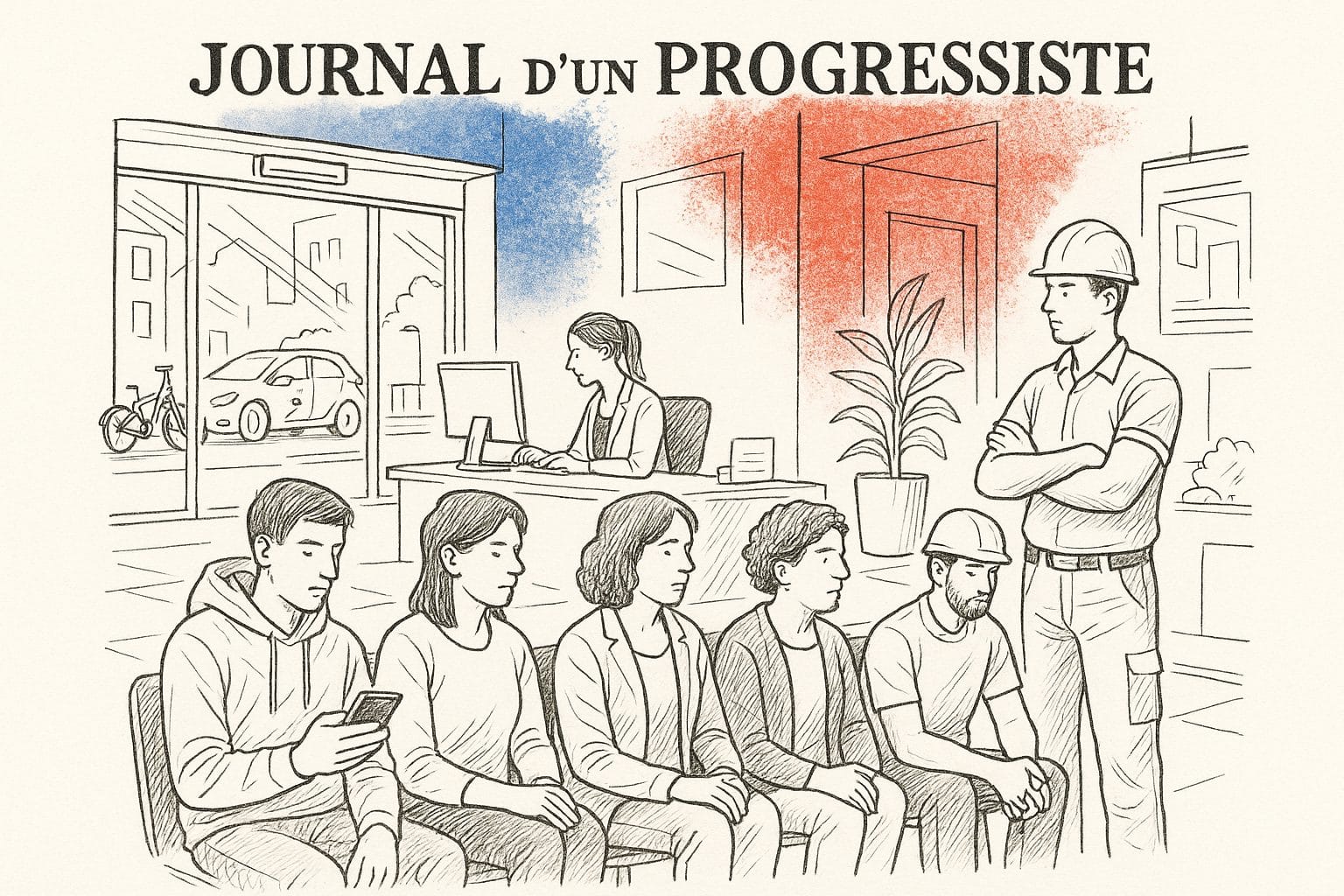
INSEE has quantified what many suspected without daring to assert. In France, a 10-point increase in the share of remote workers is associated with productivity growth of 0.7 to 1 point between 2019 and 2022, depending on the intensity of remote work observed in April 2022. Published on May 19, 2026 in INSEE Analyses No. 120, this result is presented as a correlation. The study also estimates, using an instrumental variable, a local causal effect of 2.7 points for companies whose adoption of remote work was facilitated by the existence of separate offices before the health crisis.
The Essentials
- In France, a 10-point increase in the share of remote workers is associated with a productivity gain of 0.7 to 1 point between 2019 and 2022, according to INSEE.
- The estimated causal effect of 2.7 points concerns companies whose adoption of remote work was facilitated by their pre-Covid real estate configuration; the study does not allow for isolating an effect conditioned by a reorganization of management methods.
- The debate on returning to the office reflects a tension between management by presence and management by objectives, but the study does not allow for quantifying the specific cost of one or the other.
- The productivity study does not allow for attributing the gain to specific professional categories; it concerns companies and presents sectoral results.
- The challenge for the next decade is whether French companies can generalize this model without widening the gap between those who can work remotely and those who cannot.
The Limits of INSEE’s Measurement
The selection problem runs deeper than it appears. Companies that make greater use of remote work may also be those that were already more advanced organizationally or digitally before the period of constraint. The observed association may therefore reflect preexisting characteristics, without allowing by itself the conclusion that remote work mechanically transforms performance. This interpretation preserves the practical utility of hybrid work while shifting attention to what precedes and conditions its deployment: an organization’s capacity to formalize what it truly expects from its employees.
The publication INSEE Analyses No. 120 is based on a matching between data from a survey on remote work and company accounts. The study links productivity growth between 2019 and 2022 to the share of employees in remote work observed in April 2022, rather than to an explicitly identified trajectory of maintenance or abandonment after health constraints. The central result, 0.7 to 1 point of productivity for 10 additional percentage points of remote workers, is presented as an association, not as strict causality. The authors take care to specify this.
This point deserves attention. The measured association may reflect two distinct phenomena. Either remote work directly produces a gain, through reduced commute times, better concentration on high value-added tasks, or more efficient personal organization. Or companies more advanced organizationally or digitally adopt remote work more easily and also experience productivity gains independent of remote work. INSEE acknowledges this risk of selection bias in the initial association.
However, it uses an instrumental variable based on the existence, before the crisis, of offices separate from production or sales sites, and thus estimates a local causal effect of remote work for companies whose adoption depended on this configuration.
The study demonstrates with greater clarity a circumscribed result: it highlights a local causal effect for companies whose recourse to remote work depended on separate offices before the crisis. It does not explicitly compare companies that voluntarily maintained remote work to those that would have abandoned it after the lifting of health constraints. The preexisting organizational and real estate configuration seems to condition the effect of remote work in certain companies; the study does not allow for ranking the relative importance of management and remote work.
Management by Presence Costs Dearly
There has been a debate since 2022 on returning to the office, notably driven by large American companies that have required five days a week in-office presence. In France, the movement has been more measured, but pressures exist. They reveal a real tension in companies between two control models: management by presence, where physical visibility serves as proof of commitment, and management by objectives, where what matters is the result produced.
Economist Nicolas Bouzou has documented, in several of his works on French productivity, what he calls managerial conservatism: the tendency of companies to reproduce inherited organizational modes even when the conditions that justified them have disappeared. For Bouzou, pessimism about French productivity is partly a cultural pathology. Companies that take the risk of organizing work around autonomy and explicit objectives can, according to this reading, capture gains that others leave aside through hierarchical inertia. INSEE’s data identify a local causal effect of remote work in a subgroup of companies, but do not allow for generally distinguishing between different management strategies.
The cost of management by presence is rarely quantified because it is invisible: unproductive coordination meetings, time spent signaling activity rather than producing it, decisions slowed by validation procedures designed for centralized organizations. When hybrid work forces objectives to be made explicit, because one can no longer rely on corridor surveillance, these costs can decrease. INSEE mentions, in particular, more efficient management among the possible mechanisms behind its results, without measuring them directly.
Reorganizing Tasks, Not Just Changing Location
Wording matters. Remote work is often spoken of as a right of access to a tool—the home. The data invite us to speak of remote work organization, which is different. Allowing employees to work from home without modifying management methods, information flows, meetings, and evaluation modalities amounts to superimposing a logistical constraint on an organization designed for in-person work. The result is often degradation: isolation, loss of coordination, overload of video meetings to compensate for the absence of informal contact.
Companies that captured a gain were able to do something else. They were able to redefine periods of in-person presence based on activities that truly justify them—creative collaboration, skills transmission, conflict management—and free up the rest for concentrated remote work. They were able to invest in asynchronous coordination tools. INSEE mentions organizational mechanisms, as well as working conditions, as possible explanations for the observed effect, but measures neither a modification of evaluation criteria nor a shift from presence to output.
This shift is more difficult than it appears. It obliges middle managers to precisely define what they expect from their teams, and thus to assume a clarity on objectives that can be uncomfortable. It obliges senior management to trust evaluations that no longer rely on corridor intuition. For organizations accustomed to dense hierarchical control, this is a change of culture, not a logistical adjustment. This may be why it remains unevenly deployed, and why the causal effect highlighted by INSEE remains limited to a subset of companies.
A Gain That Does Not Benefit All Employees
Another reading of INSEE’s data, less reassuring, concerns the distribution of the gain. Remote work is, structurally, a possibility reserved for certain categories of workers. In France, the remote-work capability of jobs remains highly unequal: industrial, artisanal, care, and personal service sectors remain largely tied to a physical location.
The productivity study does not allow for attributing the gain to specific professional categories: it concerns companies and presents sectoral results. The occupations of workers, service agents, and health auxiliaries today have very low remote-work capability according to INSEE data. However, the study does not allow for asserting that they never indirectly benefit from remote work or that no technological evolution could modify this situation. If hybrid companies gain in productivity and talent attraction, they can accentuate their competitive advantage over sectors where this model is difficult to deploy. The fracture between cognitive work and physical work deepens, as shown by other dynamics already at work in the digital economy.
Dani Rodrik, an economist whose work on job quality illuminates this tension, has shown that aggregate productivity gains can coexist with growing polarization of the labor market. “Good jobs,” autonomous, well-paid, hybrid, are consolidating, while constrained jobs stagnate or become precarious. Remote work did not create this dynamic, but it potentially amplifies it by making employer attractiveness even more dependent on conditions that only certain employees can offer.
Concrete Practices of French Companies
Several major French companies have formalized hybrid work agreements since 2021, often through negotiations with employee representatives. Danone, L’Oréal, Société Générale, and Capgemini have implemented charters specifying expected days of presence, meeting modalities, and equipment coverage. These agreements formalize a framework, but do not alone allow for establishing the mechanisms at the origin of potential productivity gains.
The most documented case of actual reorganization concerns digital services firms and consulting firms, where project-based work naturally creates conditions conducive to results-based evaluation. For these sectors, adaptation has been less culturally costly: objectives were already often explicit, teams accustomed to remote coordination.
For mid-sized companies and large groups with more hierarchical structures, reorganization remains partial. Direct managers, whose traditional role relies on direct supervision, are the actors most exposed to change. Several field studies, notably from French HR directors’ networks, indicate that managerial training is the principal underinvested lever in hybrid work deployments. Building infrastructure is not enough to transform practices: the same logic applies to organizations.
Toward a Model That Few Companies Have Yet Completed Building
The 2019-2022 period retained by INSEE’s study covers both the pre-crisis period, phases of heavily constrained remote work during the pandemic, and the exit from crisis. The remote work measurement used by the study is that of April 2022, after the lifting of most national restrictions on March 14. The gains observed therefore reflect distinct organizational contexts, from adaptation under pressure to the maintenance of hybrid work. The open question is whether these gains can be reproduced, amplified, and generalized as deliberate choice rather than constraint.
Available data for the 2023-2025 period are less clear-cut. Certain indicators of aggregate productivity in France remain disappointing: INSEE’s blog signals a productivity drop in several sectors since the health crisis, without attributing it to the insufficiency or failure of the spread of hybrid work. The diffusion of formal remote work has not uniformly translated into broad managerial transformation. The adoption of a practice and the profound reorganization of work modes are two distinct things.
The horizon of the coming years poses a concrete question to business leaders: will hybrid work remain a concession granted under social pressure, or will it become the pretext for genuine reorganization around objectives? The two trajectories coexist today. The first preserves the appearance of hierarchical control while granting flexibility. The second accepts redefining what managing means. INSEE’s data identify a local causal effect of remote work in a subgroup of companies; they do not generally distinguish between different management strategies, and leave companies to choose.
Sources
- INSEE Analyses No. 120, “Remote Work Increased Work Productivity in Companies That Maintained It After the Covid-19 Crisis” (May 19, 2026)
- Dani Rodrik, Good Jobs Needed: The New Global Challenge, Project Syndicate and associated works
- INSEE Blog on French Productivity Since the Health Crisis
- Methodological Working Document Associated With the Study on Remote Work and Productivity
- INSEE Study on Social and Professional Diffusion of Remote Work
- INSEE Review of Literature on Remote Work and Productivity
- National Health Recommendations Applicable From March 14, 2022