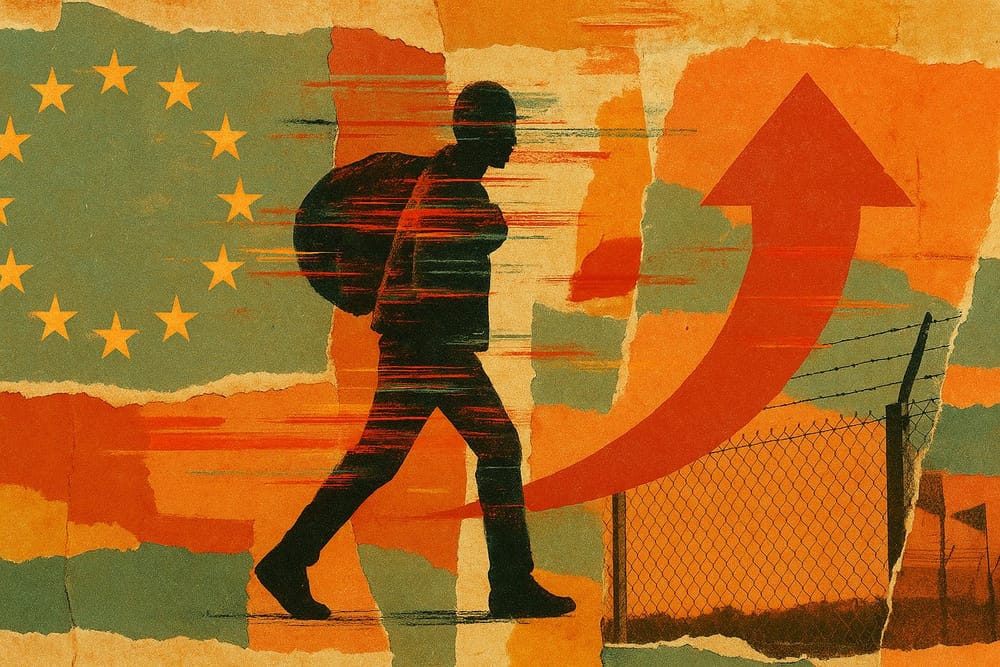
The EU aims for an employment rate of 78% of 20-64 year-olds by 2030. To achieve this, it is counting on 51 million vulnerable people, including 7 million migrants, to strengthen its workforce. This strategy marks a major political reversal: immigration officially becomes an instrument of economic competitiveness rather than a challenge to manage.
The essentials
- The European Union aims for an employment rate of 78% of 20-64 year-olds in 2030 and is counting on 7 million migrants to strengthen its workforce.
- Non-European citizens represent 6% of total employment, compared to 2% in 2010.
- The European Union is losing approximately 1 million workers per year until 2050, with shortages in construction, engineering, health, and information technology.
- The revised single permit in March 2024 allows workers to change employers and retain their permit for three to six months in case of unemployment.
- Recognition of qualifications, language, and discrimination still limit migrants’ access to employment.
6% of non-Europeans in total employment, compared to 2% in 2010
With 2.9 million non-EU citizens in the working-age population in 2023, migrants already represent 6% of Europe’s total workforce, compared to just 2% in 2010. This progression reveals the scale of the shift underway: Europe is massively absorbing an extra-European workforce to compensate for its demographic deficit.
A significant share of jobs created in recent years has been filled by non-European workers, despite their representing only 6.6% of Europe’s working-age population. This integration efficiency reveals structural demand that Europe’s native supply no longer meets.
The geography of the phenomenon draws an unprecedented map. In Portugal, the number of foreign workers more than tripled between 2017 and 2022, their contributions to the social security system now covering 17% of the country’s pension and retirement costs. In the Czech Republic, beneficiaries of temporary Ukrainian protection have sometimes contributed more in taxes than they received in benefits.
A demographic crisis with measurable consequences
The EU is losing approximately 1 million workers per year until 2050. The working-age population could decline by 20.2% by 2070, meaning 42.8 million fewer workers. In unfavorable scenarios, this drop could reach 26.7%, equivalent to 55.9 million people.
This contraction affects strategic sectors. Shortages are intensifying particularly in construction, engineering, health, and information technology. Currently, only 5.6% of European adults possess basic digital skills, well below the requirements of an evolving labor market.
Migrants represent an important share of the workforce in professions facing shortages, confirming their role as an adjustment variable in response to sectoral deficits.
Barriers persist despite needs
Migrants still face numerous obstacles: language barriers, difficulties in qualification recognition, discrimination, low education levels, and increased family responsibilities, particularly for women. The proportion of educated migrants excluded from employment exceeds that of natives.
Discrimination remains documented. A September 2024 report shows that one in five people in Europe’s working-age population is not employed, with women, those over 55, migrants, and people with disabilities facing particular obstacles. 24% of third-country nationals who have lived in the EU for at least one year report having experienced discrimination related to their migrant, ethnic, or religious origin.
Belgium illustrates this paradox: it has the highest proportion of inactive non-Europeans in the EU and the lowest employment rates for first-generation migrants among its neighbors and Scandinavian countries. Second-generation employment rates also remain particularly low.
An institutional transformation underway
The EU is deploying concrete instruments. In 2024, eight new transnational projects were launched through the Asylum, Migration and Integration Fund (AMIF), including POWGEN for integration in renewable energies, WISER for female migrant entrepreneurs, and INTEGRALITY for the inclusion of agricultural workers.
The revised single permit, approved in March 2024, is no longer tied to a specific employer, allowing workers to change jobs and reducing their vulnerability to exploitation. Permit holders can retain their permit for three to six months in case of unemployment depending on their seniority.
Effectiveness conditioned by integration
In recent years, the employment rate of people born outside the EU has experienced notable growth, slightly exceeding the increase observed among natives. Two-thirds of this growth is explained by increased labor market participation, the remainder by declining unemployment.
Despite these improvements, the employment rate of people born outside the EU remains below that of natives and citizens born in another European country. This gap reveals the room for improvement available if discrimination declines.
Part-time employment illustrates this gradual convergence: non-Europeans represent 22.2% of the part-time workforce in 2024, but the gap is narrowing with European citizens (20.8%) and nationals (16.6%). This normalization of employment paths testifies to growing integration.
Europe is transforming a political challenge into an economic opportunity. The effectiveness of this strategy will depend on its capacity to eliminate persistent discrimination that keeps 7 million migrants operating below their productive potential. In a global race for talent where China, India, and several Middle Eastern countries are also recruiting skilled workers with attractive salaries and benefits, the stakes become existential: can Europe transform its social inclusivity into a competitive advantage?