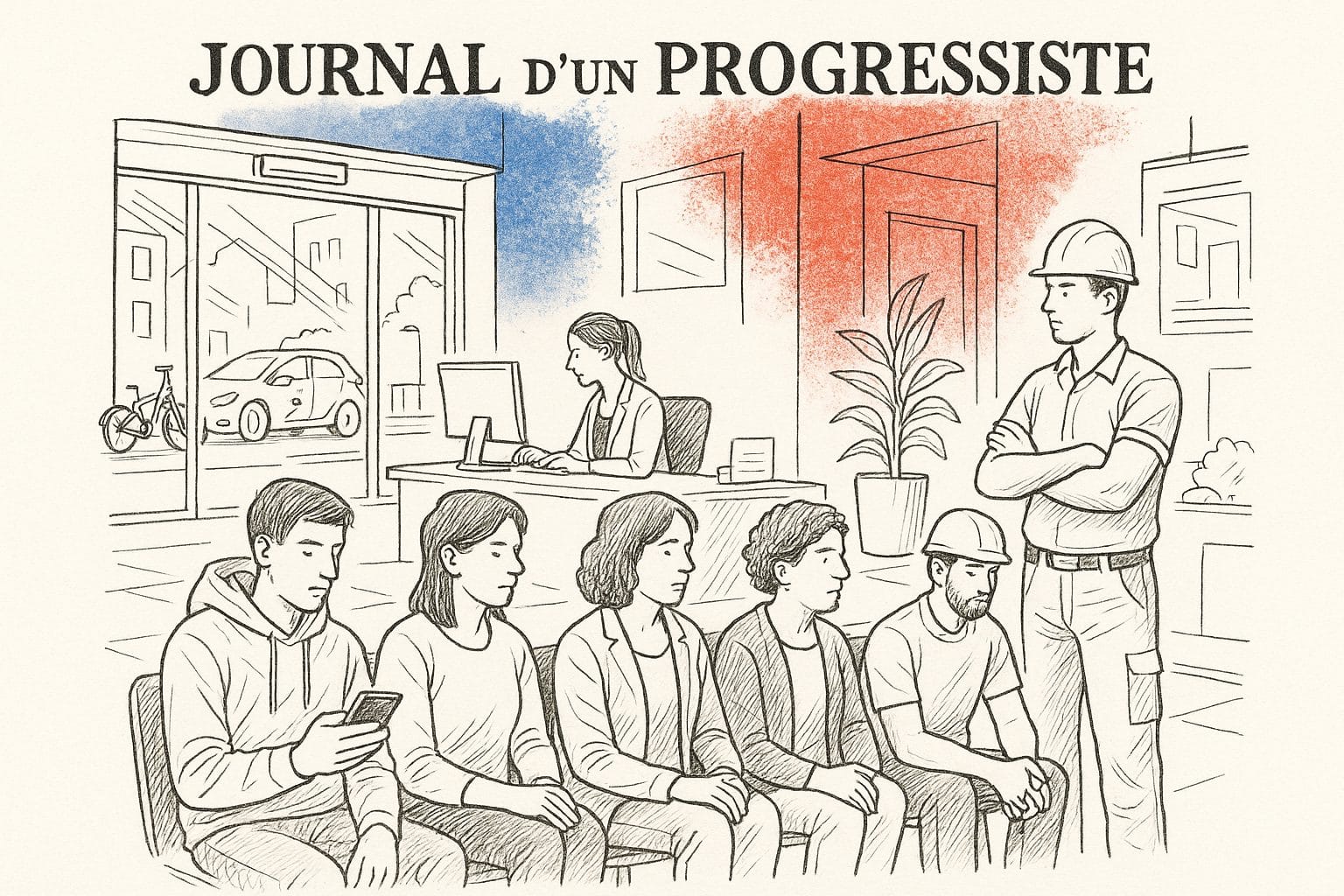
Saudi Arabia, the United Arab Emirates, and their neighbors in the Gulf Cooperation Council have committed tens of billions of dollars to artificial intelligence, united by a shared conviction: oil revenues alone will no longer suffice. The IMF estimates that AI could increase non-oil GDP in Gulf countries by 2.8%, provided adequate digital infrastructure and a skilled workforce are in place. The challenge transcends technology: these economies rely on a massive and heterogeneous foreign workforce, whose capacity to benefit from the digital transition remains entirely open.
The Essentials
- The IMF estimates that AI could increase non-oil GDP in Gulf countries by 2.8%, conditional on adequate digital infrastructure and adapted skills.
- The ILO and ESCWA warn of a risk of internal fracture: AI gains could remain concentrated in enclaves of experts, leaving the majority of low-skilled foreign workers out of the gains.
- The Emirates and Saudi Arabia have launched ambitious national AI programs (UAE AI Strategy, Vision 2030), but their training mechanisms remain insufficient to cover the entire labor market.
- By 2035, the diffusion of technological gains must extend beyond public sectors and technology zones to reach the millions of unskilled workers who make up the bulk of the region’s workforce.
A Necessary Diversification, Two Decades After Initial Promises
The Gulf did not wait for AI to pursue diversification. Since the 2000s, each oil boom has reignited the same ambitions: reduce dependence on hydrocarbons, develop dynamic private sectors, build a knowledge economy. Results have been partial. Saudi Arabia’s Vision 2030 and the Emirates’ national AI strategy represent the most recent and most systematic version of this effort.
Quantitative signals are encouraging on certain segments. The Emirates rank among the world’s leading economies in terms of digital preparedness, according to a report by the ILO and the United Nations Economic and Social Commission for Western Asia (ESCWA). Saudi Arabia has devoted substantial investments to cloud infrastructure and data centers, leveraging partnerships with Microsoft, Google, and Amazon Web Services. In March 2024, Saudi Arabia’s sovereign wealth fund (PIF) was in talks with Andreessen Horowitz to create a dedicated AI fund of $40 billion; this project was not formally launched in that form, and it was ultimately the HUMAIN vehicle, created in 2025, that embodied the PIF’s AI strategy.
What is different this time is the sectoral granularity of projections. Unlike the generic diversification ambitions of past years, AI offers measurable gains in specific domains: automation of public services, logistical optimization, healthcare, finance. The ILO-ESCWA report maps these effects sector by sector, making it possible to identify not only where gains are expected, but also who risks missing them.
The Exposed Sectors Are Not What We Imagine
The ILO and ESCWA analysis overturns common intuition. The jobs most exposed to automation in the region are not the low-skilled jobs in construction or agriculture, which are difficult to robotize. The tasks most substitutable by AI are those of intermediate white-collar workers: administrative processing, data entry, financial back-office, call centers. These jobs are widespread in Gulf public sectors, where they often represent the first rung of local employment for nationals.
This reality creates a sensitive political tension. The stated objective of diversification is to increase national employment in the private sector and reduce dependence on expatriates. But if AI automates primarily intermediate administrative functions, it reduces precisely the types of jobs toward which labor nationalization policies seek to direct young Saudi, Emirati, or Qatari graduates.
The risk is not hypothetical. A PwC study published in 2026, the AI Jobs Barometer UAE, signals an acceleration in the adoption of generative AI tools in large Emirati companies, particularly in financial and HR functions. The question of substitution versus complementarity of human skills already arises in large organizations, as illustrated by the case of American companies deploying AI agents without a clear framework of responsibility.
Migrant Workers: A Majority Outside the Field
It is necessary to name what global statistics willingly erase. In most Gulf countries, nationals represent a minority of the actual workforce: approximately 24% of total salaried workers in Saudi Arabia (2020 data), less than 15% in the Emirates, according to 2023 census data. The workforce is composed largely of migrants, coming primarily from India, Pakistan, Bangladesh, the Philippines, and Egypt. These workers occupy both highly skilled positions in tech and finance and unskilled jobs in construction, food service, and domestic services.
The ILO-ESCWA report emphasizes that regional AI policies tend to target national workers and skilled expatriate professionals. Low-skilled workers, who constitute the bulk of the workforce, remain largely absent from retraining programs. This absence is not an oversight: it reflects the very structure of the migrant labor system in the Gulf, where residency status is tied to the employer and where social protection covers non-nationals very unevenly.
The emerging fracture does not only pit AI experts against others. It reproduces an already longstanding segregation between a formal and well-paid economy, accessible to nationals and skilled expatriates, and a poorly protected service economy that keeps daily life in these societies functioning. If the AI transition ignores this reality, it will not reduce the duality of the regional labor market: it will deepen it.
National Strategies in Practice
Diagnosing the fracture is not enough. We must also examine what is being built. The Gulf’s national AI strategies are not intention documents: they come with real investments and operational programs.
In the Emirates, the Mohamed Bin Zayed University for Artificial Intelligence (MBZUAI), founded in 2019 in Abu Dhabi, has become in a few years one of the few institutions in the Arab world entirely dedicated to AI research. It trains master’s and doctoral students, with a scholarship policy open to candidates from throughout the region. The Emirati government has also launched the AI Talent Initiative program, which targets training civil servants in digital skills, with an objective of several thousand graduates per year.
In Saudi Arabia, the national LEAP program, launched in Riyadh, has become one of the world’s largest technology events, with a stated ambition to transform the country into a regional hub for AI and cloud computing. The SDAIA (Saudi Data and Artificial Intelligence Authority) oversees a catalog of projects ranging from connected health to predictive justice, including customs automation. These initiatives show that the priority infrastructure first is indeed understood: it is not enough to purchase models; the data and connectivity layers that make them usable at scale must be built.
But AI training remains concentrated on managers and engineers. Initiatives targeting low-skilled workers, whether migrant or not, are virtually nonexistent at the regional scale. This is a blind spot that the authors of the ILO-ESCWA report document with precision, without limiting themselves to diagnosis: they propose frameworks for digital skills certification accessible at elementary levels, sectoral retraining programs, and social dialogue mechanisms that include representatives of migrant workers.
Between Controlled Diffusion and Algorithmic Enclave: How Trajectories Diverge
The ILO-ESCWA report and IMF projections allow us to trace two realistic trajectories toward 2035. They are neither prophecies nor judgments: they are conditions to which public policy will need to respond.
In the first trajectory, AI gains diffuse beyond expert enclaves. This requires several simultaneous conditions: an extension of training programs to intermediate service workers, a relaxation of residency conditions allowing skilled migrant workers to remain and retrain without dependence on a single employer, and integration of non-national workers into social protection systems. This trajectory is not utopian. Singapore, which built a knowledge economy on a similar demographic basis with a high proportion of foreign workers, has developed continuous qualification mechanisms covering its entire workforce. South Africa is exploring comparable logic in a very different register, betting on advanced technologies without necessarily mastering their production chain.
In the second trajectory, AI remains confined to public sectors, technology zones, and large international companies. The majority of the workforce, especially low-skilled migrant workers, continues to occupy jobs barely touched by the digital transition, and little enriched by it. The economy fragments further: a mobile, well-paid technology elite coexists with a base of manual services that indirectly finances modernization without benefiting from it. This algorithmic enclave trajectory corresponds to the current trend if no policy shift occurs.
What will distinguish the two trajectories is not difficult to observe. The signals to follow are precise: the evolution of the pay gap between AI experts and other worker categories, the share of national budgets devoted to continuous training for the unskilled, and the capacity of migrant workers to obtain transferable digital skills certifications from one employer to another. These three indicators measure whether diffusion is real or remains rhetoric.
A collective need is missing from the agenda: social protection frameworks explicitly covering non-national workers. Social dialogue in the Gulf remains limited and independent unions are absent. Alternative mechanisms exist, however, notably sectoral worker councils that some international organizations are experimenting with regional governments. The ILO itself is working with several Gulf governments on minimum standards for training migrant workers in sectors exposed to automation.
The Geopolitics of AI Complicates the Picture
An external factor adds to this internal equation. Gulf countries are not only purchasers of AI technology: they aspire to become producers and hosts. Abu Dhabi developed Falcon, a language model developed by the Technology Innovation Institute, which ranks among the most downloaded open-source models in the world. This strategy of technological self-sufficiency responds to clear geopolitical logic: not to depend solely on American or Chinese models in a context of growing tensions over semiconductors and data.
But producing sovereign AI requires specific human resources that the region struggles to train locally in sufficient volume. Attracting highly skilled foreign talent remains the primary lever. The Emirates have simplified visa procedures for AI engineers, and Saudi Arabia offers competitive compensation packages to attract researchers from around the world. This logic is effective in the short term for building cutting-edge capabilities. It does not resolve the question of a two-speed local economy.
The tension between technological sovereignty and inclusive diffusion of gains remains entire. A country can have world-class AI models and a deeply unequal labor economy: the two realities coexist without contradiction, and it is precisely this coexistence that training and social protection policies are meant to correct.
Sources
- International Labour Organization and ESCWA, Artificial Intelligence and Employment Futures for the Arab Region, https://www.ilo.org/publications/artificial-intelligence-and-employment-futures-arab-region
- IMF, Leveraging AI and Enhancing Preparedness, February 2026 (cited in editorial brief; URL unverified, to be consulted via IMF website), https://www.imf.org/en/news/articles/2026/02/03/sp-md-leveraging-artificial-intelligence-and-enhancing-countries-preparedness
- PwC, 2026 AI Jobs Barometer UAE, June 2026, https://www.pwc.com/m1/en/publications/ai-jobs-barometer-uae-2026.html
- Saudi Data and Artificial Intelligence Authority (SDAIA), https://sdaia.gov.sa
- Mohamed Bin Zayed University of Artificial Intelligence (MBZUAI), https://mbzuai.ac.ae
- ILO, Official press release on the ESCWA-ILO report AI and Employment Futures for the Arab Region, May 22, 2026, https://www.ilo.org/resource/news/ai-driven-transformation-puts-jobs-inequality-and-skills-crossroads-arab
- ESCWA (UN), Official page for the AI and Employment in the Arab Region report, https://www.unescwa.org/publications/artificial-intelligence-employment-futures-arab-region
- Official UAE Government Portal, UAE Strategy for Artificial Intelligence, https://u.ae/en/about-the-uae/strategies-initiatives-and-awards/strategies-plans-and-visions/government-services-and-digital-transformation/uae-strategy-for-artificial-intelligence
- CNBC, Reportage on Saudi PIF’s $40 billion AI fund with Andreessen Horowitz, March 2024, https://www.cnbc.com/2024/03/20/saudi-arabia-in-talks-with-andreessen-horowitz-to-create-ai-fund.html
- French Treasury, The Labor Market in Saudi Arabia at End 2021, https://www.tresor.economie.gouv.fr/Articles/f2b22af4-b7c4-4d2d-9130-79e4784fe2c9/files/3f3d29e7-2e8b-436a-a3cb-e65a0428623b
- TII, Official press release on launch of Falcon 40B, May 25, 2023, https://www.tii.ae/news/uaes-technology-innovation-institute-launches-open-source-falcon-40b-large-language-model
- Data Center Dynamics, AWS to invest $5.3 billion in Saudi Arabia, https://www.datacenterdynamics.com/en/news/aws-plans-to-launch-saudi-arabian-cloud-region-in-2026-promises-53bn-investment/