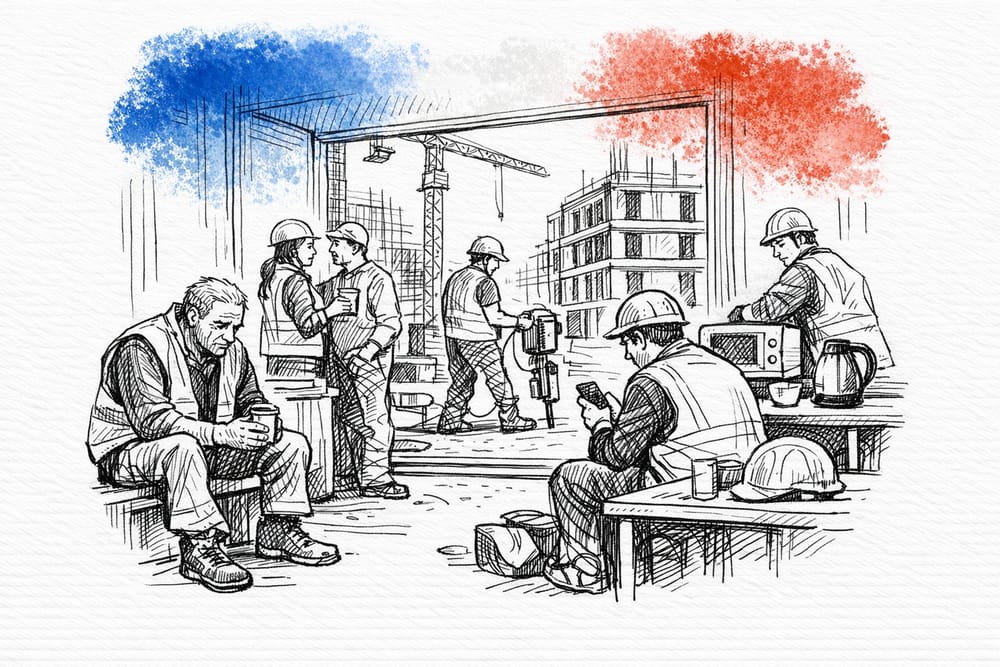
Eleven years after its creation, the hardship account has not enabled anyone to anticipate leaving work en masse. Over a decade, fewer than 30,000 employees have converted their points into early retirement, part-time work, or training. Last year, 6,500 people—1% of employees who drew their pensions—left earlier thanks to this scheme. A country with millions of workers worn out before their time has not found anything better.
The question posed to 2027 is not how to improve the scheme marginally. It is to decide who has the right to have their wear and tear recognized: and above all who pays for having caused it.
Three exposed workers out of ten recognized by law
In 2017, 13.5 million people, or 61% of French employees, were exposed to at least one hardship factor: 10.7 million suffered significant physical constraints, 4.1 million worked in an aggressive environment, 4.8 million had atypical work schedules. This is the true scale of wear and tear at work in France.
What the scheme protects is much narrower. In 2023, the DARES identified that 2.8% of salaried jobs had allowed employees to earn points on the hardship account (C2P)—3.4% of private sector employees. But according to the Sumer survey, the reference source on occupational health and safety, at least 9% of jobs are covered by one of the criteria entitling workers to points. Between those who should be accumulating points and those actually accumulating them, the rate of concrete realization caps out at one-third.
Moreover, this calculation measures only the six factors still retained. Because of the removal of four criteria out of ten when the previous scheme was transformed into C2P in 2017, the proportion of employees potentially exposed to hardship account factors dropped from 15% to 9%. In other words, the 2017 reform began by narrowing the scope of what we accept seeing.
The 2017 choice: erasing invisible risks
The four excluded factors are as follows: exposure to dangerous chemical agents, manual handling of loads, painful postures, and mechanical vibrations. The reason given at the time was the complexity of their measurement for employers. The stated reason: exposure was too difficult for employers to determine.
These are precisely the risks affecting the most physically demanding occupations: healthcare assistants, masons, forklift operators, food processing workers. In 2017, handling heavy loads remained the daily reality for 35% of employees. These workers wear out their backs and shoulders every day, but their wear and tear no longer registers on any individual account.
The paradox is that these factors did not disappear from labor law. For these risks, the Fund for Investing in the Prevention of Occupational Wear (FIPU) was created in exchange in 2023, but it still gives the employee no individual points. The money goes to the employer to improve equipment. The worn-out employee cannot anticipate his retirement.
The FIPU is endowed with one billion euros over five years. But in 2023, the allocation had to be postponed, the scheme only becoming operational in March 2024. The same penalty applied in 2024: 160 million euros, or 70% of the actual budget, were deferred to 2025. In 2024, only 31% of available funds were actually used. A fund supposed to compensate for the removal of individual rights, massively unconsumed.
Under-declaration, symptom of poorly constructed architecture
The problem stems not only from the six remaining factors. Even where the right exists, it is not exercised. The presence of employee representatives nearly triples the chances of earning points: 8% of jobs versus 2%. In small businesses without union delegates, the employer declares alone, and declares little.
Women are less exposed to the factors enabling them to earn C2P points than men: 1.5% of jobs held by women are covered compared to 3.9% for those held by men. The gap largely reflects the composition of the six retained factors (night work, hyperbaric, noise) which correspond more to male-dominated sectors. Painful postures, absent since 2017, much more often affected women in personal services and care work.
The 2026 DARES study emphasizes that current criteria favor “visible and imminent” risks, often associated with male-dominated occupations, at the expense of musculoskeletal disorders arising from routine and repetitive physical demands, typical of personal services.
This visibility bias is not an accident. Bruno Palier and Christine Erhel, in Working Better (PUF, 2025), document the same logic: France has followed a “low-cost” strategy for forty years that compresses costs rather than investing in work quality. Palier proposes moving from this strategy to a quality strategy for all, by designing an economic and social policy that no longer relies either on cost compression or on work dequalification. Unrecognized hardship is the flip side of this logic: wear and tear is tolerated because it is not counted.
The contribution removed, responsibility diluted
There is another mechanism absent from the debate: financing. Since January 1, 2018, companies are no longer subject to the basic contribution and additional contribution that funded the hardship fund. Now the C2P is financed by the work accident and occupational disease branch of Social Security.
Before 2018, employers whose employees were exposed paid an additional contribution. It was a price signal: exposing employees to hardship had a direct and individualized cost. This contribution was removed at the same time as the four ergonomic factors. Today, the AT-MP branch transfers 0.1 billion euros for the professional prevention account: money pooled among all employers, regardless of their individual claims history.
Acemoglu and Johnson, in Power and Progress (Pearson, 2024), pose exactly this type of question on a general level: prosperity in the past took shape because technological progress and the way its gains were shared were wrested from the hands of the elite. Today as in the past, “progress” left to itself enriches a small group while the vast majority benefits little. Applied to hardship, this framework is clear: whoever pays for wear and tear determines who has an interest in preventing it.
At the end of 2024, 2.7 million professional prevention accounts had been opened. But the number of employees who have accumulated more than 60 points (the threshold allowing them to advance their retirement by one or two years) is only about 24,000 people. In twenty-five years of existence of the hardship account in its various forms, this figure measures the true ambition of the scheme.
Linking the right to wear and tear and the employer’s responsibility for imposing it
The choice posed to 2027 is architectural. It does not hinge on shifting an exposure threshold or creating new aid. It hinges on two linked decisions: reintegrating into the individual account the four factors removed in 2017, and restoring a differentiated contribution based on actual exposure of employees.
Reintegrating ergonomic factors changes who is eligible: millions of material handlers, healthcare assistants, construction workers would regain an individual right to anticipate their retirement, to move to part-time work, or to retrain. Restoring the targeted additional contribution changes who pays: the employer who exposes their employees bears the cost of this exposure, and thus has a financial incentive to eliminate it—something the FIPU, a pooled and under-consumed fund, has failed to create.
The resulting scheme functions differently from the present one: the employer is no longer a passive declarant but a financially responsible actor for the wear and tear they generate. Palier argues precisely for a strategy that no longer relies on cost compression: what the removal of the contribution organized, by making wear and tear free for those who inflict it.
Budget constraints exist. The AT-MP branch must cover new expenses related to hardship and occupational wear; altogether, its deficit is projected to reach 0.5 billion euros in 2028. A targeted additional contribution produces precisely the revenue that is missing, charged to exposing employers rather than the public.
Sources
[1] DARES, “Which jobs lead to earning points on the hardship account in 2023?”, DARES Analyses, April 2, 2026, https://dares.travail-emploi.gouv.fr (accessed 01/10/2026).
[2] Ministry of Labor / DARES, SUMER survey 2017, results published 2019, https://dares.travail-emploi.gouv.fr (accessed 01/10/2026).
[3] Laboris-info, “Ten years of hardship account: a balance sheet far from announced objectives”, November 18, 2025, https://laboris-info.fr/dix-ans-de-compte-penibilite-un-bilan-eloigne-des-objectifs-annonces/ (accessed 01/10/2026).
[4] National Pension Insurance Fund (CNAV), circular no. 2024-30, The professional prevention account: use for retirement, October 31, 2024, https://legislation.lassuranceretraite.fr (accessed 01/10/2026).
[5] Social Security, evaluation report on Social Security policies (REPSS) AT-MP, indicator 1.10, “Beneficiaries of professional prevention accounts”, 2024, https://evaluation.securite-sociale.fr/home/at-mp/AT18.html (accessed 01/10/2026).
[6] Senate, report of the social affairs commission on the AT-MP branch, Towards a fair balance between compensation and prevention of occupational risks, report no. 18, session 2024-2025, https://www.senat.fr/rap/r24-018/r24-0189.html (accessed 01/10/2026).
[7] Social Security, 2024 Report on Under-declaration of Work Accidents and Occupational Diseases, October 1, 2024, https://www.securite-sociale.fr/home/medias/presse/list-presse/sous-declaration-branche-at-mp-r.html (accessed 01/10/2026).
[8] Social Security, AT-MP Summary, 2025, https://evaluation.securite-sociale.fr/home/at-mp/SyntheseATMP.html (accessed 01/10/2026).
[9] Sante-et-travail.fr, “Hardship: the dormant funds of the Fipu”, 2025, https://www.sante-et-travail.fr/penibilite-fonds-dormants-du-fipu (accessed 01/10/2026).
[10] Prévention BTP, “FIPU: launch of the fund for investing in the prevention of occupational wear”, 2024, https://www.preventionbtp.fr (accessed 01/10/2026).
[11] Christine Erhel & Bruno Palier (eds.), Working Better, PUF / La Vie des idées, special issue, September 2025, 222 p., https://laviedesidees.fr/Travailler-mieux (accessed 01/10/2026).
[12] Daron Acemoglu & Simon Johnson, Power and Progress. Technology and Prosperity, Our Millennial Struggle, Pearson, November 2024, 632 p.
[13] INRS, “Hardship at work: Traceability of exposures to certain occupational risk factors”, updated 2024, https://www.inrs.fr/demarche/penibilite/tracabilite-des-expositions-aux-facteurs-de-penibilite.html (accessed 01/10/2026).
[14] Retirement Guidance Council (COR), plenary session of March 23, 2023, DARES document on employees benefiting from C3P, https://www.cor-retraites.fr/sites/default/files/2023-03/Doc_12_Dares_Salariés-bénéficiaires-C3P.pdf (accessed 01/10/2026).