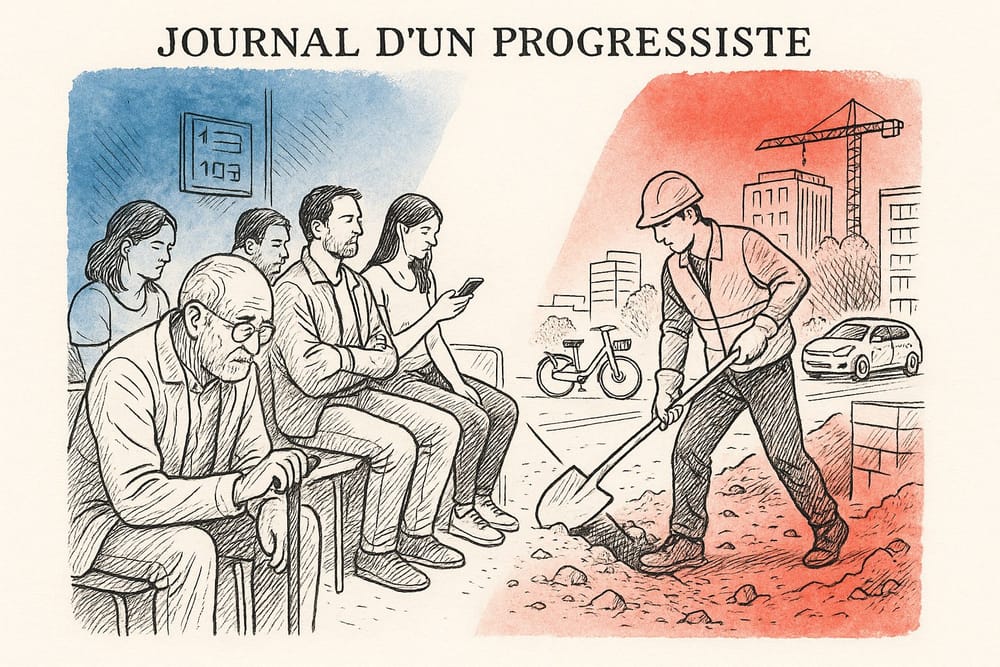
Thirteen years separate the life expectancy of the poorest men from that of the wealthiest [1]. This gap has widened over the past decade. Life expectancy without disability peaked at 63.7 years for men in 2024 [3]—precisely the legal retirement age since the 2023 reform.
For a worker exposed for decades to heavy loads and painful postures, this threshold is reached well before retirement. The choice that 2027 will pose is this: integrate job strain into retirement rights and redirect a portion of the 265.4 billion euros of ONDAM toward prevention. To continue without acting is to pay dearly for repairing bodies that better working conditions would have preserved [8].
Living long, but in good health for far shorter
In 2024, life expectancy at birth reached 85.6 years for women and 80.0 years for men [3]. France ranks second in the European Union for women, behind Spain, and tenth for men [3].
Life expectancy without disability tells a different story. It stood at 63.7 years for men and 64.1 years for women in 2024 [3]. A man retiring at 64 enters retirement, statistically, at the threshold of his good health.
The Eurostat method confirms the divergence. The French can expect to live 63.6 years in good health in 2024, placing them fifteenth among the twenty-seven member states [4]. The European average stands at 65.2 years. In several Eastern European countries, this duration is increasing. In France and other Western European countries, it is declining [4].
Between 2008 and 2023, life expectancy without disability at age 65 increased by nearly two years for both women and men [3]. Since 2021, it has been declining at birth and sits slightly below 2019 levels [3].
A five-year gap between executives and workers that three decades have not erased
Under mortality conditions from 2020–2022, men who are executives at age 35 live on average 5.3 years longer than workers [5]. Among women, this gap is 3.4 years [5].
Workers face more than twice the risk of executives of dying between ages 35 and 65 [5]. Between 65 and 75, this risk remains 1.7 times higher [5].
Since the 1990s, the gap in life expectancy between executives and workers has narrowed by 1.7 years for men. It has widened by 0.8 years for women [5]. Thirty years of medical progress have reduced the male gap by only one-third.
In 2020–2022, the gap in life expectancy at age 35 between those with higher education and those without reaches 8.0 years for men and 5.4 years for women [5]. At the median net salary of 2,190 euros per month in 2024, eight years represents roughly 210,000 euros in income that a lifetime will not allow one to earn [2].
Geography overlaps with this pattern. In 2020–2024, holding sex, age, and standard of living constant, people live longest in the Pays de la Loire and Occitanie regions, and shortest in the Hauts-de-France [1]. The geography of mortality mirrors the geography of social inequality.
First in Europe at treatment, mediocre at prevention
France shows high rates of premature death even as its mortality rates after age 65 are among Europe’s best. This tension has been documented since the 1980s. For mortality preventable by medical treatment, it ranks first among European Union countries [6]. For mortality preventable through prevention, it falls to sixth in Europe and twelfth in the OECD [6].
This paradox has a social cost. In 2019, 24.2 percent of employed people smoked daily [7]. Among skilled workers, this share reached 35.0 percent. Among professional and scientific occupations, it fell to 15.0 percent [7].
Health inequalities take root before birth. Prematurity and low birth weight are more common among mothers of modest means [7]. By the final year of preschool, twice as many children of workers as children of executives are overweight [7].
Working conditions extend and amplify these early gaps. Since 1984, the proportion of low-paid employees who carry heavy loads, remain in painful postures for long periods, or perform painful movements has risen steadily through 2019 [7]. Retirement improves health status, all the more markedly when employees have been exposed to significant physical and psychosocial risks [7].
What ONDAM finances, and what it avoids financing
ONDAM reaches 265.4 billion euros in 2025 [8]. Its share of GDP rose from 8.2 percent to 8.9 percent between 2019 and 2025 [8]. France ranks third globally in total health spending, at nearly 12 percent of GDP in 2025, behind Germany at 12.5 percent and the United States at 16 percent [8].
This trajectory deepens the deficit of social security branches. It reached 11.8 billion euros in 2024 [8]. The Court of Auditors projects it could reach 20.1 billion in 2028, with cumulative social debt of 73.4 billion over 2025–2028 [8].
This budget finances curative care massively. Prevention represents a marginal fraction. The Court of Auditors summarizes its cost-containment paths in three axes: spend wisely, spend effectively, spend equitably [8]. Equity is named last and remains the least equipped.
The chain linking low-skilled employment to premature death
Job strain results from an economic model that chose to lower costs rather than improve jobs, as documented by Bruno Palier and Christine Erhel [10]. This model is paid for in years of life.
The chain is direct. Low-skilled jobs expose workers to higher physical and psychosocial risks—a finding that data from DREES and Santé publique France establish over four decades [7]. Health deteriorates at work, life expectancy without disability declines, and retirement arrives at or after the threshold of good health for the least advantaged. The state then responds by financing increasingly costly care for chronic diseases that better working conditions would have delayed.
The benefits of modern medicine have accrued more to upper-income groups, who incorporated them into their lifestyles, as shown by INSEE data on mortality gaps by social class [5]. In working-class populations, working conditions undercut medical progress. Acemoglu and Johnson show that technology is shaped by those who control it, and its benefits do not distribute spontaneously [9].
If innovations in health, diagnostics, treatments, and personalized prevention continue to benefit affluent groups first, the mortality gap will continue to widen [9]. The direction of progress depends on collective choices.
Shift rights rather than compensate for wear
The central choice is this: shift public policy from compensating worn bodies to preventing their wear. This requires three simultaneous moves.
Make job strain visible, first. Annual, public measurement of job strain indicators by sector, industry branch, and company size, modeled on carbon footprint reporting, would objectify what aggregate health statistics obscure [10]. Twenty concrete proposals for work reorganization already exist [10]. Industry-level collective agreements could be the vehicle for implementing them.
Refocus health prevention on social gradient, next. Universal campaigns reach preferentially those who need them least [7]. Interventions in living and working environments—companies, schools, territories—reduce the gradient more effectively than general information.
Inscribe job strain in retirement rights, finally, with objective, measurable, verifiable criteria. The budget balance of social systems depends directly on health trajectories of cohorts, as Hippolyte d’Albis shows [11]. A retirement system applying the same rules to differently worn bodies redistributes collectively in favor of those with higher life expectancy.
This choice closes the model that compresses labor costs and shifts the bill to health insurance and pension schemes [8]. It opens a strategy that raises the quality of French products and services through work organizations less degrading to bodies, as described by Palier and Erhel [10]. The choice commits the generations entering the workforce today.
Sources
[1] INSEE, Nathalie Blanpain, “From 2012–2016 to 2020–2024, the gap in life expectancy between modest and affluent people has grown,” Insee Première no. 2085, December 2025, https://www.insee.fr/fr/statistiques/8679561 (accessed August 15, 2026).
[2] INSEE, “Salaries in the private sector in 2024,” Insee Première no. 2079, October 2025, https://www.insee.fr/fr/statistiques/8657156 (accessed August 15, 2026).
[3] DREES, “Life expectancy without disability at 65 is 11.8 years for women and 10.5 years for men in 2024,” Études et Résultats no. 1363, January 2026, https://drees.solidarites-sante.gouv.fr/publications-communique-de-presse/etudes-et-resultats/260122-ER-esperance-de-vie-sans-incapacite (accessed August 15, 2026).
[4] Eurostat, Data on life expectancy in good health at birth, EU-SILC method, 2024, https://ec.europa.eu/eurostat/fr/web/health/data/database (accessed August 15, 2026).
[5] INSEE, Nathalie Blanpain, “Life expectancy gaps between executives and workers: 5 years among men, 3 years among women. Mortality tables by social class and by educational attainment through 2020–2022,” Insee Résultats, July 2024, https://www.insee.fr/fr/statistiques/8220688 (accessed August 15, 2026).
[6] HCSP, Indicators of ‘Premature’ and ‘Avoidable’ Mortality, Documents collection, April 2013, https://www.hcsp.fr/explore.cgi/avisrapportsdomaine?clefr=357 (accessed August 15, 2026).
[7] DREES / Santé publique France, The Health Status of the French Population in Light of Social Inequalities, Dossier no. 102, September 2022, https://drees.solidarites-sante.gouv.fr/publications-communique-de-presse/les-dossiers-de-la-drees/letat-de-sante-de-la-population-en (accessed August 15, 2026).
[8] Court of Auditors, The National Health Insurance Expenditure Target (ONDAM), report, April 2025, https://www.ccomptes.fr/fr/publications/lobjectif-national-de-depenses-dassurance-maladie-ondam (accessed August 15, 2026).
[9] Daron Acemoglu and Simon Johnson, Power and Progress: Technology and Prosperity in a Changing World, Basic Books, 2023.
[10] Bruno Palier and Christine Erhel, Working Better, PUF / La Vie des idées, September 2025, https://laviedesidees.fr/La-qualite-du-travail (accessed August 15, 2026).
[11] Hippolyte d’Albis, Seniors and Employment, Presses de Sciences Po, 2022.