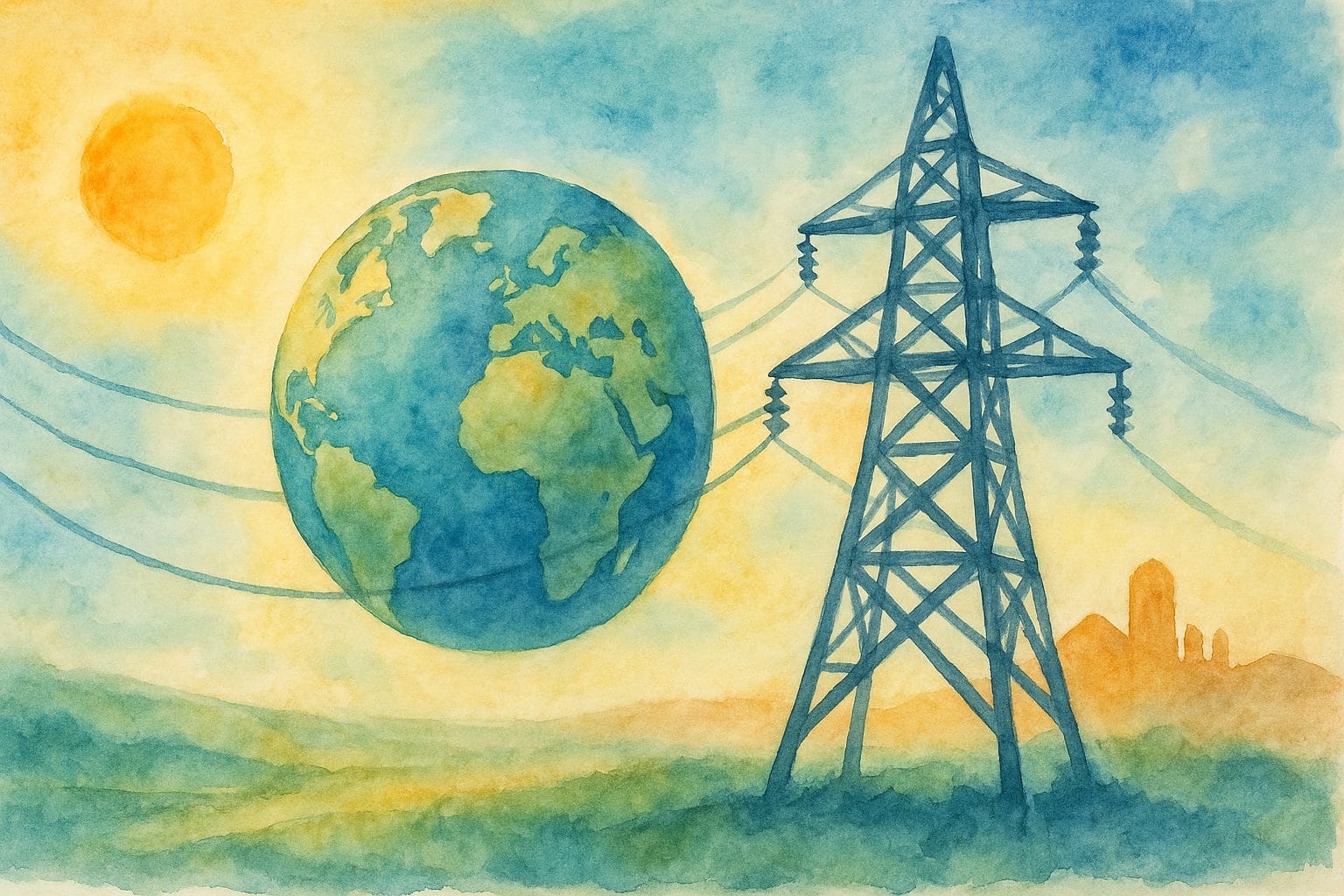
China and France are decarbonizing. But they are not building the same thing. One is constructing a distributed network of water management spanning its entire territory; the other is concentrating its bet on a few centralized nuclear power plants. These two infrastructure choices commit to radically different forms of resilience in the face of the decades ahead, and deserve to be read together rather than separately.
The Essentials
- China invested 5.68 trillion yuan (approximately $810 billion) in water infrastructure over 2021-2025, covering a significant portion of its territory through 172 major projects (Ministry of Water Resources, 14th Five-Year Plan assessment).
- France is launching a program for six to fourteen new EPR2 reactors, with an official cost of €72.8 billion (2020 value) for the first six EPR2 reactors, spread over approximately 20 years.
- The Chinese model distributes territorial robustness; the French model concentrates decarbonization power.
- Climate change will subject both models to different stresses: droughts and floods for the first, cooling constraints for the second.
- Each leaves blind spots on the horizon to 2050.
A Figure That Demands Attention
According to the Ministry of Water Resources (communications from January to March 2026), China has launched 172 major water infrastructure projects covering a significant portion of its territory under the 14th Plan (2021-2025), for a total investment of 5.68 trillion yuan (approximately $810 billion) over five years, mobilizing a significant workforce throughout the period. These projects include reservoirs, interbasin transfer canals, water treatment and recycling systems as well as coastal dikes. Together they constitute an architecture for managing the water cycle at continental scale.
Comparison with the French nuclear program is spontaneous and instructive if approached carefully. France has launched its nuclear revival program, with six confirmed EPR2 reactors and an option on eight additional reactors. The official cost of the program is €72.8 billion (2020 value) for six reactors, spread over approximately 20 years; the €100 billion figure is a high estimate incorporating inflation, mentioned informally but never adopted as official budget. The two figures are not directly comparable: different time horizons, different scopes, incomparable economies of scale. But both represent, each in its national context, a structuring bet on the form that decarbonization infrastructure should take.
This bet differs profoundly in its geography, temporality, and very nature.
Water as Infrastructure for Territorial Resilience
The Chinese choice is one of distribution. The South-North Interbasin Transfer Canal, launched in 2002 and predating the 14th Plan, carries growing volumes annually from the Yangtze to the parched northern plains. The two operational routes (eastern and central) have a combined capacity of approximately 24.3 billion cubic meters per year; in 2024, the total annual volume of the two operational routes (eastern and central) reached approximately 10 billion cubic meters, with the central route alone having current capacity of approximately 9.5 billion cubic meters per year, bringing the cumulative total of the two routes to approximately 76.7 billion cubic meters by December 2024. The flagship project of the 14th Plan is the national water network, which brings together 172 major projects according to official sources from the Ministry of Water Resources. The new infrastructure of the 15th Plan extends this logic: connecting surplus areas to deficit areas, storing before drought peaks, draining before floods.
This model has a virtue that engineers call distributed redundancy. If one node in the network fails, the system can reroute. If a province suffers severe drought, transfers compensate partially. Resilience comes from multiplying support points, not from the power of a single site. It is a logic close to that of smart electrical grids, or, as seen in the adaptation of fish stocks to climate warming, the capacity to follow flows that shift rather than fix resources in immobile infrastructure.
Climate change has intensified hydrological extremes in China for two decades: devastating floods in the Yangtze basin, prolonged droughts in Henan and Hebei. Building an architecture for regulating the water cycle is a direct response to this volatility. The 14th Plan’s water investment is part of the climate strategy of which it forms the physical backbone.
Decarbonization integrates through hydroelectric power, which represents approximately 15% of Chinese electricity production, and through reduction of energy losses related to pumping and water treatment. But the principal benefit remains agricultural and urban: securing water supply for 1.4 billion people facing growing water stress.
The French Nuclear Bet: Concentrated Power, Deep Decarbonization
France makes an inverse choice in its structure. Rather than distribute, it concentrates. Three officially designated sites for the first six EPR2 reactors: Penly, Gravelines, and Bugey, each hosting a pair of reactors producing approximately 1,600 megawatts of low-carbon base-load electricity. A fourth site, Tricastin, had been envisaged then set aside for the third pair. The objective is clear: maintain or strengthen an electrical network whose carbon intensity is already among Europe’s lowest, while electrifying currently fossil-powered uses: transport, industrial heat, green hydrogen.
The power of this model is real. According to IEA data on electricity costs, nuclear base-load power provides low-carbon electricity at predictable cost over decades, without depending on weather conditions. For a country whose heavy industry needs high-temperature heat and continuous electricity, this is an advantage that intermittent energies cannot easily replace.
The fragility of the model is symmetrical to its strength. Concentrating production on a few large sites creates points of failure. A prolonged heat wave, like those of 2003 and 2022 that forced EDF to reduce production from several riverside reactors due to insufficient cooling capacity, can affect multiple sites simultaneously, although only a fraction of the fleet is affected at once. Climate change is making these events more frequent and intense. The question of cooling for future EPR2 reactors, some planned on inland waterways, deserves attention that official announcements still treat superficially.
The other fragility is temporal. According to the current government schedule (PPE3, CPN5), first operation is targeted for 2038, in an optimistic scenario. The decade 2025-2035 therefore remains to be managed with an aging existing fleet and renewable capacities ramping up. Nuclear infrastructure produces long-term resilience, but it creates short-term vulnerability that France will have to manage.
The Blind Spots of Each Model
Water infrastructure addresses the consequences of warming without reducing its causes, while nuclear reduces emissions without securing the physical resources threatened by that same warming. This asymmetry reflects different political priorities and investment timelines. A model centered on mitigation remains exposed to physical shocks; a model centered on adaptation perpetuates the conditions that make that adaptation necessary. Long-term robustness requires both dimensions to progress simultaneously, something neither country has yet fully committed to.
Neither model alone covers the complete spectrum of challenges ahead.
The distributed Chinese model better manages local hydrological shocks. It creates employment across the territory and reduces inequality in water access between provinces. But it does not alone solve the problem of deep decarbonization of electricity. China remains the world’s leading CO2 emitter, and fossils represented approximately 58% of its electricity mix in 2025 (coal alone approximately 54%), compared to over 60% for total fossils in 2024. Water infrastructure is necessary for adaptation, but mitigation—reducing emissions—requires in parallel massive deployment of solar, wind, and nuclear that the 15th Plan programs but that the 14th Plan did not achieve at announced speed.
The centralized French model deeply decarbonizes electricity. But it leaves blind spots: industrial heat, agriculture, water management. France suffers from growing water stress in its Mediterranean basins and the Southwest, without water storage and transfer infrastructure comparable to what China is building. The 2022 drought, which affected agriculture, waterways, and nuclear plants simultaneously, showed the vulnerability of a country that has not yet thought through its water adaptation with the same ambition as its electrical transition.
What Resilience by 2040-2050: Architecture or Power
The scenarios opening up toward 2040-2050 depend largely on the nature of shocks hitting each system.
If the coming decades are marked by intensification of hydrological extremes, what IPCC projections suggest for East Asia as well as Mediterranean Europe, then China’s distributed architecture offers a structural advantage. It can absorb a local shock without systemic collapse. It protects food security and access to drinking water for populations spread across vast territory. Robustness comes from redundancy.
If the coming decades require above all rapid and deep electricity decarbonization to keep to climate trajectories, then the French model offers an advantage in power. A renewed nuclear fleet can supply low-carbon base-load electricity to an economy massively electrifying its uses. The question is whether the actual deployment schedule, always susceptible to slippage, will allow this advantage to be maintained.
Daniel Yergin, in his analysis of regional energy trajectories, emphasizes that infrastructure choices commit the type of risk a society decides to assume. France assumes the risk of concentration and dependence on a few large sites. China assumes the risk of complexity inherent in managing a distributed network at continental scale, while remaining dependent on coal for its base electricity production.
What is certain is that both approaches will need to be complemented by dimensions each neglects. France will need to invest in water management and energy storage to handle growing intermittency in its mix. China will need to accelerate its electricity decarbonization so that its water infrastructure does not simply serve to adapt to warming it continues to fuel. In both cases, resilience is not a final state: it is a continuous process of investment and adjustment.
Signals to Monitor in the Next Five Years
Two indicators will allow judgment of whether each bet holds.
On the Chinese side: actual utilization rate of water infrastructure during the next major drought or flood episodes, and the 15th Plan’s capacity to meet its goals for coal plant closures in parallel with water infrastructure deployment. Coherence between adaptation and mitigation remains the Achilles heel of the model.
On the French side: actual schedule for EPR2 construction project launches and EDF’s ability to hold announced costs after the chaotic Flamanville experience. The credibility of the nuclear bet depends as much on industrial execution as on the relevance of strategic choice. Facing warming, nations suffering consequences of emissions without being primary sources remind us that each year of decarbonization delay has real human cost.
Both trajectories share conviction that physical infrastructure remains the basis of all resilience. Markets and pricing policies can accelerate or slow transitions, but pipes, dams, reactors, and networks determine what a society can absorb when the system is under stress. Each country must fill its blind spots before they become critical vulnerabilities.
Sources
- People’s Daily Online – NDRC 15th Five-Year Plan, February 2026
- IEA – World Energy Outlook 2024 (International Energy Agency, no direct link)
- IEA – Projected Costs of Generating Electricity 2025 (International Energy Agency, no direct link)
- French Government – Nuclear Policy Address, February 2022 and Energy Program Law 2023 (no direct link)
- IPCC – Sixth Assessment Report, Working Group II: Impacts, Adaptation and Vulnerability, 2022 (no direct link)