In Iraq, in the Thi Qar governorate, a five-hectare pilot constructed wetland project treats wastewater and benefits more than 30,000 people. The United Nations Environment Programme presents this nature-based infrastructure as a multifunctional solution, potentially less costly and complementary or alternative in certain contexts to conventional infrastructure. Thi Qar thus constitutes an operational pilot project, presenting potential for replication and scaling provided its sustainability after transfer to local authorities.
The Essentials
- An artificial five-hectare wetland in Thi Qar governorate treats wastewater and benefits more than 30,000 people, according to UNEP. It also contributes to restoring part of the region’s biodiversity.
- Constructed wetlands often have lower operating and maintenance costs than conventional processes, with ecosystem benefits that treatment plants do not produce. Their total cost is not, however, systematically lower, particularly when land is expensive or scarce.
- Treatment is based on sedimentation and the combined action of plants, soils, and especially microbial communities, which promote multiple physical, biological, and chemical processes that reduce contaminants and pathogens.
- Generalization depends on both technical factors—site characteristics, hydraulics, pretreatment, required performance, and land availability—and sustainable institutional capacities for operation and maintenance.
- The Mesopotamian Marshes, inscribed on the UNESCO World Heritage List, provide the ecological framework within which this project is situated, but their condition remains precarious.
The Mesopotamian Marshes Nearly Disappeared
To understand what a five-hectare project in Thi Qar governorate represents, we must first measure the scale of what was destroyed. The Mesopotamian Marshes, which once covered nearly 20,000 square kilometers between the Tigris and Euphrates rivers, were drained by more than 90 percent between the 1970s and 2000, as a result of dams upstream, drainage works and water diversions, agricultural development, and deliberate drainage conducted under the Saddam Hussein regime.
The result was an ecological catastrophe of rare brutality. The Marsh Arabs, who had lived in these wetlands for millennia, were dispersed. Migratory species that used the marshes as a stopover on migration routes between Central Asia and Africa lost their habitat. Fish, birds, water buffalo: an entire interdependent ecosystem collapsed within decades.
Since 2003, part of the marshes has been restored as the dikes and locks constructed to drain them were demolished. UNESCO inscribed them on the World Heritage List in 2016, simultaneously recognizing their natural and cultural value. But restoration remains partial and fragile. The available water flows in Iraq are declining due to the combined effects of dams and withdrawals in Turkey and Syria, infrastructure projects by Iran on certain tributaries and shared waterways, as well as droughts and internal uses. The Thi Qar project recreates lost natural functions.
Five Hectares Doing the Work of a Treatment Plant
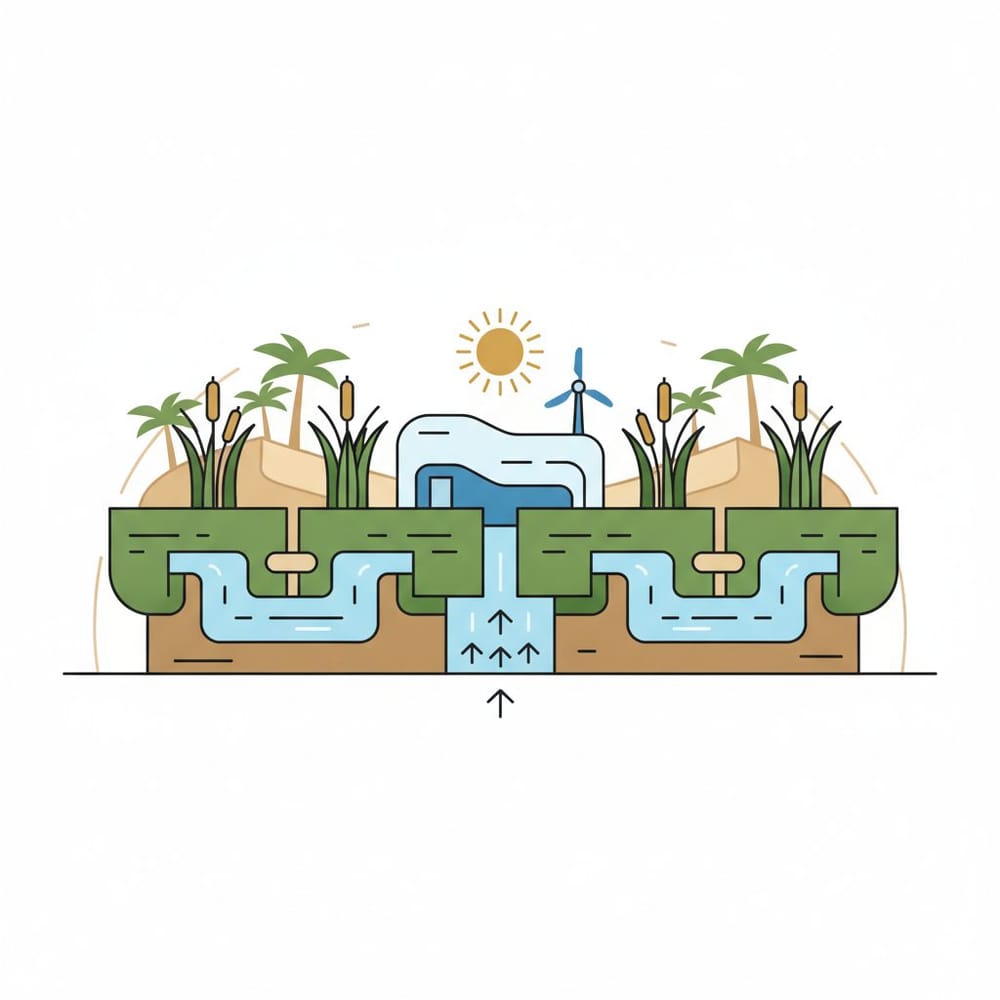
The principle of a constructed wetland is simple in design, complex in calibration. Raw wastewater is conveyed by gravity or pumping to basins planted with aquatic vegetation, primarily reeds of the genus Phragmites. Constructed wetlands combine sedimentation and physical filtration, adsorption and chemical reactions, as well as microbial and plant processes.
The mechanisms for reducing pathogens vary according to design and operating conditions. The treated water is discharged into natural waterways after documented improvement in its quality. However, its compliance with specific discharge standards or agricultural reuse standards is not established in the public source, and local reuse remained prohibited at the time of publication.
According to UNEP, this five-hectare infrastructure treats wastewater and benefits more than 30,000 people. For a governorate with limited budgetary capacity and restricted access to specialized civil engineering technicians, the advantage is decisive. A conventional treatment plant requires electromechanical equipment, chemical reactants, regular maintenance by qualified staff, and continuous energy. A constructed wetland operates primarily through biology: it consumes little energy, requires no reactants, and can be maintained by local agents trained on site.
The economic advantage is real but must be qualified. Constructed wetlands often have lower operating and maintenance costs than conventional processes, notably because they require little energy and mechanical equipment. Their total cost, however, depends heavily on topography, land availability, local hydrological conditions, and treatment requirements. In a flat environment like southern Iraq, earthwork costs are modest. But the most clear benefit appears over the long term: the absence of dependence on external inputs and imported spare parts can make these systems more resilient in regions remote from supply centers.
Biodiversity as Co-benefit, Not as Decoration
What fundamentally distinguishes a constructed wetland from a treatment plant is not solely cost: it is the capacity to produce ecological value while simultaneously treating water. UNEP reports the return of animals around the wetland, including birds and frogs, following improvement in water quality. However, the source documents neither the return of migratory birds in particular nor the recolonization of the site by multiple plant species characteristic of Mesopotamian marshes.
This ecosystem dimension has concrete consequences. Wetlands store carbon in their sediments, regulate local temperatures through evapotranspiration, and reduce flood peaks by temporarily absorbing excess water volumes. In a region where climate change simultaneously increases the frequency of droughts and the intensity of rainfall events, this buffering function has real economic value that accounting models still struggle to integrate.
This convergence between sanitary utility, climate adaptation, and ecological restoration is precisely what distinguishes this type of approach from conventional infrastructure projects.
Maintenance Among the Constraints of Generalization
The Thi Qar project works. But the question that every pilot project raises is that of its sustainability and reproducibility. On these two dimensions, the Iraqi situation raises real difficulties, both technical and institutional.
Iraq has local institutions weakened by decades of conflict, economic sanctions, and centralized governance that has invested little in the capacities of the governorates. Financing of local infrastructure depends largely on budget transfers from Baghdad, themselves conditioned by the price of oil. In this framework, a constructed wetland can degrade rapidly if maintenance is neglected: supply channels become obstructed, undesirable plant species colonize the site, water levels are no longer regulated. The result is then gradual degradation of treatment, which populations perceive belatedly because water quality is not visible to the naked eye.
This challenge is not unique to Iraq. Nature-based infrastructure projects can encounter this difficulty: maintenance costs are recurring and require sustainable local institutional organization. But this organization alone is insufficient: sizing, pretreatment, hydrology, land availability, and performance objectives remain equally determinant. A treatment plant that breaks down is immediately visible and creates political pressure for its repair. A wetland that degrades slowly does not trigger the same alarm signals.
The sustainability of the project may require training for local staff and community involvement in its daily management. Long-term financing is not established. International climate finance mechanisms, particularly adaptation funds, could play a role here: constructed wetlands are measurable climate adaptation infrastructures whose co-benefits in terms of carbon sequestration could theoretically generate carbon credits. However, these arrangements remain complex to implement for projects of this size.
Constructed Wetlands as Adaptation Infrastructure in Arid Regions
The Thi Qar experience extends beyond the Iraqi context: in regions simultaneously lacking clean water, biodiversity, and institutional capacity, nature-based infrastructure can become a basic response rather than a supplementary solution for pilot projects.
The 2030-2050 horizon opens two distinct trajectories, conditioned by political and financial choices that remain to be made.
In a first scenario, international climate finance mechanisms evolve to more systematically integrate nature-based infrastructure into national adaptation plans. Middle Eastern and North African countries, which rank among those most exposed to climate change impacts according to UNEP, could access adaptation funds conditional on demonstration of ecological and health co-benefits. In this framework, the Thi Qar model could be reproduced at the regional scale: dozens of constructed wetlands around major rivers and deltas, each sized for a community of 10,000 to 50,000 people, forming a network of decentralized infrastructure that does not depend on a centralized collection and treatment network.
This scenario is technically plausible. Constructed wetlands function in highly varied climatic contexts, from temperate marshes in Northern Europe to semi-arid regions of sub-Saharan Africa. What is lacking is both the capacity to adapt them to local conditions, the political will to integrate them into national infrastructure plans, and the financial mechanisms that allow low-income governments to invest in systems whose benefits are diffuse and spread over the long term.
In a second scenario, institutional and technical constraints prevail. Pilot projects may go unrealized due to lack of local structures capable of managing them, recurring funding to cover maintenance costs, or conditions adapted to design and implementation. The model is technically established and the Thi Qar project was financed with international support, then transferred to Iraqi authorities; its institutional sustainability remains to be observed.
This second scenario corresponds to the experience observed in many development projects: the construction phase is financed, the maintenance phase is not. The signals to monitor to distinguish between the two trajectories are therefore institutional as much as technical. Progressive integration of these infrastructures into the operating budgets of Iraqi governorates will be a first indicator. Explicit mention of constructed wetlands as a priority response in national climate adaptation plans will be a second. Finally, the evolution of Green Climate Fund and Adaptation Fund mechanisms toward financing complete cycles, including construction and long-term maintenance rather than one-off projects, could influence the long-term viability of the model.
The technical performance of five hectares in Thi Qar will not be enough. Deployment at the scale of Iraq and its neighbors will depend on governance, financing, and long-term monitoring.
Thi Qar and the Engineering of Adaptation
The Thi Qar project illustrates the capacity of nature-based infrastructure to treat water while producing ecological benefits in a context of limited resources.
Water, sanitation, and biodiversity protection networks are often administered separately. A treatment plant for water, a nature reserve for biodiversity, a flood management program for flooding. Each mechanism has its experts, its budgets, its performance indicators. This compartmentalization makes sense in contexts where resources are abundant and institutions are robust. It loses relevance in regions where resources are scarce and where institutional capacity to manage multiple mechanisms simultaneously is limited.
What the Thi Qar approach proposes, without formulating it as such, is a logic of multipurpose infrastructure: a single investment producing multiple services simultaneously. Ecology engineers and United Nations planners have designated this approach as “nature-based solutions” since the 1990s. But Thi Qar provides a proof of concept in one of the most difficult contexts: a country emerging from decades of conflict, in a semi-arid region under increasing climate pressure, with weakened local institutions.
If Thi Qar governorate ensures maintenance of the project over a decade, this result will constitute an empirical demonstration of the model. The challenge, now, is to demonstrate both that the solution can maintain its technical performance and that local institutions can become its guardians.
Sources
- United Nations Environment Programme (UNEP), Newly constructed wetland in Thi Qar benefits 30,000 people, supports climate adaptation: https://www.unep.org/news-and-stories/press-release/newly-constructed-wetland-thi-qar-benefits-30000-people-supports-climate-adaptation
- United Nations Environment Programme (UNEP), Reeds of Hope: Transforming Iraq’s water crisis through natural innovations: https://www.unep.org/news-and-stories/story/reeds-hope-transforming-iraqs-water-crisis-through-natural-innovations
- UNESCO, Inscription of Mesopotamian Marshes on the World Heritage List (2016): https://whc.unesco.org/en/list/1481
- UNEP and International Organization for Migration (IOM), handover of the wetland system to Iraqi authorities: https://www.unep.org/gan/node/14711
- United Nations, press release on the disappearance of Mesopotamian marshes: https://press.un.org/en/2003/ik334.doc.htm
- Republic of Iraq, National Communication to the UNFCCC on water resources: https://moen.gov.iq/files/POST_FILE/IRAQ_SNCBUR_-ENGLISH.pdf
- Longitudinal study on the maintenance of a constructed wetland: https://ascelibrary.org/doi/10.1061/%28ASCE%29EE.1943-7870.0000861
- Comparative study on municipal constructed wetland costs: https://www.sciencedirect.com/science/article/pii/S0925857413004266
- United Nations Environment Programme (UNEP), Environment in Iraq: UNEP Progress Report: https://wedocs.unep.org/xmlui/bitstream/handle/20.500.11822/8716/Environment_in_Iraq_UNEP_Progress_Report.pdf
- United Nations Environment Programme (UNEP), Iraq, Country Presence: https://www.unep.org/topics/disasters-and-conflicts/country-presence/iraq
- UNESCO, evaluation of conservation status of the Ahwar of southern Iraq: https://whc.unesco.org/en/decisions/7789/
- United States Environmental Protection Agency (EPA), Constructed Wetlands Treatment of Municipal Wastewaters: https://www.epa.gov/sites/default/files/2015-10/documents/constructed-wetlands-handbook.pdf
- United States Environmental Protection Agency (EPA), treatment mechanisms for wastewater in constructed wetlands: https://nepis.epa.gov/Exe/ZyPURL.cgi?Dockey=200053MF.TXT
- United States Department of Agriculture, Natural Resources Conservation Service (USDA-NRCS), technical standard for constructed wetlands: https://www.nrcs.usda.gov/sites/default/files/2023-09/656_OH_CPS_Constructed_Wetland_2023.pdf
- United Nations Environment Programme (UNEP), Nature-based Solutions for Water: https://wedocs.unep.org/xmlui/bitstream/handle/20.500.11822/32058/NBSW.pdf
- United States Environmental Protection Agency (EPA), Constructed Wetlands Treatment of Municipal Wastewaters: https://nepis.epa.gov/Exe/ZyPURL.cgi?Dockey=30004TBD.TXT
- United States Environmental Protection Agency (EPA), Subsurface Flow Constructed Wetlands: https://www.epa.gov/sites/default/files/2015-06/documents/wetlands-subsurface_flow.pdf
- United States Environmental Protection Agency (EPA), maintenance guide for constructed wetlands: https://www.epa.gov/sites/default/files/2015-10/documents/wetmeasures_guidance.pdf
- United States Geological Survey (USGS), satellite data on marsh drainage: https://eros.usgs.gov/earthshots/after-the-gulf-war
- NASA, Reclaiming Mesopotamia’s Marshes: https://science.nasa.gov/earth/earth-observatory/reclaiming-mesopotamias-marshes-38409/
- UNESCO, decision on inscription of Ahwar on the World Heritage List: https://whc.unesco.org/en/decisions/6794/
- UNESCO / ICOMOS / IUCN, Ahwar monitoring report: https://whc.unesco.org/document/223567