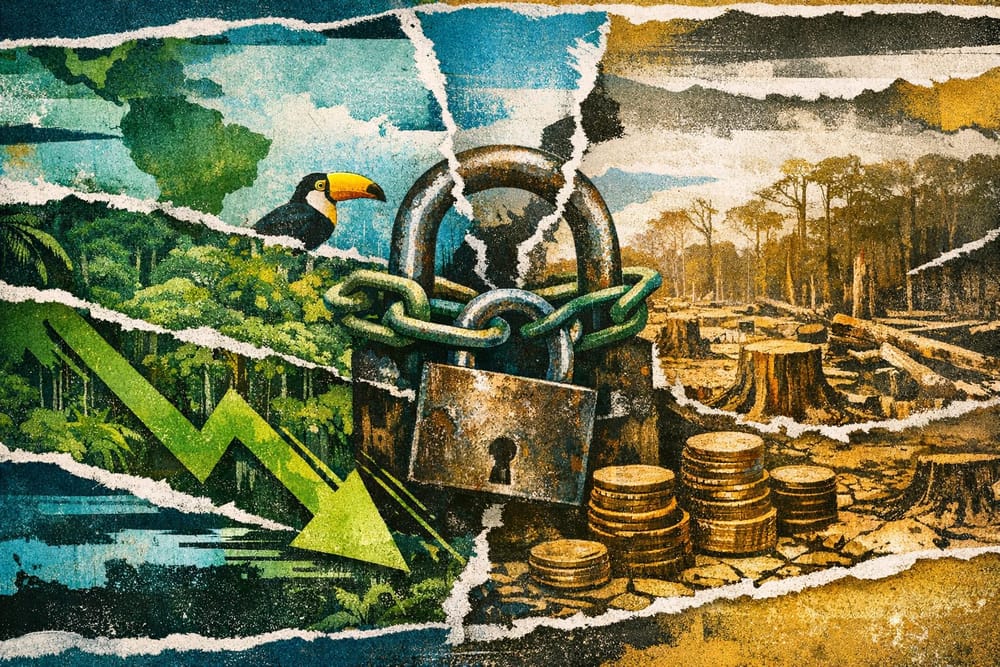
In April 2026, verification began for properties larger than four fiscal modules, based on a list derived from cross-referencing CAR-PRODES data, though this cross-referencing alone did not establish illegality. This change transforms forest protection into a condition for access to agricultural financing, rather than merely an infraction to be punished after the fact. Between February 2023 and April 2026, the public development bank BNDES issued 5,592 alerts for signs of illegal deforestation out of approximately 551,700 applications examined. The system sketches a new architecture of conservation: one in which financial risk intervenes upstream of criminal procedure, making deforestation immediately costly.
The essentials
- Verification began in April 2026 for large properties, but general deadlines were subsequently postponed according to property size.
- Between February 2023 and April 2026, BNDES issued 5,592 alerts out of 551,700 applications examined, roughly 1 percent of applications, without necessarily equating to permanently blocked files.
- The mechanism relies on automatic cross-referencing of satellite deforestation data with the rural land registry, but its updating depends on the production and updating of this data.
- The main tension lies in access to regularization: an operator who has cleared forest can theoretically bring themselves into compliance, but small landowners rarely have the legal resources to do so alone.
- This Brazilian model interests several Amazon countries and international donors, who see it as a path for linking agricultural financing and ecosystem preservation at large scale.
Forest read by satellite, credit decided accordingly
Brazil has had PRODES since 2008, a satellite monitoring system for deforestation in the Amazon operated by the National Institute for Space Research (INPE). For a long time, data produced by this system fed into reports, administrative procedures, fines—a classical circuit of environmental regulation. The innovation of the current system lies in the direct connection between this data and the credit circuit.
The Brazilian Rural Environmental Registry (CAR) catalogs agricultural properties with their land boundaries. When a bank receives a rural credit application, the system can now cross-reference the property identifier with recorded deforestation alerts. If a loss of native vegetation is detected, the file is flagged and a compliance check is initiated. Credit is not automatically refused; the procedure provides for additional verification. Detected deforestation can create a risk for credit access when the data are integrated into applicable checks.
BNDES, the public development bank whose role in Brazilian agricultural financing is central, applied this principle in advance between February 2023 and April 2026, even before the rule became mandatory for the entire banking sector. Of the roughly 551,700 applications examined, 5,592 triggered an alert. These files represented, according to BNDES, more than 1.1 billion reais in credit avoided or refused.
Making financial risk immediate
Classical environmental enforcement logic rests on a long sequence: violation, detection, procedure, sanction. Between the moment a landowner fells trees and the moment they receive a fine, months or years can pass. During that time, the cleared plot is put to productive use, possibly sold, and the economic gain is often realized long before the sanction arrives.
The conditional credit system short-circuits this sequence. Satellite detection is nearly continuous. Cross-referencing with the land registry is automated. And the consequence—suspension or conditioning of credit—can be immediate and concrete. For a farm operator dependent on credit to buy inputs, seeds, or equipment, this is a brake of a different nature from administrative fines.
This shift in timing is what distinguishes what the system brings that is new. Criminal or administrative sanctions remain relevant, but they act downstream. Credit conditions act upstream: they act before the decision to deforest is made, particularly when the operator depends on financing for operations. Analogous policies have been tested in other contexts. The European CAP already conditions certain agricultural subsidies on compliance with environmental commitments, with measured but real results.
The Brazilian mechanism pushes the logic further: cross-referencing is automated using CAR and PRODES databases, but its updating depends on the production and updating of this data.
Who deforests, who borrows, who risks slipping through the cracks
The 5,592 alerts issued by BNDES between 2023 and 2026 represent roughly 1 percent of files examined. This figure says several things at once. It suggests that the vast majority of BNDES borrowers show no sign of illegal deforestation, which is consistent with the fact that large institutions often work with operators already integrated into export chains subject to traceability requirements. It also indicates that the system identified a non-negligible fraction of problematic files, and that corresponding credit was avoided or suspended.
The question of coverage is central. Private banks and rural credit cooperatives, which finance a significant share of Brazilian agriculture, only entered the mandatory regime in April 2026. Extension to the entire banking system is therefore recent, and its uniform application remains to be verified. Small operators who go through informal credit circuits or via advances from input suppliers entirely escape the system.
The geography of Brazilian deforestation complicates the picture further. The Amazon concentrates the most massive land clearings, often carried out by actors combining land speculation with agricultural production. These operators sometimes have sufficient resources to finance their equipment themselves, reducing their dependence on institutional credit. The system is probably most effective for mid-sized operators—those clearing forest at a significant scale but still needing the classical banking system.
The compliance knot: getting into compliance when you lack resources
The rule provides for a possibility of regularization. A landowner whose plot has been identified as having suffered deforestation can, in certain cases, present one of the documents of regularity provided for, such as an approved restoration plan agreement by the competent authority, to access credit nonetheless. This mechanism acknowledges that not all operators in irregular situations are large-scale deforesters: some inherited land whose environmental status was already degraded, others cleared forest in a regulatory gray area.
The difficulty is that Brazilian environmental regularization is a complex procedure. It requires precisely mapping one’s property, identifying obligatory preservation zones, negotiating restoration plans with authorities. These steps require time, legal expertise, and often money. Large landowners and agribusiness companies integrated into export chains have access to legal services capable of supporting them. Small operators, particularly in peripheral Amazon regions, are often helpless in the face of this complexity.
The risk then becomes one of an unintended threshold effect: the system penalizes actors modest enough to depend on bank credit but not well-connected enough to regularize quickly, while the largest operators circumvent the problem through self-financing or legal sophistication. This tension between environmental ambition and capacity to access compliance is a signal to watch in the years ahead.
Lessons from the Brazilian model beyond its borders
Brazil is not the only country to have attempted to link financing and conservation. Indonesia implemented a moratorium on new permits linked to primary forests and peatlands. Several European commercial banks have adopted zero-deforestation policies in their agro-industrial credit portfolios, responding to regulatory and market pressure. But the Brazilian system stands out for its national scale and automation: it relies on consultation of PRODES satellite data, supplemented if necessary by declarations, authorizations, and documentary checks that financial institutions must consult.
This architecture interests neighboring countries sharing the Amazon basin, several of which have less developed satellite surveillance systems and less digitized land systems. It also interests major international financial institutions seeking tools to honor their green financing commitments without abandoning their agricultural portfolios in tropical countries. BNDES itself played a demonstration role by making public the figures from its experience between 2023 and 2026, a transparency approach that allows other actors to assess the model’s feasibility.
The replicability challenge lies less in technology than in institutional infrastructure. Brazil has a national rural land registry (CAR), an operational satellite monitoring system (PRODES), and a sufficiently centralized public development bank to impose a common rule. These three elements together are rare in countries with high tropical deforestation. Helping them build these data and land governance infrastructures would be, in this scenario, as important as transferring the credit rule itself.
Two possible trajectories through 2035
The Brazilian system is too recent for its effects on deforestation to be isolated from other factors—the return to stricter environmental policy under the Lula government, pressure from European export markets, fluctuations in world agricultural prices. The question facing the coming decade is whether the mechanism will be robust and extended in two different directions.
In a first scenario, the system gains strength. The entire Brazilian banking sector effectively applies it, regularization capacities for small operators are strengthened by technical and legal assistance programs—several Brazilian NGOs and peasant organizations advocate for this type of support—and coverage rates of formal credit increase in peripheral regions, which also expands the system’s reach over actors who today escape it. In this case, conditional credit becomes a structuring tool of deforestation policy, complementary to enforcement and positive incentives.
In a second scenario, the gaps widen. Private banks apply the rule unevenly. The largest operators migrate toward self-financing or less constrained international capital markets. Small operators in irregular situations find themselves excluded from formal credit without access to regularization, and turn to informal lenders who conduct no environmental verification. In this case, the system deepens financing access inequalities without significantly reducing overall deforestation.
The distinction between these two trajectories depends less on the rule itself than on what surrounds it. The signals to watch in the coming years are concrete: the rate of actual application by private banks, the number of operators assisted in regularization efforts, and the evolution of deforestation data in regions where formal credit is dominant. Periodic surveys by the Brazilian Environment Ministry and BNDES reports will allow distinguishing, as time passes, which of the two scenarios takes shape.
Between 2023 and 2026, Brazil built a functioning prototype at the scale of an agricultural continent. Its value lies in the hectares directly protected, but also in the lessons learned about conditions for replicability, about unintended exclusion effects, and about the articulation between satellite surveillance and land law. For actors examining this model from outside, the central issue is identifying which parts of the architecture are exportable and at what institutional cost.