A significant share of brand content on social networks is now produced by AI. Meanwhile, the average price of Meta ads has risen, and influencer marketing spending has increased according to available data. Spending with creators is growing, but the causal role of algorithmic abundance in this shift has not been established.
The essentials
- According to Value Add VC, 79% of images posted on Instagram, TikTok and Pinterest would be detected as AI-generated, without distinguishing brand content. Some brands place increased value on verifiable human creators.
- Meta recorded more impressions and a higher average price per ad, without evidence that the price increase compensates for an audience consuming more content.
- The IAB forecasts $44 billion in creator advertising spending in the United States in 2026, reflecting growth in the creative advertising segment.
- The creative market shows signs of segmentation between AI-generated content and human creators, though this distinction remains in flux.
- Signals to watch: performance shifts between human creators and AI-generated content, and the development of traceability mechanisms.
Saturation arrives, prices rise anyway
The figure deserves attention. According to Sprout Social, 56% of respondents report seeing “AI slop” often or very often on their social feeds. One might expect this flood to depress the value of advertising space: too much noise, less attention, falling prices. Classical attention economy predicts exactly that.
The average price per ad on Meta has increased, but available data does not allow this rise to be attributed to saturation of AI-generated content. Meta recorded more impressions delivered and a higher average price per ad. Volume of attention is not enough: it is the quality of the contact that is monetized. As the algorithmic flow accumulates AI-generated content, the value of distinctive content can shift.
Brands understood this before economists did. The growth in influencer marketing spending in 2026 reflects an increase in the importance placed on creators in media plans. They reflect a rise in creator advertising, whose exact motivations remain to be analyzed. A creator with an engaged audience, a recognizable voice, and a verifiable history of positions becomes a rare resource in a market flooded with fluid content.
AI as infrastructure, human as signal
Understanding what is happening requires separating two markets that media discussions constantly conflate.
The first market is that of volume content: articles optimized for search engines, social posts calibrated for algorithms, standardized visuals, product descriptions, follow-up emails. AI has taken a massive place there and will continue to do so. Value Add VC estimates a large share of social images detected as AI-generated, without isolating brand content. Production costs have fallen according to several sector observations. For brands playing the pure volume game, this is welcome accounting compression.
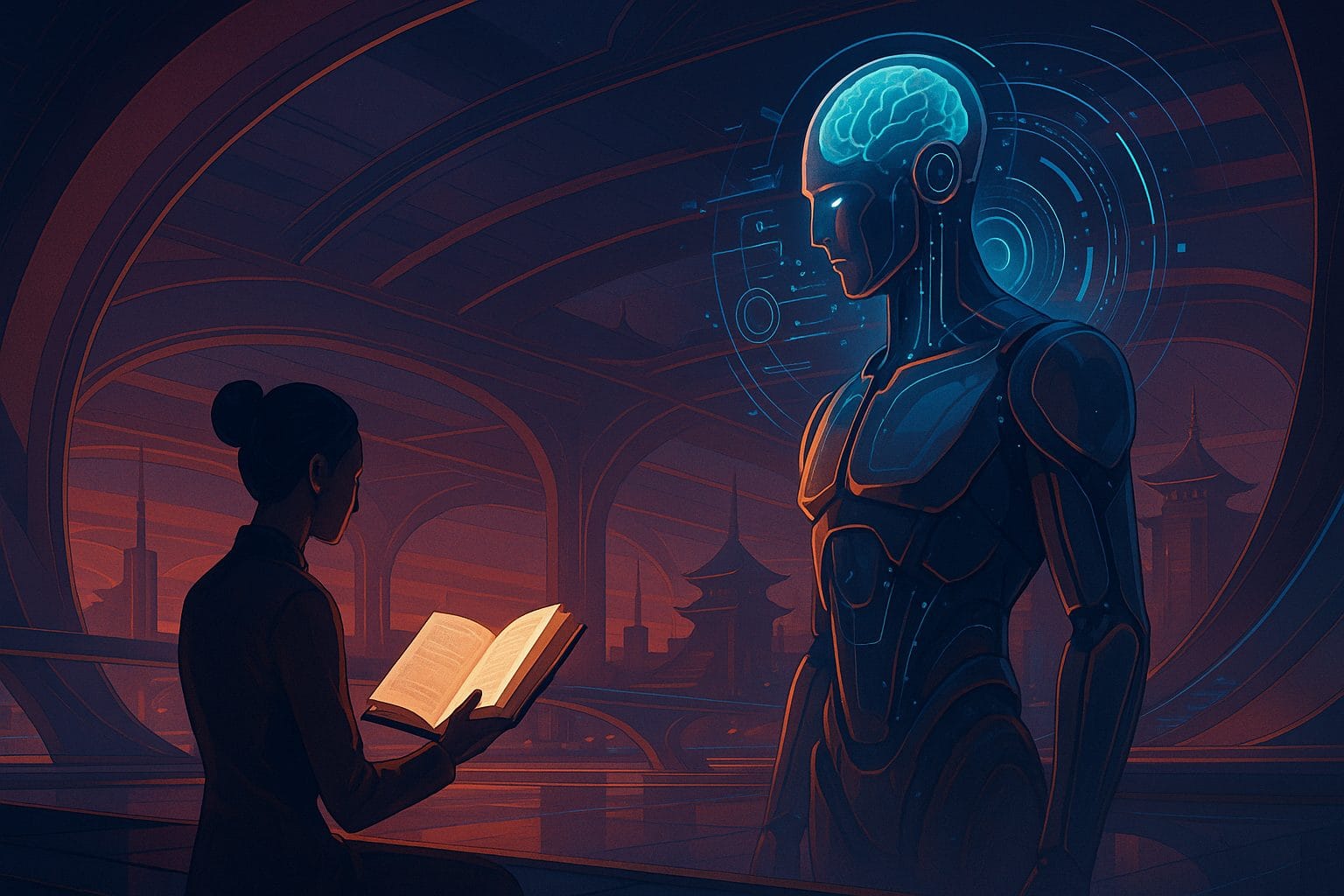
The second market is that of trust. When a person buys a product because a creator they have followed for three years recommends it, the mechanism at work is radically different. Transactional value rests on a relationship built over time, on memorized positions, on perceived consistency. This type of signal, AI can imitate, but the imitation is detectable and the market is beginning to detect it.
UNESCO has described obligations and traceability mechanisms for AI-generated content, considering the provenance and authentication of content as an issue for creation. The stakes are both ethical and economic. Certification of the human origin of content could become a competitive differentiator if authentication standards emerge and are recognized by the market.
This dynamic joins what we observe in other markets traversed by automation: when AI increases productivity in a sector, the premium shifts toward workers capable of doing what AI does not yet do well. In the creator economy, AI presents limitations in reproducing the continuous and relational human presence that some creators build with their audiences.
Mid-tier creators, first victims of the bifurcation
Compression of the volume market creates immediate pressure on a particular category: content creators who worked in the middle segment. Neither micro-influencers with an ultra-engaged community nor celebrities with massive audiences, creators who produced decent quality content for regional brands or sector niches.
This segment operated for ten years on a simple balance: accessible production talent (writing, video, photography), an honest audience in a niche, and a reasonable rate for brands. AI attacks this model from both ends: it can reduce certain production costs, though no source consulted allows establishing a cost close to zero, while failing to reproduce the trust relationship that established creators maintain with their audiences.
Nieman Lab documented in 2026 how this phenomenon already affects niche journalism: local or sector publications that employed regular freelancers for basic informational content see these commissions eroding. Platforms like Substack or Patreon observe in mirror something different: their best-established creators, those who have built direct relationships with their audiences, see their revenues grow. The bifurcation is measurable in median revenues, even if these data still require longitudinal monitoring to be definitive.
The restructuring underway affects creators differently depending on their positioning. Winners exist, they are real, and their business model differs from what they practiced before. Support mechanisms could help the mid-tier segment migrate toward credibility rather than extinction.
Current platform actions and limitations
Platforms are at the center of this restructuring because they control distribution. They decide what is amplified, what is labeled, what is monetized. Their behavior in 2026 is instructive: they have not yet chosen their side.
Meta has introduced AI content markers in its terms of service, but their application remains uneven. TikTok displays an “AI” label on content detected as synthetic, without this currently affecting its distribution in the algorithm. YouTube has launched a similar policy for videos with generated elements, while maintaining advertising revenue on such content.
Platforms are refining their algorithms to measure authentic engagement rather than simple volume metrics. Click-through rate, time spent, and substantive comments favor content that generates genuine reaction. This indirectly benefits human creators who maintain a relationship with their audience, not as a matter of principle but because engaged human content produces the metrics the algorithm optimizes for.
Storial, a platform analyzing creative trends, notes in 2026 that the most sophisticated brands are beginning to request authenticity audits from their creator partners: audience profile verification, engagement pattern analysis, even certification of human production on high-end contracts. This audit market is embryonic, but its growth signals that the question of content origin is becoming contractual, not merely rhetorical.
Two possible horizons for the creator economy by 2030
The current trajectory opens two plausible scenarios for the next five years. Data available in 2026 does not allow definitively choosing between them, but it allows clearly distinguishing them.
The first scenario is that of stable bifurcation. The creative market could organize into two segments with separate logics: an AI content infrastructure producing volume at low cost for brands seeking algorithmic presence, and a market of certified human creators whose value rests on relationship and trust. In this scenario, human creation becomes a positional good, like craftsmanship in a mass market.
Creators who survive are those who have managed to build a direct relationship with their audience, independently of platforms. Median revenues on Substack and Patreon are the signal to watch: sustained growth in these figures would indicate that the bifurcation produces two viable markets, not a market and a wasteland.
The second scenario is that of mid-tier collapse. Mid-tier creators disappear without being able to migrate to the premium segment, lacking critical mass of audience or accumulated reputation capital. Value concentrates at the two extremes, generative AI for volume, celebrities and macro-influencers for credibility, and the space between the two empties. This scenario produces a more unequal creative economy than the current one, with less voice diversity and concentrated rents. The most legible warning sign would be a fall in median revenues of mid-sized creators on direct monetization platforms, combined with stagnation or decline in new entrants to this market.
Two types of interventions could steer the trajectory toward the first scenario rather than the second. Certification of human origin is the first. If standards emerge, carried by coalitions of creators, platforms, or regulators like the European Commission working on the AI Act, creators could valorize their verifiable status in contracts with brands. Human origin certification mechanisms exist in development, but universal verification remains limited. The emergence of recognized standards would facilitate this verification, though their adoption is still underway.
The second avenue is contractual. Platforms could introduce minimum revenue distribution to verified human creators from advertising, on the model of what some neighboring rights agreements attempt for the press. UNESCO identified this type of mechanism in its April 2026 dialogue as one avenue to explore for protecting human creative economy without banning AI tools. This assumes platforms willing to accept constraints on their distribution model, which is not assured, but which becomes politically defensible as saturation in AI content becomes visible to regulators.
The CPM gap between certified human content and unlabeled AI content is the most robust signal to watch. If brands begin to pay a measurable premium for verified human content, and signals emerge in 2026 without yet allowing precise quantification, stable bifurcation becomes the most likely scenario. If instead prices converge because certification remains impossible to verify, the creative middle will continue to compress.
Actors anticipating change
Some creators and organizations are not waiting for standards to be set. Their choices draw the contours of tomorrow’s market.
The creators doing best in 2026 share a common trait: they invested in direct relationship with their audience before algorithmic saturation. Paid newsletters, private communities, subscription podcasts, these formats shift value from distribution to relationship. A creator with ten thousand paid newsletter subscribers is structurally less exposed to platform algorithmic decisions than a creator with a million followers on a single app. The question mid-tier creators must ask is whether they can build this type of direct relationship before their market segment compresses further.
The most advanced brands arbitrate between two complementary uses of AI: volume content production and analysis of human content performance. They use AI to produce hundreds of variations of an ad and identify which work, then invest the freed budget in partnerships with human creators whose audience matches their targets. This efficiency logic confirms that the value of human creators is threatened not by AI as a tool, but by confusion between the two markets.
The same bifurcation logic is observed in other sectors traversed by automation: when a tool lowers the cost of a standard task, value shifts toward what the tool cannot do. In creation, this shift is underway. It produces real winners, real losers, and an intermediate space whose form depends on choices, by creators, platforms, regulators, that remain open.
The true measure of the outcome will be in creator median revenues in three years, not in the sector’s total spending. A market that grows by concentrating its gains at the extremes is not the same as the one we would want to see.
Sources
- Value Add VC, “The Attention Economy in 2026: Is There Any Value Left After AI Saturates Content”, https://valueaddvc.com/blog/the-attention-economy-in-2026-is-there-any-value-left-after-ai-saturates-content
- Nieman Lab, 2026 reports on media economy and AI impact on niche journalism
- Hootsuite, CPM data and engagement statistics 2026
- Statista, global influencer marketing spending 2026
- UNESCO AI & Culture Futures Dialogue, April 2026
- Storial, creative trends analysis 2026