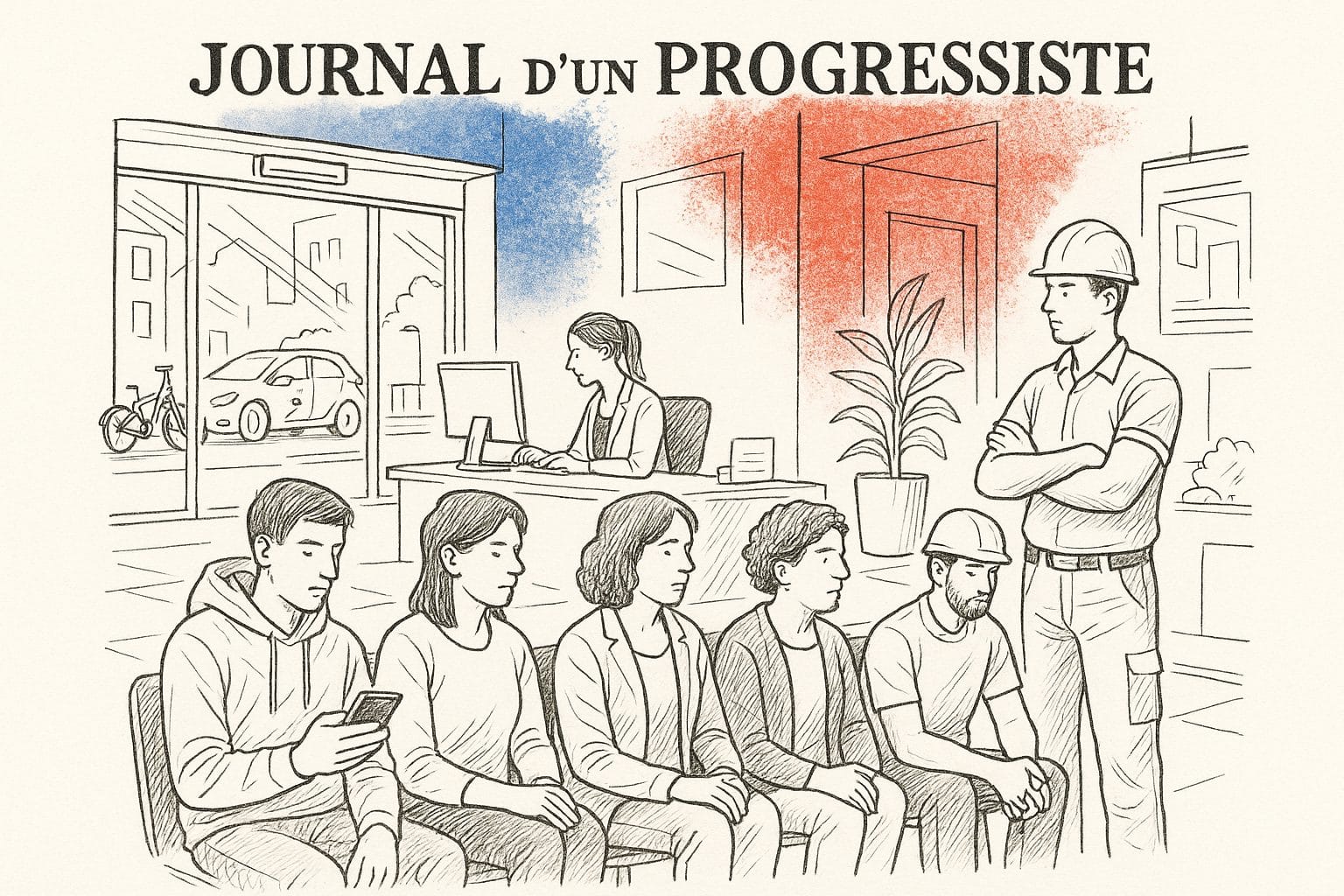
In Morocco, internship offers (PFE—end-of-studies projects) intended for young graduates have been declining since April 2026. This signal is the first concrete figure of a mechanism that precedes job elimination: the automation of junior-level tasks erases the entry gateway before anyone has crossed it.
The Essentials
- AI can modify or automate certain initial tasks, but the elimination of internships is not established.
- According to certain projections, a significant share of Moroccan jobs could potentially be affected by AI by 2030.
- Morocco has an Employment Loss Benefit, but it effectively excludes first-time entrants without a contribution history, limiting institutional buffers for newcomers.
- Economist Simon Johnson demonstrates that AI shares its gains only where citizens and institutions exert influence over its trajectory.
- By 2030, if no protection exists for those who have never contributed, no one will finance the first assignment of junior staff when AI assumes half of it.
The Moroccan Labor Market Before Market Entry
The public debate on AI and employment focuses almost exclusively on eliminating occupied positions. An engineer replaced by an algorithm, an accountant by automated processing software, a lawyer by a document review tool. This framing is real, but it misses something anterior.
The entry gateway into professional life has a precise structure. A young graduate lands an internship or first contract in exchange for undervalued, repetitive work with low immediate added value: data entry, drafting initial reports, data processing, customer support, translation, formatting. These tasks have a name in labor economics: learning-by-doing assignments. They are not trivial. They are the mechanism by which a junior becomes a professional.
The company bears a supervision cost; the junior accumulates human capital. It is an implicit exchange, never formalized, that structures entry into dozens of professions.
AI can reduce the time or cost of certain tasks, with heterogeneous gains and usage, control, and integration costs. A manager can assign the synthesis of a file to a tool that executes it in ten minutes rather than to an intern who will spend three hours and deliver a result requiring correction.
The logical consequence: junior positions disappear before senior positions are threatened. The market closes from the bottom.
4.6 Million Moroccan Jobs in the Crosshairs
Projections of the scale of AI’s shock for Morocco were relayed by Tel Quel in April 2026, attributed to an African Center for Strategic Studies and Digitalization. According to certain projections, a share of the workforce could potentially be affected by AI by 2030, with varying degrees of impact.
These figures carry information that their aggregation masks: they say nothing about distribution by seniority. But the decline in PFE internship offers—the end-of-studies project, the final mandatory step before employment for tens of thousands of Moroccan graduates each year—provides a field signal. Adjustments are being observed in internship offerings and intern recruitment. The pipeline is clogging upstream.
Ministry data indicates 135,345 graduates from public university education in 2022-2023, not even including all private components and executive training. The university system and major schools produce cohorts seeking internships to validate their degrees and enter the market. A reduction in access to first positions through automation could place graduates in an uncomfortable position: potentially overqualified for certain informal jobs while lacking experience for available formal positions.
The Moroccan economy presents an additional structural vulnerability. Several sectors exposed to automation figure among the entry sectors for graduates. These are the jobs that enabled the social advancement that university had promised.
The Absence of Institutions Transforms a Shock Into Exclusion
Comparison with Germany illuminates what is at stake in Morocco by contrast.
Facing pressure from industrial automation, Germany has mobilized its partial unemployment system, Kurzarbeit, for several years, adapting it to technological transitions. The principle: the state covers a portion of salary for employees whose work hours are reduced during a restructuring or upskilling phase. Workers in place maintain their connection to the company during transition. Adjustment costs are mutualized. The IAB Institute for Labor Market Research documents the effects of this system on skills retention and retraining speed.
Morocco has an unemployment insurance system, Employment Loss Benefit (IPE), created in 2015. It covers only private sector employees who have contributed for at least 780 days, over two years. A first-time entrant who has never obtained a formal contract has no rights under it. Interns, who lack formal employee status and contribution history, do not meet IPE conditions. A young graduate without prior employment and without contributions does not meet IPE conditions.
Labor protection systems were designed to absorb shocks mid-career: economic layoffs, corporate restructuring, site closures. They presuppose prior entry into the formal system.
The automation of junior tasks produces a shock before this entry. This gap is at the center of the problem.
The automation of junior tasks could affect access to first formal jobs for first-time job seekers, who are counted among the unemployed according to the High Planning Commission, even if they have no right to IPE.
This is precisely the thesis developed by economist Simon Johnson, co-author of works on institutions and technology. In an analysis published by The New Yorker, Johnson argues that AI creates shared prosperity only on the condition that citizens and institutions influence its orientations. Where transition institutions exist and social dialogue is structured, automation can be accompanied by retraining. Where they are absent or inadequate, gains go to companies adopting the tools, and costs fall on the least protected individuals.
The argument merits confrontation with a competing reading. Liberal growth economists, like Tyler Cowen or Philippe Aghion in his work on creative destruction, recall that generic technologies ultimately create more jobs than they destroy, provided the economy remains open and flexible. Previous transformations—agricultural mechanization, office computerization—produced similar fears and resulted in larger labor markets. Long history argues for patience.
The tension between these two readings is real. But it resolves differently depending on institutional context. In an economy with buffers, patience is a viable option: displaced workers can survive and retrain during transition. In an economy without a safety net for entrants, creative destruction destroys first and creates later, with a delay that affected individuals cannot self-finance. Robotization already concentrates gains at the top in economies better equipped than Morocco; the effect is amplified where buffering institutions are lacking.
Sectors Losing Their Entry Points
Not all sectors are affected equally. Three fields concentrate risk for Moroccan juniors.
Tools can automate or assist certain financial and accounting tasks without demonstrating they cover the full range of first-position missions. A bac+3 assistant accountant processed bank reconciliation files, produced preparatory statements, verified supporting documents. These tasks can be partially automated or assisted depending on tools, data, and control procedures.
The digital and software development sector, often cited as a refuge for technology graduates, experiences its own disruption. Code assistants can help with certain junior development tasks, but generalized substitutive automation is not established. Some Moroccan digital service companies are adjusting their recruitment strategies, sometimes using programming assistance tools.
Marketing and communications represent the third focus. Web writing, content management, monitoring, functional translation: all classic first-job assignments that generative AI now executes on demand.
These three sectors figure among the career paths for graduates in management, computer science, and communications programs. Latin America has begun responding to this challenge by training its own engineers in AI tools, an avenue Morocco has not yet translated into structured public policy.
2030: Financing the First Assignment When AI Does Half
Persistence of difficulties accessing first employment could expose a substantial cohort of graduates to insufficient institutional protections.
A first scenario, likely if nothing changes, sees this cohort taking refuge in three parallel trajectories. One fraction joins the informal economy, losing the comparative advantage of its degree. Another emigrates to Europe or Gulf countries, where labor markets still absorb junior profiles in certain sectors. A third remains in limbo, extending studies or remaining dependent on families, swelling graduate unemployment already structurally high at around 20% according to High Planning Commission data.
This default scenario carries macroeconomic costs. The absence of first formal jobs can affect consumption and savings trajectories, with implications for urban middle-class dynamics. The stakes exceed the social to rejoin the country’s economic trajectory.
A second scenario assumes an institutional response targeted at the employment entry problem. Subsidized contracts for first-time entrants, partially subsidizing wage costs during the first twelve months, would make juniors competitive again against AI for learning assignments.
This formula has precedents: France, Spain, and several sub-Saharan African countries have experimented with similar systems. It presupposes public spending and administrative capacity that Morocco will need to finance and manage.
A complementary avenue concerns training itself. If junior assignments that disappear are learning-by-doing assignments, universities and major schools must reintegrate this learning into their curricula through professional clinics, company-commissioned projects, or partnerships with public structures. This requires pedagogical reform that Moroccan institutions have not yet undertaken at scale.
A third lever concerns AI usage regulation in recruitment and internal outsourcing processes. Countries like France have introduced transparency requirements for algorithmic tools used in human resources management. The idea of imposing a minimum quota of first human positions in companies above a certain automation threshold has been mentioned in several European reports. It remains politically difficult to implement, but it illustrates Johnson’s logic: if AI shares gains only when institutions compel it to, then the question is building these constraints before the market closes.
Europe faces its own version of this problem, with technical skills shortages blocking deployment of otherwise available technologies; Morocco, meanwhile, faces the opposite problem: available graduates and closure of the entry gateway.
The Moroccan Signal Addressed to the Rest of the Emerging World
Morocco presents high graduate unemployment, a visible characteristic that can illuminate dynamics operating in other contexts. This combination makes the mechanism legible in its pure form.
The same dynamic operates, less visibly, in more advanced economies. In the United States, several consulting and audit firms announced significant reductions in junior recruitment starting in 2023. In France, law firms and communications agencies revised their intern programs downward. The difference with Morocco is this: in those countries, families and social protection systems absorb the shock individually and collectively for a time. In Morocco, that time is short.
The Moroccan signal tells other emerging countries—Tunisia, Senegal, Côte d’Ivoire, Egypt—that the debate on AI and employment cannot wait for massive evidence of mid-career job destruction. The AI and employment problem’s entry point could precede mid-career job destruction. Internship offers, first-time graduate placement rates, and work-study contract trends are readily available and quick-to-collect signals.
The report relayed in April 2026 has the merit of existing. Morocco already has structured public responses in digital and AI, notably the Morocco Digital 2030 strategy and the “AI Made in Morocco” roadmap, even if their specific adequacy for new labor market entrants remains a separate question. The window before 2030 is four years. Sufficient to build transition systems targeting entrants, if political will to finance them follows diagnosis.
Sources
- CAESD Tangier / Tel Quel, “Jobs: a study quantifies AI’s shock in Morocco and sounds the alarm,” April 2026, https://telquel.ma/2026/04/30/emplois-une-etude-chiffre-le-choc-ia-au-maroc-et-tire-la-sonnette-dalarme_1987101
- Simon Johnson, “Can A.I. Be Pro-Worker?”, The New Yorker, https://www.newyorker.com/contributors/john-cassidy
- IAB Institute (Institut für Arbeitsmarkt- und Berufsforschung), research on Kurzarbeit and technological transitions, IAB Institute, Nuremberg
- High Planning Commission of Morocco, data on graduate unemployment, High Planning Commission, Rabat