In 2024, humanity drew 235 million tonnes of fish, crustaceans, and seaweed from the water. It’s a record. But behind this figure, two divergent stories have been unfolding over four decades, and they do not tell the same story about the future.
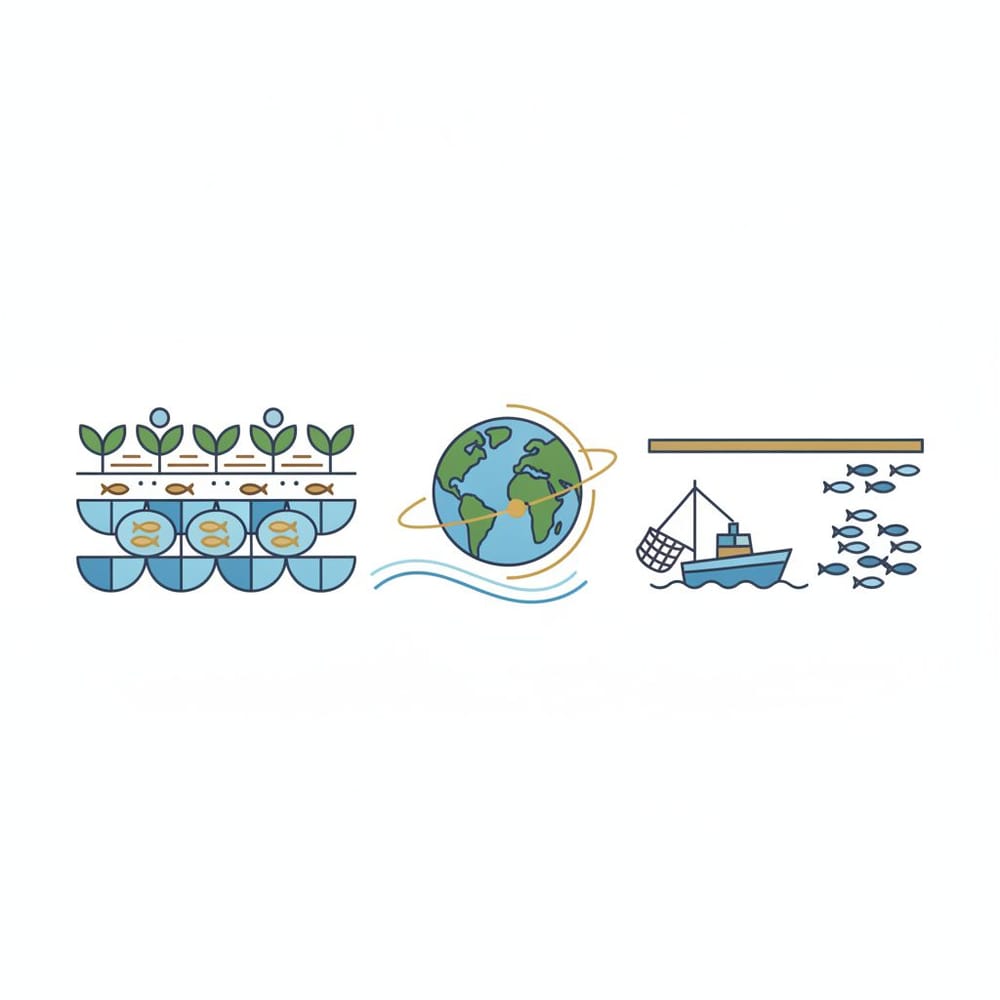
Wild fishing reached its physical ceiling in the 1980s. It hasn’t moved since. All growth comes from aquaculture, which has multiplied its production by twelve in forty years to now cover half of what humanity consumes in fish. This silent shift is one of the great food transformations of the twentieth century. But it does not solve everything. In 2023, 37.6% of assessed marine stocks were overexploited, compared to 35.6% two years earlier. The trajectory is bad, and its consequences will not be distributed equally.
The Essentials
- Record global fisheries and aquaculture production of 235 million tonnes in 2024, more than half from aquaculture (FAO, SOFIA 2026).
- 37.6% of assessed marine stocks in overexploitation in 2023, up 2 points in two years; the Mediterranean, North-East Atlantic, and Centre-East Pacific concentrate the most degraded zones.
- Namibia, Iceland, and New Zealand have demonstrated that reconstitution of collapsed stocks is possible within a decade through scientifically-grounded quota systems.
- The FAO projects a 10% decline in exploitable fish biomass by 2050 if current trends persist, a loss that would first strike coastal populations in low-income countries.
- Asia represents 89% of global aquaculture production; the policy choices that its governments make over the next ten years will determine the outcome.
Wild Fishing Hit a Wall, Aquaculture Took Over
In 1980, fishermen around the world hauled approximately 65 million tonnes of fish from seas and freshwater. In 2024, this figure barely exceeds 90 million tonnes. Forty years of additional effort, more powerful boats, more precise sonar, wider nets, for a gain of only 40%. The marginal productivity of wild fishing has collapsed. The ocean is not an unlimited resource: its biological capacity to produce fish has a limit.
It is aquaculture that took over. In 1980, it weighed less than 10 million tonnes. It now produces over 120 million, a multiplication by twelve. From marine farms off Norwegian coasts to carp breeding ponds in China, through shellfish parks in Brittany and shrimp farms in Southeast Asia, aquatic farming has become the leading source of animal protein intentionally produced by humanity.
This shift has a very precise geography. China alone represents approximately 57% of global aquaculture production. Broadening to all of Asia, we reach 89%. It’s not by chance: coastal demographic density, the tradition of fish consumption, and the voluntarist industrial policy of several Asian governments created the conditions for a takeoff that the rest of the world has not replicated at the same scale.
Overexploitation: Two Points More in Two Years, a Trend Not Yet Reversed
The figure of 37.6% of overexploited stocks does not say that the seas are empty. It says that more than a third of assessed fish populations are caught beyond their biological renewal capacity. That’s an important difference. But it’s a difference that’s eroding.
FAO scientists use the concept of maximum sustainable yield (MSY): the level of extraction beyond which a population begins to decline. Fishing above MSY does not immediately destroy a stock, but it weakens it progressively. The most affected stocks are those in the Mediterranean and Black Sea (a majority in overexploitation), the North-East Atlantic, and certain zones of the Centre-East Pacific. In the Mediterranean, major commercial species like bluefin tuna or gilthead bream have seen their populations divided several times over since the 1970s.
Two points of progression in overexploitation in two years is little in absolute value. It’s significant as a trend signal. The curve has not reversed despite multilateral management agreements, despite discussions at the World Trade Organization on fishing subsidies, despite decades of scientific work. It’s not inevitable: cases of stock reconstruction exist and have been documented. But they remain minority at the global scale.
Namibia, Iceland, New Zealand: When Quotas Reconstruct What Overfishing Destroyed
Namibia is one of the best-documented cases of successful reconstitution. After independence in 1990, the Namibian government established a system of individual transferable quotas (ITQs) based on scientific recommendations from the Namibian Fisheries Advisory Committee. Namibian hake, whose stock had been collapsed by foreign trawlers during the colonial period, was partially reconstituted in less than fifteen years. National production increased and, more importantly, the value per tonne caught advanced because fish quality improved with reduced fishing pressure.
Iceland followed similar logic from the 1980s onward for cod. Its quota system, initially controversial because it concentrated rights among a few large companies, nevertheless allowed partial reconstruction of stocks. New Zealand adopted in 1986 a tradeable quota system covering all its exclusive economic waters, which became one of the reference models in fisheries management.
These three examples share several mechanisms in common: catch limits based on scientific evaluation of stocks rather than political compromises, systems of effective control of fishing effort, and an allocation of rights that creates economic incentives for conservation. A fisher holding a quota has a direct interest in the stock reconstituting. Individual economic horizon aligns with collective ecological horizon.
This is not the only path. Norway adopted a model of centralized quota management with non-transferable licenses, achieving comparable results on its Arctic cod stocks. What matters is the existence of a scientifically determined, respected, and controlled limit. The precise instrument matters less than its credibility.
The Asian Question Is the Central Question
If 89% of global aquaculture happens in Asia, decisions by Asian governments on managing their coastal and offshore fisheries have disproportionate importance on the state of oceans by 2050. That is where the bulk of fishing overcapacity concentrates. That is where government subsidies for shipbuilding and fuel have most inflated fleets beyond what stocks can support. And that is also where the most significant progress remains to be accomplished.
China has made significant announcements over the past ten years. The government launched several programs to reduce its coastal fishing fleet, instituted periods of biological rest in its internal waters, and began formalizing management agreements with its neighbors in the South China Sea. These commitments remain partial and their implementation uneven across provinces. But they exist, and they testify to an awareness that collapse of Chinese coastal stocks would have interior political consequences.
Indonesia, the world’s second-largest fishing producer, suspended between 2014 and 2018 several thousand foreign fishing licenses that were emptying its waters. Vietnam is investing in satellite monitoring of vessels to reduce illegal fishing, which has posed a commercial threat to its exports since the implementation of the European IUU (illegal, unreported, unregulated fishing) regulation.
These are positive signals. They do not yet draw an overall trajectory. The Asian challenge is not only a matter of political will: it’s also a matter of institutions. As lessons drawn from other structural reforms show, having the right rules is not enough if control and enforcement mechanisms don’t have the capacity to make them respected.
What the 2050 Biomass Will Tell Future Generations
The FAO projects a 10% decline in exploitable fish biomass by 2050 in the scenario of maintaining current trends. This figure merits being read carefully, with its assumptions. It does not mean that oceans will be empty in twenty-five years. It means that the overall productive capacity of marine fisheries, if no correction is applied to current practices, will be one-tenth lower than it is today.
Ten percent less of a subsistence resource for hundreds of millions of people is not an abstract figure. Approximately 3.3 billion people worldwide derive a significant portion of their animal protein intake from fish, according to FAO data. The vast majority live in low or middle-income countries in tropical coastal zones: sub-Saharan Africa, South Asia, the Pacific islands. These populations don’t eat Norwegian farmed salmon. They eat fish caught in their territorial waters, often by artisanal fishermen with modest vessels.
They will be the first to suffer a contraction in wild biomass. They have the weakest adaptive capacities. They cannot easily substitute fish protein with other sources. And they precisely suffer from the excesses of industrial fleets, often foreign, fishing in their waters under insufficient regulatory conditions.
There is an intergenerational and geographical inequality that global production curves alone cannot reveal. The record of 235 million tonnes in 2024 is real. But its distribution does not correspond to its geography of need. The bulk of value added from global fishing is captured by a few major fishing powers. The bulk of vulnerability to its decline is borne by populations that have neither the fleets, nor the fishing rights, nor the institutions to deflect its trajectory.
It is in this context that one must read the agreement on harmful fishing subsidies concluded at the WTO in 2022, the first multilateral trade agreement specifically dedicated to environmental sustainability. It prohibits subsidies to fleets fishing overexploited stocks and restricts those supporting illegal fishing. Its implementation remains slow and conditional, but its existence traces a new normative boundary. The same institutional dynamics that enabled, at another scale, progress like that documented in the fight against air pollution in Europe suggest that common rules, once established, end up producing effects.
Aquaculture Has Its Own Limits Not to Ignore
Aquaculture is not without costs. Intensive salmon farming in Norway or Chile poses problems of sea lice, escapes of farmed fish into natural environments, and pressure on wild fish stocks used as meal for farmed carnivores. Historically, one tonne of salmon produced required several kilograms of wild fish transformed into meal and oil. This ratio is improving: feed formulations progressively integrate plant proteins, insects, and single-cell yeasts. Pilot farms in Norway and Scotland are bringing the dependence coefficient on wild meal below one-to-one. But the overall dynamic of the sector is not there yet.
Farming of herbivorous species, on the other hand, does not have this problem. Carp, tilapia, freshwater trout, bivalve mollusks, and seaweed represent the majority of global aquaculture production, and they are either herbivorous or filter-feeders. Mussels and oysters even improve water quality in environments where they are cultivated by filtering suspended particles. These are sectors that can grow without exerting additional pressure on wild stocks.
The issue is therefore to direct the growth of aquaculture toward these low-impact species, while reducing the dependence on wild fish meal of carnivorous species. It’s a matter of sectoral policy, research in aquaculture nutrition, and labeling systems that allow consumers to distinguish products with very different footprints.
What the 40-Year Curve Says About the Next Ten Years
Four decades of plateauing wild fishing and rising aquaculture draw a bifurcation, not a collapse. Humanity has managed to respond to the physical limits of the oceans through massive productive innovation. It has also demonstrated, in a few well-documented cases, that it could reconstruct what it had degraded.
The question is not whether the tools exist. They do: quotas based on science, reduction of harmful subsidies, satellite surveillance, low-impact species aquaculture. The question is whether fisheries governance institutions, at national and international levels, will be capable of deploying them at sufficient speed to reverse the curve of 37.6% before the threshold of irreversibility is reached in the most fragile zones.
The long arc here is measurable. The next twenty-five years will decide whether the 10% biomass decline projected by the FAO is the realized trajectory or the avoided scenario. Proof of concept exists. What is missing is not ideas. What is missing are decisions.
Sources
- FAO, SOFIA 2026 report — Fishing and Aquaculture: 5 Lessons — Agence Ecofin
- FAO — The State of World Fisheries and Aquaculture (SOFIA), previous editions — fao.org
- WTO — Agreement on Fishing Subsidies, adopted at the 12th Ministerial Conference, Geneva, June 2022 — wto.org
- Namibian Fisheries Management — annual reports from the Ministry of Fisheries and Marine Resources of Namibia
- Ministry of Fisheries of Iceland — cod quota management data, Reykjavik