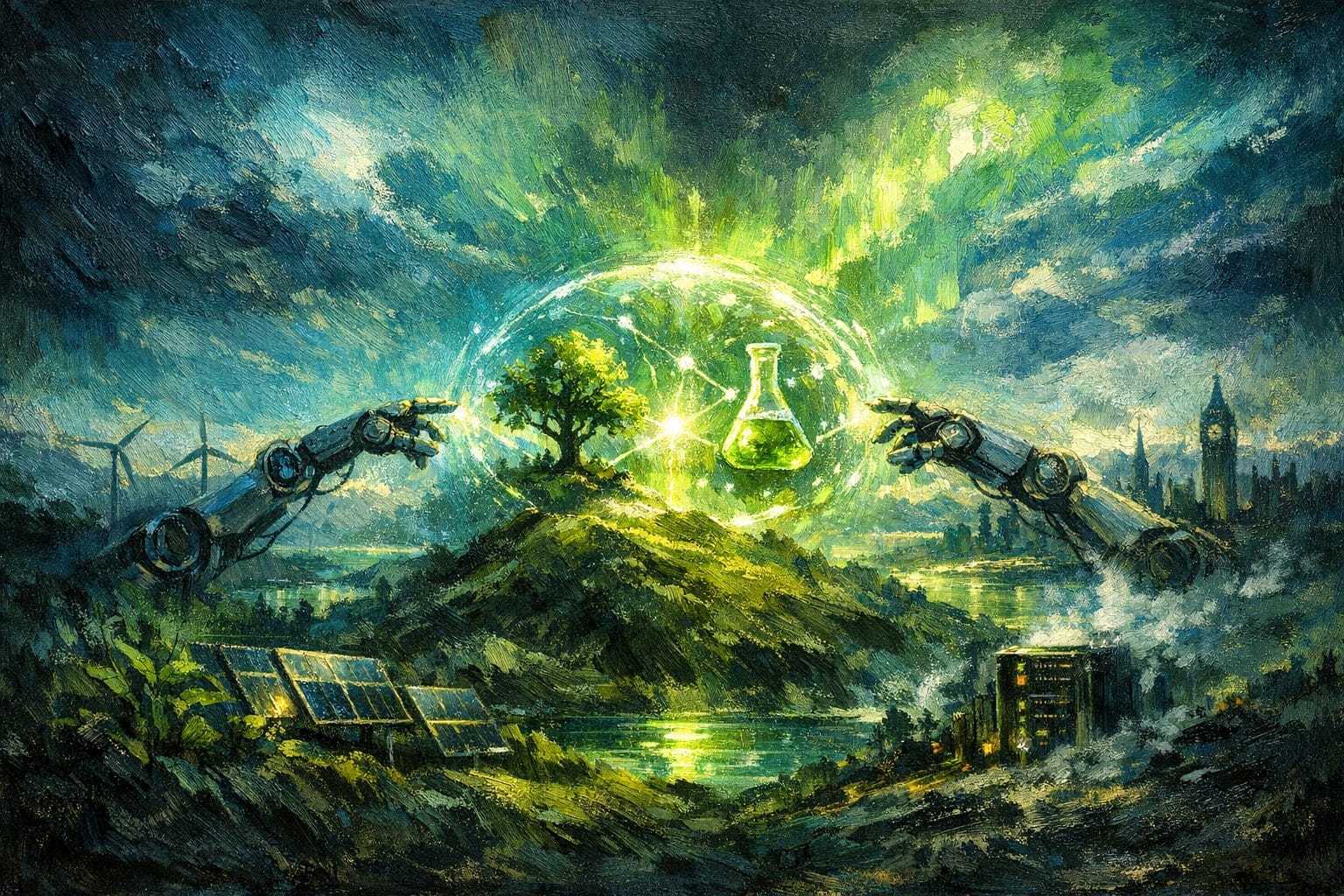
Synthetic biology now makes it possible to design a genome from scratch, not merely read or edit it. On the Future of Species, published on April 28, 2026 by MIT Press, is written by a co-founder of a company specializing in synthetic genome construction. Woolfson treats the power to manufacture living things as a political question as much as a technical one.
The Essentials
- Woolfson argues that synthetic biology has moved beyond genome editing into the design of new biological entities.
- His experience as co-founder of a genetic design company grounds the thesis in industrial practice.
- The book connects artificial intelligence, DNA synthesis, and governance.
- The central question is distributive: which capacities for designing living things should be auditable, shared, or concentrated.
- In September 2026, the WHO opened an initiative on dual-use research in life sciences, though without yet having the necessary tools.
A Scientist Who Built What He Discusses
Adrian Woolfson is co-founder of a company specializing in the design and construction of synthetic genomes. This background shapes the entire posture of the book: Woolfson writes from inside the industrial laboratory, with precise knowledge of what the tools actually allow and what they cannot yet do.
This positioning stands apart from most works on synthetic biology, which oscillate between technical manual and precautionary essay. On the Future of Species holds both ends. The 480 pages from MIT Press constitute neither a plea for acceleration nor an indictment against manipulating living things. They establish a framework for collectively thinking through a technical capacity that already surpasses existing ethical and regulatory categories.
From Editing to Design: The Shift the Book Documents
Twentieth-century molecular biology learned to read DNA. CRISPR, in the 2010s, learned to edit it with unprecedented precision. Woolfson locates the current decade beyond that: DNA synthesis combined with artificial intelligence now makes it possible to design genomic sequences with no equivalent in nature.
This shift from editing to design changes the nature of the problem. Editing means modifying something that exists. Design means starting from an intention and manufacturing a biological object to realize it. The errors are different, the irreversibilities are different. Woolfson shows that this shift is already underway in some industrial laboratories, not a future horizon but a present reality in research infrastructures, both private and public, in the United States, China, and Europe.
The author insists on a point that public debates tend to overlook: the actual technical limits of manufacturing living things. Designing a functional genome remains extraordinarily difficult. AI tools accelerate exploration of the space of possible sequences, but the complexity of biological interactions resists. This honesty about technical constraints is one of the book’s most useful contributions: it prevents both complacent techno-optimism and premature regulatory panic.
The Distributive Question in the Argument
Woolfson states his thesis plainly. The decision to modify or design organisms was made, by default, as technical capacities advanced. The question is now distributive: who accesses these tools, who can audit them, who decides their uses.
The author develops three dimensions of this distribution. The first is technological: tools for DNA synthesis and generative AI models capable of designing sequences are becoming increasingly accessible, at rapidly falling cost. The democratization of access is real. It creates opportunities for resource-limited countries, for independent researchers, and risks, some of which fall into the biosecurity category.
The second dimension is institutional. Existing regulatory bodies were designed to oversee research on modified natural organisms. The design of entities without natural precedent poses problems to which these frameworks do not respond. No institution today certifies that a synthetic organism designed to restore an ecosystem will not produce cascading effects, and none has established legitimacy to decide.
The third is geopolitical. Capacities for designing living things are unevenly distributed. The United States and China concentrate the bulk of public and private research infrastructure. Europe has quality research but a less developed synthesis industry. This asymmetry recalls the concentration issues observed in quantum computing, where a handful of private and state actors claim a technical capacity of collective interest.
Early WHO Initiatives and Their Gaps
In September 2026, the WHO advanced on the governance of dual-use research in life sciences, a domain on which it has been engaged since the 2022 global framework. The signal matters. It shows that a multilateral institution recognizes the need for adaptive governance in the face of rapidly evolving life sciences.
But Woolfson, had he written this chapter after his book’s publication, would probably be measured in his assessment of these advances’ scope. The WHO has advisory governance and capacity-building tools, while also noting implementation gaps. They address member states, who transpose them, or do not, into their national frameworks. WHO tools target mainly countries and institutions, while also involving industry in governance efforts. The WHO identifies longstanding governance challenges and calls for anticipatory and reactive mechanisms, without systematically quantifying the lag between technical innovation and governance.
The book does not lapse into pessimism on this point. Woolfson identifies concrete mechanisms that could narrow this gap: auditability of AI systems used in genomic design, traceability of synthesized sequences, creation of international registries analogous to those existing for dangerous pathogens. These approaches are not mere wishes; some are already being tested in national frameworks.
The Angles Woolfson Does Not Address
On the Future of Species is dense and ambitious. Its blind spots deserve to be named.
The first concerns therapeutic access. Woolfson discusses capacities for designing living things primarily through the lens of risk governance. He moves more quickly over the question of how these capacities could accelerate therapy development for rare diseases, adaptive vaccines, or ecological restoration tools accessible to countries that cannot afford to participate in their development. Inequality of access to benefits is the counterpart to inequality of access to tools, and this counterpart is underexplored.
The second blind spot is non-state actors. The book thinks mainly in terms of states, multilateral institutions, and formal enterprises. Garage biology (biohacking) and independent research communities, which have nonetheless produced surprises in other technological domains, remain on the margins of the analysis.
The third angle is temporality. Woolfson is precise on present capacities and cautious about projections. This caution sometimes makes it difficult to calibrate regulatory urgency: acting before capacities mature risks blocking useful applications; acting after risks running behind accomplished facts.
The Decade That Will Decide
The 2030-2050 horizon that Woolfson sketches implicitly is one of bifurcation. The first trajectory is governance constructed ahead of uses: auditable institutions, internationally recognized biosecurity protocols, a distribution of design capacities that includes actors from the Global South. The second is one of de facto concentration, where a few private laboratories and a few states decide, without collective mandate, which biological entities exist and for what purposes.
Nothing guarantees the first trajectory. But signals exist. The WHO’s September 2026 initiative on dual-use research is one. Ongoing debates in the U.S. Congress over regulation of de novo DNA synthesis are another. The fact that scientists like Woolfson, who have direct commercial interest in expanding these capacities, publicly advocate for rigorous governance rather than deregulation may be the most interesting signal.
Those best positioned to see what these tools actually allow are also pushing hardest for collective decisions on how to wield them.
On the last page, the book leaves open the question of institutions capable of making programmable biology a tool for health and ecological restoration without rendering irreversible decisions made by a few laboratories or states. The answer lies in political choices most democracies have not yet engaged.
Bibliographic Information On the Future of Species Adrian Woolfson The MIT Press, April 28, 2026 480 pages
Sources
- MIT Press, bibliographic page for On the Future of Species
- WHO, “WHO advances tools to govern life sciences and dual-use research,” press release, September 29, 2026 (https://www.who.int/news/item/29-09-2026-who-advances-tools-to-govern-life-sciences-and-dual-use-research)