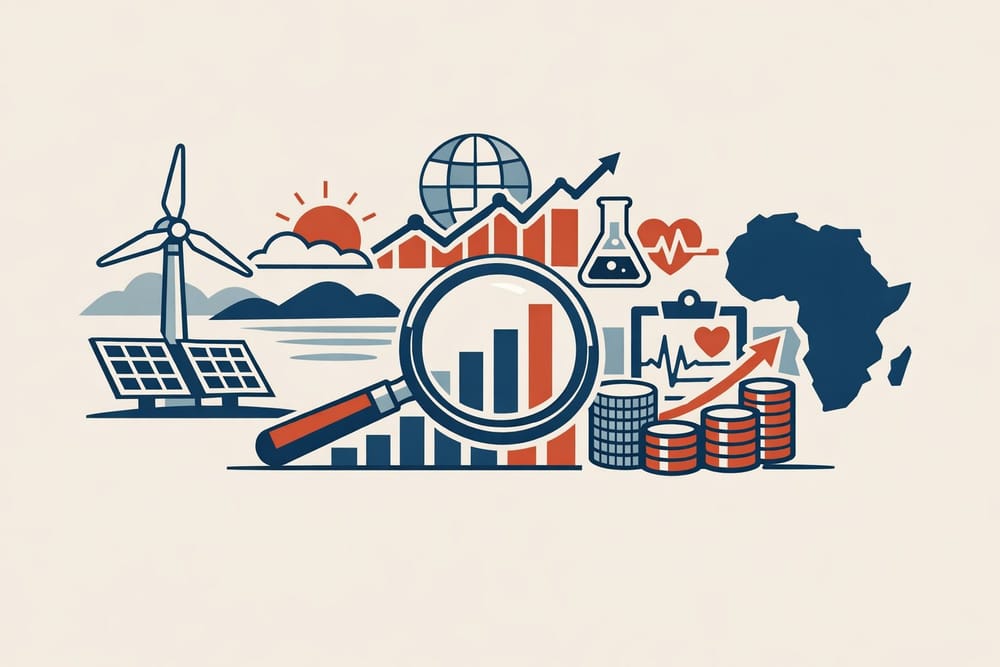
Nineteen organizations from West Africa responded to On Think Tanks’ annual survey in 2026. Their shared diagnosis can be summed up in one sentence: they speak to the right people, but lack the means to sustain the conversation over time. The report State of the Sector 2026, based on 299 organizations across 94 countries, confirms this: it documents high self-assessed influence and deep institutional fragility. The analysis establishes a gap between access to decision-making processes and institutional capacity to convert that access into lasting influence.
The essentials
- West African think tanks suffer less from a lack of audience than from profound organizational fragility: limited reserves and heavy dependence on donors.
- 79% of leadership positions are held by men in West Africa, compared to 59% globally (On Think Tanks 2026 State of the Sector).
- The ATTP was the subject of a call launched in July 2025 and grant agreements signed by the AUC on April 17, 2026 with 13 think tanks. The total envelope is $50 million over five years, of which $24.2 million is to be disbursed in phases.
- A significant portion of African Union decisions are not fully domesticated at the national level, which can limit the reach of research produced locally.
- The challenge for the decade is empowering regional knowledge-producing institutions.
Survey scope and limitations
On Think Tanks has been publishing its State of the Sector for several years. The 2026 edition is the largest to date: 299 organizations, 94 countries, with a deliberate effort to expand geographic representation beyond North America and Western Europe. The 19 respondents from West Africa form a small but coherent subset, and their responses converge on several points that the global survey documents differently.
The report does not claim to measure the political impact of think tanks. It measures their organizational capacities: governance, financing, human resources, access to decision-makers. This methodological boundary makes it a useful tool, because impact surveys often fall into the trap of unverifiable causality: attributing a ministerial decision to a report rather than to political negotiation remains impossible to prove.
On Think Tanks asks questions about what is measurable: how many women hold leadership positions, where does the budget come from, does the organization have reserves to survive six months without a contract.
On these three questions, the West African responses are concerning. The concentration of male power first: 79% male directors, compared to 59% in the global sample. Research on public policy organizations shows that leadership composition influences research agendas, mobilized networks, and hiring decisions. Leadership that is 79% male weighs on what an institution chooses to study and on who it recruits to do the work.
Financial dependence constitutes a second vulnerability factor. Most of the organizations surveyed in West Africa depend on external funding for a significant portion of their budget. According to the survey, 26% of West African organizations have no financial reserves, and a substantial portion have reserves limited to less than three months of operations. A funding gap between contracts halts activity, and teams built up are often dispersed when work resumes.
The ATTP: an African Union bet
The institutional response to these vulnerabilities is called the ATTP, Africa Think Tank Platform. The ATTP was the subject of a call launched in July 2025. The AU Commission signed agreements with the 13 think tanks on April 17, 2026 at a strategic workshop in Addis Ababa. These agreements provide for $24.2 million disbursed in phases; the total ATTP envelope is $50 million over five years. $50 million divided equally among 13 institutions over five years represents approximately $0.77 million per institution per year.
The intention is explicit: strengthen the capacity of African think tanks to produce research usable by continental decision-makers, and in particular to accelerate implementation of the African Union’s Agenda 2063. The finding that motivates this program is documented in the workshop report: less than 10% of African Union decisions are fully domesticated at the national level. Member States adopt frameworks, sign protocols, commit to processes. Then national administrations encounter difficulties translating these commitments into concrete policies. Local think tanks should occupy this space, but they lack the structural means to do so.
The ATTP is therefore as much a capacity-building program as a research program. This is what Habibatou Ibrahima Thiam, ATTP project manager at the Pan-African Institute for Citizenship, Consumer Affairs and Development (IPAR) in Dakar, emphasizes. In an interview published by On Think Tanks, she describes an institution with access to decision-making processes but lacking stability to use that access continuously. The challenge, she says, is to be present when decision-makers are ready to listen. And that requires an organization that can sustain itself between windows of opportunity.
The IPAR diagnosis
In September 2026, authors associated with IPAR published an analysis with On Think Tanks of the vulnerabilities in the West African sector, including recognition of IPAR’s own vulnerabilities. This type of document is rare. Think tanks, like most civil society organizations, publish their successes and remain silent about their structural constraints. IPAR does the opposite: it documents its project dependence and the financing constraints it generates.
The diagnosis crosses and amplifies data from the global survey. Sub-Saharan African think tanks have limited reserves, but they are not systematically less well-resourced than those in all other regions. IPAR shows why: when most of the budget comes from contracts tied to specific deliverables and imposed timelines, room to build reserves can be limited. Money comes in and leaves with the project.
The financing model is an important factor among others, and the data do not allow us to rule out the role of management or organizational size. Development donors generally finance projects, but some mechanisms, including the ATTP, also finance institutional strengthening. They pay for reports, workshops, trainings, but not for the months of reflection that precede them, nor for the administrative capacities that allow an organization to remain operational between projects. The result is a knowledge industry that looks more like a network of consultants than an ecosystem of sustainable institutions.
For those who track the link between solid institutions and stable democracy, this diagnosis resonates with a broader finding: illiberal drift takes hold where analytical counterweights are absent. Structurally fragile think tanks cannot play this counterweight role in a sustainable way.
Governance as a blind spot
The State of the Sector survey poses a question that few reports on African think tanks address directly: who governs these institutions, and how. West African responses reveal several significant gaps.
The first concerns the role and functioning of boards of directors. Boards of directors often exist on paper; their role in strategic decisions, particularly on research orientation and financial risk management, appears variable.
The second is the gender imbalance already mentioned. These two gaps reinforce each other: governance concentrated in a rarely renewed leadership favors reproduction of existing profiles. Opening boards and diversifying leadership are two movements that condition each other mutually.
The survey does not say why this gap exists between West Africa and the rest of the world. The 19 respondents do not form a large enough sample for solid conclusions about causes. But the gap is documented, and it is pronounced enough to justify specific attention in the ATTP’s selection and renewal criteria.
Two trajectories for 2030
The ATTP expires in 2031. The report raises, without formulating it explicitly, the question of what comes after: will the institutional gains survive the exhaustion of the $50 million.
Two trajectories are emerging, each conditional on the other.
The first path is mutualizing. If the 13 institutions benefiting from the ATTP use the temporary stability that the program offers them to build shared functions—human resources management, audit, information systems, collective advocacy with donors—they could exit the program with a larger institutional footprint than the one they entered with. A shared reserve fund, financed by modest deductions from each donor contract, would allow these institutions to cover several months of operations without external funding.
Mutualization reduces individual vulnerability without eliminating competition between institutions. It distinguishes thirteen fragile organizations from thirteen organizations capable of waiting for the right political window rather than accepting any contract to survive.
This trajectory assumes a condition that the survey identifies as structurally absent: internal governance capable of collective decisions, with boards that truly exercise their role. If correcting the gender imbalance is integrated as a criterion for renewing African Union funding, it creates an external incentive for governance to evolve. The gap between 79% and 59% is sufficiently documented to serve as a measurable target.
The second trajectory is reconcentration. If each institution remains in individual competition for post-ATTP funding, the $3.8 million annually per organization will not have been enough to build autonomous reserves. Donors will retain a selection lever that perpetuates structural vulnerabilities. The best-connected institutions internationally will survive; others will convert to service providers, or disappear. The sector will fragment, and with it the possibility of sustained analytical influence on regional policies.
These two scenarios are not symmetric in terms of probability, but the signals that would allow us to distinguish between them are identifiable. The share of institutional budgets covered by own resources or reserves, measured annually by On Think Tanks, is the first indicator. The proportion of women in leadership positions in ATTP institutions, recorded at each State of the Sector cycle, is the second. If these two metrics improve between 2026 and 2030, the sector is on a consolidation trajectory. If they stagnate, the ATTP will have been just another round of financing in an endless cycle.
Contributions of this report to understanding the subject
The debate on African think tanks typically oscillates between two registers. The first celebrates their rise in prominence: more institutions, more trained researchers, more published reports. The second accuses them of being transmission belts for the agendas of their Western donors. Both registers have their share of truth, and both miss what the State of the Sector 2026 documents.
This report presents organizational continuity and resilience as central challenges among several determinants of influence capacity. Influence in public policy rests on relationships maintained over time, a reputation established over multiple cycles, and a capacity to respond when opportunities arise. An institution whose organizational stability is fragile loses these advantages. Influence in public policy generally rests on relationships maintained over time, a reputation established over multiple cycles, and a capacity to respond when opportunities arise.
This is what Habibatou Ibrahima Thiam articulates in her interview: the audience exists. What is lacking is the institution capable of sustaining it. This distinction—between having the ear of decision-makers and having the means to make use of it—is the report’s true analytical contribution.
It also has an implication for donors. The project-based financing model, calibrated to short-term deliverables, is rational from a donor perspective: it secures accountability and limits fiduciary risk. But it can fragilize institutional resilience, particularly when it dominates and remains restrictive. Strengthening think tanks’ capacity to influence African policies requires multi-year funding offering greater flexibility, and accountability mechanisms that balance donor expectations with institutional strategy. The ATTP is a step in this direction.
Bibliographic information Title: State of the Sector 2026 Organization: On Think Tanks Publisher: On Think Tanks Publication date: 2026 Format: Survey report (unpaginated, free access online)
Sources
- On Think Tanks, State of the Sector 2026, article on West Africa: https://onthinktanks.org/articles/west-africas-think-tanks-have-the-audience-do-they-have-the-institution/
- Pan-African Institute for Citizenship, Consumer Affairs and Development (IPAR): https://ipar.sn/
- African Union Commission, account of the ATTP strategic workshop, April 27-30, 2026: https://au.int/en/pressreleases/20260506/auc-launches-strategic-workshop-drive-policy-impact-of-african-think-tanks