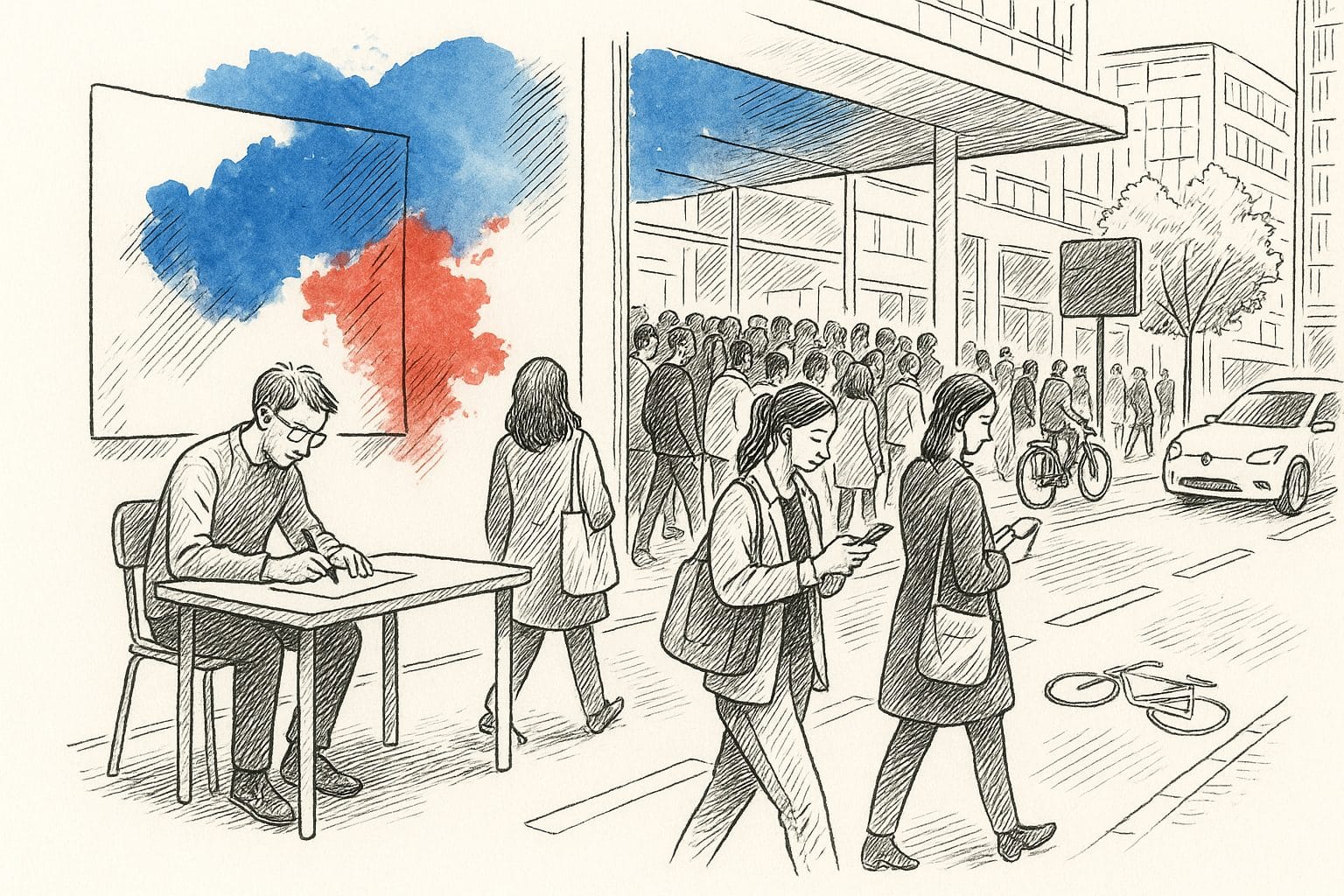
The 2025 annual report from UNESCO’s Beijing office documents concrete progress on digital accessibility in China and media reforms in Mongolia, across five East Asian countries monitored by the organization. These advances matter: they broaden the reach of information, reduce real access divides, and follow a measurable trajectory. But technical inclusion and information pluralism are two distinct things, and conflating them amounts to measuring freedom to read by the number of readers.
The Essential Points
- Digital inclusion is advancing in East Asia, driven by infrastructure investments and accessibility policies documented by UNESCO Beijing in 2025.
- In China, advances concern technical access: connectivity, interfaces, coverage. They do not alter the conditions of information production and distribution.
- In Mongolia, media reforms are underway in a more open institutional context, but their scope remains to be assessed.
- Bruno Patino raises the central question: the attention economy organizes visibility before censorship even intervenes. Access to a screen does not guarantee access to plural narratives.
- The challenge by 2030 is to determine whether digital inclusion can become a lever for pluralism, or whether it closes in on merely amplifying dominant narratives.
Access as Necessary, Not Sufficient Condition
For a long time, the debate on East Asian media focused on barriers: what could not be read, what could not be broadcast, what was filtered. The UNESCO Beijing Annual Report 2025 invites us to also look at what is opening. In China, digital accessibility policies have advanced: interfaces adapted for elderly users, expanded coverage in rural areas, devices designed for people with disabilities. In Mongolia, reforms affecting the media regulatory framework are underway. These are documented facts from an organization whose methodological credibility on these subjects is solid.
These advances deserve to be taken seriously. Access to information begins with the physical and technical capacity to receive it. A inhabitant of the Mongolian steppes who can now consult an online information source was unable to do so ten years ago. A Beijing senior citizen who accesses a readable interface gains in information autonomy. These gains are real, they are not negligible, and dismissing them out of hand in the name of an ideal of pluralism not yet achieved would be a form of condescension toward those who experience them.
They leave unanswered the question that UNESCO itself raises in its guidance on cultural and media policies: who produces the narratives, and according to what rules. Technical inclusion broadens the audience. It does not necessarily change the conditions in which narratives are manufactured, selected, and amplified.
In China, Infrastructure Advances, Editorial Space Remains Bounded
China has made universal connectivity a state objective. The figures are impressive: according to data from the International Telecommunication Union, internet penetration exceeds 78% of the population in 2024, compared to less than 20% in the early 2000s. Platforms like WeChat or Douyin rank among the world’s most sophisticated digital environments in terms of user experience and accessibility. Infrastructure investments have placed China at the forefront globally for 5G coverage.
These figures do not measure the nature of what circulates on these networks. China’s information regulation system, abundantly documented by researchers at the Citizen Lab platform and teams at the China Media Project, operates at multiple levels: technical filtering via the Great Firewall, algorithmic moderation on platforms, self-censorship by content producers, and editorial framing of state information. The UNESCO Beijing Annual Report 2025 notes advances in accessibility without claiming that these mechanisms have changed. They have not changed.
The report allows us to observe a decoupling. Infrastructure is deployed with a universalist ambition. Editorial space remains bordered by rules that limit who can speak, about what, and in what register. Access to a fast and well-designed network can even strengthen the effectiveness of dominant narratives: it makes them more fluid, more accessible, more pleasant to consume. This is precisely the tension analyzed by Bruno Patino, editorial director of Arte and author of work on the attention economy: a technically excellent platform can serve both information diversity and its concentration equally well.
Architecture does not determine use, but it contributes strongly to it.
Mongolia, A Different Case and An Open Project
The Mongolian situation deserves separate treatment because it belongs to a different institutional register. Mongolia is a parliamentary democracy that has experienced several political transitions since 1990. Its media landscape is plural, even if it suffers from ownership concentrations and economic dependencies on political and mining actors. Press independence there is not a formal question: it is a living debate, with actors fighting for and against it.
The reforms documented by the UNESCO Beijing Annual Report 2025 thus fit into this context. Without accessing the full details of the report, UNESCO’s angle points toward adjustments in the regulatory framework: how media are registered, financed, subject to transparency obligations. This type of reform may seem technical. It is not. Registration and financing rules determine who can enter the information market and under what conditions.
A well-designed reform can reduce barriers to entry for independent media; a poorly designed reform can create new administrative locks.
It is too early to judge. Mongolia has an institutional space in which this type of reform can have real effects on pluralism. Growing digital access in the country’s rural and nomadic zones, combined with a more open regulatory framework, could expand both the audience and the diversity of voices. This scenario remains conditional: it assumes that reforms are implemented, that independent actors can benefit from them, and that economic and political pressures on newsrooms do not close what regulation has opened.
The Attention Economy Changes the Equation
There is a competing reading of digital pluralism, notably carried by economists working on information markets. Daron Acemoglu and Simon Johnson, in their work on technology and capture of gains, pose the question of who truly benefits from digital infrastructure. Their answer is structural: gains go first to those who control platforms and distribution algorithms, not necessarily to content producers or audiences.
Bruno Patino adds another layer. The attention economy, as he describes it, does not function through crude censorship but through continuous selection. Recommendation algorithms maximize engagement, which favors content that provokes strong reactions: outrage, confirmation of existing beliefs, emotion. This mechanism operates independently of political context: it structures information visibility in Beijing as much as in Paris or New York. In an environment where editorial space is already constrained, as in China, this attentional filter adds to the political filter.
In a more open environment like Mongolia, it can paradoxically favor polarizing content over rigorous informational content, even in the absence of censorship.
Access to infrastructure is not sufficient to guarantee quality information pluralism. The conditions for this pluralism are at once political (who has the right to speak), economic (who can finance themselves), and algorithmic (who is made visible). UNESCO, in its “Re|thinking Policies for Creativity” report published in 2022, the global report on the 2005 Convention on the Diversity of Cultural Expressions, begins to articulate these three dimensions, recognizing that cultural content policies must now integrate the governance of distribution platforms. This is an important shift in the organization’s thinking framework.
Lessons from the Comparison Between the Two Countries
Placing China and Mongolia side by side in the same report is not trivial. These two countries share a border thousands of kilometers long and decades of interwoven history, but their institutional architectures are profoundly different. UNESCO Beijing also covers the Republic of Korea, Japan, and the Democratic People’s Republic of Korea in its regional scope, which gives this report an implicit comparative character between highly contrasting political models.
This comparison has a virtue: it forces us to separate what relates to infrastructure, institutional framework, and information culture. South Korea and Japan both have first-rate digital infrastructure and established democratic systems. Their media landscapes are nonetheless not free from concentrations, political pressures on newsrooms, or advertising dependencies that influence editorial lines. Universal digital inclusion, when it exists, does not automatically produce a plural information space.
Mongolia, with less developed infrastructure and a more fragile media market, has produced investigative journalism recognized regionally, notably on extractive industries. The professional culture of journalists, the legal protections they benefit from, and social demand for independent information count as much, if not more, than the level of connectivity.
This observation aligns with what we see in other regions. On the dynamics between infrastructure and cultural content, the sequence that seems most robust is precisely this one: infrastructure is a prerequisite, but what comes next determines uses. And in other geographic contexts, as with Rabat where the book has become an urban policy, we observe that the most effective cultural investments are those that combine physical access and conditions for production of narratives.
Reforms That Would Actually Make a Difference
Digital inclusion represents real but incomplete progress. Reforms allowing us to take the next step remain to be specified. UNESCO sketches several directions in its general guidance, which the Beijing report illustrates contextually.
The first concerns algorithmic transparency. If platforms distributing information in China or Mongolia made their recommendation criteria public, content producers and regulators could identify systemic biases favoring certain narratives over others. This type of transparency is technically feasible. It faces economic and political resistance in all contexts, including Western democracies.
The second direction concerns funding for independent media. In Mongolia, the economic fragility of newsrooms is a structural vulnerability: newspapers that cannot finance themselves through advertising or subscriptions become dependent on political or economic actors with interests in their editorial line. Public funding mechanisms with independent governance, like those that exist in Scandinavia or, in different form, in the United Kingdom, can partially correct this imbalance. Their transfer to a different institutional context is a delicate operation, but not impossible.
The third direction is the most fundamental and most uncertain for China. It concerns the legal framework that defines what journalists and citizens can publish. No infrastructure, however performing, can compensate for the absence of source protection, press freedom, and legal recourse against abusive prosecution. UNESCO can only document the gap between international standards and observed reality. Closing this gap requires political choices that international institutions cannot impose.
The question that remains open, and which the Beijing 2025 report poses without being able to answer it, is whether extending digital access ultimately creates social demand for more pluralism. The history of media transitions in other regions of the world suggests that access to information can nurture expectations that eventually weigh on the systems constraining them. This scenario is conditional, non-linear, and subject to powerful counterforces. But it deserves to be taken seriously as a working hypothesis, rather than dismissed outright.
Sources
- UNESCO Beijing Annual Report 2025
- UNESCO, Re|thinking Policies for Creativity, 2022 Global Report on the 2005 Convention on the Diversity of Cultural Expressions (UN iLibrary)
- International Telecommunication Union, data on internet penetration in China, 2024 (itu.int)
- Citizen Lab, University of Toronto – GFWatch, platform for measuring China’s DNS censorship
- China Media Project, University of Hong Kong, analyses of the Chinese media system (chinamediaproject.org)
- Bruno Patino, The Civilization of the Goldfish, Grasset, 2019; work on the attention economy
- Daron Acemoglu & Simon Johnson, Power and Progress, PublicAffairs, 2023 (MIT Stone Center)
- UNESCO Beijing – About (official page)
- CNNIC – 55th Statistical Report on China’s Internet Development
- Congressional Research Service – Mongolia
- RSF – Who owns the Media in Mongolia?
- GIJN – Mongolia Holds Pioneering IJ Conference
- China State Council – China’s 5G Leadership