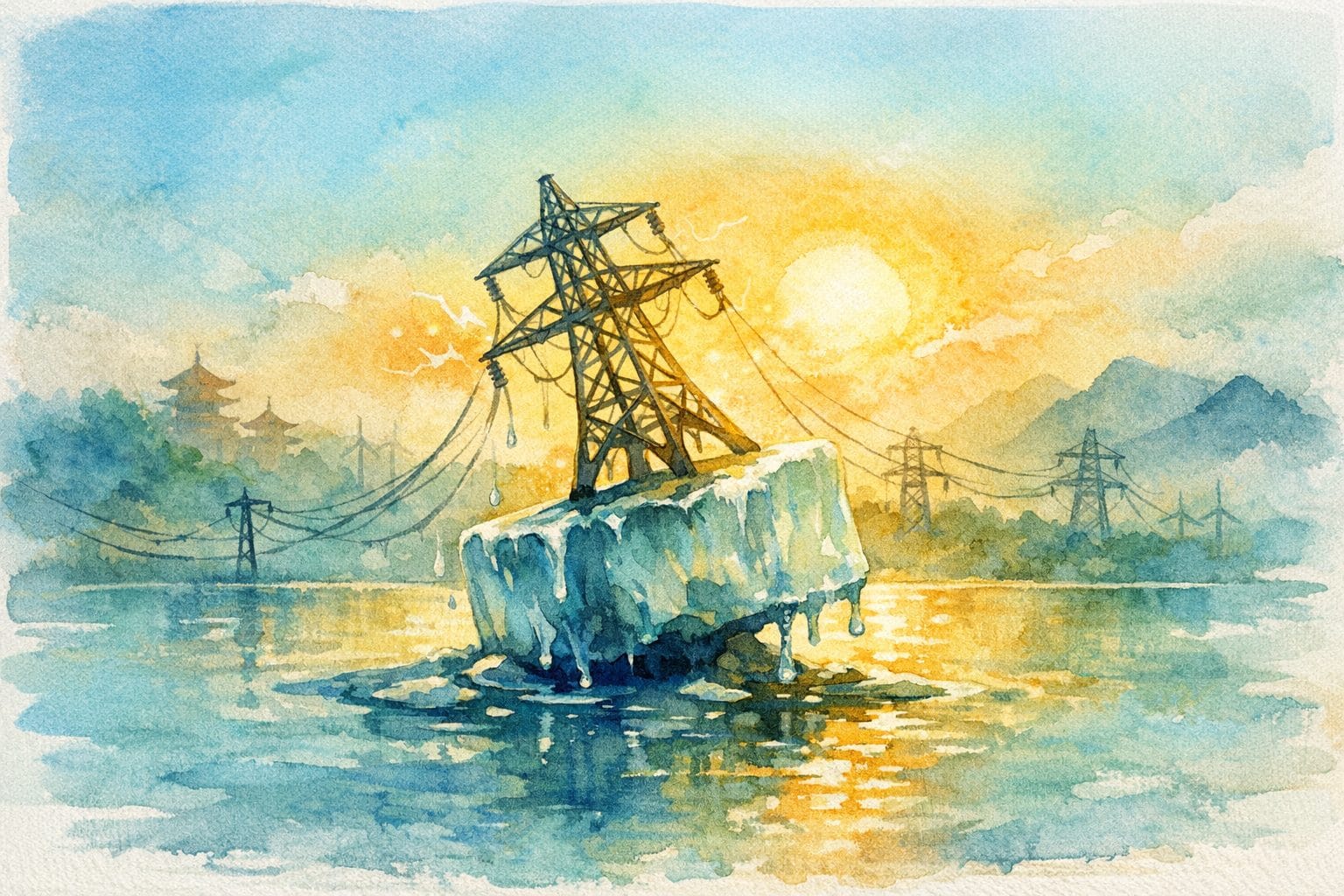
In southern Africa, the 2026-2027 agricultural season looks set to be difficult: GEOGLAM estimates a probability greater than 70% of extreme temperatures between November 2026 and April 2027. Millions of smallholder farmers will receive an alert. Many will be unable to act on it. Climate information exists; what is missing is the full set of institutions, data, connectivity, and financial mechanisms that convert this information into capacity for action before losses occur.
The essentials
- Climate alerts can modify certain agricultural decisions, but their effect strengthens considerably when coupled with index-based insurance and accessible input credit.
- The Global Center on Adaptation recommends in 2026 linking climate advice distributed via SMS, voice, or radio to concrete financial mechanisms for African smallholders.
- GEOGLAM projects a probability greater than 70% of extreme temperatures in southern Africa during the November 2026 – April 2027 season, making the issue immediate.
- The principal risk is concentration of benefits among farmers already equipped, reproducing the access inequalities of formal agriculture.
- Concrete approaches exist: single-window services combining alerts, index-based insurance, and credit, conditioned on the inclusion of informal farmers.
The alert arrives. The farmer cannot protect himself.
In late October, a Malawian farmer receives a text message on his phone: the season will be hot, rainfall uncertain, drought risks high. He reads it. He understands it. And he plants the same seeds as the previous year, at the same time, with the same money borrowed from a neighbor.
The problem lies in the entire chain, not in one isolated technical aspect.
The Global Center on Adaptation (GCA) documents this disconnect in its Adaptation Insights report published in 2026. Digital climate advisory services are reaching a growing number of smallholder farmers across sub-Saharan Africa, via SMS, voice messages, and radio broadcasts. Coverage is expanding. Measured impact is variable: the GCA report documents yield increases of 10 to 30% and benefit-cost ratios of 7:1 to 26:1 in several contexts. The report identifies the cause: these services operate in silos, disconnected from the financial instruments that would transform a forecast into concrete action.
Climate information has considerable theoretical economic value. A farmer warned of probable drought can choose drought-resistant varieties, adjust his planting dates, reduce his inputs to limit losses. But these trade-offs require three things that most African smallholders do not simultaneously have: access to credit to buy different seeds, insurance that covers losses if the forecast comes true, and a local market that sells appropriate inputs. Without these three elements, the effect of forecasts may be reduced, but they can still influence certain agricultural decisions. They can even worsen the situation: a farmer informed of risk but unable to act accumulates anxiety, not resilience.
The limits of technology without institutional framework
Carl Benedikt Frey, in How Progress Ends, poses a thesis that African agriculture illustrates with uncomfortable clarity. Technological progress, according to him, does not deploy itself through its own force. It requires a fragile balance between decentralized innovation—here, mobile apps for climate advisory—and institutions capable of integrating it at scale and making it operational for all.
African digital climate advisory tools are, technically, a success. Organizations like Farmerline in Ghana or ESOKO in Kenya distribute localized forecasts, agronomic advice, market prices. Adoption rates are rising. But the impact on yields and farm resilience remains below initial projections. Frey would explain this without hesitation: technology preceded institutions.
A competing reading exists. Mariana Mazzucato, in her analysis of the entrepreneurial state, would insist on the necessity of deliberate, directed public investment to build these missing institutions—index-based insurances, emergency credit lines, land registries that allow informal farmers to access guarantees. For her, waiting for markets to spontaneously create these mechanisms would be an error. The state must shape the terrain.
These two readings do not really oppose each other. They complement each other. Frey diagnoses why technology alone fails; Mazzucato prescribes what public institutions must build so that technology becomes useful. The GCA describes existing innovations and general institutional barriers at the African scale: innovation is real, institutions are lacking, and markets alone probably will not build them.
Coverage and current limits of index-based insurance
Index-based insurance constitutes a potentially useful mechanism for converting alerts into economic protection. Its principle: payment does not depend on individual evaluation of each farmer’s damages, a costly and often corruptible process, but on an objective, verifiable index: rainfall level measured by satellite, temperature recorded by a weather station, regional average yield calculated by GEOGLAM. If the index crosses a predefined threshold, payment is automatic.
This is precisely what GEOGLAM’s projections for the 2026-2027 season make possible. With this probability, work on preparing indices can be envisioned, subject to additional historical, contractual, and local data. An insurer or public fund can set the trigger threshold, calculate the premium, and offer contracts before planting. The farmer who subscribes before November already knows that if January is too hot, he receives payment in February, without having to prove losses field by field.
The problem: almost no informal smallholder subscribes. The reasons are documented. Premiums remain high relative to agricultural income. Payment delays, even automatic ones, can take several weeks—too long when cash flow is at zero. And trust in formal financial products remains low in communities that have never seen an insurer keep their promise.
A previous article on African states and drought insurance established that coverage first hits institutional and financial obstacles: one actor must subsidize the premium to make the product accessible, and another must guarantee liquidity so payment arrives quickly.
Input credit, the most fragile link
Insurance protects against losses. Input credit helps prevent them. These two instruments are complementary and their integration can strengthen the transition from alert to action.
The mechanism is simple in theory. A farmer receives in October an alert announcing a dry season. He wants to plant drought-resistant varieties rather than his usual seeds. These varieties cost considerably more. He has no money.
Quick input credit can facilitate certain adaptations, but a forecast can also modify practices that do not require new purchases.
The GCA recommends bundling climate advisory with input credit and insurance. Concretely: when the advisory service sends a recommendation to change varieties, a linked microcredit mechanism triggers simultaneously, allowing the farmer to buy the recommended inputs without delay. Repayment occurs after harvest, with adjusted conditions if losses occur despite precautions.
This model exists at small scale. Some programs have tested couplings between digital advisory and input credits, with positive results on yields and adoption of adapted practices. The difficulty is scaling up. Small informal farmers frequently encounter obstacles to commercial credit, notably the absence of collateral and financial history, but some banking and digital devices finance them. Microfinance institutions have local trust but often lack liquidity to finance agricultural inputs at the scale of a regional season.
The question joins that posed by thermal protection in African cities: solutions exist, their deployment is blocked by deficits in institutional and financial infrastructure, not technological deficits.
Who builds the chain, and for whom
The GCA report structures its recommendations around six guiding principles and five deployment accelerators. It advocates for integration of digital climate advisory services with index-based insurance and input credit, without prescribing a linear three-level architecture.
These three levels exist separately. Connecting them requires precise policy decisions: who finances premium subsidies for farmers below an income threshold, who guarantees insurer liquidity in case of massive regional loss (the scenario GEOGLAM draws for 2026-2027), and who mandates that alert programs funded with public money include informal farmers as a condition of access.
These questions find no answer in technology. They call for institutions. Governments that set inclusion criteria. Climate funders, the Green Climate Fund, African development banks, that condition their financing on coverage of the most vulnerable farmers. Telecommunications operators that open their mobile payment platforms to agricultural insurance products.
There is a real risk that these mechanisms, once built, benefit first the larger farmers and those best integrated into formal supply chains. Agricultural information systems tend to benefit first those who already have access to credit, markets, and advice. Avoiding this concentration is not automatic. It requires explicit inclusion criteria, verification mechanisms, and political will to serve the smallest farmers first, not last.
Two trajectories for 2030: what sets them apart
The 2026-2027 season constitutes a concrete test. GEOGLAM’s projections have been known since autumn 2026, the GCA’s recommendations are published, and tools are available. For the five years that follow, there remains the question of who builds the complete chain and at what pace.
The first scenario is successful integration. States—Malawi, Zimbabwe, Zambia, Mozambique, all in the zone identified as high-risk by GEOGLAM—finance or compel the creation of single-window services combining alerts, index-based insurance, and input credit. Climate funders condition their financing on coverage of informal farmers. Mobile payment operators integrate agricultural insurance products into their platforms. In this scenario, an extreme season like the one GEOGLAM projects for 2026-2027 results in automatic payments in January or February, not uncovered harvest losses.
Climate information becomes a real economic infrastructure.
The second scenario is persistent fragmentation. Digital advisory services continue to deploy, coverage rates progress in the statistics, but financial mechanisms remain disconnected. Index-based insurances tend to benefit first those farmers with access to formal credit. Many small informal farmers receive the alert but lack the means to act. Losses from the 2026-2027 season accumulate in the most vulnerable households.
And funders finance another cycle of digital advisory without having solved the previous problem.
What would allow distinguishing the two trajectories before 2030: two measurable signals. First, the share of small farmers covered by triggerable index-based insurance in zones identified by GEOGLAM as high-risk, an indicator that remains below 10% in most southern African countries today, according to estimates from specialized organizations. Second, the average delay between the issuance of a climate alert and the actual disbursement of payment or credit to the beneficiary farmer. A few days means real protection. Several weeks means the loss is already there when the money arrives.
These two signals are simple to collect. They are rarely published. Making them appear in funder reports would be a first concrete step, not a substitute for institutional building, but a way to measure if it is advancing.
Clear-eyed optimism on this subject looks like this: the tools to build the complete chain exist, the knowledge to architect it is documented by the GCA, and several African governments have demonstrated capacity to deploy large-scale social protection mechanisms via mobile. The blockage is simultaneously institutional, financial, and technical. It can yield, if the right conditions are set, and if the inclusion of the smallest farmers is treated as a starting constraint, not as a long-term objective.
Sources
- Global Center on Adaptation, Adaptation Insights: A Practical Roadmap for Scaling Digital Climate Advisory Services in Africa (2026), https://gca.org/reports/adaptation-insights-a-practical-roadmap-for-scaling-digital-climate-advisory-services-in-africa/
- GEOGLAM Crop Monitor, special El Niño reports and seasonal projections, https://www.cropmonitor.org/special-reports
- Carl Benedikt Frey, How Progress Ends: Technology, Innovation, and the Fate of Nations, Princeton University Press, https://press.princeton.edu/books/hardcover/9780691233079/how-progress-ends