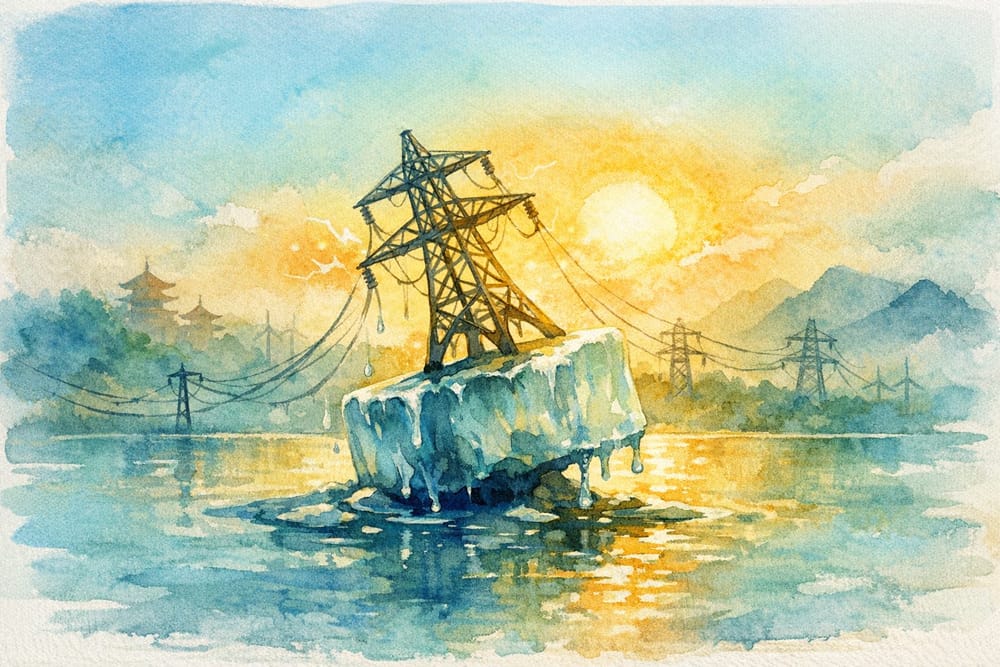
During heat waves, millions of households turn on their air conditioners at the same time, placing a simultaneous load on electrical grids. Cooling accounts for approximately 10% of electricity consumed annually worldwide, but up to 30% of demand during peak hours, according to the International Energy Agency (IEA). In Southeast Asia, the residential air conditioning stock is expected to triple by 2035, making the tension between protecting populations and maintaining grid stability one of the decade’s most concrete energy challenges.
Key Points
- Cooling accounts for 30% of global peak electricity demand, far beyond its 10% annual share (IEA).
- In Southeast Asia, air conditioning penetration among households is expected to rise from 30% to over 50% by 2035 (IEA, Accelerating Electrification in Southeast Asia).
- Lack of efficiency and flexibility can increase capacity needs and reliance on fossil fuel plants during peak hours.
- The IEA shows that stricter standards, smart grids, and flexibility can limit demand growth and emissions.
- Solutions exist—regional standards, time-varying tariffs, intelligent demand management—but their implementation remains incomplete and unevenly deployed across the region.
30% of Peak Demand for a Few Hours of Heat Wave
The asymmetry is striking. An air conditioner consumes electricity year-round, but most of its impact on the grid is concentrated over just a few dozen hours: scorching afternoons when all devices run at full capacity simultaneously. This gap between annual consumption and peak power demand is what makes cooling so difficult for grid operators to manage.
The IEA quantifies this gap precisely: 10% of global annual consumption, 30% of peak demand. In other words, cooling has a disproportionate contribution to peaks relative to its annual consumption, which increases capacity and flexibility needs. This reserve capacity is expensive to build and maintain, and in several Southeast Asian countries, it still relies heavily on coal, while gas dominates in some others; heavy fuel oil is marginal at the regional scale.
The issue goes beyond climate concerns alone. A grid that becomes saturated during heat waves risks supply disruptions affecting essential services and transport, precisely when populations need them most. Heat kills more elderly people, those with chronic illnesses, outdoor workers. Depriving these populations of electricity during a heat wave to preserve grid stability amounts to choosing who will be protected. This is a political decision, not merely a technical one.
Southeast Asia Facing a Doubling of Cooling Demand
The region combines three factors that make its trajectory particularly strained. Temperatures there are already among the highest in the world. Household incomes are rising rapidly, making air conditioner purchases accessible to a growing share of the population. And electrical grids must be modernized and expanded to absorb rising demand, though they are not uniformly undersized.
The IEA projects a shift from 30% to over 50% household air conditioning penetration by 2035 in its report Accelerating Electrification in Southeast Asia. This figure deserves to be translated into concrete terms: in a region with several hundred million households, adding tens of millions of air conditioners in a decade represents a considerable new load for grids already struggling to cover current peaks.
The feedback loop mechanism is straightforward. The hotter it gets, the more people buy air conditioners. The more they buy, the higher peak demand climbs. The higher the peak, the more grid operators need additional capacity. If this capacity is fossil fuel-based—as is currently the case across much of the region—emissions increase, contributing to warming, pushing temperatures higher, accelerating equipment purchases.
Understanding weather forecasts as a tool for economic protection is not unrelated to this topic: heat alert signals could eventually drive cooling demand before it overloads grids.
Inefficient Appliances, Networks Under Pressure
The quality of appliances matters as much as their quantity. Efficiency requirements for air conditioners vary widely across the region and often fall short of the ASEAN harmonized target of 6.09 Wh/Wh. This efficiency gap between the bottom and top of the market directly contributes to peak problems on grids.
In several countries in the region, there are no minimum efficiency standards for air conditioners sold on the market. Cheap appliances are not systematically less efficient: efficiency varies widely at comparable purchase prices, and price and efficiency show little correlation in these markets. Newly equipped households can purchase appliances with highly variable efficiency; inefficient appliances increase peaks, but the specific link to first-time buyers has not been established.
This situation is not inevitable. Minimum efficiency standards exist in other markets—the European Union, China, the United States—and scenarios show potential for reducing peak cooling demand, without directly establishing their effect on equipment adoption rates. The IEA documents this effect in several countries: in the IEA scenario, strengthened efficiency policies would reduce cooling’s share of peak demand from 30% to below 20%. This is equivalent to several gigawatts of avoided capacity.
Fragmented Governance Facing an Integrated Loop
Stéphane Grumbach, a researcher at INRIA, describes in his recent work a dynamic found here in pure form: mass technology diffusion, whether artificial intelligence or connected cooling, creates loops between adoption, infrastructure, and environmental footprint that only integrated governance can manage. Fragmented governance, treating household equipment, grid capacity, and energy policy separately, cannot absorb these loops. It amplifies them.
In Southeast Asia, cooling governance is precisely fragmented. Efficiency standards fall under industry or commerce ministries, depending on the country. Grid planning depends on national electricity operators, often public. Climate policy belongs to a separate set of actors. And programs for cooling access to vulnerable households, where they exist, are managed by social administrations with no coordination with the other two levels.
A different reading is possible. Economists close to the liberal tradition, Philippe Aghion or Tyler Cowen, to name voices that think through innovation and growth, emphasize that markets, if they receive the right price signals, can align technological adoption and efficiency without requiring heavy centralized coordination. Applied to cooling, this reading suggests that electricity tariffs reflecting the true cost of peak demand—far higher during critical hours—would suffice to encourage households to buy efficient appliances and moderate use during the most strained times.
The objection is serious, but it runs into a distribution problem. High peak tariffs protect the grid by making electricity expensive during heat waves. But these are precisely the poorest households, most exposed to heat, least able to do without air conditioning, who bear this cost most heavily. Without accompanying redistributive mechanisms—social tariffs, subsidies for efficient appliance purchases, support for households in energy poverty—the correct price signal produces real injustice. The two approaches therefore do not exclude each other: they must be combined.
Two Trajectories Through 2035
The IEA analyzes several general energy scenarios, with results depending on efficiency, grid, flexibility, and clean energy policies.
The IEA recommends progressive regional minimum standards and complementary policies to accelerate cooling efficiency. Households equip themselves, and more efficient appliances consume less during peaks. Flexibility can limit fossil fuel use during peaks, without guaranteeing that no thermal capacity is needed. The electricity bill of newly equipped households remains affordable because their consumption is contained. And progressive integration of renewable energy into the mix, led by solar, which produces precisely during hot and sunny hours, can cover a growing share of cooling demand without additional emissions.
The IEA evaluates scenarios of current policies and commitments, which include varying levels of efficiency and deployment of clean technologies. Inefficient appliances dominate the low end of the market. Heat waves can cause overloads and increase the risk of disruptions, depending on margins and grid condition. Without increased efficiency and flexibility, cooling can require more capacity and peak solutions, whose composition depends on energy policy choices. These plants run at a loss the rest of the time, their cost is passed on to tariffs, and their annual carbon footprint is real even if usage is occasional.
Dependence on fossil fuels increases precisely as extreme heat episodes, according to IPCC projections for Southeast Asia, become more frequent and intense. The risks posed by insufficient capacity on electrical supply stability are documented in other geographic contexts: the problem of unanticipated peaks is not unique to the region.
The signal to watch in distinguishing the two trajectories is precise: the share of air conditioners sold each year that meet the minimum efficiency standard in effect in each country.
Smart Grids: Capacities and Limits
Demand management technology exists. Connected air conditioners can receive a signal from the grid and automatically reduce consumption for twenty or thirty minutes during a critical peak, without the occupant perceiving it as an outage. Active demand management systems, deployed at various scales in South Korea, Singapore, and Japan, show that it is possible to moderate demand peaks without interrupting cooling service.
But these solutions require several technical, regulatory, and social conditions. Automated management requires a communication and control interface, integrated into the appliance or added through retrofitting; the appliance need not be recent. Without a control interface, the appliance does not receive the signal directly, but an external command or connected thermostat can ensure this transmission. For large-scale automated management, household trust, comfort guarantees, and appropriate incentives strongly favor participation, without constituting an identical condition in all programs. This social acceptability is built; it cannot be imposed.
The connection between mass equipment deployment and integrated grid governance is precisely the point where Grumbach’s thesis gains full force: a technology deployed without corresponding control infrastructure solves nothing. It shifts the problem downstream, to grid operators who must manage uncontrollable demand, and to the long term, when parks of inefficient appliances become too numerous to replace quickly. Coordination challenges in emerging energy sectors illustrate a comparable structural difficulty: decisions made upstream in the supply chain condition available options downstream for decades.
Guaranteeing Access to Cooling Without Fossilizing Grids
The fundamental question is not whether Southeast Asia should equip itself with air conditioners. Southeast Asia has a hot and humid climate and episodes of extreme heat, making cooling a vital necessity, particularly for elderly people, young children, and urban workers in poorly ventilated housing. The question is how to organize this equipment so it does not create the conditions for its own failure.
Three levers have proven effective elsewhere and remain underused in the region. Minimum energy efficiency standards for air conditioners, aligned with best available technologies, reduce peak demand without limiting access to cooling; they simply raise the market’s quality floor. Time-varying tariffs can encourage users to shift or reduce consumption during peaks; their effect on efficient appliance purchases depends on their design and other policies. And purchase support mechanisms for moderate-income households make it possible to combine universal access to cooling with energy efficiency, rather than opposing them.
The window for action is narrow. Before equipment penetration stabilizes, current efficiency decisions will have a structuring weight on decades to follow. Once a large park of inefficient appliances has been installed, appliance lifespans will make replacements gradual and costly. Decisions on standards and tariffs will heavily influence the region’s energy trajectory.
The next heat wave in Southeast Asia will not wait for governments to coordinate. But efficiency standards adopted today can reduce future peaks and needs for new capacity, particularly fossil fuel capacity depending on the electricity mix chosen.
Sources
- International Energy Agency (IEA), Cooling a Hotter World: El Niño Meets Strong Growth in Global Electricity Demand, https://www.iea.org/commentaries/cooling-a-hotter-world-el-nino-meets-strong-growth-in-global-electricity-demand
- International Energy Agency (IEA), Southeast Asia Energy Outlook 2026, https://www.iea.org/files/b99d4ce3-3ed4-4d82-b274-bbedd46146b8/SoutheastAsiaEnergyOutlook2026.pdf
- Stéphane Grumbach, Une transformation numérique et écologique ?, INRIA / Médiation scientifique TIPE 2024, https://mediation-scientifique.gitlabpages.inria.fr/tipe-2024/blog/2024/Stephane-Grumbach/