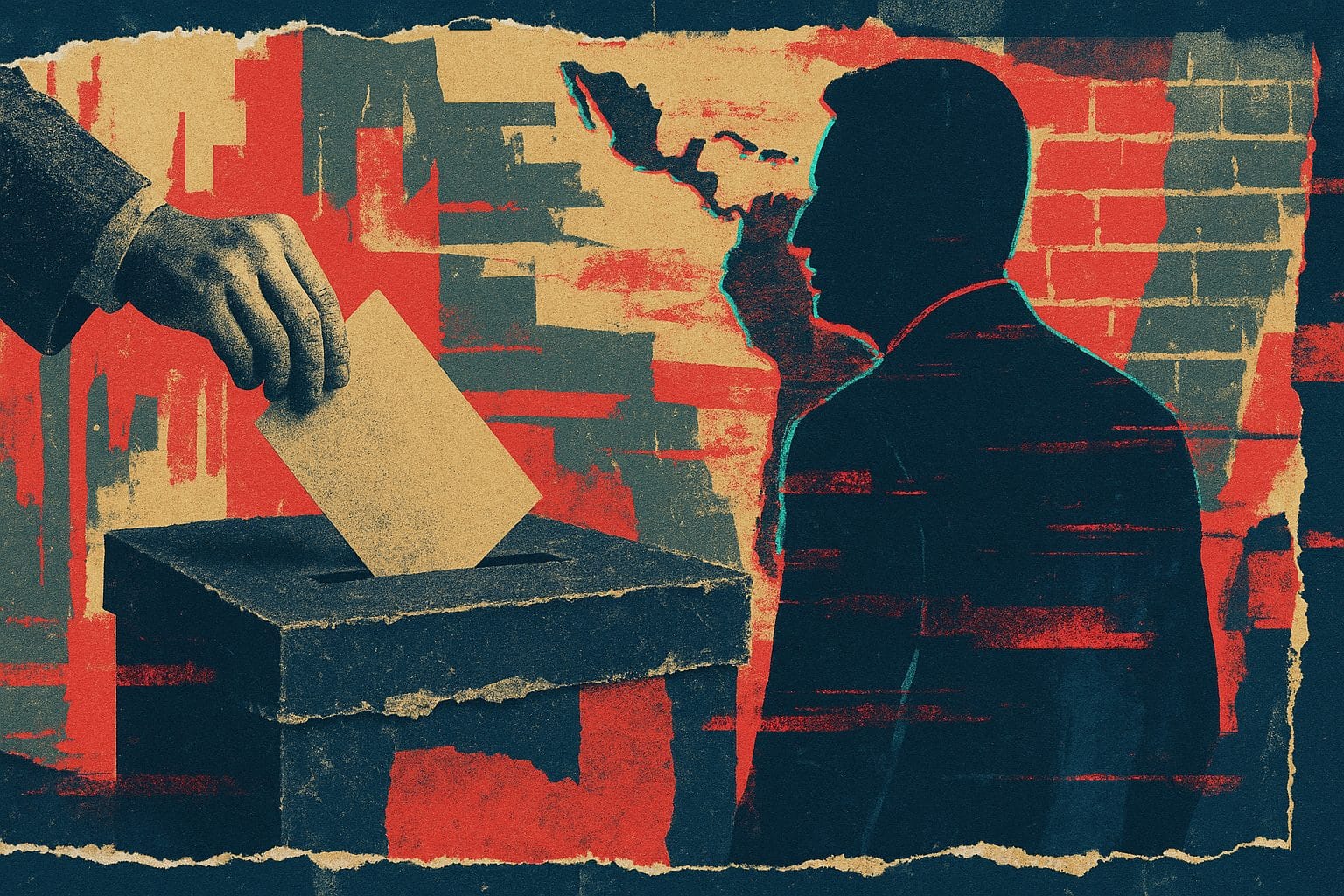
In Southeast Asia and South Asia, governments can maintain elections while limiting the effective exercise of power by the elected. Democratic indicators measure many political effects of surveillance, but they do not necessarily have a uniform variable that is directly comparable across each technical architecture or supplier contract.
The Essentials
- Coordinated surveillance architectures shift power from elected officials to technical agencies while preserving elections: a form of authoritarianism that conventional democratic indicators do not detect.
- India, Cambodia, the Philippines, and Thailand each deployed these systems between 2024 and 2026, according to Frontiers in Political Science 2026 and the Atlantic Council 2025.
- International IDEA projects that in a scenario of democratic decline, surveillance becomes a structural source of employment, creating organized interests in favor of its perpetuation.
- No documented democratic reversals have been observed once these systems are installed, according to the same sources.
- The model spreads through common technology suppliers, transforming a regional phenomenon into a systemic risk for electoral democracies in other regions.
Surveillance as a Substitute for Governance
Liberal democracy rests on a simple postulate: elections produce mandates, mandates confer power, power is exercised. This postulate can be broken without eliminating elections. It suffices that real power migrates elsewhere, to agencies, technical commissions, data processing centers that answer to no elected official.
This shift is not new in principle. European technocracies, independent American agencies, central banks all constitute transfers of competence outside the electoral sphere, acknowledged and regulated. In several contexts, control can be discretionary rather than regulated and aim at political behaviors.
This control can be inscribed in cybersecurity laws, smart city contracts, and public data management programs.
The work of Christophe Jaffrelot on contemporary India provides the most precise key to reading this mechanism. Jaffrelot documents how Hindu nationalism in power has progressively hollowed out Indian democratic institutions of their substance while preserving their form: competitive elections, an active parliament, an intact constitution, and simultaneously a continuous shrinking of space for opposition, minorities, and independent press. Digital surveillance can fit into this logic. Detection algorithms and cross-referenced databases can reinforce control capacities. The two mechanisms strengthen each other mutually.
The Mechanism: Ordinary Laws, Extraordinary Effects
None of the four countries has proclaimed a state of surveillance. Ordinary legislative tools have been used in several of these countries.
In Thailand, the Computer Crime Act frames offenses and powers related to computer data; no identified primary evidence establishes the precise mechanism of alleged automated analysis. An algorithm that detects “disruptive content” applies the law; the law, in turn, validates the algorithm.
In the Philippines, urban systems can be used for security and traffic; assertions about the traceability of communications require distinct evidence of legal or illegal surveillance of communications. The physical infrastructure is identical; the purpose varies depending on who formulates the request. In Cambodia, opponents linked to the CNRP were excluded or prosecuted after the party’s dissolution; the link to a specific surveillance architecture remains to be established.
In India, the scale gives the phenomenon a dimension that exceeds regional comparisons. The deployment of Aadhaar, the biometric national identity system covering more than 1.3 billion people, created one of the world’s largest biometric identification infrastructures. Debates about its secure use remain open in Indian courts; Aadhaar enables authentication and, in certain regulated cases, the sharing of identity information or e-KYC; the sharing of central biometrics is prohibited and data uses are legally limited.
The Blind Spots of Indicators
The problem for outside observers is precisely the formal robustness of these systems. India organizes large-scale competitive elections and remains one of the most documented democracies in the world. The Philippines maintain genuine political pluralism, a press sometimes hostile to power, an active civil society. Thailand has elected parliamentarians.
Freedom House and V-Dem indices measure both formal rules and many practical or gradual restrictions affecting opposition, press, civil society, information, and checks and balances. Applebaum analyzes contemporary dynamics of authoritarianism in Twilight of Democracy; this should not lead one to conclude that Freedom House or V-Dem indices ignore gradual erosions of checks and balances.
International IDEA warns that poorly designed or unregulated digital infrastructures can be exploited for surveillance and repression.
This observation contradicts a competing, liberal and optimistic reading, which would want digital surveillance to remain intrinsically fragile in the face of market and opinion pressure. The argument, defended by some institutionalist economists, is that regimes that suppress information end up making poor economic decisions and collapse under their own inefficiency. Twentieth-century history provides examples for this thesis. These practices can take different forms depending on contexts.
Automation can reduce the operating costs of these systems. Economic fragility is not its obvious Achilles’ heel.
Propagation Through Common Suppliers
The question of technology suppliers deserves particular attention. Urban management technologies can be deployed in different contexts.
This diffusion phenomenon is not unique to surveillance. Regulating others’ AI does not make one sovereign: the question of who controls the underlying technical layers precedes that of regulating uses. A state that buys facial recognition infrastructure from a foreign supplier controls neither the algorithm nor possible backdoors; it buys the capacity to control its own population with tools it does not fully master.
Supplier convergence can be accompanied by similar practices. Administrations that purchase these systems receive training, protocols, sometimes models of legal frameworks. Technology transfers can be accompanied by transfers of administrative expertise on data use. This is a form of institutional diffusion that liberal democracies have underestimated by focusing on weapons exports and neglecting surveillance software exports.
Whoever owns the cable owns the public services: dependence on digital infrastructure creates vulnerabilities that are not limited to cybersecurity. It also creates political dependencies, information asymmetries between states that deploy and suppliers that operate.
The Checks and Balances That Still Hold
The diagnosis must not erase what resists. In each of the four countries studied, institutions still function and produce real effects.
In India, the Supreme Court ruled in 2017 that the right to privacy was a fundamental constitutional right; the 2018 ruling on Aadhaar imposed the most direct restrictions on the program. This decision did not halt infrastructure construction, but it created a jurisprudential framework that digital rights defenders actively use. The 2024 elections produced a surprising result: Modi’s BJP did not achieve the absolute majority it targeted, which strengthened the weight of its coalition allies and complicated the most sensitive reforms. Formal democracy retains its own dynamics, even under pressure.
In the Philippines, independent press, despite legal proceedings against certain media, maintains coverage of abuses. Civil society networks survived the Duterte period. Thailand saw in 2023 an opposition party win legislative elections before being excluded from power by constitutional mechanisms, which demonstrates both the persistence of real opposition voting and the system’s capacity to neutralize its effects.
These elements do not overturn the general diagnosis, but they indicate that the societies concerned have not abandoned democratic ground. Resistance is uneven, often precarious, sometimes costly for those who exercise it. It exists.
The Probable Evolution of These Systems by 2030-2040
The question of the model’s sustainability is perhaps the most complex, and the most decisive for formulating responses to it.
If surveillance systems continue to automate, their operating costs decrease while their capacities increase. A state that can monitor ten thousand people at near-zero marginal cost no longer needs to choose its targets: it monitors everyone and filters afterwards. This change in scale can alter the pressure exercised on political behaviors. Self-censorship can be encouraged by the perception of surveillance whose triggering criteria are not known.
In this scenario, the political stability of these regimes could extend. International IDEA documents persistent challenges for democracy and digital risks. A regime that controls information without suppressing it and maintains limited electoral competition may seek to preserve a form of legitimacy.
The other scenario is less linear. Surveillance systems create massive archives of politically sensitive data, and these archives themselves constitute a risk. A change of regime, a leak, a judicial decision, can transform a control infrastructure into evidence. The Snowden revelations had a lasting impact on American intelligence agency practices and global public debate, without dismantling the systems. But they demonstrated that the invisibility of these architectures is fragile.
For liberal democracies seeking to respond to this diffusion without renouncing the technologies that carry it, the challenge is institutional as much as technological. Democratic measurement tools could usefully integrate indicators on governance, algorithmic transparency, and independence of data protection mechanisms. Initiatives exist: the European AI regulation explicitly prohibits certain uses of real-time biometric surveillance in public spaces; at the Council of Europe, work and recommendations address secret surveillance and spyware, but it is not established that a specific treaty on cybersurveillance is under negotiation. These frameworks are useful for signatories. They do not export automatically.
The question that remains open is that of the conditionality of technology transfers. Providers of surveillance systems can escape commercial accountability mechanisms. Due diligence mechanisms, similar to those applied to arms sales, are beginning to be discussed in several multilateral forums. Their implementation is another matter. When surveillance infrastructures do not explicitly appear in commercial statistics and impact assessments, their diffusion remains difficult to measure and even more difficult to regulate.
These developments merit analysis, particularly with regard to their possible effects on the exercise of electoral mandate.
Sources
- Frontiers in Political Science, “Surveillance architectures and democratic façades in Asia,” 2026, https://www.frontiersin.org/journals/political-science/articles/10.3389/fpos.2026.1757636/full
- Christophe Jaffrelot, India, Nationalism and Illiberal Drift: When Democracy Remains Formal, https://example.com/jaffrelot-inde-nationalisme-illiberalisme
- Atlantic Council, report on the diffusion of surveillance technologies in Southeast Asia, 2025
- International IDEA, report on the state of global democracy, 2025
- Anne Applebaum, Twilight of Democracy, Doubleday, 2020