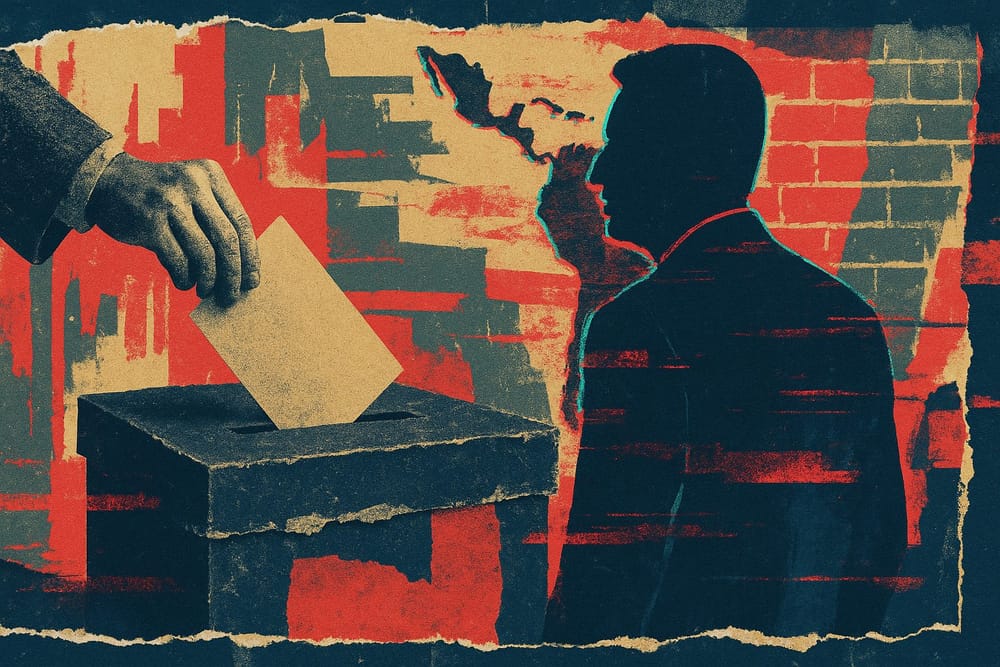
Between 2016 and 2024, trust in Latin American electoral authorities rose from 32% to 34%. Latinobarómetro also recorded 47% in 2006, but for a different question about the electoral court. The formal institutions did not disappear. This figure points to a mechanism more worrying than classical electoral fraud: citizens vote, but lose confidence in electoral institutions. Illiberal regimes have consolidated in some countries in the region, coexisting with varying institutional deficits in the delivery of security, justice, and basic services.
The Essential Points
- Trust in Latin American electoral authorities fell from 47% in 2006 to 34% in 2024, even as formal institutions remained in place. Between 2016 and 2024, it rose from 32% to 34% (Latinobarómetro 2024).
- Weak state capacity is associated with several institutional difficulties across diverse regimes, without aggregated data establishing a causal link to democracy.
- A documented mechanism: when voting does not produce tangible results in areas that are priorities for citizens, electoral legitimacy erodes.
- Pierre Rosanvallon, in The Democratic Knot (2025), names this aporia: institutions can formally account for themselves without that accountability producing real change for citizens.
- The trajectory is not irreversible: Visible improvements in public performance can, under certain conditions, strengthen confidence in public institutions.
The Vote Is No Longer Proof That Something Will Change
Let us begin with what the UNDP figure actually says. Between 2016 and 2024, the proportion of Latin Americans trusting electoral authorities rose from 32% to 34%. Latinobarómetro also recorded 47% in 2006, but for a different question about the electoral court. This decline occurred during a period when the electoral institutions of several countries continued to function formally. Elections took place. Results were announced.
Winners took office. The machinery was there, but something else was missing.
In certain states where executive capacity is weak, voting does not always produce visible changes in public services. The signal goes out, but nothing moves. After several cycles of this type, citizens conclude that the lever is rigged.
The process coincides with documented erosion of trust, without Latinobarómetro establishing a causal link. Distrust does not concern fraud in the technical sense—ballot stuffing, phantom votes. It concerns the feeling that voting has limited utility as an instrument of change. Venezuelans who voted for Chávez, Nicaraguans who voted for Ortega, Salvadorans who voted for Bukele all had the feeling that ordinary channels had failed before them. This chronology is not insignificant: Illiberalism often arrives after other signs of institutional failure.
It arrives afterward.
Rosanvallon in Brazil, Bolivia, El Salvador
Marcel Gauchet devoted part of his work to a question that seems abstract but proves very concrete in Latin America: what is the point of democratic accountability if no one can be held responsible for results? In The Democratic Knot: At the Origins of the Neoliberal Crisis (2024), he describes a pathology in which institutions respond to immediate pressures without ever building the capacity to keep their promises over time. Elections become ritual events, formally legitimating, substantively empty.
In Latin America, this diagnosis finds direct application. Take El Salvador. Nayib Bukele was elected in 2019 on an explicit rejection of the two parties that had governed since the end of the civil war. His central argument: they had thirty years, they failed. Homicides, corruption, misery—all of it was documented, lived, unbearable.
His illiberal response on rights, spectacular in form, coincides with an official drop in homicides. The homicide rate fell. The population approved. Formal institutions were circumvented or weakened, but the legitimacy of results held.
This is the aporia that Rosanvallon would describe as characteristic of our time: In the Salvadoran case, perceived security results contributed to support for a regime that became more illiberal. BTI 2026 and V-Dem 2026 data allow complementary analysis of illiberal consolidation and state capacity deficits, without mechanically establishing a regional ranking without explicit calculation.
The Liberal Reading: Institutions First, Results Later
Rosanvallon’s analysis meets serious objection, carried notably by the institutional liberal tradition that Acemoglu and Johnson formalized in their work on inclusive institutions. Their argument is as follows: executive capacity does not fall from the sky. It rests on institutions that protect property rights against expropriation and govern private contracts. According to Daron Acemoglu, increasing state capacity without regard to counterweights can intensify conflicts over capture of power.
Applied to LAC, this argument would say: Bukele did effectively reduce homicides, but the emergency regime suspended certain constitutional guarantees and organized coordination between security, defense, and national police. The visible result is accompanied by a weakening of institutional safeguards. When Bukele leaves, or when his successor takes up the same levers for other purposes, the safeguards will be gone. Weakened constitutional guarantees create an asymmetry between short-term gains and long-term risks.
The tension between procedural legitimacy and results legitimacy is real, and the data do not settle it definitively. Available reports associate weak executive capacity with democratic fragility; accessible data do not allow us to conclude that illiberalism durably improves this capacity. Available data allow separate study of democratic decline and certain aspects of public administration in multiple countries. The promise of efficiency often remains only a promise.
This joins the diagnosis we examined in our analysis of French democracy: institutional distrust advances independently of the formal quality of procedures, insofar as citizens see no connection between their participation and their daily lives.
What Distinguishes Countries That Hold from Those That Tip
Not all Latin American states with weak executive capacity have produced illiberal regimes. This nuance is analytically important. The 2026 UNDP report and BTI data distinguish several configurations. In some countries, executive weakness is accompanied by dense civil society and a free press that exercise substitution pressure on governments—not by making the state more efficient, but by making incompetence politically costly. In others, the absence of these counterweights leaves the field clear.
Costa Rica illustrates the first configuration. With per capita GDP comparable to several of its neighbors, it maintains electoral institutions whose credibility exceeds the regional average, supported by long-term civic culture and an independent press. Executive capacity is not exceptional, but informal accountability—journalists, associations, parliamentary opposition—partially compensates. Citizens do not always see the results they expect, but they see that someone asks questions and gets answers.
This is precisely the mechanism that Rosanvallon identifies as alternative to the election alone: the institutions of counter-democracy—surveillance, veto, judgment—that allow citizens to control power between elections. Where these mechanisms exist and function, several countries have maintained more durable institutional resistance. Where these counterweights are absent or weakened, the risks of authoritarian drift increase.
The question of funding these counterweights arises with urgency in this frame. African think tanks depend 80% on foreign donors, a structural fragility that LAC also knows in certain countries. When monitoring organizations depend on non-permanent external funding, their capacity to play this substitution role erodes with funding cycles.
What Democracy Can Function Without a Capable State
The central forward-looking question concerns the possibility of maintaining active electoral citizenship in a structurally weak state, without passing through an illiberal phase, and on the conditions under which this would be possible.
The most pessimistic scenario, which current data render plausible, is one of continuous erosion. An improvement in the executive capacity of states in the region could affect trust in electoral authorities, currently at 34% in 2024. At a certain level, the election ceases to be a mobilizing event and becomes a formality that elites perform among themselves. This floor is not precisely fixed by available data, but the trajectories of Venezuela and Nicaragua illustrate the difficulty of reversing this process once engaged.
The alternative scenario rests on a hypothesis that several documented experiences have tested: Targeted reforms to executive capacity, concentrated on public services, can affect citizen perception of state functioning. Neighborhood security, delivery of identity documents, access to primary health care—these domains do not require total institutional transformation. They require services that work, within timeframes that citizens can measure.
Uruguay ranks among countries with the highest levels of institutional trust. With executive capacity above the regional average according to BTI indices, it preserves more stable electoral confidence. The causal relationship is difficult to establish rigorously; Uruguayan institutions have a long history, but the correlation is there and stable over time.
The track of local participatory democracy deserves particular attention. Devices like participatory budgets, first tested in Porto Alegre in the 1990s and since exported to several cities in the region, allow the creation of a direct and visible link between collective decision and concrete result. When residents decide together on the allocation of a municipal budget and see the infrastructure built, the link between vote and change reconstitutes itself at a scale where the weak state can still deliver. The phenomenon of consultation without decision that we analyzed at the French scale shows, however, the opposite of what is possible: participation that commits to nothing produces exactly the same disillusionment as elections without results.
The signal to monitor in the coming years is precise: the evolution of electoral confidence in countries where targeted administrative reforms have been undertaken, disaggregated by level of satisfaction in the services concerned. If the correlation holds—and the few documented experiences suggest it does—that would give an empirical argument for orienting international aid and national reforms toward execution capacity rather than toward formal institutional architecture alone.
The Limits of Electoral Guarantee Alone
Latin America has become the world’s laboratory for a problem that democracies everywhere will have to address: the value of a perfectly functioning electoral institution when the state behind it can deliver nothing.
The answer that 2026 UNDP data allow us to sketch is uncomfortable for both schools of thought that dominate this debate. The proponents of institutional primacy are right that procedures matter—countries that maintained counterweights resisted illiberal pressure. But they underestimate that procedures that do not produce visible results risk losing their electoral legitimacy. And those who bet on authoritarian efficiency are right that results matter—peoples do not vote out of love for democratic abstraction. But they rarely produce the durable capacity they promise, and they destroy in the process the correction mechanisms that would allow changing course when they fail.
The democratic knot that Gauchet describes, the growing impossibility of tying together legitimacy of origin and legitimacy of exercise, constitutes a challenge of institutional and administrative engineering that several countries have begun to address, with partial but real results. The stake in 2026 is identifying in which countries and under what conditions the link between the vote and change can be sufficiently reconstructed so that the next generation still considers democracy a tool rather than decor.
Sources
- UNDP, Democracy and Development Report 2026, Latin America and the Caribbean, May 2026
- Pierre Rosanvallon, The Democratic Knot: At the Origins of the Neoliberal Crisis, Fayard, 2025
- Bertelsmann Stiftung, BTI 2026, Transformation Index (Latin America), Bertelsmann Stiftung
- V-Dem Institute, Democracy Report 2026, University of Gothenburg
- Daron Acemoglu & Simon Johnson, Power and Progress, PublicAffairs, 2023