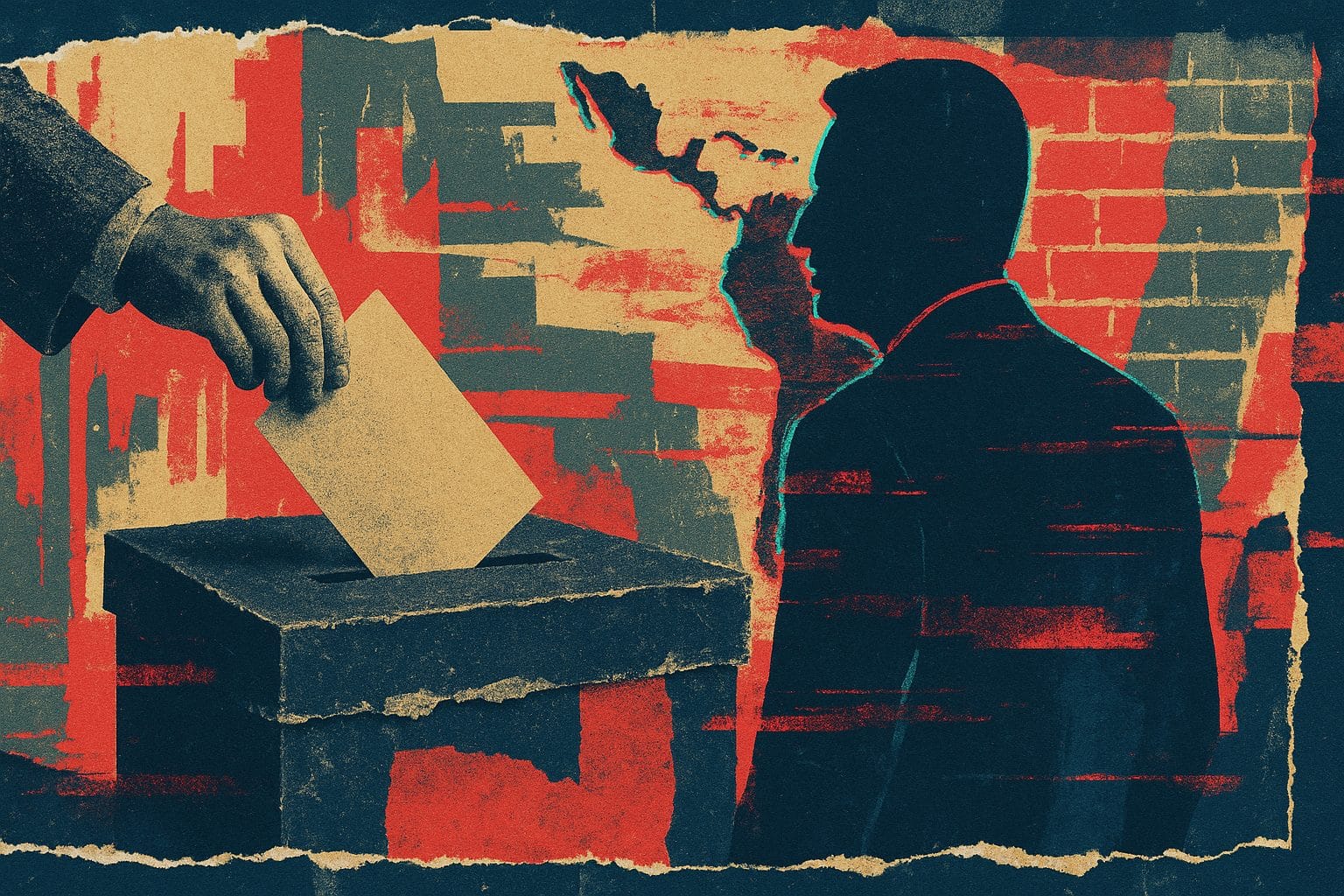
Israelis must vote on October 27, 2026 for the first time since the legislative elections of November 1, 2022. These elections arrive at a moment when several institutional variables remain undetermined. The country has experienced judicial contestation, pressure on the media, and fragmentation of the opposition. The Hungarian and Polish cases show that rapid institutional reforms can weaken checks and balances, without establishing irreversibility.
The essentials
- Illiberal drift typically follows a sequence of successive institutional measures, several of which can complicate a potential reversal.
- Governance indicators have registered degradation linked to tensions around judicial reform and the context of war.
- Hungary after 2010 and Poland after 2015 offer points of comparison: institutional restoration proved difficult in Hungary after fifteen years, while it remained possible in Poland after eight years.
- The balance between security imperatives and the maintenance of institutional safeguards figures among the stakes of the October 2026 elections.
- Signals of resistance exist: sustained civic mobilization since 2023, still-active independent press, Supreme Court that continues to rule despite pressure.
The sequence that no one deliberately chooses
Each step in the sequence modifies the incentives of actors who could have blocked the next one. Weakening of judicial controls can expand the space for government measures. Once media pressure is exerted, the political position of the opposition becomes more complicated. The sequence closes in on itself because each link precisely weakens the one that could have served as a foothold for turning back. This logic of self-reinforcement, not a declared intention, makes the process difficult to perceive from within at the moment it unfolds.
Illiberal drifts rarely resemble a coup d’état. They resemble a series of defensible decisions taken in emergency, each of which appears reversible at the moment it is made, and whose accumulation progressively closes the door.
Viktor Orbán did not abolish Hungarian democracy in 2010. The Orbán-led majority adopted a new electoral law in December 2011, reconstituted the Constitutional Court, and Hungary lowered the mandatory retirement age for judges through texts from 2011 that came into force in 2012. Each measure had a technical justification. In four years, the reforms profoundly modified the Hungarian institutional and electoral framework. When the European Union launched serious infringement procedures in 2018, European mechanisms had not yet produced sufficient progress on several identified deficits.
Poland followed the same path starting in 2015, but reversal remained possible there. The 2023 election allowed a change in parliamentary majority and the Tusk government undertook an institutional restoration that continues still, although this restoration remains partial. The gap between the two trajectories is explained in part by the duration of the process of institutional degradation in each country. In Hungary, institutional restoration proved structurally very difficult. In Poland, it was still open.
It is this window that Israel faces squarely in 2026.
The real effects of judicial reform
The judicial reform proposed by the Netanyahu government in 2023 officially aimed to rebalance powers between the Supreme Court and the Knesset. It provoked significant civic mobilization: sustained protests, refusal to serve in the army by reservists, economists’ warnings about consequences for the financial market.
The reform was not adopted in its entirety. But it produced two lasting effects. The reform contained measures likely to reduce judicial review, although its promoters presented it as a strengthening of the separation of powers. And it consumed considerable civic energy just before Israel entered war.
Between 2023 and 2026, institutional indicators registered degradation in several areas. Brain drain accelerated. A significant number of high-level professionals, predominantly opposed to the reform, left the country or are preparing to leave. This type of selective emigration weakens precisely the groups that carry institutional resistance.
War as an accelerator of each step
The October 7, 2023 attack modified the political and security context. It provided a framework in which certain restrictive measures can be explained by security imperatives. Critical coverage of military operations faced increased pressure. Voices of opposition were constrained to restraint that the security situation made difficult to publicly refuse.
It is the classical mechanism of what political scientists call “democradura”: a regime that retains electoral forms but progressively drains checks and balances of their substance. Institutions remain standing. Their capacity to constrain the executive, however, tends to weaken.
The Israeli context presents a particularity that Hungary and Poland lacked: existential pressure is real. Israel is at war, surrounded by actors who contest its existence. This pressure reduces time available for institutional deliberations and diminishes political appetite for debates on safeguards, perceived as peacetime preoccupations.
Francis Fukuyama, in his 2024 update of his work on the end of history, identifies the risk particular to democracies under pressure: they slide toward authoritarianism through accumulation of emergency decisions that are never revoked once the emergency passes. The state of exception becomes the normal state through simple institutional inertia.
The Polish and Hungarian lessons
European comparison is the only available laboratory at a documented scale. It shows that democratic restoration is possible, but that the more time passes, the more difficult it becomes to achieve.
In Poland, the Tusk government, elected in October 2023 after eight years of drift under PiS, undertook a restoration of judicial independence. Two years later, this restoration still encounters judges appointed in the previous era, a president of the Republic from the old regime, organic laws requiring difficult-to-obtain supermajorities. The process advances, but it is slow, contested, and politically costly. The European Union provided a decisive external lever: the unblocking of funds conditioned on restoration of the rule of law.
In Hungary, this external lever did not suffice. In Hungary, institutional reconfiguration—electoral law, media, universities, civil society—produced a system where different elements reinforce each other mutually. Restoration would require undoing simultaneously dozens of interlocking mechanisms, with an opposition durably fragmented and a media landscape where a significant share is controlled by actors close to the government.
Israel in 2026 is at a stage where institutional degradation has been documented, but where a change of course remains plausible, comparable to Poland before 2023. Institutions still partially resist. The Supreme Court continues to rule. Independent press publishes. Street protests have reached significant scale proportionally to the population.
Fragmentation of opposition as decisive variable
The persistence of institutional degradation can be linked to fragmentation of the political opposition. In Hungary, this calculation worked over a long term. In Poland, it failed in 2023 because very different formations—liberals, agrarians, moderate conservatives—coalesced around institutional stakes.
In Israel, fragmentation of the political space is structural. The Israeli proportional system, with an electoral threshold of 3.25 percent, produces multiparty representation marked by deep cleavages: status of territories, role of religion, civil rights. Constituting a coalition alternative to Netanyahu means assembling parties with profound programmatic divergences.
Since 2019, Israel has experienced several elections. The 2021 election allowed formation of an alternative coalition, while others did not produce a stable alternative majority. This electoral exhaustion contributes to institutional drift, because chronic instability reinforces the argument that only the outgoing coalition is capable of governing in wartime.
The role of October 2026 elections
The October 2026 elections arrive at a moment when several variables remain undetermined. War in Gaza remains a factor influencing public opinion. Israel’s international position, marked by tensions with several Western partners and disagreements over the conduct of operations, affected the government’s external legitimacy. And the civic mobilization of 2023-2024, though exhausted, produced organizational structures that survived.
Two trajectories remain plausible, without any available source allowing one to assign probabilities to either.
In the first, the outgoing coalition is returned to power. Institutional degradation would continue, progressively weakening checks and balances.
In the second, a broad coalition assembles and undertakes institutional reforms to restore democratic safeguards. This trajectory presupposes that parties unite around the institutional stake despite their divergences.
What distinguishes the two trajectories, fundamentally, is the ability of the Israeli political elite to read the European lesson without having lived it. Poles in 2023 had eight years of PiS behind them: the concrete consequences on courts, universities, media, they were palpable for millions of voters. The Israeli voter in 2026 judges the institutional situation in a context of war that makes its effects less visible. The consequences of institutional degradation are less visible because of security urgency.
The signals to watch in the weeks preceding the election are specific: the turnout rate in major cities, Tel Aviv, Haifa, Beersheba, where opposition to the outgoing coalition concentrates; the capacity of center parties to maintain a common list on at least institutional stakes; and the position of Israeli Arab parties, whose electoral behavior in recent elections has influenced the formation of alternative majorities.
Liberal democracy is not a form stable by nature. It is stable when its institutions are, and its institutions are when enough political actors have interest in maintaining them. Israel in 2026 is at the point where institutions retain political supports, but this possibility of inflection weakens with each election that reproduces the same majorities.
Sources
- UCLA-Berggruen Report on Israeli Governance 2026, https://www.prleap.com/pr/314310/elections-will-determine-whether-israel-remains-the-middle-easts-only-democracy-new-report-says
- Francis Fukuyama, The End of History and the Last Man (updated 2024), Cambridge University Press, https://www.cambridge.org/core/books/end-of-history-and-the-last-man/
- GIGA Hamburg, MENA Governance Report 2026, German Institute for Global and Area Studies
- V-Dem Institute, Democratic Backsliding Indicators, University of Gothenburg
- Varieties of Democracy (V-Dem), Democracy Report 2026, University of Gothenburg, https://www.v-dem.net