France has massively expanded access to higher education over the past twenty-five years. Inequalities rooted in family background remain strong. According to OECD Education at a Glance 2025, 75% of 25-34 year-olds with at least one parent who holds a higher education diploma are themselves higher education graduates, compared to 32% for those whose parents did not complete upper secondary education. This 43-point gap is observed in comparable data from the early 2020s.
The essentials
- Access to higher education has expanded, but the gap between advantaged and disadvantaged backgrounds remains significant, measured at 43 points in 2023 (OECD Education at a Glance 2025).
- Selection operates upstream, within the family and at middle school, before even entering high school: acting on tuition fees or university quotas does not address this mechanism.
- Canada shows a gradient of 36 points on the same indicator in 2023, 7 points lower than France.
- France Stratégie notes that streaming and segregation contribute to inequalities, without producing this forward-looking scenario.
- Options exist: class splitting in primary school, large-scale mentoring, salary enhancement for short-cycle vocational programs.
Expansion failed to deliver on its promise of mobility
Selection is decided well before entry into higher education.
France now has approximately 2.9 million students in higher education, nearly double the 1990 figure. Access to higher education has progressed for several social categories. This is a genuine success, and it would be unfair to deny it.
The problem lies in a distinction that crude access rates obscure: gaining access to higher education does not mean the same thing for everyone. A senior executive’s child and a factory worker’s child who both enter university do not walk the same corridor. The first aims for a preparatory class or business school; the second often enters a general degree program with less clearly defined job prospects. The OECD measures access, not destination.
On the most neutral indicator—simply whether or not one obtains a higher education diploma—43 points separate children of graduates from children of non-graduates in 2023. The expansion of higher education has occurred alongside persistent social inequalities, without these figures being sufficient to measure their evolution with precision.
Invisible selection operates before the baccalauréat
Understanding why expansion fails to reduce inequalities requires tracing back the sequence. The streaming decision at middle school is the first branching point. By age 15, a wide fraction of trajectories is already set: students streamed toward vocational pathways rarely have access to long-cycle higher education, and this streaming closely follows social origin.
INSEE data on school cohorts shows this strikingly. A senior executive’s child is approximately 1.8 times more likely to be streamed into general and technological secondary education than an unskilled factory worker’s child in available raw data; this comparison does not demonstrate that the gap persists at identical entry performance levels in sixth grade. The performance gap exists, certainly. But it does not fully explain it. A significant portion of the streaming gap persists even after controlling for academic performance.
This phenomenon has a name in the economic literature on education: relative social position effects. Families from working-class backgrounds systematically underestimate the benefits of pursuing long-cycle studies and overestimate the risks of failure. Families from working-class backgrounds have less complete information about the benefits of long-cycle studies, which influences streaming choices.
Family plays a role that school does not compensate for. Children of graduates benefit from informal academic support, networks, and familiarity with the codes and procedures of elite pathways. The school institution, conceived as a neutral space for meritocratic competition, treats as self-evident what some possess and others do not. What work on university funding inequalities documents upon entry into higher education actually begins much earlier in schooling.
The Canadian comparison indicts French institutional choices
International comparison provides decisive insight. A French gradient of 43 points attributable to culture or republican heritage should appear in culturally comparable countries. OECD data shows it does not.
Canada shows a gradient of 36 points on the same indicator in 2023. In 2023, Canada’s gradient is 7 points lower than France’s on this OECD indicator. Canada has a different culture, certainly, but shares with France the model of public higher education, accessible universities, and an stated commitment to equal opportunity.
Canada has massively invested in early support programs. Academic preparation assistance programs in disadvantaged neighborhoods, policies for mixing in secondary schools, and an orientation system that is less irreversible allow children from modest backgrounds to alter an initial trajectory. The door to higher education remains open longer.
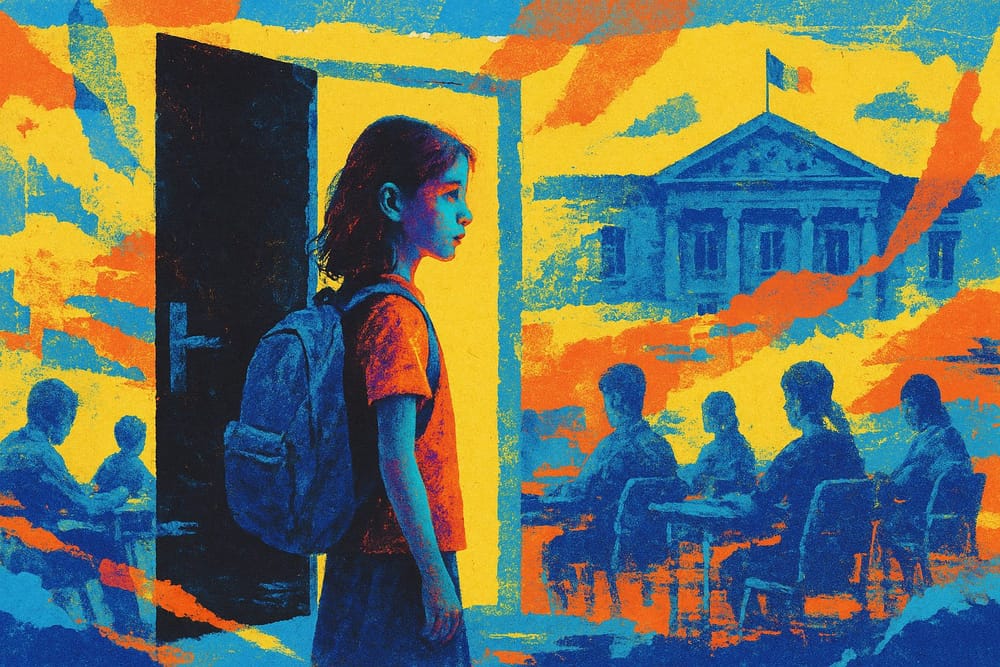
This comparison directly feeds a structuring French debate. Bertrand Martinot, a specialist in labor markets and institutional reform, argues that the blockages to social mobility in France precede the labor market. Rehabilitating the value of work, returning effort to the center of policy, is necessary. But if selection operates at middle school according to social origin, cultural rehabilitation arrives too late for children already streamed toward pathways with no access to higher education. The entrance door has opened; the corridor remains blocked.
A competing interpretation, advanced by economists close to Dani Rodrik’s work on labor market institutions, shifts the emphasis. It insists that valuing short-cycle vocational diplomas would be a more realistic path than imposed social mixing, deemed difficult to implement politically. On this point, the two analyses are not mutually exclusive. The 43-point gradient is wide enough that several levers are needed simultaneously.
Middle school streaming, blind spot in inclusion policies
Reform of middle school streaming is the least advanced and probably the most decisive challenge. France has reformed the baccalauréat, adjusted tuition fees, and multiplied “open” preparatory classes in elite schools. Interventions at the end of middle school remain limited, even though this moment is decisive for school trajectories.
In disadvantaged-zone schools, the guidance counselor meeting is often brief and inadequately resourced. Teaching teams lack time, data, and sometimes training to counterbalance social position effects. Children whose parents know the system benefit from an informal guidance consultation that lasts four years. The others have a twenty-minute interview.
Mentoring programs exist, notably pairing university students with third-year middle school students in under-resourced territories, but their measurable effects on academic ambitions and streaming choices are not systematically demonstrated. The Cordées remain a targeted program, but they already cover more than 900 networks and 3,500 schools according to the 2024 ministry assessment. They aim to change information, support, and ambitions, but their causal effect on trajectories remains insufficiently established.
The splitting of kindergarten and first-grade classes, deployed since 2017 in priority education zones, is the signal to watch over the long term. The effect on performance at age 8 is documented; its effect on the gradient in higher education at age 25 will not be visible until around 2040. This is the limit of any ambitious education policy: results arrive after elected terms.
Margins for reducing the gradient over fifteen years
Three trajectories emerge by 2040, and current data allow us to distinguish them without confusing them with forecasts.
The first scenario is the status quo. Streaming and social mixing are documented as relevant levers for acting on the gradient. Access to higher education will continue to progress for all categories, but children from modest backgrounds will be concentrated in the least valued and lowest-paid pathways. Diplomas progressively lose value for those who gained access to them latest, because children of graduates will tend to occupy the most valued positions as programs become more stratified.
This scenario requires significant upstream intervention, in primary and middle school: reinforced social mixing in the most segregated schools, large-scale mentoring programs, streaming reform toward greater reversibility. France Stratégie estimates that targeted intervention policy over several years could reduce the gradient significantly. This outcome would place France at the level of Germany or the United Kingdom. Its realization requires political stability that is unusual on educational matters.
The third scenario partly bypasses the gradient through vocational pathways. If short-cycle vocational diplomas, including BTSs and BUTs, see their job prospects clarified and starting salaries increase, some children from modest backgrounds could find a valued trajectory without going through the long-cycle higher education gradient. This scenario is partially underway. This scenario depends on labor market evolution, which is reconfiguring under the effects of automation. The way AI redistributes skilled jobs in countries like Germany suggests that high-level technical and vocational pathways could gain attractiveness, if wages keep pace.
None of these three scenarios unfolds alone. The signals to monitor are precise: the evolution of the social composition of preparatory classes over the next ten years, the measured effect of kindergarten-first-grade splitting on middle school streaming for the affected cohorts, and the rate of access to long-cycle higher education by parents’ income quintile by 2030.
What remains open
France has all the data to locate the problem. The gradient is observable at a comparable level over the period. In 2023, Canada’s gradient is 7 points lower than France’s on this OECD indicator. The bifurcation occurs at middle school. The data do not establish the order of priority for the levers to deploy.
Reforming streaming, organizing social mixing, developing mentoring, valuing vocational pathways: these four challenges are documented, and small-scale experiments conducted in France or larger-scale ones in Canada provide orders of magnitude on expected effects. The real constraint is not ignorance of mechanisms. It is political: these reforms require time, span multiple terms, and their results are visible only a generation after the decision.
The gradient measures the diploma gap in higher education between young adults according to their parents’ diploma level. It says that school opens its doors, and that the corridors remain unequal. Reducing this gap is possible. The question is whether political institutions can commit to a horizon that elections do not measure.
Sources
- OECD, Education at a Glance 2025, https://www.oecd.org/en/publications/education-at-a-glance-2025_19991987-en/
- INSEE, school cohort data 1980-2023, Tables of the French Economy
- France Stratégie, work on intergenerational mobility and assessment of education policies
- Bertrand Martinot, work on the labor market, school streaming, and institutional reforms (Institut Montaigne)
- Dani Rodrik, Good Jobs, Princeton University Press, 2023