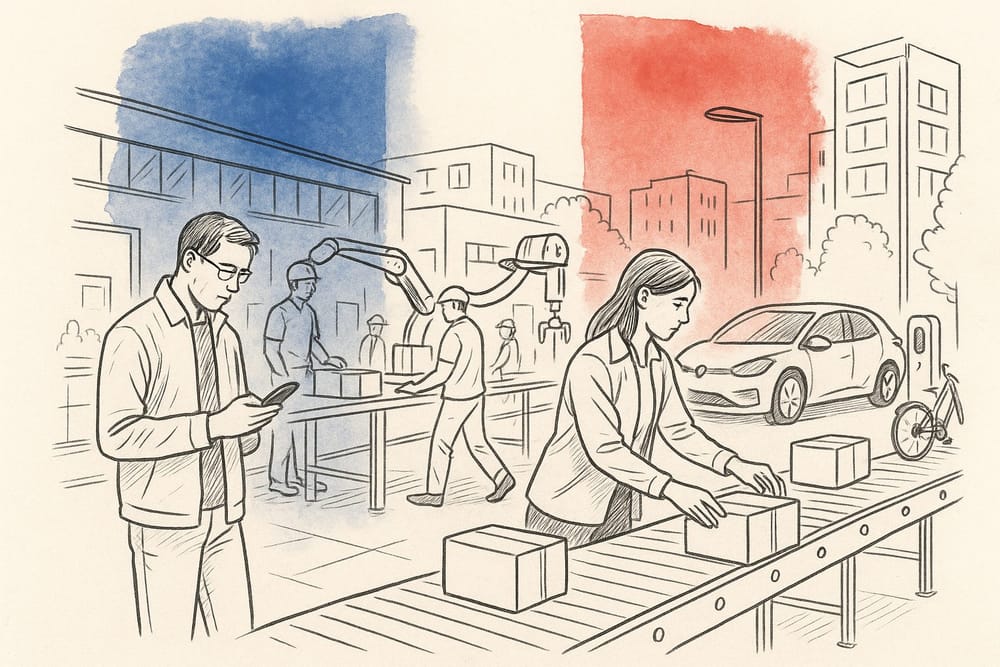
France has lost half its industry in half a century. Its share of GDP has fallen to 9.38%, at the level of Greece [1]. In 2024, for the first time since the state began keeping records, more factories closed than opened [3]. The choice to be made in 2027 is straightforward to name, difficult to sustain: transfer control of long-term savings allocation to regional authorities, or let that money continue financing the social debt.
From 22% to 9% of GDP in Half a Century
The share of manufacturing industry in GDP fell from an average of 22.13% over 1950–1970 to 9.38% in the first quarter of 2025, according to France Industrie [1]. France had 5.1 million industrial jobs in 1980. It had 2.7 million in 2020 [10]. Between 1970 and 2020, it was Europe’s most deindustrialised country.
This outcome stems from deliberate choices: the so-called “fabless” model, accepted tertiarisation, priority given to services over manufacturing. Liberal doctrine convinced leaders that France could remain competitive by concentrating solely on high value-added work at the end of the supply chain. It encouraged deindustrialisation and the devaluation of manual labour. Anaïs Voy-Gillis documents this choice in Pour une révolution industrielle (Presses de la Cité, 2025) [17].
The Brief Recovery of 2017–2023 and the Wall of 2024
After decades of unbroken decline, a rebound began to take shape. Reduced charges on low wages, apprenticeship reform, and the France 2030 plan, endowed with 54 billion euros, produced visible results. Between 2021 and 2025, more than 300 net new factories were created, generating 100,000 direct jobs [2].
Then the wall. The reindustrialisation momentum slowed markedly in 2024. It moved into negative territory for the first time since the creation of the state’s industrial barometer in 2022. That barometer recorded 114 openings of new factories that year. It also recorded 119 closures, for a net balance of -5 factories [3].
The net balance of job creation in industry remained positive in 2024, but fell by more than 60%. It stood at 31,223 net jobs, down from 81,637 a year earlier [3]. Job losses jumped 77%. Job creation fell 18% [3].
In 2025, France shows a positive balance of +19 thanks to extensions of existing sites. But the slowdown confirms, with a balance down from 2024 (+88). Classical industry, particularly automotive, chemical, and metallurgical sectors, is suffering more [4].
Nicolas Dufourcq, speaking from Bpifrance, is direct: “Reindustrialisation is very difficult. We are today on a plateau, with roughly as many factories opening each year as closing.”
At Greece’s Level in the European Union
With industry weighing 10% of GDP, France ranks among the lowest in the European Union, at Greece’s level. The EU average stood at 23.5% in 2022, according to World Bank data [1].
The trade balance in goods illustrates the cost of this slippage. In 2024, the trade deficit improves to 81.0 billion euros, after 100.0 billion in 2023 [5]. The point of comparison remains telling: in 2019, before Covid, this deficit was 58 billion [5].
In 2025, it narrows further to 69.2 billion [6]. The trajectory is improving, but from a historically degraded level. Since 2004, France’s trade balance has remained persistently in deficit [13].
Research and development spending tells the same story. In 2023, France devotes 2.18% of its GDP to it [9]. Germany devotes 3.13% [9].
The target set by the EU is 3%. The average for OECD countries is 2.70% [9]. If France had the same economic structure as Germany, with more industry and while maintaining its sectoral research intensities, company research spending would reach 2.7% compared to 1.4% currently [8]. The R&D gap with Germany is largely mechanical: it reflects the absence of heavy industry rather than under-investment in research at comparable structure.
Three Deep Mechanisms, Beyond Symptoms
The usual discourse on reindustrialisation lists symptoms: labour costs too high, excessive regulations, lack of land. The causal chain runs deeper.
First mechanism: financial. Nearly 2,000 of the 3,500 billion euros of public debt comes from social spending financed on credit, establishes Nicolas Dufourcq in La Dette sociale de la France (Odile Jacob, October 2025) [18]. Each month, three days of pensions, income support, or unemployment benefits out of thirty are financed by borrowing.
In the early 1980s, debt financed only 1% of social spending. It now finances 10% [18]. The money mobilised this way did not fund the 200 billion euros of productive investment that Olivier Lluansi estimates necessary for reindustrialisation [11]. Credit financing of social spending has drained the capacity to invest in the productive base that alone could sustain that same social spending.
Second mechanism: energy. Decarbonisation and reindustrialisation are simultaneously necessary and physically constrained. In the first half of 2024, French companies pay an average of 172 euros per MWh for their electricity [7].
That is 1.5 times more than in 2021, before the energy crisis [7]. Lluansi had warned: reaching the European average for industry, around 16% of GDP, will require two decades. France will face a problem of decarbonised electricity availability if it wants to move faster. By 2035, the sustainable target lies between 12 and 13% of GDP [11].
Third mechanism: demographic and skills. Tensions in industrial trades are already real. More than 35% of industrial workers will reach end of career by 2030 in some trades [12]. Attractiveness remains low, particularly in least-skilled and most gruelling positions [12]. Industry cannot recruit what it has not trained.
Industrial AI, a Break in the Rupture
On top of these three structural mechanisms, a technological innovation redraws the problem’s parameters. Philippe Aghion (2025 Nobel Prize in Economics) sees AI as a lever of potentially decisive productivity for industry. He attributes to it the capacity to reinvent the very structure of markets and firms, well beyond simple task automation [19]. At the scale of industrial establishments, robotisation produces a slightly positive effect on employment of the less qualified and a positive effect for engineers and managers. Establishments that robotise create jobs [19].
History imposes a countervailing test. Economic stagnation was long the norm, and even today the most advanced economies have fallen short of expectations. Carl Benedikt Frey identifies in How Progress Ends (Princeton University Press, 2025) a recurring tension: decentralisation favours exploration of new technologies, but bureaucracy is crucial to deploy them at scale. When institutions fail to adapt to technological change, stagnation sets in [20].
The direct lesson for France: the France 2030 plan and Bpifrance’s ambitions finance exploration. Bpifrance has deployed 25 billion euros for the industrial sector since 2021, roughly 50% of all means the bank has injected into the economy [14]. Rolling out industrial AI at scale runs into the same institutional, regulatory, and training obstacles that Frey identifies as the historical grave-diggers of innovation [20].
Forty Years of Closures, Regions on the Front Line
Reindustrialisation addresses issues of territorial cohesion, economic sovereignty, and reduction of environmental footprint. Lluansi judges sustainable a target of balanced trade in goods, corresponding to an industry share of between 12 and 13% of GDP by 2035 [15] [16].
For every ten points of industrial jobs lost, on average the disappearance of 9.5 local amenities per 10,000 inhabitants is observed [11]. Fewer factories means fewer town doctors, fewer shops, fewer associations. The link between deindustrialisation and rural desertification is a measured fact.
Reindustrialisation can succeed by leveraging real assets: mobilisable savings, low density of land use, relatively inexpensive and decarbonised electricity, an adaptable training system [15]. The financing constraint is symmetrical: investment capital can only come from a reorientation of private savings, abundant in France, and a reduction in credit financing of current spending [18]. This reorientation has its fiscal counterpart, detailed in the article “Tax burden weighs on labour while AI empties the tax base”. The tax on automated capital taxes capital that substitutes for labour and preserves productive capital.
Household Savings Shift Toward Regional Industrial Investment, or They Stay in Life Insurance
The decision to be made in 2027 is a choice of governance: deciding who controls the orientation of French savings. Today, national financial intermediaries place household savings, among Europe’s highest, mostly in public debt and real estate.
The lock is political. European law prevents nothing: Lluansi says so plainly, in 2025 [15]. The architectural choice is therefore this: create regional savings funds with their own competence for allocation toward long-term industrial investment, with governance rooted in territories, distinct from the central state and Bpifrance. Paris would no longer decide alone on long-term savings allocation.
Autonomous regional funds shift industrial investment competence to the scale where Lluansi locates the real potential: territories outside major metropolitan areas, where low density, available land, and labour pools are assets [15]. This transfer fragments investment doctrine. It creates risks of disparities between regions. It deprives the central state of a macroeconomic steering lever it has always held.
Dufourcq poses the constraint in arithmetic terms: reindustrialisation cannot be financed by an increase in public debt [18]. If private savings remain in current circuits, the 200 billion euros of productive investment estimated by Lluansi will remain out of reach [11]. Rodrik adds the condition of consistency: localised industrial policy is viable only if it articulates financing, qualification, and procurement over the same territorial perimeter [21]. Regional funds without competence over training and local public procurement would reproduce the fragmentation the choice is meant to correct. The architecture is coherent only if the three competences—savings, training, and purchasing—are found at the same scale.
Sources
[1] France Industrie, “Tableau de bord de France Industrie: Juillet 2025,” July 2025, http://www.franceindustrie.org/app/uploads/2025/07/TABLEAU-DE-BORD-DE-FRANCE-INDUSTRIE-Juillet-2025.pdf (accessed 16/09/2026).
[2] Direction générale des Entreprises (DGE), “Baromètre industriel de l’État: en 2025, les extensions d’usines portent la réindustrialisation avec un solde positif malgré un contexte international dégradé,” March 2026, https://www.entreprises.gouv.fr/espace-presse/barometre-industriel-de-letat-en-2025-les-extensions-dusines-portent-la (accessed 16/09/2026).
[3] DGE / AFP, “Net ralentissement de la réindustrialisation de la France en 2024 selon le gouvernement,” relayed by autoactu.com, 14 March 2025, https://www.autoactu.com/actualites/net-ralentissement-de-la-reindustrialisation-de-la-france-en-2024-selon-le-gouvernement (accessed 16/09/2026).
[4] L’Usine Nouvelle, “Bilan complet des créations et fermetures d’usines en France en 2025,” 12 February 2026, https://www.usinenouvelle.com/made-in-france (accessed 16/09/2026).
[5] Direction générale du Trésor, “Rapport 2025 sur le commerce extérieur de la France,” 7 February 2025, https://www.tresor.economie.gouv.fr/Articles/2025/02/07/rapport-2025-sur-le-commerce-exterieur-de-la-france (accessed 16/09/2026).
[6] Direction générale des Douanes et Droits Indirects, “Résultats du commerce extérieur de la France pour le mois de décembre et pour l’année 2025,” 6 February 2026, https://www.douane.gouv.fr/actualites/resultats-du-commerce-exterieur-de-la-france-pour-le-mois-de-decembre-et-pour-lannee (accessed 16/09/2026).
[7] SDES / Eurostat, “Prix de l’électricité en France et dans l’Union européenne en 2024,” July 2025, https://www.statistiques.developpement-durable.gouv.fr/prix-de-lelectricite-en-france-et-dans-lunion-europeenne-en-2024-0 (accessed 16/09/2026).
[8] OECD, “Études économiques de l’OCDE: France 2024,” July 2024, https://www.oecd.org/en/publications/2024/07/oecd-economic-surveys-france-2024_ea032499.html (accessed 16/09/2026).
[9] Eurostat / OECD, “Dépenses intérieures de R&D: Statistiques pays, 2024,” in Finance Innovation, April 2026, https://www.financeinnovation.fr/2026/04/15/rapport-ocde-3-400-milliards-de-dollars-investis-en-rd (accessed 16/09/2026).
[10] INSEE / DARES, “Le recul de l’emploi industriel en France entre 1980 et 2007,” Économie et Statistique, no. 438–439–440, 2010, https://www.insee.fr/fr/statistiques/1377172?sommaire=1377175 (accessed 16/09/2026).
[11] France Stratégie / DGE (Lluansi report), “Réindustrialiser la France à l’horizon 2035: besoins, contraintes et effets potentiels,” July 2024, https://www.strategie-plan.gouv.fr/files/2025-02/fs-2024-dt-mission-industrie-22juillet10h-couv-final%20(2).pdf (accessed 16/09/2026).
[12] DGE, “Les Thémas de la DGE, n° 20: mai 2024,” May 2024, https://www.entreprises.gouv.fr/files/files/Publications/2024/themas/2024-themas-dge-n20.pdf (accessed 16/09/2026).
[13] INSEE, “Solde de la balance commerciale en biens,” long series 1971–2024, https://www.insee.fr/fr/statistiques/2381430 (accessed 16/09/2026).
[14] Bpifrance, “25 milliards d’euros déployés depuis 2021 pour le secteur industriel,” https://www.bpifrance.fr/nos-actualites/lambition-de-bpifrance-pour-lindustrie-creer-des-ponts-entre-la-tech-et-la-fab (accessed 16/09/2026).
[15] Olivier Lluansi, “Réindustrialiser pour mieux vivre en France: agir pour tous et sur tous les territoires,” Futuribles, no. 465, 2025, p. 39–59, https://shs.cairn.info/revue-futuribles-2025-2-page-39?lang=fr (accessed 16/09/2026).
[16] Olivier Lluansi, Réindustrialiser, le défi d’une génération, 2024, https://forcesfrancaisesdelindustrie.fr/produit/olivier-lluansi-reindustrialiser-le-defi-dune-generation/ (accessed 16/09/2026).
[17] Anaïs Voy-Gillis, Pour une révolution industrielle, Presses de la Cité, January 2025, https://www.pressesdelacite.com/livre/pour-une-revolution-industrielle-anais-voy-gillis (accessed 16/09/2026).
[18] Nicolas Dufourcq, La Dette sociale de la France, Odile Jacob, October 2025, https://clubturgot.com/nicolas-dufourcq-la-dette-sociale-de-la-france-eds-odile-jacob-octobre-2025-525-pages/ (accessed 16/09/2026).
[19] Philippe Aghion, interview on AI, creative destruction, and productivity, La République des Pyrénées, December 2025, https://www.leconomistemaghrebin.com/2025/12/02/ia-destruction-creatrice-philippe-aghion/ (accessed 16/09/2026).
[20] Carl Benedikt Frey, How Progress Ends: Technology, Innovation, and the Fate of Nations, Princeton University Press, 2025, https://press.princeton.edu/books/hardcover/9780691233079/how-progress-ends (accessed 16/09/2026).
[21] Dani Rodrik, Shared Prosperity in a Fractured World: A New Economics for the Middle Class, the Global Poor, and Our Climate, Harvard, 2025, https://drodrik.scholars.harvard.edu/publications (accessed 16/09/2026).