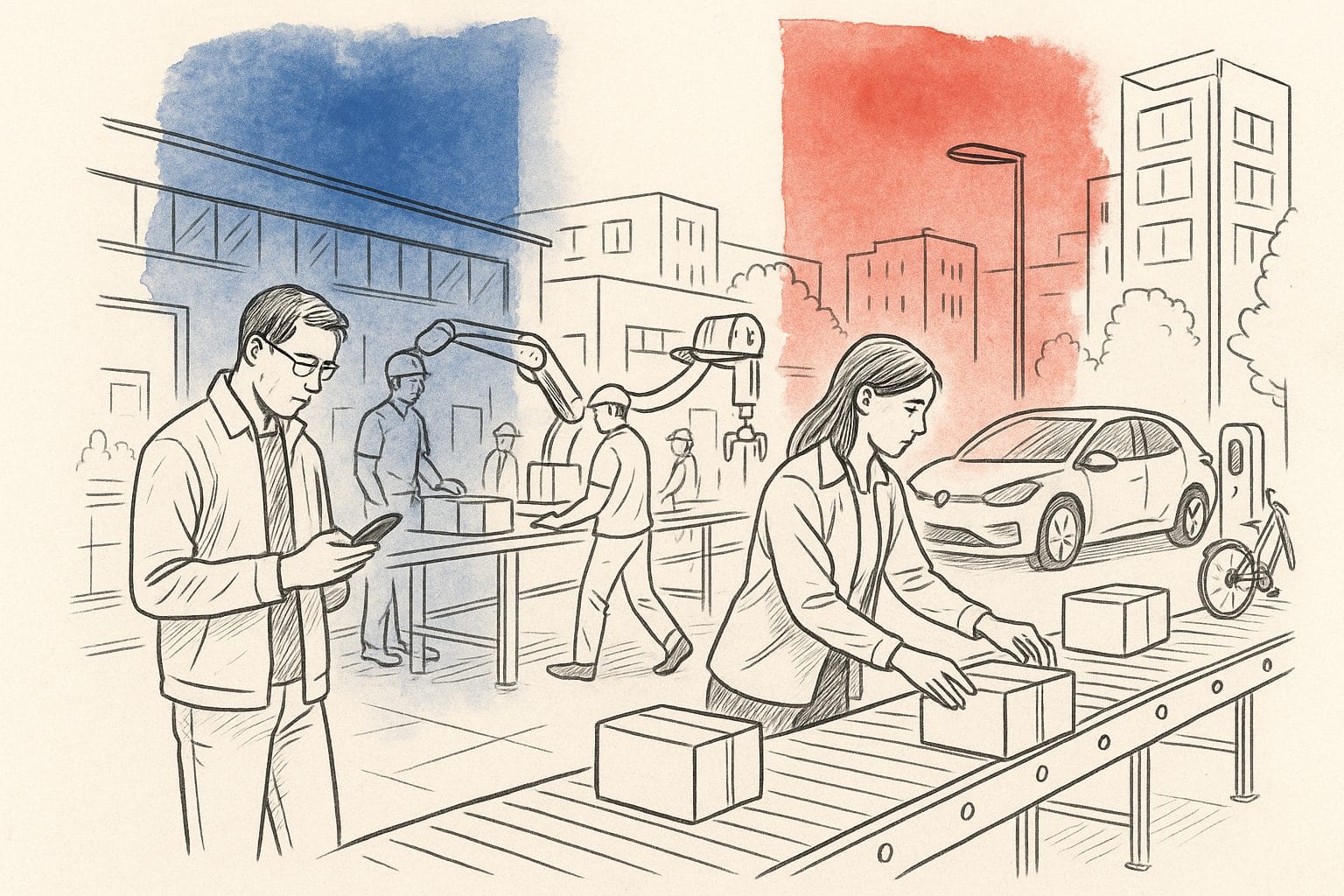
France spends 57% of its GDP on public expenditure. France ranks among OECD countries with the highest public spending, with the OECD average at 42.6% of GDP in 2023; it had reached 48.3% at the pandemic peak in 2020. Agnès Verdier-Molinié, director of iFRAP, draws a conclusion that many avoid stating clearly: there is no longer room to finance new needs without touching what already exists. Face au mur is a book of diagnosis, but also a book of urgency, and its central argument is that chosen adjustment is better than imposed adjustment.
The essentials
- France devoted approximately 57% of its GDP to public expenditure in 2023, against 42.6% on average in the OECD, with debt exceeding 110% of GDP.
- Verdier-Molinié defends the necessity of spending reduction to avoid adjustment imposed by markets.
- The Italian example of 2011 structures the demonstration: an adjustment imposed by markets differs from an adjustment decided politically.
- The central intellectual tension concerns the possibility of compressing spending without sacrificing the productive functions of the state—education, health, and investment.
An economist who has been counting euros for twenty years
Agnès Verdier-Molinié has led iFRAP (Foundation for Research on Administrations and Public Policies) since 2007. She has spent two decades producing international comparisons on French public spending, scrutinizing the budgets of regional authorities, and quantifying the costs of reform inaction. Her work, often uncomfortable for successive governments, has fueled debates on pensions, the civil service, and unemployment insurance. Face au mur, published in June 2025, is less an ideological manifesto than a quantified state of affairs, written at a moment when the Court of Auditors and the OECD are warning of the degradation of French public finances and recommending budgetary adjustment.
The wall, in figures
Verdier-Molinié’s thesis rests on an arithmetic finding. France spends 57% of its GDP on public expenditure. Debt exceeds 110% of GDP. The interest on this debt absorbs a growing share of the state budget. According to the Court of Auditors, the debt burden increased sharply in 2024.
Several structural factors explain this level of spending: inherited structures, a patchwork of territorial layers that multiplies duplications, social transfers whose redistributive effect is real but whose visibility and conditionality have been lost, and a civil service whose workforce has increased over the long term, with declines notably in 2017 and 2018. This debt reduces the budgetary margin available to respond to new shocks.
The argument is calibrated to contradict a rhetoric that has long prevailed in France: the claim that one can spend more to solve unresolved problems while touching nothing that exists. This calculation has become contestable according to Verdier-Molinié.
Italy as a mirror
The most striking passage in the book is the Italian comparison. In 2011, financial and political crisis contributed to Berlusconi being replaced by Mario Monti, appointed and then invested by Parliament. Interest rates on Italian debt soared. The ECB demanded reforms in an August 2011 letter. The Monti government was not directly elected, but it was formed according to constitutional procedure and invested by Parliament.
The adjustment included structural measures, notably the Fornero pension reform.
Verdier-Molinié uses this episode as a warning, not as a model. An adjustment imposed by markets differs from an adjustment negotiated on the timetable and political priorities. Verdier-Molinié draws a lesson about the limits of room for maneuver.
This demonstration rests on the work of Alberto Alesina and coauthors on episodes of budgetary consolidation in Europe, which argue that consolidations through spending and transfers are, in their sample, less damaging to activity than tax increases. France is not yet Italy in 2011. But the signals—spreads widening, rating agencies downgrading, the 2025 budget adopted amid political difficulty—indicate that the distance is shrinking.
Questions the book leaves open
Verdier-Molinié is a liberal economist, and her proposal for exit through reduction rests on spending cuts rather than on raising levies. This choice is acknowledged, but it deserves to be put under tension.
The work of economists like Dani Rodrik on industrial policy and employment, or that of OFCE on the effects of budgetary consolidation during periods of weak growth, recalls a real limit: not all public spending is equal. Cutting unproductive transfers does not have the same macroeconomic effect as cutting vocational training, research, or infrastructure investment. Public spending does not all have the same macroeconomic effect: reducing allocations does not have the same impact on future growth as reducing investment in training, research, or infrastructure.
On this point, Face au mur offers leads—regional authorities, simplification of transfers, review of tax expenditures—but without a robust hierarchy between cuts that durably impoverish the state’s productive capacity and those that clean out accumulated rents. This is the book’s blind spot. Verdier-Molinié trusts the price signal and budgetary discipline to then allocate freed resources. A moderate Keynesian would reply that, in an economy with low potential growth, this trust is a hypothesis, not an achievement.
What remains is that the central thesis holds: one can debate the composition of adjustment. The Court of Auditors calls for adjustment, the OECD recommends consolidation, while OFCE anticipates budgetary consolidation in 2026.
The question the book poses to French democracy
The most stimulating section of Face au mur is less about figures than about politics. Verdier-Molinié seeks to understand how to convince a majority of citizens to support structural reforms before crisis imposes them. This difficulty touches on how contemporary democracies function.
France has a tradition of reform from above, austerity plans announced by decree, implemented by executive orders, and contested in the streets. The 2023 pension reform is the most recent illustration: it was conducted under conditions that undermined its acceptance and hardened resistance for subsequent reforms. This cycle—imposed reform, social rejection, partial or total backtracking—makes subsequent adjustments more difficult.
Verdier-Molinié states the diagnosis without fully answering it. She sketches pedagogy: publish readable public accounts, set binding budgetary rules, make the costs of inaction visible. This is an institutional response, and it is sound. But it assumes that citizens, correctly informed, will make different choices. Recent experience, in France, in Germany with the Schuldenbremse (the constitutional brake on debt), in Britain after the Truss episode, shows that information alone is not enough.
Confidence in the institutions that carry reforms matters at least as much. This article has already explored how the state sometimes subsidizes structures that slow necessary adjustments.
What is at stake between 2027 and 2035
The horizon opened by Face au mur is that of the next decade. If France does not engage in significant consolidation, between 0.5 and 1 percentage point of GDP of annual structural deficit reduction over several years, two trajectories become plausible.
The first is that of slow and painful adjustment: a gradual degradation of public services through hiring freezes and deferred investment, without anyone announcing it clearly. This is the scenario of the invisible wall—you only see it when you run into it. Potential growth declines, inequality in access to services increases, and distrust of institutions deepens. The effects of this disintegration can already be read in certain segments of the labor market, where public investment in training is lacking precisely when technological transitions would make it most useful.
The second is that of political adjustment. It assumes that a government manages to build a coalition broad enough to carry reforms. The political conditions of 2025, marked by a fragmented Assembly and the absence of a stable majority, make this path narrow.
The third trajectory is that of adjustment under external constraint, when outside events force a timetable not chosen politically.
What would make it possible to distinguish these scenarios in the years to come hinges on a few concrete signals: the evolution of the spread between the French OAT and the German Bund, the next government’s ability to have a budget voted in first reading without resorting to Article 49.3, and the attitude of European partners on margins of flexibility in the Stability Pact. The evolution of these signals would influence the available political options.
The book’s value
Face au mur speaks to anyone who wants to understand why debates on public services, pensions, or ecological transition run up against the same budgetary constraint. The book presents a framework for analyzing this budgetary constraint.
Verdier-Molinié is not a catastrophist. She believes adjustment is possible and that it can be just if conducted with discernment. She is more precise on diagnosis than on remedy, and this may be intentional: the exact composition of adjustment belongs to political debate, not to the economist. What she refuses is that this debate continue to be avoided.
The skeptical reader as to the necessity of reform will find the work uncomfortable. One convinced of it will find in it the arguments and international comparisons that often are lacking in French public discussions.
Bibliographic information
Title: Face au mur Author: Agnès Verdier-Molinié Publisher: Éditions Observatoire Publication date: June 15, 2025
Sources
- Agnès Verdier-Molinié, Face au mur, Éditions Observatoire, 2025
- Court of Auditors, report on the situation and prospects of public finances, 2024-2025
- OECD, Economic Outlook, data on compared public spending, 2024
- OFCE, macroeconomic forecasts for France, 2026
- iFRAP work on spending by regional authorities and social transfers (www.ifrap.org)