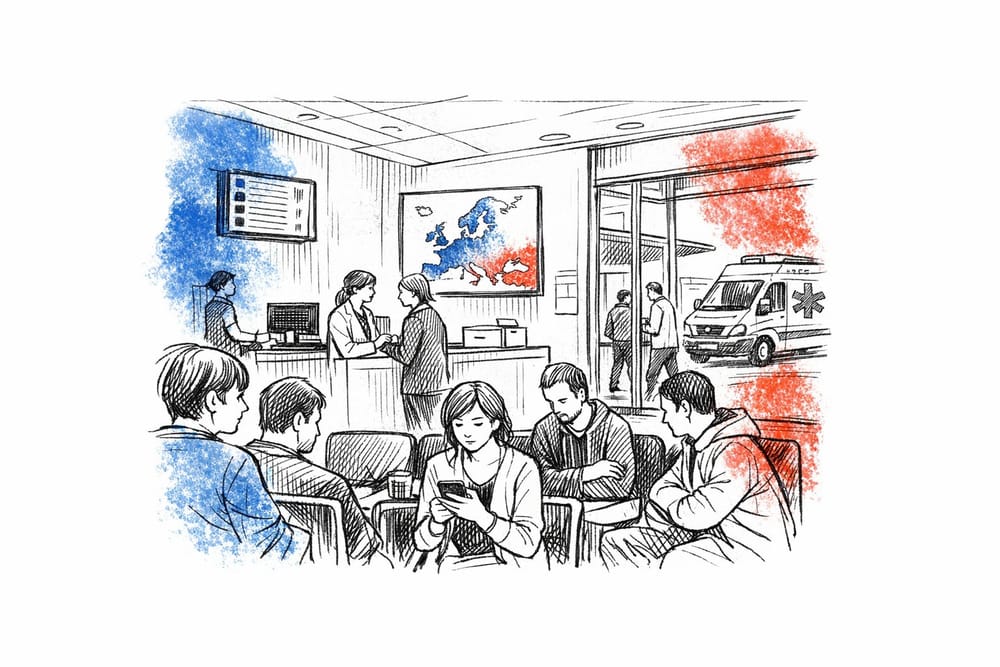
Eighteen months. That is the median delay that separates, in France, European authorization of a medicine from its actual reimbursement: 549 days, according to the W.A.I.T. indicator from the European Federation of Pharmaceutical Industries and Associations (EFPIA), 2024 edition.
A cancer diagnosed, a neurological disease progressing, a therapeutic window closing: during these eighteen months, the treatment exists. It has been validated by the European Medicines Agency. It is prescribed elsewhere. It is not here.
This is not a gap in research. This is an administrative architecture.
The treatment exists, the patient waits
Eighteen months separate France from other countries in a critical measure: the gap between European authorization of a medicine and its effective reimbursement is 549 days at median, according to the W.A.I.T. indicator from the European Federation of Pharmaceutical Industries and Associations (EFPIA), 2024 edition. In Germany, that delay is 38 days, according to the European Observatory on Medicine Access Times from France’s National Health Insurance Fund (Cnam), 2025 edition.
Eighteen months on one side of the Rhine, five weeks on the other, for the same medicine, authorized by the same European agency. Half of French employees earn less than 2,190 euros net per month. These 549 days of waiting represent roughly eight months of that salary: not paid in money, but absorbed by the disease progressing in its absence.
An enviable early access system, a standard procedure that stifles
France does not lack a response. It has an early access system (a legacy of temporary use authorizations born in 1992 for HIV patients, reformed in 2021) that allows patients in therapeutic dead-ends to obtain a treatment even before its final authorization. More than 140,000 patients were able to benefit from medicines under this framework, before or shortly after their marketing authorization, between 2021 and 2025. In France, access to medicine is nearly four times faster thanks to the derogatory system compared to the standard procedure.
But this exceptional system covers only part of the patient population. For all the others (the majority), the standard procedure applies. And that is where the 549 days accumulate. Medicine price negotiation delays are at the origin of the main bottlenecks.
The chain is long: evaluation by the High Health Authority, then price negotiation by the Economic Committee for Health Products (CEPS), then listing for reimbursement. Each step is sequential. Each step is national. The negotiation delays between pharmaceutical companies and CEPS, set at 180 days by the European directive called “transparency,” are regularly exceeded: the CEPS itself indicated overruns on three classes of products as early as its 2017 report.
What the trend reveals
The trend is not toward improvement. The average time between approval and patient access in Europe reached 578 days in 2025: more than a month longer than in 2023. Fewer than half of centrally approved innovative medicines are available to European patients, compared with 48% in 2019; only 29% are fully reimbursed, compared with 42% in 2019.
And a geopolitical rupture is beginning to worsen this underlying picture. For a growing number of treatments, the question is no longer when they will arrive in Europe, but whether they will: two out of five medicines approved by the American FDA since 2025 have been subject to no request to the European Medicines Agency. The cohort that does request European authorization is composed almost exclusively of large pharmaceutical companies with well-established European infrastructure; the one making no request is dominated by smaller biotechnology firms and Chinese biopharmaceutical companies. These are often the most innovative therapies (RNA, gene therapies, targeted monoclonal antibodies) that thus pass by Europe.
The Alzheimer’s case shows this concretely. Since 2002, no therapeutic treatment in the field of Alzheimer’s disease had received approval in Europe; lecanemab and donanemab are the first disease-modifying treatments at an early stage. The European Agency authorized both in 2025.
The French High Health Authority initially refused early access to lecanemab in September 2025, then ruled against reimbursement in October 2025, deeming the medical benefit rendered insufficient. For donanemab, the HAS refused early access in March 2026; the Transparency Commission confirmed the refusal of reimbursement in May 2026. This refusal sends a very negative signal to patients, to their families, to researchers, but also to industrial investors, even as the national 2025-2030 strategy on neurodegenerative diseases displays the ambition to support research and innovation in France.
An institutional lock, not medical caution
France spends. Internal expenditure on research and development represented 61.7 billion euros in 2023, or 2.18% of GDP. The budgetary constraint is real: CEPS negotiates prices to keep medicine spending compatible with the national objective for health insurance expenditure. Given the sharp increase in medicine spending and the growing complexity of regulatory mechanisms, the General Financial Inspectorate and the General Inspectorate of Social Affairs drew up a balance sheet of the current system in 2026.
But the regulatory mechanism produces a perverse effect: by compressing prices and lengthening delays, it discourages laboratories (especially the most innovative, the smallest, the most financially fragile) from filing applications in France. The financial risk is real: the price expected after national negotiation may not cover the costs of market introduction for medicines with low demand. It is not the HAS that is at fault: it applies rigorous evaluation criteria, legitimate from a public health standpoint. It is not CEPS that is failing: it applies a budgetary mission voted each year in Parliament. The problem lies in the architecture itself: two national institutions, sequential, uncoordinated with their European counterparts, arbitrate alone between innovation and public spending.
Philippe Aghion, Nobel Prize winner in economics 2025 whose work underpins the theory of creative destruction, said this about AI but the formula applies here: an in-depth reform of a health system deemed too bureaucratic is essential for technological transformations to benefit everyone. Daron Acemoglu and Simon Johnson, in Power and Progress (Pearson, 2024), pose the central question: technology can provide new opportunities and new growth, but who will reap the benefits is a political question, not a technical one. In this case, French patients are not reaping them.
On September 28, 2026, after more than six months of negotiations, a new four-year framework agreement was signed between CEPS and representatives of the pharmaceutical industry. Tariff negotiations will now be capped at thirteen months; at the end of this period, the CEPS presidency may formulate an arbitral proposal. This is a cursor adjustment. The ceiling goes from infinity to thirteen months: a real step forward, but which leaves intact the mechanism that produces the delay.
Transfer the decision to the level where it can be resolved
The arbitration that 2027 must pose is this: continue to regulate medicine by medicine, country by country, in national sequences, or transfer the competence of evaluation and price negotiation to the European scale for medicines with high added therapeutic value.
This is not a new idea. The European regulation on health technology assessment, in force since January 2025, requires for the first time that member states rely on a common clinical evaluation for oncologic medicines and advanced therapies. This is the beginning of coordination. What is missing is the next step: that price negotiation follow the same logic, and that France renounce replicating alone, after Europe, an evaluation that Europe has just conducted.
Concretely, this means changing who decides and who pays: replace the double national evaluation with a presumption of reimbursement for medicines that have received a positive European clinical evaluation, with a multilateral price negotiation coordinated at the European level. After this change, the HAS would no longer have the competence to add a national evaluation of clinical value for these products: it would focus on care organization and proper use. What this makes possible: reduce the standard procedure delay from 549 to fewer than 90 days for covered medicines. What this closes off: each member state’s ability to protect its budget alone by rejecting expensive medicines.
This budgetary constraint is real. It calls for a response equal to the task: a shared European envelope to cofinance access to high-value therapies, on the model of what was done (imperfectly but really) for Covid vaccines. The 2026 IGF-IGAS report itself calls for a reassessment of policies supporting pharmaceutical company investments through product prices. This institutional signal exists. What is missing is transforming it into a shared architecture, not an additional national adjustment.
Sources
[1] EFPIA, “Patients W.A.I.T. Indicator 2024 Survey,” June 2024, https://efpia.eu/media/vtapbere/efpia-patient-wait-indicator-2024.pdf (accessed 29/09/2026).
[2] EFPIA, “Patients W.A.I.T. Indicator 2025 Survey,” May 2025, https://www.efpia.eu/media/mnfdwzax/efpia-patients-wait-indicator-2025.pdf (accessed 29/09/2026).
[3] EFPIA, “Patients W.A.I.T. Indicator 2025: press release,” May 2025, https://www.efpia.eu/news-events/the-efpia-view/statements-press-releases/new-data-shows-no-shift-in-access-to-medicines-for-millions-of-europeans/ (accessed 29/09/2026).
[4] EFPIA, “Patients W.A.I.T. Indicator 2025: press release,” May 2026, https://www.efpia.eu/news-events/the-efpia-view/statements-press-releases/patients-in-europe-waiting-longer-for-new-medicines-as-inequality-grows-between-member-states/ (accessed 29/09/2026).
[5] Cnam (National Health Insurance Fund), HAS, ANSM, “European Observatory on Medicine Access Times: 2026 Edition,” International Comparisons no. 9, June 2026, https://www.assurance-maladie.ameli.fr/etudes-et-donnees/2025-comparaisons-internationales-delai-acces-medicaments (accessed 29/09/2026).
[6] Cnam (National Health Insurance Fund), HAS, ANSM, “European Observatory on Medicine Access Times: 2025 Edition,” International Comparisons no. 7, September 2025, https://www.assurance-maladie.ameli.fr/presse/20250616-observatoire-delais-d-acces-medicaments-innovants (accessed 29/09/2026).
[7] Sanofi, “Access to therapeutic innovation in France: the Citizen Health Dialogue,” July 2026, https://www.sanofi.fr/fr/media/sanofi-today/votre-sante/acces-a-l-innovation (accessed 29/09/2026).
[8] France Assos Santé, “Transparency on access times for innovative medicines,” February 5, 2020, https://www.france-assos-sante.org/bon_mauvais_point/transparence-delais-acces-medicaments-innovants-avancee-has/ (accessed 29/09/2026).
[9] National Assembly, Bill no. 2153 on medicine access times, 15th legislature, https://www.assemblee-nationale.fr/dyn/15/textes/l15b2153_proposition-loi.pdf (accessed 29/09/2026).
[10] IGAS/IGF, “Assessment and evolution of the medicine price regulation system,” May 2026, https://igas.gouv.fr/bilan-et-evolution-du-dispositif-de-regulation-du-prix-des-medicaments (accessed 29/09/2026).
[11] CEPS, Leem, Alma, MedFrance, Initiative Pharma, “Framework agreement on medicines,” signed September 28, 2026, https://europe-business-news.com/29/09/2026/prix-des-medicaments-accord-cadre-ceps-2026/ (accessed 29/09/2026).
[12] Vidal, “Access to innovative medicines: what is France’s place on the international stage?,” July 17, 2026, https://www.vidal.fr/actualites/38019 (accessed 29/09/2026).
[13] HAS, “LEQEMBI (lecanemab): Alzheimer’s disease: unfavorable reimbursement opinion,” October 22, 2025, https://www.has-sante.fr/jcms/p_3702487/fr/leqembi-lecanemab-maladie-d-alzheimer (accessed 29/09/2026).
[14] France Alzheimer, “Refusal of reimbursement for Kisunla (donanemab): an incomprehensible decision,” May 28, 2026, https://www.francealzheimer.org/refus-de-remboursement-du-kisunla-donanemab-une-decision-incomprehensible/ (accessed 29/09/2026).
[15] Alzheimer Europe, “Position paper on access to anti-amyloid treatments in Europe,” July 2026, https://www.francealzheimer.org/note-de-position-dalzheimer-europe-sur-lacces-aux-traitements-anti-amyloides-en-europe/ (accessed 29/09/2026).
[16] MESR-SIES, “Research and development effort in France: State of Higher Education, Research and Innovation no. 19,” publication.enseignementsup-recherche.gouv.fr, 2025, https://publication.enseignementsup-recherche.gouv.fr/eesr/FR/T923/l_effort_de_recherche_et_developpement_en_france/ (accessed 29/09/2026).
[17] FIPECO (François Ecalle), “Public expenditure in support of research and innovation,” updated 2025, https://www.fipeco.fr/fiche/Les-d%C3%A9penses-publiques-en-faveur-de-la-recherche (accessed 29/09/2026).
[18] INSEE, “Salaries in the private sector in 2024,” INSEE Première no. 2079, October 23, 2025, https://www.insee.fr/fr/statistiques/8657156 (accessed 29/09/2026).
[19] Philippe Aghion, Céline Antonin, Simon Bunel, The Power of Creative Destruction, Odile Jacob, 2020.
[20] Daron Acemoglu, Simon Johnson, Power and Progress. Technology and Prosperity, Our Millennial Struggle, Pearson France, November 2024 (translation of Power and Progress, Basic Books, 2023).