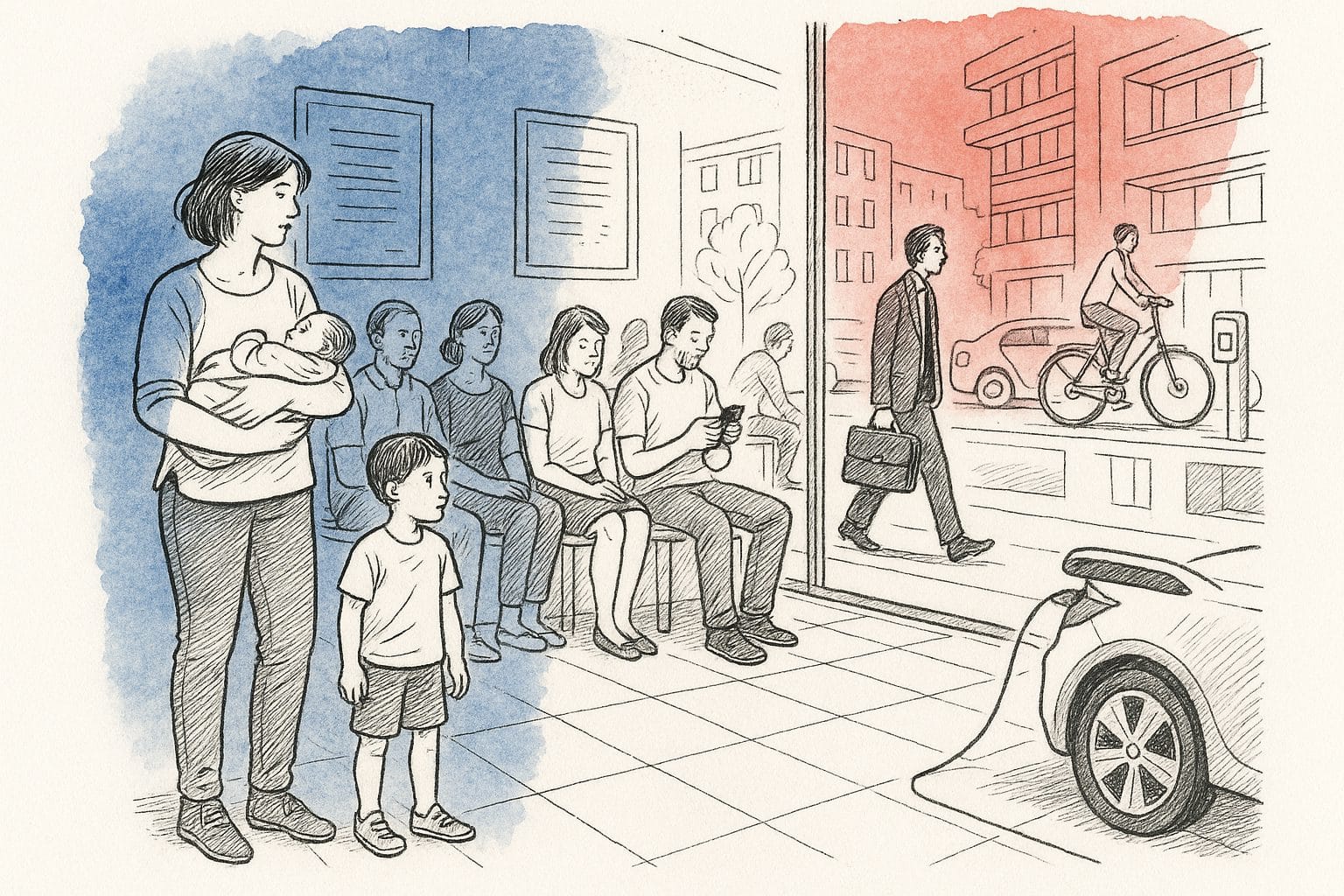
In 2025, France recorded a negative natural balance for the first time since 1945: more deaths than births. The fertility rate has dropped to 1.56 children per woman, its lowest level since the end of the First World War, according to INSEE. France is experiencing a decline in fertility and a negative natural balance in 2025, but it maintains a significantly higher fertility rate than Germany and especially Italy in the latest available comparable data.
The Essentials
- In 2025, France records a fertility rate of 1.56 children per woman, the lowest since 1918 (INSEE).
- The natural balance is negative for the first time since 1945: immigration is the only positive demographic balance.
- France is joining Germany and Italy on a trajectory that neither has managed to stabilize institutionally.
- The intergenerational contract, pensions, health and long-term care, rests on an active workers/retirees balance that demographics are structurally eroding.
- The reforms undertaken or avoided between 2025 and 2030 will shape very different trajectories by 2035-2050.
The Record Nobody Wanted
The figure of 1.56 children per woman requires perspective to reveal its true weight. France has long displayed one of the highest fertility rates in Western Europe, flirting with 2.0 in the early 2010s. This level, often attributed to generous family policy—allowances, parental leave, childcare networks—was presented as proof that demographics could resist modernity. The 1985 mark, the postwar low reference year, was crossed downward. The level of 1918 is reached again; it is not crossed further downward.
The decline is rapid. In ten years, French fertility has fallen by nearly 0.4 points, a decline of a magnitude that demographers were still recently describing as unlikely outside major economic crises. In 2025, the decline affects women under 35; INSEE does not formulate in this assessment findings covering all socioprofessional categories. The housing crisis, the cost of living, climate uncertainty felt by young generations, the transformation of individual life projects: the causes are multiple and interwoven, and demographic research does not yet allow us to rank them with certainty.
What is certain, however, is the mechanical consequence. A fertility rate of 1.56 means that each generation is not replacing itself. The replacement threshold stands at 2.1 children per woman. Fertility that remains durably below the replacement threshold increases the risk of long-term demographic decline, but this also depends on mortality, age structure, and migration. France has globally been below the replacement threshold since the mid-1970s, with a temporary increase close to the threshold during 2000-2010.
A Negative Natural Balance for the First Time Since 1945
The natural balance measures the difference between births and deaths. When it becomes negative, a country loses inhabitants through the sole action of its internal biological dynamics. France avoided this threshold for eighty years, even during the difficult years of deindustrialization and mass unemployment in the 1980s and 1990s. In 2025, the threshold is crossed.
Two movements explain this evolution. Births are declining while the baby-boom generations, born between 1945 and 1975, are entering massively into age groups with high mortality. Their conjunction forms a structural evolution that INSEE projections have described with precision for at least twenty years.
The positive migration balance currently compensates for the natural deficit and maintains demographic growth; according to INSEE’s central scenario, it would no longer suffice from 2037 onward. This dependence on immigration as the only positive demographic engine exposes population trajectory to political and geopolitical variables that internal natality did not involve: visa decisions, diplomatic tensions, relative territorial attractiveness, integration policies.
The experience of Germany and Italy over the past twenty years shows that immigration can cushion a demographic shock in the short term, without responding to it structurally, especially when integration fails to transform arrivals into net contributors to the social system.
Germany and Italy: Two Unheeded Warnings
Germany crossed the negative natural balance threshold in the 1970s. Its fertility rate, around 1.35 to 1.45 for decades, has remained among the lowest in Western Europe. It compensated massively through immigration, including during the major wave of Syrian and Afghan arrivals in 2015-2016. The result is a society that is demographically stabilized but politically fragmented on the migration question, with a rise in anti-immigration parties directly correlated with integration tensions in certain regions.
Italy presents an even darker picture. Its fertility rate is among the lowest in the developed world, around 1.20 to 1.25. Its population is declining in absolute value despite a positive migration balance. Regions in the South are losing their young people to the North or abroad, creating dynamics of local demographic desertification that international immigration does not compensate for geographically. The Meloni government has launched several pro-natality plans—birth bonuses, tax deductions, public campaigns—without measurable results at this stage.
These two cases show that available data do not permit identification of a single policy that alone guarantees a sustained increase in fertility; certain instruments can nonetheless have positive effects, variable depending on the countries and programs. There are exceptions. France and Sweden have long displayed relatively high fertility, in contexts comprising developed family policies; it is not possible, however, to attribute this level to these policies alone. Work on growth and well-being emphasizes that individual trade-offs between career, housing, and family resist poorly to public intervention when structural constraints remain.
The Intergenerational Contract Under Strain
The French pension system rests on a simple principle: today’s workers finance today’s pensions. This principle was designed in a France with strong demographic growth, with a favorable active workers/retirees ratio. This ratio is deteriorating. The OECD projection places this ratio at less than two to one by 2050, according to the current demographic trajectory.
The 2023 pension reform, raising the legal retirement age to 64, attempted to correct this imbalance on the labor supply side. It triggered massive social mobilization, but aging forces trade-offs between several levers: employment, retirement age, contributions, taxes, productivity, indexation, and pension levels. Immigration can provide additional contributors, but only if these persons are durably integrated into formal employment, a condition that requires reception policies, training, and diploma recognition that France has not yet systematized.
The question of long-term care poses itself with comparable urgency. In 2021, approximately 670,000 seniors were in severe loss of autonomy; just over 2 million were in loss of autonomy overall, according to INSEE and Drees studies. This figure should grow with the accelerated aging of the baby-boomers. The fifth branch, created in 2020, faces sustained pressure linked to aging; its insufficient resources must nonetheless be supported by explicit comparison between resources, expenses, and needs. Comparison with the Japanese challenge and its Asian equivalents is telling: even economies that anticipated these transitions struggle to find a stable financing model.
The 2025-2030 Window and Margins for Action
Demographers distinguish between fundamental trends, over which public action has little purchase in the short term, and support policies, which can deflect trajectory over the span of a generation. France finds itself in a window where several levers remain mobilizable, even if none is sufficient alone.
The first lever is family policy. Nordic countries have maintained relatively high fertility by combining parental leave accessible to both parents, universal early childhood care, and flexible labor markets that do not force women to choose between career and family. France has part of this arsenal, but its deployment remains uneven across territories and social categories. Access to childcare, notably, remains insufficient in dense urban areas and in certain rural territories.
The second lever is the economic integration of immigrants. The effect of immigration on social financing depends notably, but not exclusively, on professional integration and the socioeconomic characteristics of the persons concerned. An immigrant who works, contributes, and consumes is an actor in system financing. An immigrant kept in precarity or informal employment is not. France invests in integration policies, whose deployment varies according to the programs.
The third lever is productivity. A more productive economy can maintain a high standard of living and public financing with a smaller active population. Automation and AI play an ambiguous role here: they can increase output per head and thus tax revenues, but they also raise questions about the distribution of gains. Daron Acemoglu and Simon Johnson showed in their recent work that technological progress does not automatically benefit all workers, and that sharing gains requires explicit institutional choices.
Toward 2050: Three Plausible Trajectories
France in 2050 could resemble three very different models depending on decisions made in the next five years.
In a first scenario, family policy is reformed in depth and immigrant integration is treated as a priority investment. Fertility stabilizes around 1.7 to 1.8, without recovering the replacement level, but limiting the decline. The active workers/retirees ratio deteriorates less quickly than expected. This scenario requires significant budgetary trade-offs and political coherence difficult to maintain over several legislative terms.
In a second scenario, family policies remain fragmented and integration insufficiently funded. Fertility continues to decline slowly. Immigration keeps the overall population roughly stable but employment of immigrant persons remains below average. The active workers/retirees ratio continues its deterioration and tensions over financing pensions and long-term care intensify. This scenario resembles Germany’s current trajectory.
In a third scenario, migration restriction becomes the dominant political choice, under pressure from nationalist parties. If the migration balance declined and fertility did not improve, the risk of demographic decline would increase; this is a scenario hypothesis, not an automatic chain of events. The French population could decline over time. Social protection system financing can mobilize several levers: employment, productivity, contributions, taxes, effective retirement age, indexation, spending reallocation, and deficit. Italy offers here the clearest example of what this trajectory produces.
None of these scenarios is a fatality. The World Population Prospects 2024 show how different hypotheses of fertility, mortality, and migration would modify projected trajectories; they do not demonstrate that determined public policies would produce these changes. The total fertility rate is an annual indicator, susceptible to varying rapidly; the final fertility of generations is a long-term measure. The employment rate of women with children, the childcare access rate, and the professional integration rate of immigrants can contribute to policy evaluation, but they are influenced by numerous factors and do not alone measure their quality. They can be indicators of social and economic context, but alone do not permit forecasting demographics of the following decade.
France must define what intergenerational contract a society agrees to finance when its demographic structure has fundamentally changed. Germany has still been seeking its answer for twenty years. France is joining Germany on one precise point, a negative natural balance compensated or partially compensated by migration, but their demographic trajectories remain different.
Sources
- INSEE, Demographic Summary 2025
- United Nations, World Population Prospects 2024 (United Nations Population Division)
- OECD, Fertility Rates and Health at a Glance (2023-2024 edition)
- High Council for Family, Childhood and Aging, reports on long-term care
- Daron Acemoglu & Simon Johnson, Power and Progress (PublicAffairs, 2023)