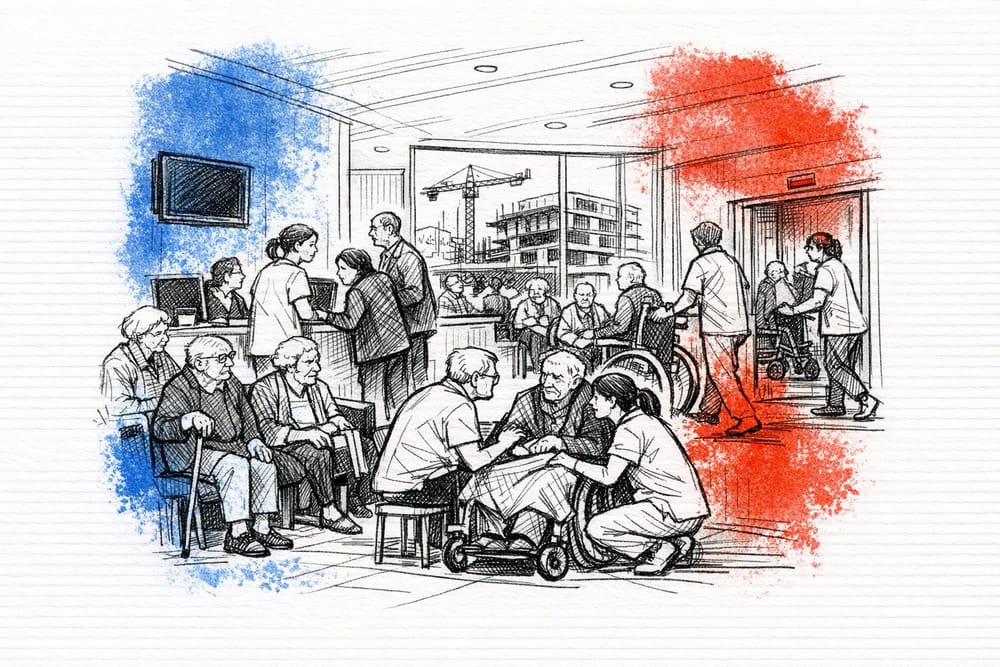
By the end of 2023, France’s 7,400 nursing homes for dependent elderly people (known as EHPAD) welcome 573,000 residents, half of whom are older than 87 years and 11 months [1]. These figures describe the current state. The future state, by contrast, is documented with unusual precision: the first baby boom generations will reach 85 years old starting in the 2030s, and the number of people aged 85 and over will increase by 77% between 2031 and 2052 [2].
France will have nearly 2.8 million elderly people with loss of autonomy by 2050, some 700,000 more than in 2021 [3]. This wave has been known for decades. It is arriving anyway to a medical and financial system that has not been rebuilt to absorb it.
Medical Shortage Strikes at the Heart of Facilities
Geriatrics has made real progress over the past fifteen years. The DREES (research department for studies, evaluation and statistics) observes nearly a tripling of the number of geriatricians since 2012, from 1,200 to 3,400 [4]. This is a 183% increase in absolute terms—and it remains insufficient given the scale of the demographic challenge.
The most concrete sign of this insufficiency is visible in the nursing homes themselves. In France, nearly 7,500 facilities are required to rely on a coordinating physician, who ensures the consistency and quality of care. Yet nearly 2,000 positions remain vacant [5].
According to the latest DREES survey on personnel and recruitment difficulties in nursing homes, nearly one facility in two faces medical recruitment challenges. The 2024 Senate report confirms that a third of facilities audited by the Court of Accounts experiences a vacancy lasting longer than six months. The latest 2026 assessment even mentions one facility in three without stable medical coverage [6].
Geriatrics suffers from a lack of appeal: according to the 2024 Medical Demographics Atlas from the Physicians’ Association, only 5% of newly qualified doctors say they want to pursue geriatrics [7]. A coordinating physician cannot prescribe except in emergencies. They cannot work full-time in a single facility. Their role is to coordinate care provided by other physicians: private practitioners who, for reasons of time and accessibility, withdraw from follow-up care when their patient enters an institution [8]. Result: a nursing home resident depends on a primary care physician who no longer makes house calls, a part-time coordinator who cannot prescribe, and an emergency room that they will use for lack of alternatives.
Research conducted in Nord-Pas-de-Calais demonstrated that outside life-threatening emergencies, nearly 30% of nursing home residents’ emergency room visits were avoidable [9]. The HAS (French health authority) for its part analyzed serious adverse events occurring in nursing homes: 56.7% were judged as avoidable or probably avoidable by those reporting them. Among these, 40% led to death [10]. These figures illustrate the human cost of medical absence in facilities.
A Financial Model Exhausted Before the Wave Even Arrives
The dependent elderly population will increase significantly over the next 25 years: compared to 2020, the increase would be about 16% by 2030, 36% by 2040, and 46% by 2050 [11]. This figure has been known since 2024, precisely when nursing homes tipped into the red.
Between 2020 and 2023, the share of deficit-ridden nursing homes rose from 27% to 66%. In 2023, 84.4% of facilities recorded a deficit result. The French Hospital Federation estimates the overall deficit at 800 million euros in 2023 [12]. The sector was in serious financial difficulty even before the major wave of the 2030s began to form.
The structural cause lies in the very architecture of financing. Each resident is supported by three separate funders who do not speak to one another: health insurance finances care through Regional Health Agencies (ARS), the department finances dependency support, and the resident and their family pay for housing. These structures relied on three funding sources—departments for the dependency portion, regional health agencies for the care section, and residents for housing—and emerged depleted from COVID-19, the Orpea scandal, and inflation [13]. When costs rise quickly and simultaneously across all three sections, none of the three funders spontaneously makes up for what they do not control. Deficits accumulate.
In 2024, long-term care spending reached 52.2 billion euros, or 16% of current health spending [14]. France devotes approximately 2% of its GDP to this, well below the average of Scandinavian countries (which reach 3%), with spending below 1% of GDP in some southern and eastern European countries and approaching 3% of GDP for Nordic countries [15]. France occupies an intermediate position, but with structurally more rigid capacity for scaling than northern systems.
The autonomy branch has a spending target of 43.6 billion euros by 2026, but without a twenty-year programming law calibrated to actual needs. Long-term financing for dependency has not been settled. Beyond 2026 credits, there is no graduated vision through 2050 for massively scaling intermediate housing or fundamentally modernizing nursing homes [16]. The financing need for the elderly had been assessed as early as 2019 at nine to ten billion euros by 2030 [17]. For seven years, this figure has circulated without finding institutional translation.
Changing Who Decides and Who Pays
The obstacle is not technical. Geriatrics is a specialty that exists, nursing homes are facilities that function, home care is developing. What is missing is an architecture that makes these scattered pieces coherent. Economist Hippolyte d’Albis, in his work on the economics of life stages, showed that the recomposition of social solidarity has not occurred uniformly across age groups: the state’s role strengthened in favor of the young, partially offsetting the erosion of family support, while it shrank for the elderly, for whom market-based resources occupy an increasing share [18]. The fourth age is thus the blind spot of public solidarity.
The HCFEA (High Council for the Family, Childhood and Aging), in its June 2026 report on nursing homes, put the proposal on the table: simplify facility financing, particularly by generalizing the merger of the “care” and “dependency” sections, by extending the scope of this new section to all primary care, and by renovating pricing tools [19]. This merger is the central arbitration. It places medical decision-making in nursing homes under a single funder (health insurance) instead of the current two who pass costs back to each other. It requires each facility to have integrated medical presence, including primary care that private practitioners no longer provide, because the financing now includes them.
The HCFEA proposes to finance these additional measures with one billion euros by 2030 through transfers from outpatient care spending and savings on avoidable hospitalizations, particularly those related to falls [20]. The economic argument is thus available: better medical coverage in nursing homes reduces emergency room visits and unscheduled hospitalizations, whose cost far exceeds that of a physician permanently on-site.
The rupture measure for 2027 is this: merge the care and dependency sections into a single national medical allocation, entrusted to health insurance, which would finance a full-time coordinating physician in each facility above a certain capacity threshold, with complete prescribing authority. Departments would remain responsible for housing. But medical decision-making (who treats, how, with what resources) would cease to be split among three funders unable to coordinate. Such a reform does not adjust a financing dial: it transfers elderly care medical competence to a single funder responsible for quality of care in its facilities. After this shift, nursing homes function as integrated medical structures, not as housing places that occasionally rent a physician.
Budget constraint is real. But it does not ease by waiting. The 2030-2040 shock represents a 36% increase in the dependent elderly population [11].
Financing it on fragmented institutional bases will cost more, in emergencies and avoidable hospitalizations, than financing it in coherent architecture. And for Hippolyte d’Albis, the fundamental question remains posed: is it normal that people who manage our money are better paid than those who care for our parents [21]? This is not a metaphor. It is a political choice that 2027 can settle.
Sources
[1] DREES, EHPA survey 2023, “Interadministrative database of medico-social facilities and services, data 2019 to 2023,” July 2026, https://drees.solidarites-sante.gouv.fr (consulted 10/10/2026).
[2] INSEE/DREES, “700,000 additional seniors with loss of autonomy by 2050,” INSEE Première no. 2078, October 2025, https://www.insee.fr/fr/statistiques/8653672 (consulted 10/10/2026).
[3] INSEE, “700,000 additional seniors with loss of autonomy by 2050,” INSEE Première no. 2078, October 2025, https://www.silvereco.fr (consulted 10/10/2026).
[4] DREES, “Demographics of healthcare professionals as of January 1, 2026,” Banque des territoires, October 2026, https://www.banquedesterritoires.fr (consulted 10/10/2026).
[5] ProfilMédecin, “Coordinating physician: missions, career path and remuneration” (based on DREES surveys), 2026, https://www.profilmedecin.fr (consulted 10/10/2026).
[6] DREES/Senate, Senate report no. 778 (2023-2024) “Nursing Homes: A Model to Rebuild,” September 25, 2024; DREES 2026 state of play, https://sosehpad.com (consulted 10/10/2026).
[7] National Physicians’ Association Council, Medical Demographics Atlas in France, situation as of January 1, 2024, October 2024, https://www.hoppi.work (consulted 10/10/2026).
[8] SNGIE (National Union of General Practitioners and Geriatricians Working in Nursing Homes), cited in Agevillage, 2023, https://www.agevillage.com (consulted 10/10/2026).
[9] French Hospital Federation, Objective Elderly: Avoiding the Hospital (Report Matières Grises), citing work by Puisieux and Wiel (Lille University Hospital), https://www.fhf.fr (consulted 10/10/2026).
[10] French Health Authority (HAS), “Analysis of declarations of serious adverse events associated with care (EIGS) related to nursing homes,” report September 2026, https://www.has-sante.fr (consulted 10/10/2026).
[11] Senate, information report no. 778 (2023-2024), Nursing Homes: A Model to Rebuild, summary, September 25, 2024, https://www.senat.fr/rap/r23-778/ (consulted 10/10/2026).
[12] French Hospital Federation (FHF), survey on 2023 consolidated results, cited in Senate report no. 778 (2023-2024), https://www.senat.fr/rap/r23-778/ (consulted 10/10/2026).
[13] Senate, report no. 778 (2023-2024), summary, https://www.senat.fr/rap/r23-778/ (consulted 10/10/2026).
[14] HCFEA, Council for Aging, Places of Life and Care for Today and Tomorrow, report adopted June 30, 2026, https://hcfea.gouv.fr (consulted 10/10/2026).
[15] DREES, “International comparisons of long-term care spending,” Health Spending in 2022, 2023 edition, sheet 36, https://drees.solidarites-sante.gouv.fr (consulted 10/10/2026).
[16] Capretraite, “Senior Plan 2026: Another Postponement,” based on DREES (February 2026), https://www.capretraite.fr (consulted 10/10/2026).
[17] High Council for the Financing of Social Protection, Elderly Care and Autonomy, Libault report, 2019, cited in National Assembly, question no. 238, https://www.assemblee-nationale.fr (consulted 10/10/2026).
[18] Hippolyte d’Albis, Economics of Life Stages, Éditions Odile Jacob, 2024; “Economic consequences of an aging population,” Constructif no. 71, 2025, https://shs.cairn.info/revue-constructif-2025-2-page-32 (consulted 10/10/2026).
[19] HCFEA, Council for Aging, Places of Life and Care for Today and Tomorrow: A Vision and Path for the Transformation of All Nursing Homes, report adopted June 30, 2026, https://hcfea.gouv.fr/des-lieux-de-vie-et-dattentions-pour-aujourdhui-et-demain (consulted 10/10/2026).
[20] HCFEA, Council for Aging, nursing home report, June 2026, https://hcfea.gouv.fr (consulted 10/10/2026).
[21] Hippolyte d’Albis, Economics of Life Stages, Éditions Odile Jacob, 2024, cited in Club Turgot, https://clubturgot.com (consulted 10/10/2026).