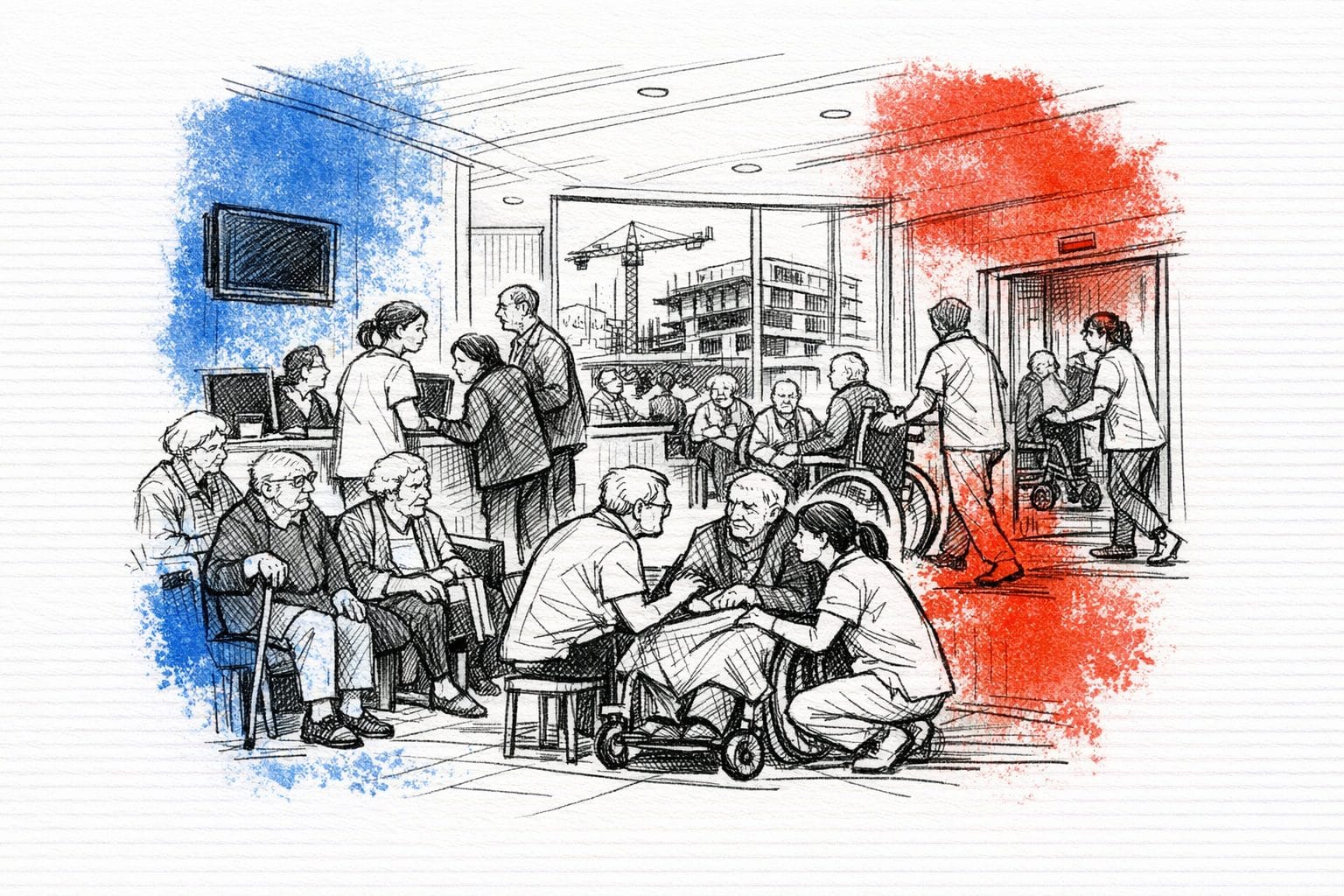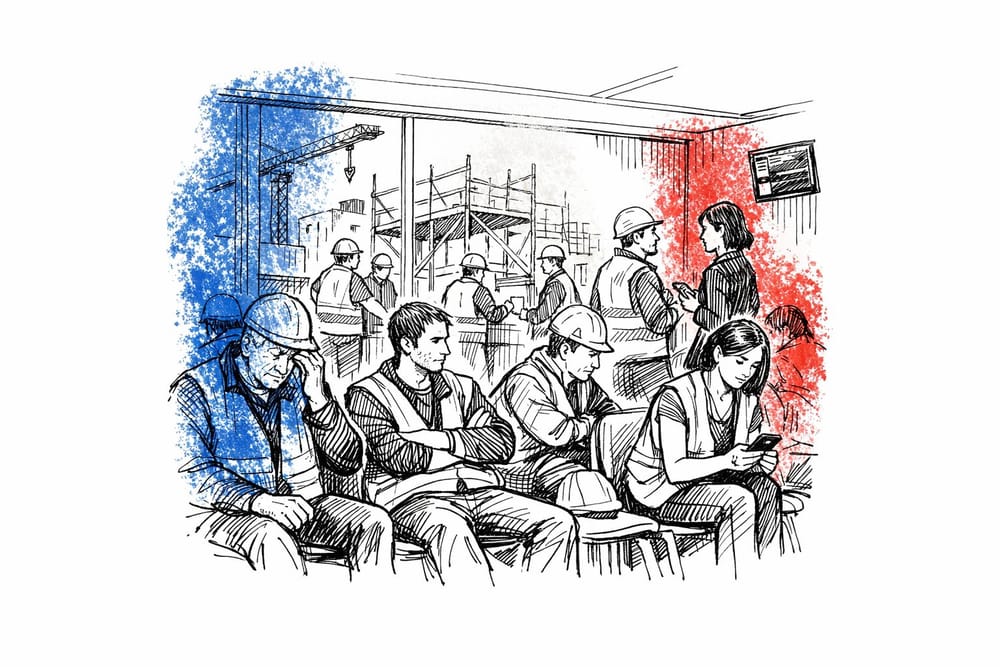
A senior executive receives roughly 930,000 euros in pension payments over their lifetime. A manual worker receives less than 300,000 euros. The same system, the same rules, three times less money.
Male senior executives can expect to receive 930,000 euros in retirement pension over their lifetime, compared to less than 300,000 euros for manual workers. This inequality is not an anomaly or a fraud. It is the mechanical consequence of two facts that the debate on pensions continues to treat separately, even though they compound each other.
First fact: executives’ salaries are three times those of manual workers at the end of their careers, and pensions reflect salaries. After age 60, a male senior executive earns more than 6,000 euros per month on average—three times more than a manual worker. Second fact: an executive lives longer.
At age 35, a senior executive can expect to live to 84, a manual worker to 77.6: a difference of six and a half years. These two inequalities interlock. More pension each month, for more years: the total calculation diverges very quickly.
Twenty Years of Reforms That Have Widened the Gap
The intuition that the pension system compensates for labor market inequalities is false. It records them. And for the past twenty years, it has amplified them.
An executive receives a total cumulative pension amount over their lifetime 2.4 times higher than a manual worker. Over the past twenty years, pension reforms have increased inequalities in this regard. The mechanism works as follows.
Raising the legal retirement age penalizes those with the shortest life expectancy: they lose months, sometimes years, of pension. It advantages those who live longer. Manual workers retire slightly earlier (senior executives retire on average at 63.1 years, compared to 61.8 years for manual workers), but this advantage of a year and a half only compensates for a fraction of the life expectancy gap.
On average, an executive lives 20.9 years in retirement, compared to 15.8 for a manual worker. Five years of pension less: at 1,500 euros per month, that’s 90,000 euros of additional difference, which adds to the monthly pension gap. The total amount per person thus diverges well beyond what is reflected by salary level alone.
The long-term dynamic is not improving. Pension expenditure represented 13.9% of GDP in 2024, a high level in international comparison, and this share would increase slightly to 14.2% by 2070. In 2024, the pension system balance was in deficit by 1.7 billion euros.
This deficit is projected to worsen: it would reach -0.9 percentage points of GDP in 2045 and -2.4 by 2070. Raising the legal retirement age is the usual political response to this imbalance. It is precisely what widens the inequality in pension reception.
Johan Norberg, in Peak Human (2025), documents the fragility of golden ages: monopolies take root, institutions close ranks, authority becomes centralized. Acquired prosperity raises the stakes of control, and those who hold it protect it. The French pension system illustrates exactly this mechanism: a system built during the era of full industrial employment froze advantages that now benefit those with the longest careers, the highest salaries, and the best health: that is, the same people.
The Manual Worker Pays for Their Pension Without Benefiting as Much
Workplace hardship is at the heart of the matter. Manual workers live shorter lives because they worked in conditions that damage the body. Musculoskeletal disorders, vibrations, carrying loads, and difficult postures represent the bulk of recognized occupational diseases.
A hardship prevention account has existed since 2015. It was cut in 2017: difficult postures, manual handling of loads, mechanical vibrations, and exposure to dangerous chemical agents were excluded. Result: fewer than one percent of new retirees each year benefit from it. The 2023 reform improved the scheme marginally, without reintegrating the ergonomic criteria removed six years earlier. The Court of Accounts deplored in 2022 the overhaul of the personal hardship prevention account, judging that it no longer adequately considered the fate of people damaged by their occupational activity.
Life expectancy at age 60 confirms the scale: at 60, the life expectancy gap reaches 7.6 years for men according to social category. These seven and a half years correspond, at the level of pension weight, to the difference between an equitable system and a system that massively transfers manual workers’ contributions toward pensions from which they will benefit for a shorter time.
The average pension is 1,666 euros gross per month at the end of 2023, and this average amount has declined in constant euros between 2017 and 2023. The average conceals everything: executives receive around 2,100 euros per month, manual workers well below that. What the average does not say is that the manual worker contributes for 42 years for a 15-year retirement, while the executive contributes for a few years more for a 21-year retirement.
Link the Right to Retire to Life Expectancy Duration, Not Just Age
The break to make comes down to a basic shift: the retirement age should no longer be uniform; it should be adjusted according to life expectancy at birth by socioprofessional category—something the Pension Advisory Council already calculates, and which no one uses as the legal basis.
Hippolyte d’Albis, in Economics of Life Ages (2026), defends the idea that generalizing the calculation of pension wealth would allow workers to better understand the system and open discussion on paths for innovative evolution. This calculation exists: it reveals a gap of 630,000 euros between an executive and a manual worker, and it is used as a basis for no enforceable right.
The lever is not to pay more to those who receive little: it is to change who decides when to retire. Concretely, this means two things. First, reintegrate ergonomic criteria into the hardship prevention account (carrying loads, difficult postures, vibrations) and make them enforceable: an employee exposed for fifteen years to these factors has an automatic right to early retirement, without having to go through a medical commission. More than 90% of recognized occupational diseases correspond to these criteria that are currently excluded. Health damage linked to ergonomic factors represents 90% of recognized occupational diseases, and they result in permanent disability ratings often below 10%, which often excludes them from current permanent disability retirement schemes.
Second, anchor the legal age to a target retirement duration (eighteen years on average, calculated by professional category) rather than to a uniform age. Executives would retire later, manual workers earlier, not through political decision but through application of a demographic rule. It is not about compensating for a pension gap: it is about changing who holds the right to decide the retirement age, by basing it on actual life expectancy rather than on an average that systematically advantages the same people.
This architecture prohibits the usual adjustment. It requires that the table of life expectancies by socioprofessional category (which INSEE has produced since the 1990s) become the legal basis for an enforceable right. Bruno Palier, who has documented the mechanisms of hardship and exclusion in social protection systems, stresses that successive reforms have not addressed physical hardship and even less psychological hardship, instead asking those who can no longer cope to work even more.
The data produced by the Pension Advisory Council and by INSEE are there. The gap of 7.6 years in life expectancy at age 60 between the bottom and top of the social scale is quantified, dated, updated. What is missing is the legal framework that translates it into a differentiated retirement age. After this reform, the system no longer distributes pensions as before: not in amount, but in duration: the manual worker and the executive would have a retirement of comparable length, financed by contributions differentiated according to actual exposures.
Sources
[1] Observatoire des inégalités, Louis Maurin, “Retraites : les cadres touchent trois fois plus que les ouvriers au cours de leur vie”, 2023, https://www.inegalites.fr/retraite-montant-global-des-pensions-par-categorie-social (accessed 10/10/2026).
[2] Observatoire des inégalités, “Les inégalités face aux retraites”, 2023, https://www.inegalites.fr/Les-inegalites-face-aux-retraites (accessed 10/10/2026).
[3] Conseil d’orientation des retraites (COR), Annual Report Évolutions et perspectives des retraites en France, June 2025, https://www.cor-retraites.fr/sites/default/files/2025-06/RA_2025_def_publi.pdf (accessed 10/10/2026).
[4] COR / INSEE, “L’espérance de vie par niveau de vie et catégorie sociale”, document presented at COR plenary session of February 6, 2025, https://www.cor-retraites.fr/sites/default/files/2025-02/1.%20Insee_cor_esperance%20de%20vie_avec%20annexe.pdf (accessed 10/10/2026).
[5] COR, Annual Report 2026, summary, https://www.cor-retraites.fr/sites/default/files/2026-06/Synth%C3%A8se_RA_2026_0.pdf (accessed 10/10/2026).
[6] Court of Accounts, Situation financière et perspectives du système de retraites, February 2025, https://www.ccomptes.fr/sites/default/files/2025-02/20250220-Situation-financiere-et-perspectives-du-systeme-de%20retraites_0.pdf (accessed 10/10/2026).
[7] DREES, Les retraités et les retraites: Édition 2025, fact sheet 05 “Le niveau des pensions”, July 2025, https://drees.solidarites-sante.gouv.fr/sites/default/files/2025-07/Fiche%2005%20-%20Le%20niveau%20des%20pensions.pdf (accessed 10/10/2026).
[8] National Assembly, bill on reintegration of ergonomic criteria in the personal hardship prevention account, text no. 1049 (16th legislature), https://questions.assemblee-nationale.fr/dyn/16/textes/l16b1049_proposition-loi.pdf (accessed 10/10/2026).
[9] CFTC, “La pénibilité, enjeu majeur de la négociation sur les retraites”, 2023, https://www.cftc.fr/actualites/la-penibilite-enjeu-majeur-de-la-negociation-retraites (accessed 10/10/2026).
[10] Johan Norberg, Peak Human: What We Can Learn from the Rise and Fall of Golden Ages, Atlantic Books, 2025.
[11] Hippolyte d’Albis, Economics of Life Ages. Ending the Generational War, 2026: Le Cercle des économistes, https://lecercledeseconomistes.fr/presentation/membres-et-auteurs/membres/hippolyte-dalbis/ (accessed 10/10/2026).
[12] Bruno Palier, interview “Retraites : au-delà de la réforme”, Institut Montaigne, 2023, https://www.institutmontaigne.org/expressions/retraites-au-dela-de-la-reforme (accessed 10/10/2026).
[13] Fipeco, François Ecalle, “La situation et les perspectives des régimes de retraite”, updated 2025, https://www.fipeco.fr/fiche/La-situation-et-les-perspectives-des-r%C3%A9gimes-de-retraite (accessed 10/10/2026).
[14] COR, plenary session of February 6, 2025, document no. 3, “Parcours professionnels, écarts d’espérance de vie et retraite”, https://www.cor-retraites.fr/sites/default/files/2025-02/Doc_03_Ouvriers%20retraites_Population%20et%20Soci%C3%A9t%C3%A9s.pdf (accessed 10/10/2026).