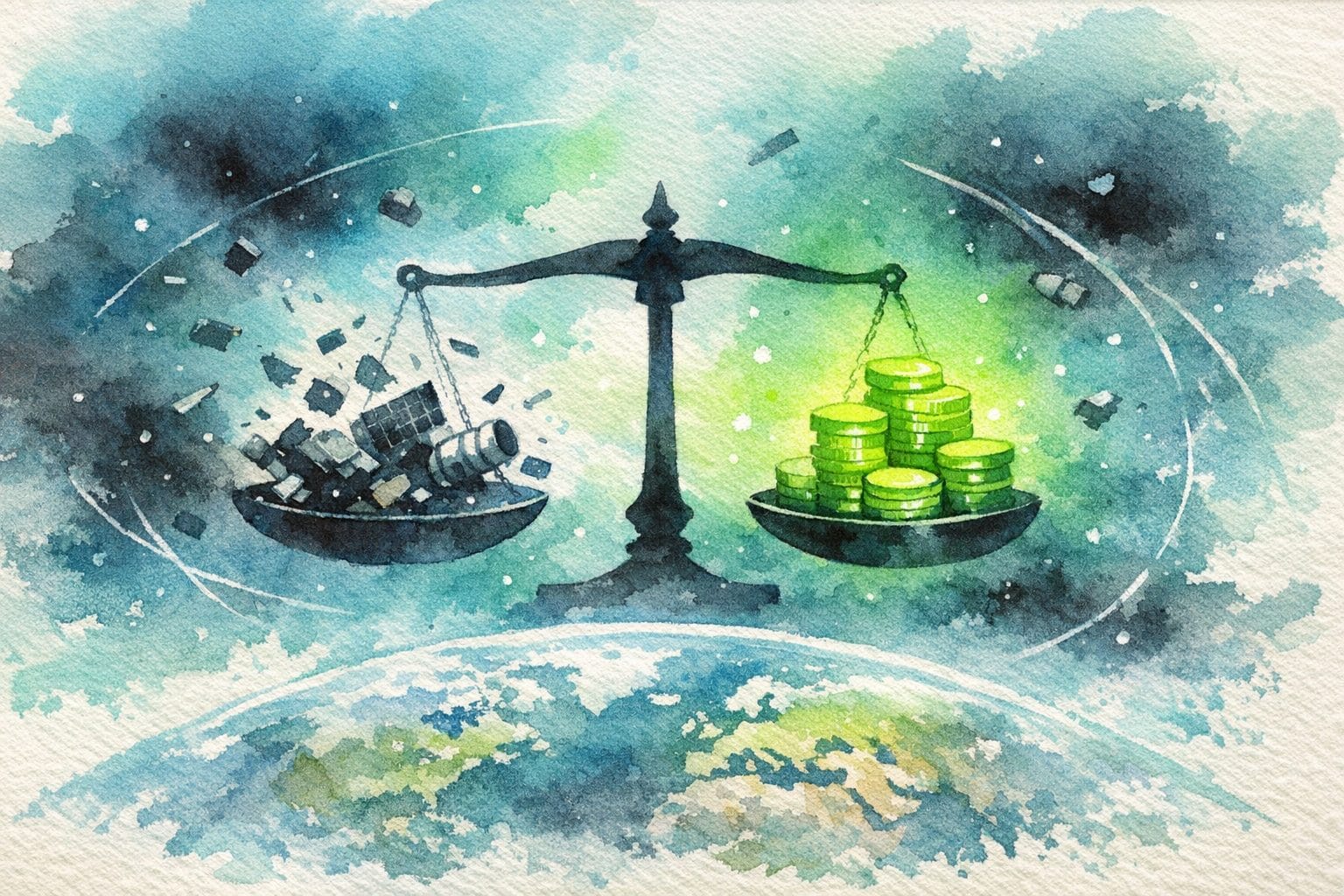
A scientific article that is free for readers can cost its author thousands of euros. The European Commission’s audit covering 27 member states and eight associated countries documents this reversal: open access, conceived to democratize reading, now charges the right to publish. Under-resourced institutions publish less not because they research less, but because they cannot afford to pay.
The essentials
- Open access is growing in Europe, but unevenly across member states and types of institutions.
- Publication fees charged to authors—up to several thousand euros per article in top-tier journals—constitute a structural barrier for researchers at less well-funded institutions.
- Universities in Central and Eastern Europe, and small institutions without collective licensing agreements, are most exposed.
- The European Commission calls for coordinated action to prevent the economic model of scientific publishing from reproducing, on the production side, the inequalities it claims to erase on the reading side.
Open access is progressing, but the price of freedom varies with your budget
For roughly the past fifteen years, Europe has pushed its researchers to publish in open access. The idea is sound: knowledge financed with public money should be readable by all, without subscription. Major funding agencies, starting with France’s National Research Agency and its German, British, and Dutch equivalents, made it a condition of their grants.
The result is real. A growing share of articles produced in Europe is now freely accessible. But the report that the European Commission’s directorate general for research and innovation published in September 2026 highlights a side effect that movement advocates had underestimated.
Scientific publishers adapted their economic model to preserve revenue. Rather than eliminating payment by readers, hybrid publishers often add an option where the author, their institution, or their funder pays publication fees. These fees, designated in industry jargon as article processing charges (APCs), can reach several thousand euros for publication in a top-tier journal. Nature charges $12,850 per article for its Gold Open Access option; Science is not presented by AAAS as a Gold Open Access journal with APCs, unlike Science Advances.
For a well-funded university with a collectively negotiated licensing agreement and a dedicated budget, this cost is manageable. For a research laboratory in Romania, Bulgaria, or Slovakia, it often represents several months of operating budget.
The map of inequality follows that of national income
The European audit covers 35 countries. It reveals that open access progress is geographically highly concentrated. The Netherlands, Sweden, and the United Kingdom show the highest rates of articles published in open access. Central and Eastern European countries remain significantly behind.
Polish, Czech, and Hungarian researchers publish in competitive international journals. The institutional capacity to fund publication fees varies by country. Major research universities in wealthy countries have negotiated so-called “transformative” agreements with leading publishers: Elsevier, Springer Nature, Wiley. These agreements allow their researchers to publish in open access without paying per article.
Without a transformative agreement, an institution can pay APCs individually, but other routes to open access without APCs exist.
The consequence is mechanical: researchers who most need international visibility to have impact in their field are precisely those least able to afford it.
Alternative models exist, but struggle to scale
The difficulty also stems from fragmented initiatives. Each alternative model developed in a particular discipline or national space, without overall coordination. This dispersion prevents the buildup of critical mass sufficient to influence evaluation practices or to negotiate hosting and sustainability conditions comparable to those offered by major commercial publishers. An isolated public infrastructure remains vulnerable to budgetary decisions and cannot guarantee researchers the stability they expect from a recognized publication channel.
Scientific publishing did not wait for major commercial houses to exist. Open archives like arXiv in physics, SSRN in economics, or HAL in France have allowed free, open deposit of articles for decades, readable by all. These platforms operate on public or cooperative funding, without commercial intermediaries.
The problem is recognition. In evaluating researchers and institutions, publishing in a peer-reviewed journal with a high impact factor still carries far more weight than a deposit in an open archive. The academic promotion system remains largely indexed to rankings that favor journals from major commercial publishers. As long as this link is not broken, open archives remain a supplement, rarely a substitute.
Some countries are trying other routes. Switzerland experimented with a national fund that directly finances publication fees for researchers without sufficient institutional resources. Consortiums of university libraries in Scandinavia negotiated framework agreements that pool costs across institutions of vastly different sizes. These initiatives show that solutions exist. They have not yet been scaled to the European level.
Work produced in under-resourced countries struggles to circulate at the European level when the entry cost into recognized channels is structurally inaccessible to them. The Commission’s report raises this issue without offering a definitive answer.
Institutions without framework agreements pay twice
There is an irony in the current system that the European report documents without ambiguity. A university in Lithuania or Slovenia pays a subscription to access journals whose publication fees it cannot afford. Its researchers read articles by their Dutch or Swedish colleagues, but those same Dutch and Swedish colleagues benefit, through their transformative agreements, from subsidized open access that the Lithuanian university indirectly finances through its subscriptions.
The Commission’s report does not precisely quantify this resource transfer. But the logic is clear: the least well-resourced institutions contribute, through their subscriptions, to financing a system from which they are partly excluded as producers.
This imbalance results notably from costs, regulatory fragmentation, and evaluation incentives. Major commercial publishers have succeeded in adapting their offerings to each segment of the academic market. For wealthy institutions, global agreements combining reading and publishing. For others, per-unit fees or subscriptions alone. The result is market segmentation where the structure of fees and agreements can reinforce preexisting inequalities between institutions with unequal resources.
This recalls, in another register, how procedures for access to medical treatments can deprive patients of care available elsewhere in Europe: the resource exists, but access conditions vary depending on the starting position of the institution or country.
Commission recommendations and persistent gaps
The weakness of recommendations stems partly from their non-binding nature. They address member states and institutions without creating obligations, leaving entirely open the question of their effective implementation. Better-resourced countries, which have already negotiated favorable agreements, have little incentive to accept coordination that would redistribute benefits to less influential institutions. European collective interest and the interests of the best-positioned actors diverge here clearly enough that any substantial progress requires a political arbitration that the report alone cannot produce.
The Commission’s report is not limited to diagnosis. It formulates leads. The report notably recommends strengthening coordination through national reference points and monitoring at the ERA level. The lever already exists partly with cOAlition S, the grouping of European funding agencies that mandates immediate open access for its funded work. But cOAlition S does not cover all member countries, and its rules apply mainly to work funded through competitive calls, not to the entire corpus of scientific output.
The report supports sustainable European funding for open science infrastructures. Platforms like OpenEdition in the humanities or DOAJ, the directory of open access journals, operate with modest public budgets and already cover thousands of titles. Strengthening them presents an alternative to publication fees demanded by major commercial publishers.
The report recommends better alignment of evaluation systems with open access objectives. As long as evaluation systems tend to reward editorial prestige and closed publication channels, researchers and institutions will have a powerful reason to pay the requested fees. Evaluation systems that value deposits in open archives, shared research data, or software published in open source code would change the calculation. Several European countries have begun this shift, but it remains incomplete.
Here we find a structural obstacle analogous to that encountered by public buyers facing innovation: the system’s rules reward conformity to established standards, even when these standards impede the stated objective.
Signals pointing toward possible rebalancing
A few recent developments suggest that the status quo is not immutable. In 2024, several American universities decided not to renew bundled subscriptions with Elsevier, or to renegotiate them by reducing their scope. In Europe, Germany conducted tough negotiations with the same publisher that resulted in an agreement integrating open access and reading for its universities. These precedents show that the balance of power can shift when institutions act collectively.
On the researcher side, entire communities have developed alternatives. In mathematics and computer science, arXiv has been the de facto reference for years, to the point that commercial journals often play an ex post validation role rather than serve as the main distribution channel. In biology, preprint platforms like bioRxiv have altered how research results are shared. These developments originate from researchers themselves, without awaiting institutional decisions.
The European Commission’s report thus arrives on time. Its value lies less in its recommendations, which are not new, than in its scope: 35 countries, systematic comparison, official recognition that progress is uneven and that inequality follows a resource logic. This is the type of diagnosis that, in other domains like digital infrastructure access or clinical research, preceded more ambitious convergence policies.
The question that remains open is timing. Scientific publishing models evolve slowly, because actors who benefit from them have the means to slow change. But under-resourced institutions in Central and Eastern Europe now have a European audit documenting their situation. This is a point of leverage their representatives can use in upcoming negotiations on research funding at the European level, notably within the framework of the next program-framework succeeding Horizon Europe.
Sources
- European Commission, Directorate General for Research and Innovation, Open access policies in EU Member States and beyond, 15 September 2026
- COAlition S, Plan S and its implementing guidelines (cOAlition S, coalition of European funding agencies)
- DOAJ, Directory of Open Access Journals (directory of open access journals)
- OpenEdition, open publishing platform in humanities and social sciences
- ArXiv, open archive in physics, mathematics, and computer science (Cornell University)