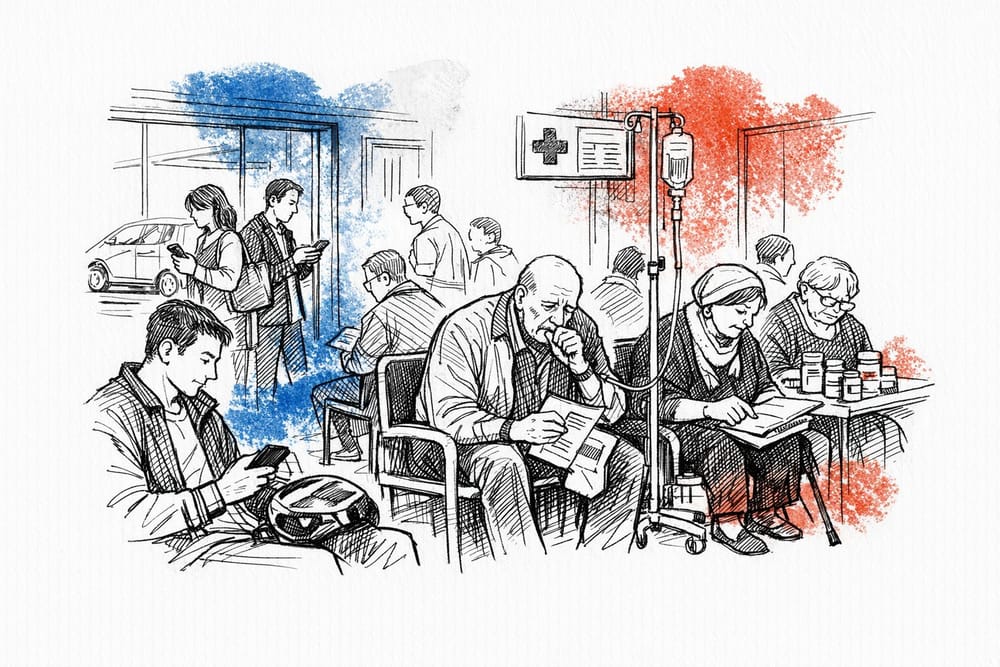
Becoming seriously ill in France remains less costly than elsewhere in Europe. This true fact produces a dangerous illusion: it masks the fact that the most severely ill patients pay proportionally far more than the healthy, and that this imbalance will worsen as chronic diseases become more prevalent.
The “One Hundred Percent” That Doesn’t Cover Everything
The average out-of-pocket cost in France stands at 292 euros per person in 2024, compared with 276 euros in 2023. These 292 euros are a national average. It includes millions of people who paid almost nothing in the year, and several million who paid considerably more.
The long-term illness status (ALD) scheme aims to reduce out-of-pocket costs after mandatory health insurance for patients with chronic illness requiring prolonged treatment and particularly expensive therapy. In theory, care related to the condition is reimbursed at 100 percent. Yet the out-of-pocket cost for patients with ALD status, after Social Security reimbursement, is almost twice as high as that of other patients: 780 euros versus 430 euros.
The “100 percent” fractures along four lines. Expenses can relate to transportation for follow-up examinations, to medications that are little or not reimbursed and prescribed during the post-treatment period, to consultations with professionals like psychologists or dietitians, or to doctor’s fee overcharges. One person in two reports having out-of-pocket costs between two and five years after the end of treatment.
For breast cancer, the figures are precise and severe. The resulting financial burden averages between 1,300 and 2,500 euros according to the League Against Cancer, an amount that leaves more than 50 percent of insured women under 40 concerned in distress and pushes some to forgo treatment options that are too expensive.
Doctor’s fee overcharges reached 4.5 billion euros in 2024. Among private practice medical specialists, more than half practice in sector 2 (allowing fee overcharges), and this proportion is set to grow. For a patient with ALD status living in an area where the no-overcharge sector is barely present, the 100 percent coverage status does not protect against overbilling. The poorest 20 percent forgo care 1.5 to 2 times more than the general population.
Twenty Million With Chronic Illness Within Ten Years
In 2024, 14.5 million people are covered under long-term illness status, with an increase of 2.3 percent per year on average since 2015. These patients account for nearly two-thirds of health insurance expenditure, around 112 billion euros. Four families of conditions (cardiovascular disease, cancer, mental health, and diabetes) together account for three-quarters of those concerned.
This figure will not stabilize. The number of beneficiaries could rise from 14.1 million in 2023 to 18 million by 2035, a figure more than double in the space of thirty years. Population aging mechanically increases the frequency of chronic conditions; medical advances allow people to live longer with diseases once quickly fatal, now transformed into ALD status.
Spending follows the same curve. Average healthcare spending for a patient with ALD status reaches 9,560 euros per year, compared with 1,230 euros for patients without ALD status. The share of ALD patient spending in health insurance reimbursements could reach 75 percent by 2035. Under these conditions, “financial sustainability is not assured,” according to the IGF and IGAS.[*]
The mechanism is clear: as the population ages, ALD cases increase, spending dedicated to them grows, and the system seeks savings by adjusting exemptions: which places greater burden on the sick. This circle rests on an architecture invented in 1945, a list of thirty conditions that was not designed for a society where 40 percent of the population will live with chronic illness within ten years.
The List of Thirty Wasn’t Built for This
Out-of-pocket cost across the full scope of current health spending is higher than for current care alone, due to greater household participation in long-term care. The latter represents only 16 percent of spending but concentrates 37 percent of household out-of-pocket costs.
In other words, the scheme protects well where it was designed (acute care in medical offices and hospitals) and protects poorly where needs are rising: long-term care, nursing homes, supportive care. In nursing homes, average out-of-pocket cost was 1,957 euros per month in 2019; accounting for price changes, it reaches between 2,100 and 2,300 euros per month in 2026. For a retired woman living alone whose average pension is around 1,400 euros, the math is impossible.
France is the only country with a protection system like ALD status, while other countries favor capping out-of-pocket costs for the entire population. Germany and Belgium made this choice long ago. This is not a curiosity: it is a sign that the French model has taken a turn that its neighbors have not.
The decision to enter or not enter ALD status creates a binary border. On one side, the seriously ill person is protected. On the other, the less severely chronically ill person or one in remission pays full price. Between the two, administrative logic determines who is covered: not actual spending or the patient’s income.
Replace the List With a Right to a Ceiling
The IGAS and IGF published on September 24, 2026 a costing study on the future of the relationship between mandatory health insurance and supplementary health coverage. It analyzes different scenarios for a health safety net, consisting of capping out-of-pocket costs after mandatory health insurance: beyond a certain amount of health spending, health insurance would cover 100 percent of costs.
A structural reform could consist of establishing a health safety net capping all out-of-pocket costs. Depending on the parameters chosen (level of out-of-pocket costs covered, whether to account for income, specific rules for chronic diseases), effects would be highly variable. Such a reform would simplify the existing exemption system and improve its clarity, while protecting against extreme out-of-pocket costs.
The option proposed here is specific: substitute for the list of 30 ALD conditions an annual out-of-pocket cost ceiling, calculated in proportion to income and enforceable against health insurance. A patient whose health spending exceeds this threshold (for instance 2 percent of their annual income) pays nothing beyond it: Social Security automatically takes over.
This change alters who decides and on what basis protection is granted. Today, it is the nature of the condition, validated by a doctor and an administrative list, that triggers protection. Tomorrow, it would be actual spending and the patient’s income. A diabetic in partial remission, a person in supportive care for cancer, a modest nursing home resident: all would be covered once their financial burden exceeds a threshold guaranteed by law.
The IGF-IGAS mission calculated different scenarios. It notes that the effects of a health safety net would vary greatly depending on the parameters chosen and that the reform would allow protection against extreme out-of-pocket costs. Implementation would require at least three years for the health safety net.
The trade-off is clear. A well-calibrated universal safety net mechanically reduces the market for supplementary health coverage for serious conditions, which would no longer have to act as a buffer between health insurance and the patient. Insurers would lose part of their current role. Supplementary insurance premiums could fall for insured persons whose risk is pooled toward the mandatory scheme. But the state would then bear what it currently entrusts to private operators whose premium is not indexed to income.
The cost of transition depends entirely on the level of the ceiling and its variation according to income. This is a political decision: not a technical question. The report does not favor any scenario; each responds to a different objective, between better protection of insured persons, clarification of financing, and reduction of supplementary insurance costs. Their reconciliation will depend on the parameters chosen and political decisions.
What this reform would make impossible afterward: that a patient with ALD status pay 780 euros per year on average in out-of-pocket costs because their supportive care or fee overcharges escape the official protocol. Protection would no longer depend on a fixed diagnostic category, but on a financial limit guaranteed to everyone according to what they earn.
Sources
[1] DREES, “Healthcare Spending in 2024: Results of the Health Accounts, 2025 Edition,” September 2025, https://drees.solidarites-sante.gouv.fr/publications-communique-de-presse-infographie-documents-de-reference/250930-Panorama-depenses-de-sante (accessed 28/11/2026).
[2] DREES, “Healthcare Spending: A Progressive Effort Rate Among the Economically Active, Lower Among Affluent Retirees and Very High for Certain Low-Income Households,” Studies and Results No. 1345, August 2025, https://drees.solidarites-sante.gouv.fr/publications-communique-de-presse/250828_ER_depenses-de-sante (accessed 28/11/2026).
[3] DREES, “Health Accounts: 2024 Edition,” infographic, 2024, https://drees.solidarites-sante.gouv.fr/publications-communique-de-presse-infographie-documents-de-reference/241120-Panorama-CNS24 (accessed 28/11/2026).
[4] Health Insurance (CNAM), “Annual Report on Charges and Income for 2026,” June 2025, https://www.assurance-maladie.ameli.fr/presse/2025-06-24-cp-presentation-rapport-charges-et-produits-2026 (accessed 28/11/2026).
[5] Health Insurance (CNAM), “Long-Term Illnesses: Health Insurance Spending for Insured Persons with ALD Status,” https://evaluation.securite-sociale.fr/home/maladie/1.7.2.%20D%C3%A9penses%20d%E2%80%99assurance%20mala.html (accessed 28/11/2026).
[6] IGF-IGAS, “Spending Review on Long-Term Illnesses,” report, September 2024, updated July 2025, https://igas.gouv.fr/sites/igas/files/2025-07/Rapport%20Igas-IGF%20affections%20longue%20dur%C3%A9e%20(revue%20de%20d%C3%A9penses).pdf (accessed 28/11/2026).
[7] IGAS-IGF, “Mandatory Health Insurance and Supplementary Health Coverage: Numerical Insight into Scenarios for the Evolution of Healthcare Financing,” September 24, 2026, https://www.igas.gouv.fr/assurance-maladie-obligatoire-et-complementaires-sante-un-eclairage-chiffre-sur-les-scenarios-devolution-du-financement-des-soins (accessed 28/11/2026).
[8] IRDES, “Doctor’s Fee Overcharges: Physician Practices, Share in Their Income and Patient Impact,” Report No. 596, October 2025, https://www.irdes.fr/recherche/2025/rapport-596-les-depassements-d-honoraires-pratiques-des-medecins-part-dans-leurs-revenus-et-impacts-pour-les-patients.html (accessed 28/11/2026).
[9] HCAAM-IGAS, “Annex 4: Out-of-Pocket Costs and Coverage of Fee Overcharges,” October 2025, https://www.strategie-plan.gouv.fr/files/files/Publications/2025/2025-10-02%20-%20HCAAM%20-%20D%C3%A9passement%20d’honoraires/Annexe%204%20RAC%20Rapport%20Hcaam.pdf (accessed 28/11/2026).
[10] Senate, “Report on Out-of-Pocket Costs for Dependent Elderly Persons,” Information Report No. 428, 2018, https://www.senat.fr/rap/r18-428/r18-428_mono.html (accessed 28/11/2026).
[11] National League Against Cancer, “Access to Supportive Care and Care Coordination in Oncology,” 2022, https://www.ligue-cancer.net/articles/acces-aux-soins-de-support-et-coordination-des-parcours-en-cancerologie (accessed 28/11/2026).
[12] Senate, “Bill Proposal Aimed at Full Coverage of Care Related to Breast Cancer Treatment by Health Insurance,” Report No. 066, 2024, https://www.senat.fr/rap/l24-066/l24-066_mono.html (accessed 28/11/2026).
[13] National Assembly, “Bill Proposal for the Creation of a Cap on Out-of-Pocket Healthcare Spending in Proportion to Income,” No. 2594, May 2024, https://www.assemblee-nationale.fr/dyn/16/textes/l16b2594_proposition-loi.pdf (accessed 28/11/2026).
[14] Nicolas Bouzou (co-author of the Hubert-Bouzou-Junique-Von Lennep report, “Rethinking the Relationship Between Mandatory Health Insurance and Supplementary Health Coverage”), cited in IGAS-IGF, 2026 [7].
[15] Hippolyte d’Albis, economics of ages of life, demography and generations: journal corpus, voice mobilized for the demographic trajectory of ALD.
[*] IGF and IGAS are independent audit and inspection bodies in the French government responsible for evaluating public spending and policy implementation.