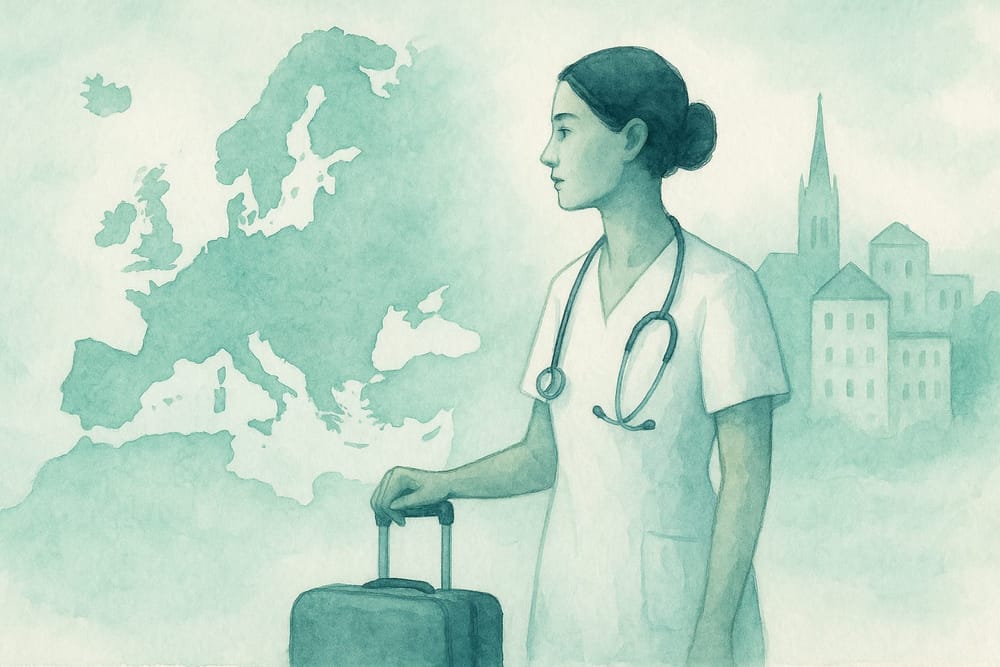
Nurses from Central and Eastern European countries are leaving to work in Western and Northern Europe. The European Union guarantees this freedom. But what free movement makes possible on the departure side, it makes impossible on the arrival side: the retention of healthcare workers in countries of origin is affected by multiple factors, while host countries must continue to train and retain their own staff. The result is a silent transfer of human resources from the most fragile health systems to the most solid ones, in the name of the same European integration supposedly designed to reduce inequalities.
The essentials
- The European Commission’s Country Health Profiles 2025 describe national health systems and document uneven nurse density across Europe.
- Poland has a nurse density below the EU average, with no official figure established for the deficit precisely caused by departures to Germany.
- The retention of healthcare workers depends on several interdependent factors: pay, working conditions, and professional opportunities.
- France faces growing demand for long-term care linked to its aging population.
- Mechanisms exist to promote retention: bilateral agreements, accelerated training, improved working conditions, but their implementation remains uneven.
European mobility produces geographic winners and losers
Free movement of workers is one of the best-documented successes of European integration. For a Polish or Romanian healthcare worker, it concretely means the possibility of doubling or tripling their salary without changing continents, without administrative barriers, often without even learning a new language beyond functional level. This freedom is real and legitimate.
Poland experiences low nurse density, which creates tensions in access to care. The Polish health system faces a retention problem that training alone cannot solve. Training more nurses without improving working conditions risks seeing them leave for wealthier countries, producing a transfer of human resources between systems.
The Country Health Profiles 2025 document workforce tensions in several Central and Eastern European countries. Poland is the most documented illustration, but not an isolated case. The density of healthcare workers per capita is a significant difference between these countries and host countries, among other structural factors. In France, nurse density was slightly above the EU average in 2023. Low nurse density affects access to care in Central European countries.
Salary explains departures, but not returns
The most intuitive hypothesis is that healthcare workers leave for money and return when salaries converge. The data suggest a more complex reality.
Nurse density varies significantly between Sweden and Poland. The salary gap between Sweden and Germany is nonetheless smaller than the gap between Poland and Germany. Professional working conditions, including autonomy in practice, influence healthcare worker retention. These are qualitative working conditions, difficult to summarize in a contract.
For sending countries, a retention policy focused solely on salary increases remains insufficient: Germany can always offer more. On the other hand, it offers less readily the social network, family proximity, native language, and local knowledge. These factors weigh in healthcare workers’ calculations and can be activated by targeted policies: improved working conditions, reduced administrative burden, development of local career prospects.
Several countries are attempting this approach. Poland has pursued since 2022 a series of reforms to nursing working conditions, with revaluation of delegated procedures and simplification of hospital protocols. Results remain preliminary, and data are lacking to measure a net effect on departures. But the diagnosis is established: the problem is structural, and the response must be too.
France, a host country, deepens its own dependence
France illustrates another facet of the phenomenon. France attracts nurses trained elsewhere in the face of structural tensions in its health system. In 2021, according to DREES, more than 2 million people aged 60 and over were experiencing loss of autonomy in France. The OECD anticipates a rise in demand for long-term care linked to demographic aging. Demand for nursing home beds should increase as the population ages.
France’s natural population balance became negative in 2025, according to provisional INSEE estimates: 651,000 deaths for 645,000 births.
These figures describe a trajectory, not an imminent catastrophe. But they outline a context in which France cannot afford to rely on sufficient domestic training in the short term. International recruitment responds to structural tensions between care supply and needs linked to aging.
The paradox is visible: France invests in medical and paramedical training while welcoming professionals trained elsewhere. This transfer appears in no European budget, in no line of community solidarity. It is invisible in accounting terms, but real in its effects. Here we find a tension that runs through other sectors, like competition for qualified talent in tech, where less well-funded countries finance skills development that wealthier ones later capture.
Policies for retaining healthcare workers in sending countries
A few European systems have succeeded in limiting outflows without closing borders. Sweden, as noted, relies on professional autonomy. The Netherlands has developed since the 2010s a delegation-of-procedures model that expands legally recognized nursing competencies, reducing frustration among highly trained healthcare workers confined to subordinate tasks. Norway combined salary revaluation and reduced working time, indexing pay to service inflation rather than fixed conventional scales.
These experiences are not mechanically transposable. Institutional context, the structure of wage negotiations, levels of unionization, and relationships between medical and paramedical professions vary sharply from country to country. But they show that retention is achievable, and it rarely hinges on a single lever. The combination of autonomy-pay-workload seems to be the triptych that works, where each of these elements taken in isolation remains insufficient.
Bilateral agreements also exist, at the margins of European law. Germany has signed partnerships with the Philippines and Morocco that include commitments to training and temporary returns to countries of origin. These mechanisms are imperfect, returns remain difficult to guarantee, but they introduce a logic of reciprocity absent from pure free movement. Applying a similar mechanism among EU member states would require political will that does not yet exist, but the model is there.
Toward 2040: which systems withstand demographic pressure
The 2035-2040 horizon places European countries before a double constraint. Demand for long-term care will grow in all developed countries simultaneously, due to aging. Competition to attract trained healthcare workers will therefore intensify, including among countries now as senders. Poland, whose population is aging rapidly, will need its nurses in ten years. The question is whether they will still be there.
Two trajectories are emerging, though it is not yet possible to determine which will prevail.
In the first, Central European countries manage to pursue structural reforms of their care systems before demographic pressure becomes critical. They invest in professional autonomy, improve working conditions, develop short training pathways targeted at home care. The migration flow slows without border closure, simply because the attractiveness differential diminishes. It is a conditional scenario: it supposes budgetary choices that compete with other political priorities.
In the second, competition intensifies. Facing their own demographic crisis, several wealthy countries strengthen attractiveness bonuses. Flows accelerate. Health systems in sending countries would undergo degradation, which could alter patient flows seeking care abroad and widen the gap. This scenario would produce a Europe with accentuated healthcare inequalities: some Northern and Western systems would have more resources, also experiencing shortages and dependence on foreign-trained labor, while Central and Eastern systems would remain under-resourced.
About three decades after the fall of the East-West border, healthcare and investment gaps would persist in Europe.
Between these two trajectories, institutional and political variables play a significant role. The European Union facilitates recognition of qualifications and can finance the strengthening of health systems, which can indirectly influence mobility. European instruments continue to develop, notably through European or regional actions on recruitment and retention of existing nurses no later than 2023-2024. A directive could regulate certain aspects of professional mobility, such as recognition of qualifications. However, obligations for compensation between national systems or care organization would encounter competencies largely held at national level in health.
Healthcare sovereignty thus limits European harmonization, without preventing the EU from adopting rules on professional mobility, a sensitive subject since the Covid crisis.
The signal to watch is that of negotiations on the next EU multiannual financial framework, expected from 2027 onward. If cohesion funds include an envelope explicitly targeted at healthcare human resources, with conditionalities on working conditions and retention rates, that would indicate that Brussels has integrated the problem into its political agenda. Otherwise, correction will remain the charge of the least equipped countries to achieve it.
The tension between integrated labor market and care equity is not specific to healthcare. It appears in other sectors, where youth unemployment dynamics and qualified mobility illustrate comparable trade-offs between national attractiveness and talent flight. What is specific to care is the irreversibility of consequences for the most vulnerable populations: a dependent senior in rural Poland cannot, themselves, exercise their own freedom of movement to access quality care.
The trade-offs Europe must make clear
The mobility of healthcare workers poses a trade-off that the EU has not yet clearly named: between freedom of movement as a fundamental right and equity of access to care as a common good. These two principles are compatible, no one proposes closing borders to nurses, but their compatibility requires active management, not passive reliance on market mechanisms.
Several avenues are documented. Train more quickly in sending countries, with short pathways targeted at the most demanded long-term care procedures. Improve working conditions before even acting on salaries, because retention is primarily decided on this terrain. Develop reciprocity agreements between national systems, modeled on those Germany has concluded with third countries. Channel European funds toward healthcare human resources, with measurable retention indicators.
None of these avenues is simple to implement, and each presumes political trade-offs that member states have not yet wanted to settle. But demographic pressure in the 2030s will force them to do so. The question is whether it will be by anticipation or by default. Competition for talent in other sectors shows that Europe knows how to mobilize significant resources when stakes are identified as strategic. Healthcare workers deserve the same diagnosis.
Sources
- Health Economics Review, Nurse Mobility and Retention in Europe
- European Commission, Country Health Profiles 2025: https://health.ec.europa.eu/state-health-eu/country-health-profiles/country-health-profiles-2025_en
- OECD, Health at a Glance 2025 (OECD Publishing, Paris)
- Healthy Europe, European Health Systems Compared: https://healthyeurope.eu/european-health-systems-compared/