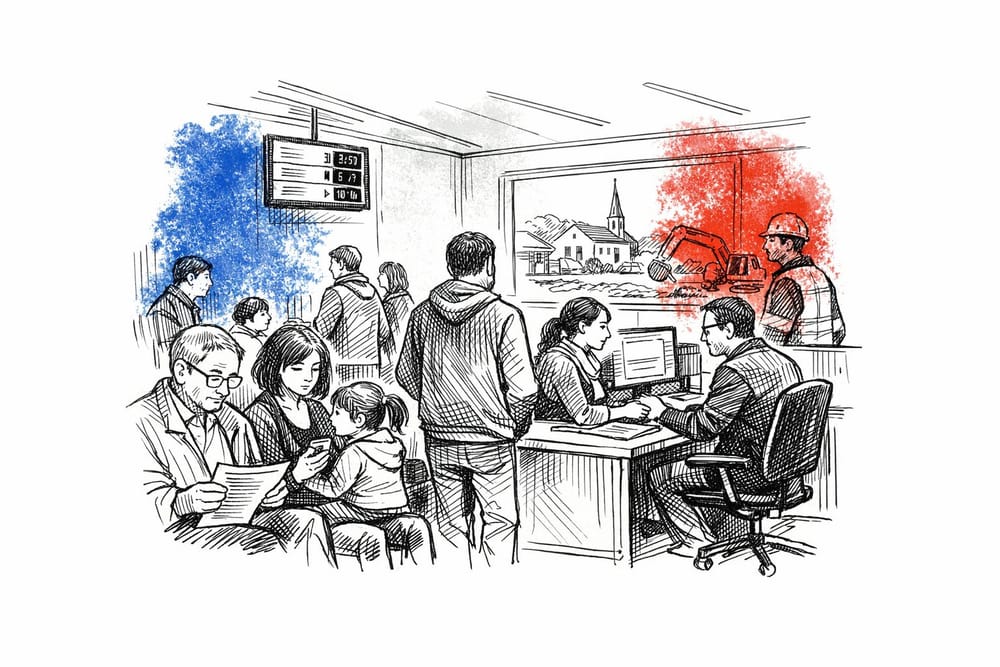
Four million French people live more than thirty minutes away from a general practitioner. Thousands of others have no physical access to an administration, a school, a social welfare office. Rural France is not lacking rights on paper. It lacks the services to exercise them, and it has no voice in what closes.
Seventeen Thousand Schools Closed in Forty Years
Of the 60,059 schools France had in 1985, 17,616 closed over forty years [3]. This is not evenly distributed across the territory: the northeast of the country, Normandy, and the Massif Central absorb a disproportionate share of these closures, according to data from the Ministry of National Education through 2025 [3]. The trend is not slowing. Public schools in priority education zones in urban areas gained 12,844 classrooms over the last decade [4]. Rural public schools lost 6,229, a decline of 8.1% [4].
Health is following the same trajectory. Approximately 6.3 million French people live in areas classified as under-served for general practitioners in 2024 [5]. Rural areas represent 30% of the population but only 25% of general practitioners [6].
From one department to another, the gaps are vast: between 49 and 290 doctors per 100,000 inhabitants [6]. The result: residents in very sparsely populated rural areas consume 16% fewer hospital services than the national average [6]. Less access, not fewer needs.
Administrative services have followed the same pattern. 82% of transactions now take place online [9], after thirty years of closures of treasuries, post offices, and social welfare windows. In rural areas, digital exclusion compounds physical distance rather than offsetting it.
One Million Additional Elderly People in Territories Losing Their Healthcare Workers
Rural areas are aging faster than the rest of the country [9]. By 2030, 20.6 million French people will be 60 or older, 1.9 million more than in 2023 [7]. Among them, 1.7 million will be 75 or older [7].
These people are concentrated precisely in the least-resourced territories. Poverty deepens with distance from urban centers: the poverty rate for households rises from 8.9% in periurban rural areas to 13.8% in non-periurban rural areas [9]. Elderly people in need of care at home are more numerous in the poorest departments [8].
The mechanism is documented: rural areas that are aging, impoverishing, and seeing their needs for care and support increase each year, in territories where supply has been declining for thirty years. A double constraint: fewer means to access the service, fewer services to reach. The 2024 annual report of Catholic Relief documents the rights violations that result in rural areas [11]. Rights that are formally available, practically inaccessible.
France Services Covers 6% of Rural Communes
The main public response is called France Services. The numbers are real: 2,840 access points opened in 2024, compared to 1,340 equivalent structures in 2018 [1]. In 2023, these sites handled 9 million requests, compared to 1.17 million in 2020 [1]. User satisfaction exceeds 90% [1].
But the Court of Auditors, in its evaluation of September 2024, identifies the flaw [1]: part of the population remains far from access due to lacking mastery of digital tools, which nevertheless form the other component of the program. Total cost is estimated at approximately 350 million euros for 2024. The State finances about 113 million. The rest relies on local authorities [1].
This is where the architecture reveals its problem. 68% of the 2,840 France Services access points are in rural areas as of end 2023 [1]. This represents 1,931 points of access for 30,775 rural communes [2], or approximately 6% of rural communes covered [1, 2].
The State sets the label, standards, and requirements. Rural communities finance the majority of operations. And the decision to close or maintain a national service remains in the hands of Paris-based administrations, with no obligation to consult local elected officials.
The program alleviates a symptom without addressing the mechanism: national services that reconfigure themselves according to their own rationalization logic, without accounting to the territories they abandon.
Transfer Responsibility, Not Just the Bill
The 2027 arbitration concerns governance, not the amount of funding allocations. Increasing the flat-rate allocation or labeling more France Services spaces leaves the current power dynamic intact. Changing who decides transforms it.
Today, school assignments, the location of treasuries, the network of health structures are determined by national administrations, sector by sector, without territorial coordination and without local elected officials having a say. Equalization transfers money to rural communes to compensate for extra costs. It gives them no leverage over what closes.
The transfer to consider is this: entrust rural intercommunalities with the responsibility for organizing first-tier services—primary care doctors, administrative support, early childhood, care for the elderly. This transfer comes with an enforceable right to service implantation, that is, a national minimum service standard that the State must fund, not simply subsidize on a case-by-case basis. After this transfer, the State can no longer decide alone to close a service point without agreement from the intercommunality in question.
The logic aligns with the work of Dani Rodrik on industrial policy [12]: top-down instruments, subsidies, and tax incentives distributed from the capital, do not capture the actual needs of an aging territory. Collaborative interaction between public agencies and local actors produces better results. Olivier Lluansi formulates the same diagnosis for territorial development [13]: top-down equalization compensates without empowering; it perpetuates dependence.
On the budgetary level, the constraint is real but not decisive. The national funding that already exists, allocations and operators, follows the transferred responsibility. What changes is that decisions to close or maintain services exit the sole purview of national administrations. The cost of a rural service is structurally higher per capita than its urban equivalent. This reality deserves to be financed by national solidarity, with an amount calculable by territory, enforceable against the State budget, not left to ministerial discretion.
Sources
[1] Court of Auditors, “France Services Program (2020-2023)”, public policy evaluation, September 2024, https://www.ccomptes.fr/fr/publications/programme-france-services-2020-2023 (accessed 29/09/2026).
[2] INSEE, “A New Definition of Rural Areas to Better Account for the Realities of Territories and Their Transformations”, France and Its Territories, INSEE References, 2021 edition, https://www.insee.fr/fr/statistiques/5039991?sommaire=5040030 (accessed 29/09/2026).
[3] Ministry of National Education / Franceinfo, data on school closures since 1985, through 2025, https://www.franceinfo.fr/societe/education/plus-de-17-000-ecoles-ont-ete-fermees-en-france-depuis-40-ans_7800776.html (accessed 29/09/2026).
[4] DEPP / National Assembly, information note on the evolution of rural classes 2015-2025, written question no. 16890, July 14, 2026, https://questions.assemblee-nationale.fr/q17/17-16890QE.htm (accessed 29/09/2026).
[5] DREES, “2024 Figures on Under-Served Areas for General Practitioners”, data from the Shared Repository of Health Professionals (RPPS), https://drees.solidarites-sante.gouv.fr (accessed 29/09/2026).
[6] Association of Rural Mayors of France (AMRF), Study on Health in Rural Areas, press dossier, 2023, cited by Geoconfluences, ENS Lyon, https://geoconfluences.ens-lyon.fr/actualites/veille/breves/deserts-medicaux-france-orne (accessed 29/09/2026).
[7] DREES, Personnel Needs in Response to Population Aging, DREES Dossiers no. 123, October 2024, https://drees.solidarites-sante.gouv.fr/sites/default/files/2024-10/DD123.pdf (accessed 29/09/2026).
[8] INSEE, “More Elderly People in Need of Care at Home in the Poorest Departments”, INSEE Focus no. 314, December 2023, https://www.insee.fr/fr/statistiques/7716002 (accessed 29/09/2026).
[9] INSEE, Presentation of Rural Areas, Senate colloquium, Filosofi 2021 and Population Census 2022 data, https://www.senat.fr/fileadmin/Office_et_delegations/Collectivites_territoriales/Controle/2024-2025/Presentation_INSEE.pdf (accessed 29/09/2026).
[10] Senate, information report, Mathilde Desjonquères and Pierre Morel-A-L’Huissier, “Implementation of the Conclusions of the Report on Access to Public Services in Rural Territories”, April 2023, https://www.senat.fr (accessed 29/09/2026).
[11] Catholic Relief, 2024 Annual Report, November 2024, cited by written question no. 2977, National Assembly, https://www.assemblee-nationale.fr/dyn/17/questions/QANR5L17QE2977.pdf (accessed 29/09/2026).
[12] Dani Rodrik, An Industrial Policy for Good Jobs, Hamilton Project / Brookings Institution, September 2022, https://www.hamiltonproject.org/publication/policy-proposal/an-industrial-policy-for-good-jobs/ (accessed 29/09/2026).
[13] Olivier Lluansi, Reindustrializing, the Challenge of a Generation, Les Déviations, 2024; interview Localtis, October 2024, https://www.banquedesterritoires.fr/olivier-lluansi-une-reindustrialisation-sans-trajectoire-environnementale-serait-vouee-lechec (accessed 29/09/2026).