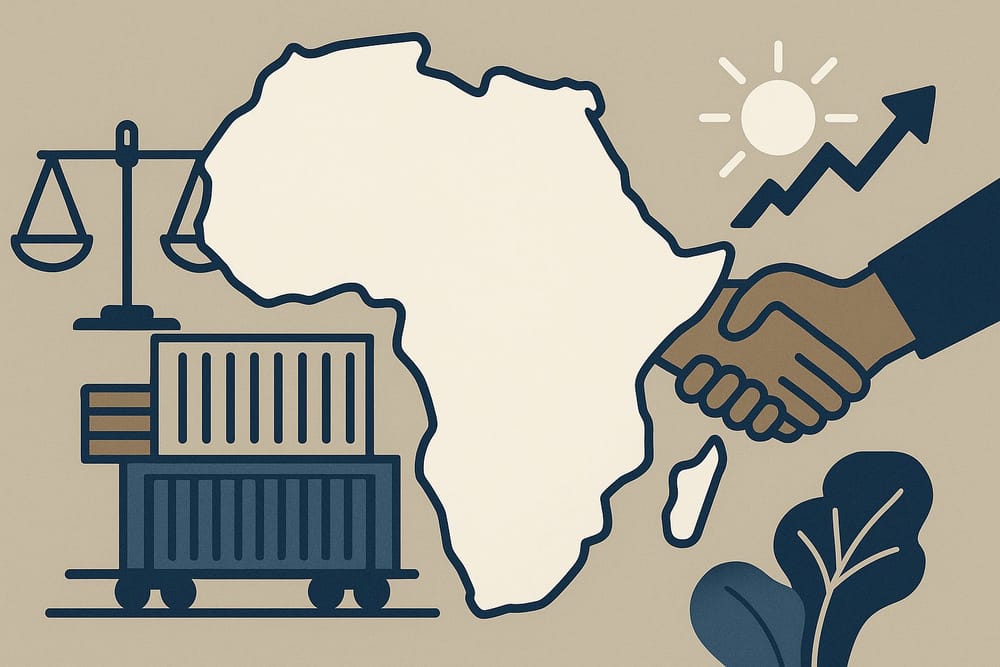
In 2017, approximately 83% of African exports were destined for markets outside Africa. Africa depends heavily on imports for manufactured goods and equipment, reflecting a strong dependence on primary products and limited productive diversification. The African Continental Free Trade Agreement (AfCFTA) aims to reverse this logic: according to World Bank projections for 2035, intra-African exports would increase by more than 81%, compared to 19% for exports to non-African countries. A continent that builds its commercial sovereignty through digital means risks reproducing asymmetries of control.
The Essentials
- In 2021, the share indicated by UNCTAD was 14.4% of total African exports, compared to 60 to 70% for intra-European or intra-Asian trade.
- According to the World Bank, the cumulative increase in intra-African exports far exceeds that of exports to non-African countries, in cumulative variation (+81% versus +19%).
- Sub-Saharan Africa accounted for more than 70% of global growth in mobile money accounts recorded in 2023, a financial infrastructure built by local actors that is becoming the nervous system of regional commerce.
- A portion of logistics flow data can be processed by external operators, which could create technological dependencies for the development of regional corridors.
- The fundamental question: building value chains inward requires active political choices, not just the elimination of tariffs.
17%: What a Number Says About a Century of Forced Economic Geography
The figure is striking. The European Union exchanges approximately 65% of its goods internally. ASEAN exceeds 25%. Africa, with fifty-four economies and 1.4 billion people, struggles to exceed a fifth of its own trade. This result stems from infrastructure historically designed for export.
Colonial rail and port networks traced axes perpendicular to the coast, from mining or agricultural sites to the shipping port. Lagos exports to Rotterdam more easily than it trades with Accra, just 320 kilometers away. African road networks remain insufficiently interconnected beyond borders, but cross-border road corridors exist and are developing. Customs regulations differ from one post to another, and currencies are not convertible between them in most regional corridors. Infrastructure deficits, non-tariff barriers, and border formalities significantly increase intra-African trade costs, but their relative level varies according to corridors, products, and partners.
The AfCFTA entered into force in 2019 and trade under its regime began on January 1, 2021. It aims to eliminate 90% of tariffs between member countries over ten years. But the secretariat’s logic does not stop at tariffs: it targets non-tariff barriers, divergent technical standards, and border crossing delays that increase regional trade far more than customs duties themselves. According to data published by Freight News Africa and SAPICS in 2026, supply chain managers identify these non-tariff frictions as the primary obstacle to developing regional corridors, ahead of freight costs.
The Corridors Already Moving
East Africa concentrates the most visible signals. The LAPSSET corridor, Lamu, South Sudan, Ethiopia, is progressively linking landlocked economies to a maritime facade. The Northern corridor connecting Mombasa to Kampala and Kigali is seeing its volumes increase since the implementation of a simplified clearance system. Rwanda, a case regularly cited as exemplary, has reduced its border crossing times to two to four hours at its main posts, and its operator Zipline ensures deliveries by drone over a perimeter covering a significant share of national territory, medicines, perishable goods, light industrial components.
This example deserves attention. Delivery drones solve a geography problem that roads cannot solve at reasonable cost in a short timeframe. They reduce dependence on urban logistics intermediaries, shorten food supply chains, and allow rural producers to access regional markets without passing through congested capitals. This is a functional breakthrough, not a technological feat.
Mobile money plays a symmetrical role on the financial side. M-Pesa in Kenya, Wave in Senegal, MoMo in roughly twenty countries: Sub-Saharan Africa accounted for more than 70% of global growth in mobile money accounts recorded in 2023, according to GSMA data. In two decades, the continent has built an operational financial infrastructure where the traditional banking system was absent or inaccessible. For a merchant in Dakar shipping textiles to Abidjan, the ability to settle an invoice in real time from a 30-euro phone is a more determining condition than the elimination of an 8% tariff.
This infrastructure is African in its deployment, but certain elements of its technical chain may remain dependent on external actors. This is where a major tension crystallizes within AfCFTA stakes.
Collective Ambition as an Economic Wager
Rutger Bregman, in Moral Ambition (2025), defends the idea that lasting transformations begin with a revolution of values: choosing to want to change the world rather than optimizing one’s position within an existing system. Applied at the continental scale, this framework offers an unexpected angle on the AfCFTA.
Building internal value chains rather than maximizing exports to Northern markets is first a political choice about what the continent wants to produce, for whom, and according to what development logic. Programs of adjustment supported by Bretton Woods institutions favored trade opening and export orientation, notably Nigerian oil, Ivorian cocoa, Ethiopian coffee. The AfCFTA pursues regional integration, industrialization, and structural transformation.
This thesis finds support in the data: World Bank projections for 2035 anticipate an 81% increase in intra-African exports and 19% toward non-African countries, partly because the starting base is low but primarily because internal needs—processed food, textiles, pharmaceuticals, light industrial goods—are growing with Africa’s middle class, whose size varies significantly depending on the definition used; the African Development Bank estimated it at nearly 350 million people in 2010 according to its broad definition.
Daron Acemoglu and Simon Johnson show in their work that the distribution of gains depends on institutions and power relationships, rather than flowing automatically from economic progress. In a digitized logistics economy, these nodes are the platforms that aggregate flow data. Aggregated data on regional commercial flows can be processed by several categories of operators, some external to the continent.
The AfCFTA’s collective ambition can be built on infrastructure that others control: and this radically changes the terms of the project.
Who Controls Data Controls Corridors
The question of logistics data sovereignty is underexplored in public debate on the AfCFTA, dominated by tariff discussions and dispute settlement protocols. Yet it is structurally central.
A commercial corridor generates data at each stage: customs declaration, weighing at the border post, transport payment, port unloading, warehouse storage, final delivery. The real-time aggregation of this data can help anticipate congestions and improve logistics planning. This is a predictive capacity of value, and it risks accumulating with operators equipped with platforms to process it.
The fragmentation of global maritime routes illustrates this mechanism at the global scale: when major shipping lines reorganize their routes, they do so based on their own data models, and economies dependent on their decisions suffer the consequences without having a voice. Africa, if it does not build its own flow analysis capacities, risks reproducing this asymmetry within its own continental market.
The warning signals are there. Several freight and payment platforms active in Sub-Saharan Africa have undergone consolidation phases. Local infrastructure is built, then may consolidate toward external centers of gravity. Mobile money follows a different logic: M-Pesa Kenya is operated by Safaricom, which Vodacom must hold a 55% majority stake in following the announced transaction, and local regulators have imposed interoperability conditions in several cases to limit concentration. This is an institutional model to replicate in logistics.
The Value Chains That Make the Difference Between Exporting and Wealth
The gap between exporting a raw material and industrializing it locally is a gap in value added, therefore in employment and income. Ivorian cocoa leaves in crude form for factories in the Netherlands and Belgium: the bean is worth a dollar, the chocolate bar ten. Ethiopian coffee is roasted in Germany: the price difference captures the margin that industrialization could have retained in Africa.
The AfCFTA creates conditions to change this equation, but these conditions alone are insufficient. There must be active industrial policies, notably special economic zones with access to electricity, appropriate technical training, and financing access for regional exporting SMEs. Several countries are advancing on these fronts. Ethiopia has developed textile industrial parks that export to the regional market and are beginning to compete with Asian imports. Morocco has built an automotive sector anchored in the regional value chains of North Africa.
Ghana is pursuing a cocoa transformation policy, “Beyond the Bean,” to retain more value added before export.
These examples show that the pivot is possible and that African actors are doing it concretely. But their generalization requires a condition that data rarely emphasizes: inter-state cooperation on standards. A regional textile value chain requires that fabric produced in Senegal be recognized as compliant in Abidjan and Lagos without costly recertification. Regulatory harmonization remains a complex undertaking for the AfCFTA.
The way Latin America attempts to weigh in the formation of AI models traces an instructive analogy: a region that does not produce its own technical standards suffers those of others, even when it participates in trade. For Africa, the risk is analogous in logistics: participating in regional commerce without controlling the technical standards that govern it means depending on the arbitrations of external operators.
Between 2035 and 2040, Two Trajectories Emerge
The AfCFTA contains differentiated timelines depending on commitments and product categories. The horizon of full integration coincides with the moment when Africa’s middle class will have doubled in size and when digital infrastructures will have reached sufficient maturity to structure regional corridors. This calendar outlines two plausible trajectories.
In the first, Africa succeeds in capitalizing on the mobile money infrastructure it has built to impose interoperability standards on logistics platforms. Flow data remains under the jurisdiction of national and regional regulators. Food, textile, and pharmaceutical value chains develop within the continent. Growth in intra-African flows exceeds initial projections because it rests on robust domestic demand and growing industrial capacity. In this scenario, the AfCFTA accomplishes what its proponents announce: a pivot from extraction toward production for oneself.
In the second, digital logistics consolidation reproduces colonial structure in another form. Freight and payment platforms that survive financing cycles are those backed by foreign capital, American venture funds, Asian logistics operators, European fintechs. They collect flow data, optimize corridors according to their own models, and sell their services to local exporters. Intra-African trade progresses in volume, but the informational value it generates accumulates elsewhere. Africa finds itself with an active regional market whose algorithmic levers it does not control.
These two trajectories are plausible scenarios whose outcome depends on the political choices that states and regional institutions will make. The signals to monitor are precise: the manner in which the African Union integrates its data policy provisions into the AfCFTA digital protocol, regulators’ capacity to impose interoperability on logistics platforms as they have done for mobile money, and the progress of sectoral regulatory harmonization in textiles, agribusiness, and pharmaceuticals.
The Rwandan drone model, the Kenyan mobile money model, and the Moroccan automotive industry model show that African actors know how to build value chains that remain under local control. The open question is whether these models can scale to the continental level, or whether they will remain islands of efficiency in a system whose geography of power remains unfavorable.
Sources
- Freight News Africa / SAPICS / Unitrans, What 2026 holds for African supply chains and the managers who shape them: https://cbn.co.za/industry-news/transport-logistics-freight-news/what-2026-holds-for-african-supply-chains-and-the-managers-who-shape-them/
- Rutger Bregman, Moral Ambition: Stop Wasting Your Talent and Start Making a Difference: https://rutgerbregman.com/books/moral-ambition
- AfCFTA Secretariat, data and projections on intra-African trade (Accra, 2026)
- GSMA, State of the Industry Report on Mobile Money (data on Africa’s share of global mobile payment transactions)
- Daron Acemoglu and Simon Johnson, Power and Progress: Our Thousand-Year Struggle Over Technology and Prosperity, PublicAffairs, 2023