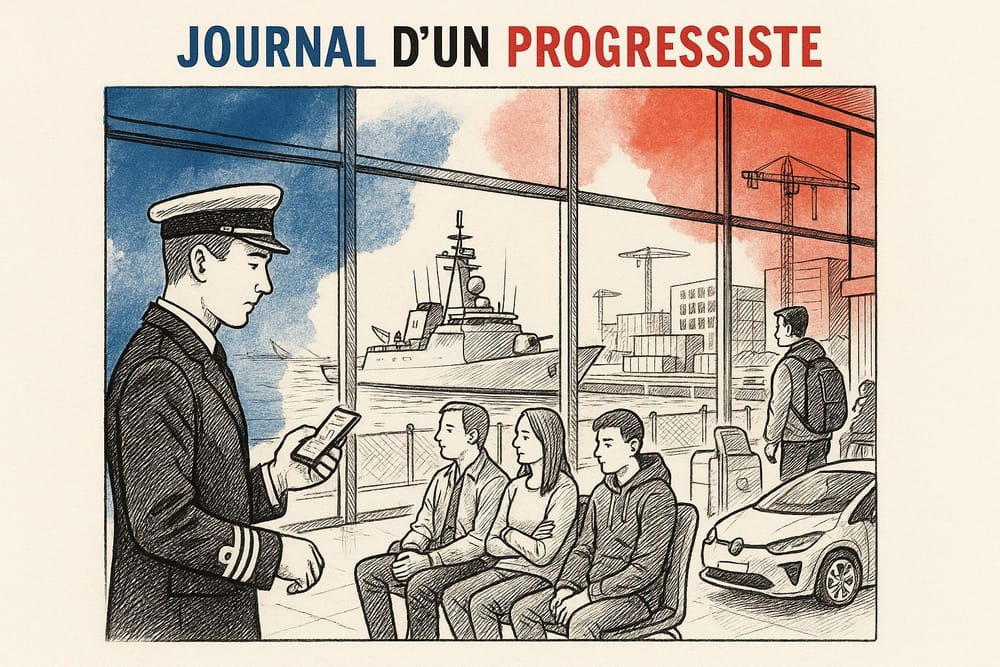
At the NATO summit in The Hague in June 2025, the allies committed to devoting 5% of GDP annually to defense and security. For France, this means tripling the effort in less than two decades. The money will flow in. The structure that allows it to be spent usefully—or uselessly—remains to be built, and that is where the 2027 decision will be made: who decides what to buy, on what industrial basis, at what level of sovereignty.
Thirty Years of Peace Dividend, Then a Lost Decade
The issue begins in the early 1990s. After the fall of the wall, Western countries cashed in what was called the peace dividend: massive cuts to military budgets, justified by the collapse of the Soviet threat. Production lines were sized for limited order volumes.
France was no exception. Military spending represented 2.06% of GDP in 2023, 1.87% in 2015, and 1.84% in 2018 [4]. An entire generation of disinvestment depleted stockpiles, reduced production rates, and allowed industrial skills to atrophy.
The 2024–2030 military programming law, enacted on August 1, 2023, launched a recovery [6]. It provides an envelope of 413 billion euros, an increase of 118 billion compared to the previous programming [6]. Defense credits would rise from 47 billion euros in 2024 to 68.9 billion in 2030 [6].
The production ramp-up is 3 billion per year until 2027, then 4.3 billion additional per year until 2030 [6]. France crossed the symbolic 2% of GDP threshold in 2024 [4]. But the The Hague summit made this trajectory insufficient. The government evoked an intermediate target of 3.5% of GDP [10].
On the industrial front, the picture is mixed. The defense industrial and technological base (BITD) concentrates 220,000 direct and indirect jobs [7]. It generates an annual revenue of 30 billion euros [7].
It rests on nine major groups and a network of 4,500 companies, of which 1,000 are considered strategic by the Defense Procurement Agency (DGA) [7]. On the export side, 2024 was the second-best year in French history. The order book totals 21.6 billion euros [5], driven notably by eighteen additional Rafale jets for Indonesia, twelve for Serbia, and four submarines for the Netherlands.
Behind these figures lies a fundamental tension. The BITD is already operating at 91% capacity utilization of its production capabilities, compared to an average of 81% for manufacturing industry as a whole [7]. This threshold, close to saturation, makes any production ramp-up impossible without major investments. Recruitment is not keeping pace: the DGA estimates 10,000 positions immediately to be filled across the 4,500 BITD companies [7].
When European Money Flows Westward
55% of European armed forces’ imports now come from the United States, according to SIPRI [2] [3]. That is 20 percentage points higher than before 2019. The only supplier seemingly able to guarantee rapid deliveries. In plain terms: post-Ukraine European rearmament is massively financing American industry.
Germany has ordered 35 F-35s and authorized the purchase of 400 AIM-120 air-to-air missiles [9]. Together with Belgian purchases of the same aircraft, these acquisitions illustrate the difficulty in organizing truly European procurement. Berlin refuses to reserve EDIP program credits for equipment designed and manufactured only in Europe, as Paris demands.
The mechanism is systemic. Each national purchase of American equipment locks in technological, logistical, and—as revealed in 2025—potentially operational dependence for twenty to thirty-five years [9]. In March 2025, a question circulated among German general staffs: could the United States remotely disable the F-35s delivered to the Bundeswehr? Defense Minister Pistorius had to consult generals and experts before publicly declaring that such remote deactivation was not possible. The dependence is such that the question had to be asked officially.
The capacity gap is massive. The number of major weapon systems in large European armies barely changed between 2023 and 2025, despite increased budgets [9]. Money is flowing, but capabilities are stagnating. A simple increase in spending will produce neither additional capacity nor independence from the United States.
The American security offer is shrinking precisely when European demand is exploding. Europe has not taken defense seriously because it never had to ensure it alone, a thesis Nicole Gnesotto has been defending for years at the Jacques Delors Institute [13]. The moment it must do so has arrived without industrial preparation.
Nuclear deterrence adds a constraint specific to France. Its sustainability is a reasonable choice, as Bruno Tertrais notes [12], but maintaining it requires substantial investments in this decade. Modernizing the nuclear component is capturing an increasing share of military programming. It directly weighs on available margins for conventional capacities and mass-production industry (ammunition, drones, armored vehicles) whose importance Ukraine revealed.
Changing the Architecture, Not the Budget Dial
France’s budgetary constraint is documented. The 2026 budget bill provides 66.7 billion euros for defense [6] [10]. The goal of 5% of GDP by 2035 would require doubling this amount in under ten years.
French public debt exceeds 110% of GDP [10]. But the amount is secondary. What determines the outcome is how the purchasing decision is made, and by whom.
The problem is first and foremost a market design problem [1]: without common rules for procurement, the preference for American equipment systematically trumps the stated preference for autonomy. American equipment costs less to buy, is delivered faster, and is anchored in already-established NATO interoperability. This correction requires an institution that changes incentives, not a political agreement based on goodwill.
The architectural choice for 2027 is as follows. Transfer procurement authority for interoperable equipment to a European agency. Give it exclusive authority over programs financed by common funds (SAFE and EDIP). Attach to this authority a European industrial content clause set at 80% [11]. This threshold exceeds the 65% already set by EDIP, and it would be binding on all member states.
In practical terms, Germany, Poland, or Belgium could no longer mobilize common European credits to purchase F-35s or HIMARS. EDIP, adopted in October 2025, is endowed with 1.5 billion euros for 2025–2027 [11]. It already conditions its financing on at least 65% of components produced in the Union.
This threshold remains insufficient. Above all, the volume is trivial compared to needs. The SAFE program provides for 150 billion euros in long-term loans [10]. This loan mechanism, coupled with a binding European preference clause, changes who decides: the national buyer no longer has free use of common money.
Aggregated demand at the European scale is the only thing capable of justifying investments in mass production capacity (ammunition, drones, missiles) that national order books cannot finance alone [9]. Between 570,000 and 800,000 additional jobs could be created by 2035 if rearmament momentum continues [7] [8]. But the French labor market lacks both depth and appropriate training channels to absorb such demand. Aggregated European demand directed toward European industry is the only condition capable of justifying structural ramp-up in training.
This mechanism closes the freedom of each member state to use common funds for bilateral acquisitions with Washington. This is precisely where the stakes are drawn: between eastern European countries, which buy American out of strategic conviction as much as operational urgency, and France, which defends an industrial autonomy of which it is the principal commercial beneficiary. After this reform, European defense funds no longer function as an envelope distributed to national sovereignties. They constitute a common public procurement, with a principal, an industrial specification, and a clause of membership. The decision rule that makes this transfer possible is detailed in the article “Europe Saves for Others”: the shift from unanimity to qualified majority voting through passerelle clauses.
Sources
[1] Jean Tirole, “European Defence,” Project Syndicate, 2026, https://www.project-syndicate.org/columnist/jean-tirole (accessed 29/08/2026).
[2] SIPRI, “Press Release: Unprecedented Rise in Global Military Spending in 2024,” April 2025, https://www.sipri.org/sites/default/files/2025%20MILEX%20PR%20FRE.pdf (accessed 29/08/2026).
[3] SIPRI, “Rise in Global Military Spending in 2025,” April 2026, https://www.sipri.org/sites/default/files/2026%20Milex%20PR%20FRE.pdf (accessed 29/08/2026).
[4] SIPRI / Statista, “Military Spending as a Share of GDP in France, 1950–2023,” September 2024, https://fr.statista.com/statistiques/1340721/armee-depenses-pib-france/ (accessed 29/08/2026).
[5] Ministry of Armed Forces, Report to Parliament 2025 on French Arms Exports, September 2025, https://www.vie-publique.fr/files/rapport/pdf/300296.pdf (accessed 29/08/2026).
[6] Senate, Report on the Finance Bill for 2025: Defense Mission, 2024, https://www.senat.fr/rap/l24-144-39/l24-144-39_mono.html (accessed 29/08/2026).
[7] DGA: Defense Industry Division, Defense Industry: Major Projects 2025, January 2025, https://www.defense.gouv.fr/actualites/industrie-defense-grands-chantiers-2025 (accessed 29/08/2026).
[8] French Government, Report on BITD Financing, March 2025, https://www.info.gouv.fr/upload/media/content/0001/13/9e90aa4b056f3a52c7cdabd480d5146914aa0e24.pdf (accessed 29/08/2026).
[9] IISS, Progress and Shortfalls in Europe’s Defence: An Assessment, September 2025, https://www.iiss.org/publications/strategic-dossiers/progress-and-shortfalls-in-europes-defence-an-assessment/ (accessed 29/08/2026).
[10] National Assembly, Written Question No. 8274, Defense Budget and NATO’s 5% of GDP Target, July 2025, https://questions.assemblee-nationale.fr/q17/17-8274QE.htm (accessed 29/08/2026).
[11] EU Council / EDIP, regulation adopted December 8, 2025, December 2025, https://armees.com/avec-edip-preference-europeenne-devient-outil-defense/ (accessed 29/08/2026).
[12] Bruno Tertrais, What Future for Nuclear Deterrence?, Fondapol, October 2022, https://www.fondapol.org/etude/quel-avenir-pour-la-dissuasion-nucleaire/ (accessed 29/08/2026).
[13] Nicole Gnesotto, “Defense 25: Breaking New Ground,” Jacques Delors Institute, 2025, https://institutdelors.eu/evenements/leurope-en-debat-quelle-defense-pour-leurope-de-demain/ (accessed 29/08/2026).
[14] GRIP, Military Spending, Production and Arms Transfers: 2025 Compendium, November 2025, https://www.grip.org/depenses-militaires-production-et-transferts-darmes-compendium-2025/ (accessed 29/08/2026).