The U.S. treated commercial software as a weapon, and global AI will never be organized the same way again
On June 12, 2026, a letter from the Bureau of Industry and Security of the U.S. Department of Commerce was enough to turn off two of the planet’s most advanced artificial intelligence models. Not for American users. For everyone. Within hours, Anthropic’s Claude Fable 5 and Claude Mythos 5, launched on June 9, 2026, became inaccessible to all foreign nationals, including those from U.S. allied countries. No security breach, no incident. Just an administrative letter, a legal framework four decades old, and a decision that redrew in real time the geopolitical risk map of artificial intelligence.
What happened on June 12 is not an isolated episode of technological regulation. It is the first public, documented, and measurable demonstration that a software service delivered by API can be treated as a weapon subject to U.S. export controls. The consequences for anyone developing, purchasing, or deploying AI systems outside American territory are immediate and structural.
The Essentials
- On June 12, 2026, the BIS applied the deemed export framework to two Anthropic models, rendering them inaccessible to all foreign nationals, including those from allied countries, within hours, according to the Center for Strategic and International Studies.
- U.S. export controls had never been applied to a commercial AI model delivered by API before this episode.
- Mistral AI is in negotiations to double its valuation to €20 billion; Cohere reports a massive surge in incoming requests since June 12, two signals that quantify market redistribution.
- Existing redundancy strategies—open-weight models, sovereign cloud, supplier diversification—absorb part of the shock but do not yet constitute a structural response to dependency.
The Deemed Export Right Applied to an API: How It Works
U.S. export controls rest on the Export Administration Regulations, a regulatory corpus developed in the 1980s to frame the sale of military or dual-use materials and technologies to foreign countries. The concept of deemed export designates a technology transfer that does not involve physical crossing of a border: once a foreign national, even present on U.S. soil, accesses a controlled technology, the access is considered an export.
The BIS extended this reasoning to AI models by invoking the ECRA, the legislative authority that underpins the EAR, without relying on a preexisting formal regulatory framework for this type of control. For context, the BIS’s major rules on AI dissemination were published in January 2025, before being rescinded by the Trump administration in May 2025. The legal argument applied to Anthropic’s models rests on classifying the model’s capabilities as dual-use technology. According to CSIS analysis, the letter sent to Anthropic was not a sanction but a compliance notification: the company was required to restrict access to its models, and unable to verify user nationality, it cut access globally.
What makes this episode unprecedented is not the existence of the legal framework. It is its application to a commercial cloud service, delivered by API, with no hardware component, no file transfer, by a simple network call. Until June 12, most legal experts considered the boundary between an AI model and a “technology” in the sense of the EAR sufficiently fuzzy to preserve freedom of access to SaaS services. This ambiguity has just been resolved.
Who Lost Access, and What It Costs in Practice
The restriction applies to all foreign nationals without geographic distinction. No allied country was exempted: European Union members, Japan, the United Kingdom, Canada, and Australia were all affected, including Five Eyes network partners. Countries already subject to preexisting technology embargoes—Russia, Iran, North Korea—were already excluded. All other foreign nationals—whether in Gulf countries, Southeast Asia, Latin America, sub-Saharan Africa, or within the EU—were struck uniformly. The EU officially protested these restrictions.
For companies and developers located anywhere in the world, the interruption was immediate. Applications built on the Anthropic API ceased functioning without sufficient operational notice. According to TechPolicy.Press, a significant number of startups in Africa and Southeast Asia that had integrated Claude into healthcare, education, or customer support services had to suspend operations within hours of the notification. This is not a minor detail: these markets represent precisely the territories where frontier models like Fable 5 and Mythos 5 had begun to find use cases with strong social value. The article on AI agents entering the enterprise documented this expansion of uses toward critical applications: this is exactly the value chain that has just been cut for part of the world.
The economic impact is asymmetric. Anthropic loses revenue on markets certainly less profitable than the United States but in rapid growth. Affected customers lose access to capacities for which they had built integrations, trained teams, sometimes reorganized entire workflows. The substitution cost is not zero.
The Political Economy of the Kill Switch: Who Really Wins
The BIS decision produces three categories of winners, with different timeframes.
Non-American competitors are the most immediate and visible beneficiaries. Mistral AI is in negotiations with investors for a €20 billion valuation. The Anthropic restriction and these negotiations occurred on the same day, June 12, 2026—a temporal correlation that several analysts find suggestive, without direct causality being established, the negotiations having presumably started before that date. Cohere, whose servers are hosted on Canadian and European infrastructure, reports a surge in incoming requests since the restriction, particularly from companies seeking to secure an AI supply chain beyond the reach of American controls. This is no calendar coincidence.
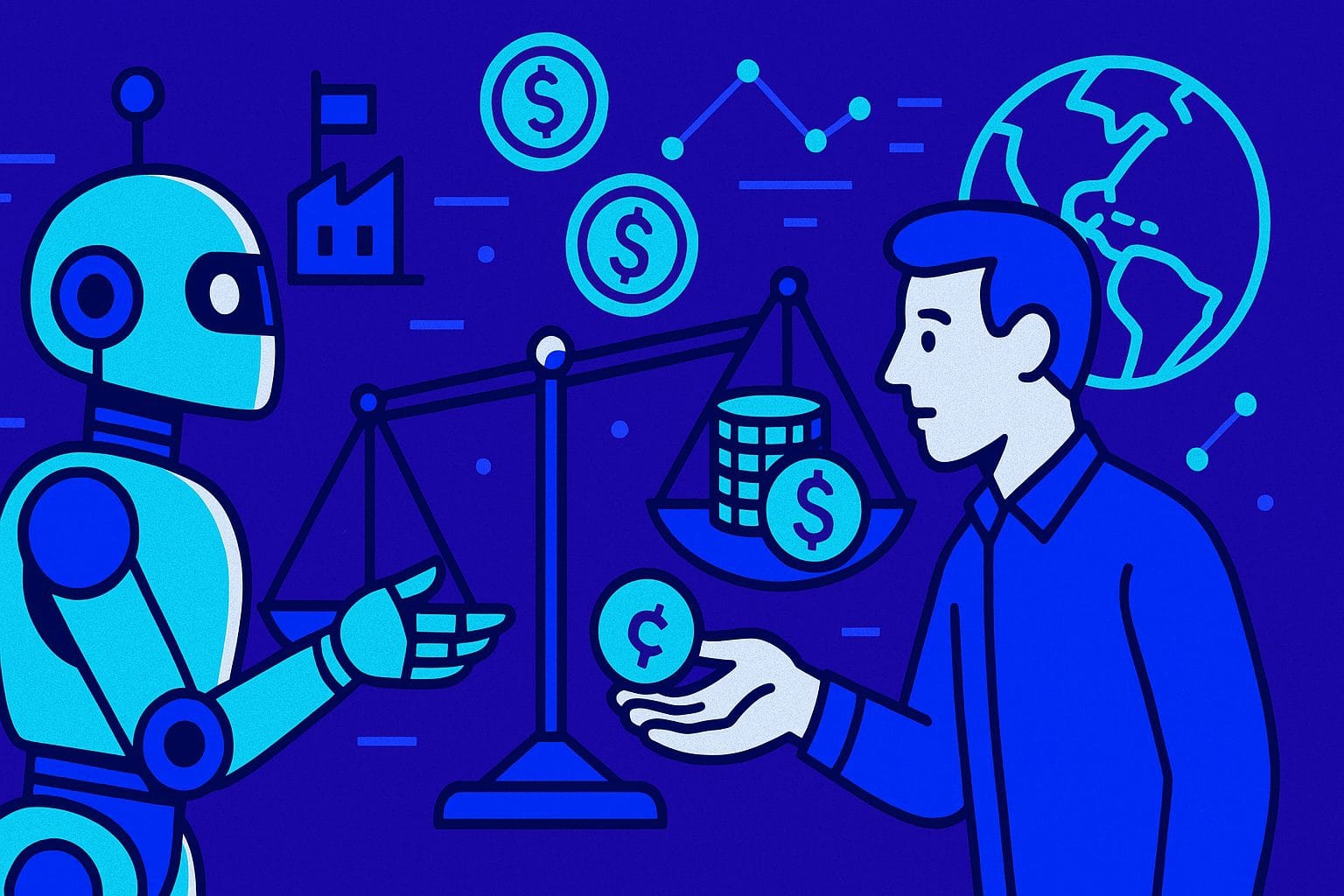
The U.S. government is the second winner, but on a longer horizon and with more uncertainty. The BIS’s reasoning is consistent with the logic of advanced chip controls applied to NVIDIA and ASML since 2023: preventing strategic adversaries from accessing technologies that determine military and economic superiority. Applied to models, this means the United States now has a direct lever of technological coercion over any state or actor that depends on its AI infrastructure. It is a real geopolitical tool, even if its calibration remains imprecise.
The third beneficiary, less expected, is companies that had anticipated the risk. Several major European and Asian industrial groups had begun deploying dual-source strategies after the first chip restrictions. They now have a factual argument to accelerate investments in sovereign AI, an argument worth far less before June 12.
Redundancy Strategies Facing Their First Real Test
Three types of responses have been activated or accelerated since the restriction.
The first is recourse to open-weight models. Meta’s Llama 4, Mistral Large, Alibaba’s Qwen 3: these models are downloadable, deployable locally, and depend on no American API. For organizations with the technical resources to operate them, this is a credible alternative. But the condition is not trivial: deploying a frontier model locally requires significant GPU infrastructure, teams capable of managing model updates and security, and tolerance for the delay between public releases and production deployment. For a ten-person startup in Nairobi or Jakarta, this is not a response to the urgency of June 12.
The second strategy is sovereign cloud. Several states, including France with its Trusted Cloud initiative backed by ANSSI doctrine, India with its IndiaAI program, and the Emirates with G42, had already invested in AI hosting infrastructure beyond the reach of American law. These initiatives suddenly make more sense. But their limitation is structural: they do not resolve dependency on the models themselves. Hosting an American model on a French cloud does not protect against an export restriction on the model. Computational sovereignty without model sovereignty remains partial.
The third strategy, supplier diversification, is the one most actively redistributing the market. Companies that maintained multi-cloud and multi-model contracts for operational reasons find themselves better positioned than those who had bet on a single supplier. This pattern reproduces well-known logic in industrial supply chain security, and the Draghi report had identified it as a structural priority for Europe: reducing critical dependencies on strategic technologies. AI has just joined the list of domains where this logic applies with operational urgency.
What the June 12 Precedent Changes for the Next Five Years
The legal precedent is the weightiest point of consequences. Before June 12, the debate on regulating AI exports focused on chips, training data, model weights distributed physically. Cloud services and APIs were considered a distinct category, harder to control, perhaps immune to the EAR. This is no longer the case. The next restriction will be faster to implement, because the legal framework will no longer need to be established.
For companies building on AI APIs, the question of jurisdictional dependency is now a documented operational risk, not a theoretical hypothesis. Technical leadership teams that have not yet conducted an audit of their dependency chain on American models will need to do so. This is not a prospective prediction: this is what CIOs of major European and Asian industrial companies have stated publicly since June 13.
For countries and regions excluded from access to advanced models, June 12 reinforces an already real asymmetry. Frontier AI is not uniformly distributed, and the concentration of computing capacity among a few actors creates dependencies that can be activated as levers. Countries without the means to build competitive models find themselves in a new position of vulnerability, with no exception for traditional U.S. allies.
For Anthropic, the situation is complex. The company is not the instigator of the restriction: it received a compliance notification and executed it. But it pays the reputational price of a decision it did not make. Several customer companies have publicly announced they are beginning migration to alternatives, explicitly citing availability risk. Trust in the service continuity of an American AI supplier has just undergone a test it failed for a fraction of its global customers.
The open question is not whether other restrictions will follow. The legal structure is in place, the precedent is set, political incentives have not changed. The real question is whether the response of non-American actors, in terms of sovereign models, multilateral technological alliances, and investments in independent training capacities, will ramp up fast enough that the next restrictions do not produce the same shock. The valuation signals from Mistral and Cohere’s statements suggest that markets have already begun answering this question.
Sources
- Center for Strategic and International Studies — Department of Commerce Restricted Access to Anthropic’s Latest Models: What Comes Next
- TechPolicy.Press — analysis of the application of the deemed export framework to commercial AI models (June 2026)
- Fortune — Mistral AI valuation and market signals post-restriction (June 2026)
- Al Jazeera — impact of the restriction on developers outside countries covered by bilateral agreements (June 2026)
- IAPP — implications of EAR rules for AI cloud services (June 2026)
- Anthropic Official Statement on Government Directive
- CSIS Analysis on Anthropic Restriction
- Bloomberg - Mistral AI Valuation at €20 Billion
- BetaKit / Bloomberg - Cohere Inbound Surge
- Digital Watch Observatory - Impact on Allied Countries