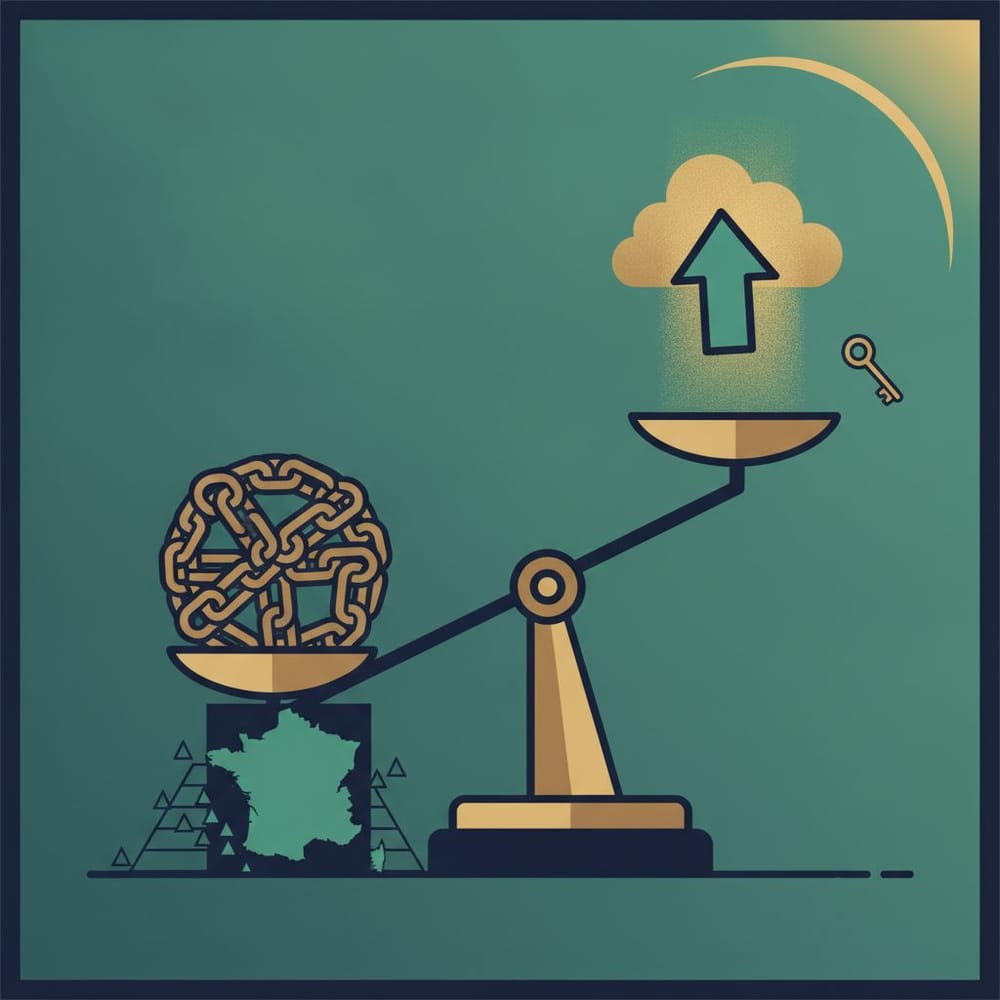
Unédic’s Debt Reveals What Official Unemployment Hides
61.5 billion euros. This is the debt that Unédic will carry at the end of 2026, according to its own financial forecasts published in March. A sum lower than the Covid peak, which reached €63.6 billion at the end of 2021, but which constitutes the second highest point since that crisis, and which continues to grow while the unemployment rate on the ILO basis stands at 7.3% — a level considered almost low by French standards over the past twenty years. This paradox deserves closer examination.
The unemployment insurance scheme is not drowning in a tsunami of job seekers. It is drowning under the combination of three distinct phenomena that official indicators struggle to read: state levies that deduct from its revenues, invisible precarity that unemployment statistics do not account for, and a debt structure that forces it to borrow expensively to repay what it borrowed at low cost during the pandemic.
The Essentials
- Unédic’s debt will reach €61.5 billion at the end of 2026, the second peak since the Covid crisis; government decisions regarding levies would have reduced Unédic’s capacity to repay its debt by approximately €13 billion
- The State levies between €2 and €4.1 billion per year from the scheme’s revenues (amount increasing from 2023 to 2026), mainly through the financing of France Travail and compensation for contribution exemptions offset by Unédic, for a cumulative total of €12.05 billion over 2023-2026
- 3.2 million self-employed workers are registered in France according to URSSAF data from Q2 2025, of which approximately half declare no turnover — a population off the scheme’s radar
- The unemployment halo represents 4.6% of the population aged 15-64 in Q4 2024, or approximately 2.0 million additional people invisible in official statistics
- The unemployment insurance convention of November 15, 2024, in force since January 1, 2025, runs until 2028; the next negotiation will have to settle a central question: who should finance what?
State Levies That Weigh on Debt Trajectory
To understand the mechanics of debt, one must begin with an institutional anomaly that Unédic’s annual reports document without ever truly naming it.
Since 2019, the State has levied the resources of unemployment insurance to finance missions that do not directly relate to indemnifying job seekers. The financing of France Travail (formerly Pôle emploi) alone absorbs several billion annually. Added to this are partial compensations for social contribution exemptions decided unilaterally by the State — relief from charges granted to employers that the scheme must partly offset without having been consulted on their scope.
The result is arithmetical. According to Unédic’s financial forecasts for March 2026, the State levies between €2 and €4.1 billion per year (amount increasing from 2023 to 2026), for a cumulative total of €12.05 billion over the period 2023-2026. The total impact of government decisions — levies and induced interest cost overruns — is estimated at approximately €13 billion, which represents as much less repayment capacity for the scheme. Without these levies, debt could have been reduced to approximately €46.7 billion at the end of 2026, according to Unédic’s February 2025 forecasts, and to €41.9 billion by 2028.
This is not cyclical debt linked to a recession or a surge in unemployment. This is structural debt linked to a financial relationship between the State and a paritetic scheme that the social partners manage but no longer truly control.
The nuance is important. The State has reasons to mobilize Unédic’s resources: the support of job seekers and indemnification are linked missions, difficult to separate properly. But the fact that these transfers occur without explicit compensation, without transparent negotiation of their amount, and without a repayment mechanism, transforms a relationship of cross-financing into unilateral deduction. The paritetic scheme loses its capacity to pilot its balances.
The Refinancing Trap: Borrowing Expensively What Was Contracted at Low Cost
Covid debt was contracted in a context of rates close to zero, between 2020 and 2022. Unédic had then borrowed massively to finance the explosion in unemployment benefits linked to the health crisis and the massive use of partial activity. The strategy was rational: borrow cheaply to cushion an exceptional shock.
The problem came later. The rise in policy rates decided by the ECB from 2022 onwards changed refinancing conditions. Covid debt is gradually maturing. Unédic must renew it on the bond markets at rates substantially higher than those at which it was contracted.
Concretely, according to the financial forecasts for March 2026, the annual interest charge is estimated at €0.6-0.7 billion in 2026 and €0.9 billion in 2027, with a crossing of the billion-euro threshold expected in 2028. This is money that finances neither a benefit recipient, nor a France Travail adviser, nor training. It is the cost of transition between two rate regimes, amplified by a debt that does not decrease because State levies maintain the structural deficit.
The irony of the situation: Unédic managed the Covid crisis well in terms of market access. Its signature remains solid, it borrows on terms correct compared to other sovereign issuers. But it is trapped in constrained refinancing, without control of the levers that would allow the scheme to become debt-free.
3.2 Million Self-Employed Workers Off the Radar
The ILO unemployment rate at 7.3% is an honest indicator of what it measures. The problem is precisely there: it does not measure everything.
URSSAF data from the second quarter of 2025 report 3.2 million self-employed workers registered in France. Among them, approximately half declare no turnover over the period in question. This population is not counted among job seekers registered with France Travail. It does not appear in the ILO unemployment rate, which requires not having worked at all, being available and actively seeking. Many of these self-employed without activity find themselves in a gray zone: too active on paper to be unemployed, too inactive in practice to live off their activity.
To this population is added what INSEE calls the unemployment halo: people who wish to work but do not meet all the strict criteria of the ILO (available but not actively seeking, or seeking but not immediately available). In the fourth quarter of 2024, this halo represented 4.6% of the population aged 15-64, or approximately 2.0 million additional people according to INSEE — a sharp increase compared to previous quarters.
These two populations share a common characteristic: they contribute little or not at all to unemployment insurance, and they are not entitled to it either. The scheme does not finance them, but their situation is that of people struggling in the labor market. They escape contributory social protection doubly.
This is not a marginal phenomenon. The acceleration of employment transformations linked to digitization pushes a growing fraction of the active population toward hybrid statuses that do not fit into the Bismarckian model on which unemployment insurance was built. A model designed for full-time salaried employees who lose their jobs, not for intermittent independent workers whose activity gradually fades away.
What Successive Reforms Missed
Since 2019, three reforms of unemployment insurance have succeeded one another. Each adjusted indemnification rules: tightening of access conditions, decreasing benefits for high earners, modulation of rights according to economic circumstances (the famous “bonus-malus” on short-term contracts, ultimately watered down). None addressed the question of State levies on the scheme’s resources.
The bias is revealing. Reforms have systematically focused on expenditure (benefit recipients, their rights, duration of indemnification) rather than revenue (what the State levies from the scheme). Social partners negotiated in a constrained space: they could touch indemnification parameters, but not challenge the institutional deductions that reduce their resources.
This asymmetry is not inconsequential. It reflects a power imbalance between the State, which unilaterally sets the scope of missions financed by Unédic, and the social partners, who manage the scheme within this imposed scope. Paritarism, which is supposed to be the institutional pillar of the scheme, actually functions within an increasingly narrow framework.
Unédic economists regularly emphasize, in their forecast documents, that the financial trajectory of the scheme depends less on unemployment trends than on political decisions regarding State levies. This is a technical formulation. What it concretely says: the financial fate of unemployment insurance is more in the hands of the Finance Ministry than of labor markets or social partners.
Real Margins for Maneuver Exist, But They Are Political
The situation is not without solutions. The levers are known; their activation is what is politically difficult.
The first lever is the transparency of levies. If the State finances missions via Unédic’s resources, one option is to make this financing explicit, negotiated and compensated. Several economists, including those who contributed to the work of the Council for Employment Orientation, have advocated for a State-Unédic financial convention that would set the amount and nature of transfers, with a periodic review clause. This is not a nationalization of the scheme, it is a clarification of financial responsibilities.
The second lever touches on the contributory base. Extending unemployment insurance to self-employed workers is not a new idea: an experimental extension had been planned by the 2019 reform, but under such restrictive access conditions that it practically did not function. A genuine overhaul of this extension, with contributions and rights adapted to the variable income of self-employed workers, would broaden the scheme’s base while offering protection to active workers who are currently excluded from it. This is a model that some Nordic countries have partially experimented with, with encouraging results in reducing invisible precarity.
The third lever is the management of existing debt. The State could take back a portion of Covid debt on its balance sheet, on the grounds that the extraordinary expenditures of 2020-2022 were both a political decision (preserving employment through partial activity) and an insurance logic. This partial takeover would alleviate the refinancing burden and restore margins to the scheme. This is not without precedent: the Social Debt Amortization Fund (Cades) was precisely created for this type of takeovers of extraordinary social debts.
These three options are known to technicians and social partners. What blocks them is not their technical complexity, but their political cost: they oblige the State to explicitly acknowledge what it levies, to repay what it has captured, or to assume its responsibility in structuring a debt it readily attributes to the generosity of the scheme or the flexibility of the labor market.
The Next Negotiation as a Test of Social Governance
The unemployment insurance convention of November 15, 2024, in force since January 1, 2025 and running until 2028, already sets the framework for upcoming discussions. The negotiation that will open in view of renewing this convention will, in all likelihood, be one of the most difficult since the creation of the paritetic scheme in 1958.
Social partners will arrive at the table with a scheme indebted at €61.5 billion, rising interest charges, a contributory base that is eroding on the self-employed side, and a State that has grown accustomed to levying from the scheme without explicit counterpart. The equation is difficult, but it is not unsolvable.
What will be at stake in this negotiation goes beyond the question of indemnification rules. It is the question of the pact that binds the State, employers, employees and precarious workers around a social protection mechanism. As European experience on other economic governance issues shows, diagnosing a problem is not enough: political actors must still accept putting the levers that belong to them up for debate.
The question is not whether unemployment insurance can restore balance. It can. The question is who will accept to pay for that balance: benefit recipients through reduced rights, contributors through increased rates, or the State through clarification of its levies and partial debt takeover. The answers to this question will not be technical. They will be political.
Sources
- Unédic — Financial Forecasts March 2026
- INSEE — Labor Force Survey, Q4 2024 (unemployment halo data and ILO rate), insee.fr
- URSSAF — Self-employed Statistics, Q2 2025, urssaf.fr
- Council for Employment Orientation — Reports on the Evolution of Forms of Employment, coe.gouv.fr
- Unédic — Annual Report 2024, unedic.org
- INSEE — Unemployment Rate Q4 2024
- INSEE — Unemployment Halo Q3 2024
- URSSAF — Self-Employed Q2 2025 (via TPEActu)
- Senate — Parliamentary Question on Unédic (March 2026)
- Unemployment Insurance Convention and 2026 Amendment