In 2024, a single artificial intelligence application deployed at Volkswagen’s Poznań factory reduced the site’s energy consumption by 12%. Not a complete overhaul of equipment. Not a heavy infrastructure investment. A single application. Connected to a common data platform. Replicated from another group site.
This figure alone says everything about the true nature of industrial digital transformation. Not a three-dimensional virtual replica of a factory, nor a digital twin in the spectacular sense of the term. But the ability to transfer an optimized decision from one site to forty others in a matter of weeks, because data speaks the same language everywhere.
Volkswagen is currently deploying more than 1,200 artificial intelligence applications across 43 factories via a common cloud platform developed with AWS. The savings amount to tens of millions of euros. And the group is far from alone: PepsiCo, BMW, Samsung Electronics are applying similar strategies, with results converging on the same conclusion. What industrialists still call “digital twins” is, in reality, a battle for data standardization. Whoever controls the common data platform holds the key to industrial progress.
The Essentials
- Volkswagen is deploying more than 1,200 AI applications across 43 global factories via a shared cloud platform with AWS, a figure from the VW/AWS press release of August 2025; the group’s 2024 annual report mentions “more than 100 new applications” across “more than 40 factories.”
- The Poznań factory reduced its energy costs by 12% through a single optimization application, replicated from another group site.
- The true value mechanism is not the digital twin itself, but data standardization between sites that makes it possible to replicate a local decision across the entire network.
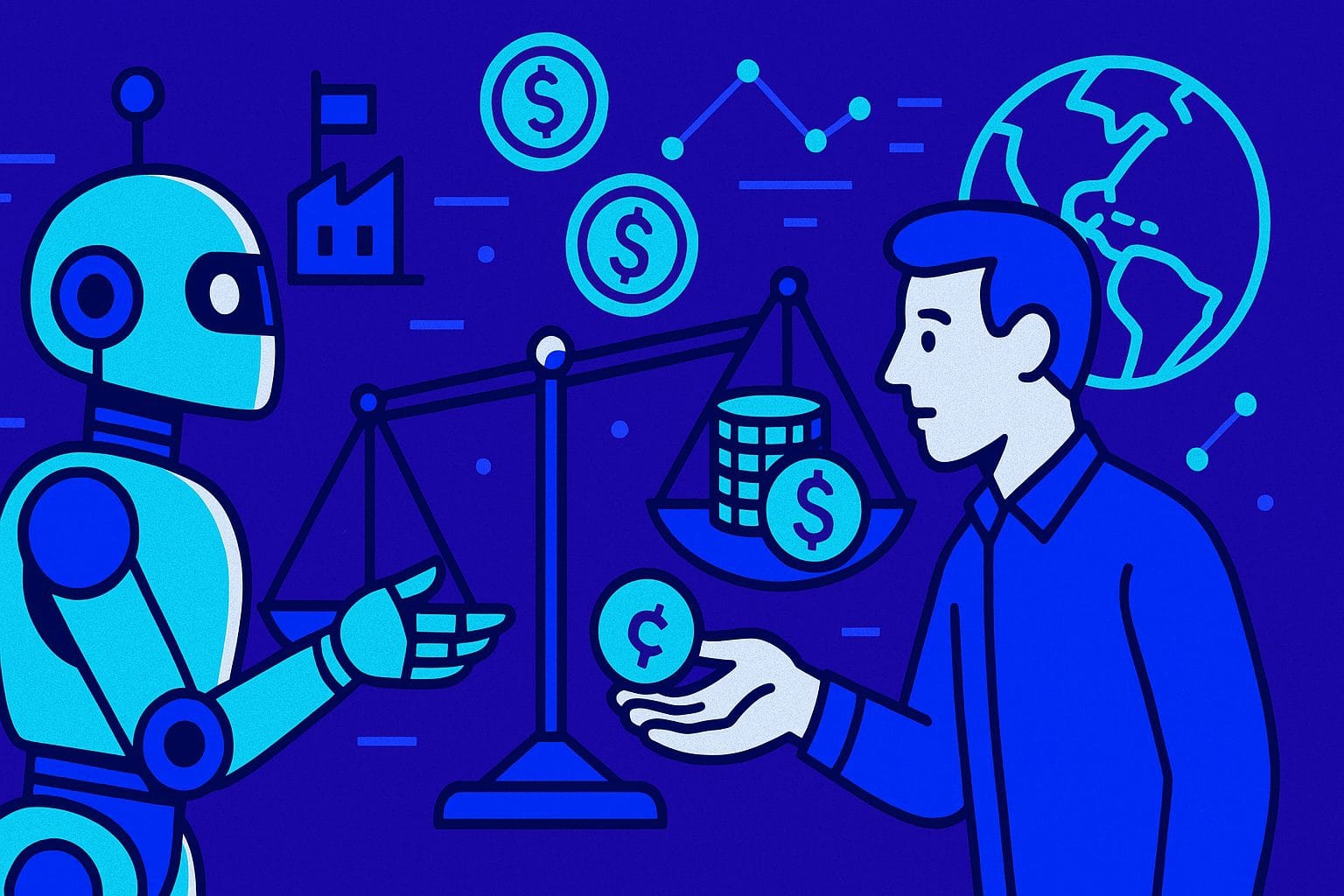
- The central tension: this model transfers a significant portion of created value to cloud providers (AWS, Siemens, NVIDIA) and widens the gap between well-equipped factories and under-resourced sites.
- The challenge of the next 18 months: the interoperability of industrial data, on which both the competitiveness of groups and their digital sovereignty depend.
What Volkswagen Understood That Its Competitors Are Still Seeking
Volkswagen did not arrive at 1,200 AI applications through spontaneous accumulation. The group built common infrastructure, the Industrial Cloud, in partnership with AWS since 2019. The initial objective was to connect 122 factories and 1,500 suppliers on a single platform. In 2024, 43 sites are in active production. This is not a delay: it is proof that harmonizing data between historically siloed sites takes time, requires common standards, and encounters organizational resistance that technology alone cannot resolve.
The core of the system rests on an industrial data exchange protocol, OPC UA, which allows machines of different brands and ages to communicate in a standardized format. Without this foundation, each factory remains an island. With it, an optimization developed in Wolfsburg can be deployed in São Paulo or Shanghai with a lag of a few weeks rather than several years.
What Volkswagen understood is that value does not reside in the quality of any particular AI model, but in the quality of the plumbing that feeds it. The 1,200 applications are worth nothing if the data that feeds them is not clean, timestamped, and consistent from one site to another. This is precisely why investment in manufacturing execution systems (MES) and in integration layers with ERPs preceded the deployment of models.
Replicating a Decision Across Forty Factories at the Same Time
The Poznań example is not anecdotal. It illustrates a mechanism that, if it becomes widespread, structurally modifies the logic of industrial production.
In a traditional organization, a factory optimizes its processes locally. Learning remains within teams, on local dashboards, sometimes in the heads of maintenance engineers. When a site improves its energy efficiency by 12%, the others know nothing about it. Knowledge does not circulate.
In Volkswagen’s architecture, the application that generated this saving in Poznań is a packaged software object, tested, documented, and available on the common platform. The question posed to other sites is no longer “how do you optimize your energy?” but “do you want to activate this application?” Knowledge transfer becomes software transfer. The timeline shifts from a few years to a few weeks.
Available analyses suggest that industrialists who succeed in their large-scale digital twin deployments generate productivity gains significantly higher than those who remain in the logic of isolated pilot projects. The difference is not technical. It is organizational: having a central team responsible for maintaining the data platform, standardizing formats, and driving deployments.
BMW applies the same logic to its assembly lines with its simulation platform based on NVIDIA Omniverse, which allows virtually testing a line reconfiguration before touching the physical line. PepsiCo has deployed digital twins on its bottling lines, with similar results in reducing unplanned downtime. Samsung Electronics uses its twins to optimize manufacturing yields for semiconductors, where even the slightest parameter deviation costs thousands of wafers.
Data Standardization: New Terrain of Geopolitical Competition
What this transformation reveals goes beyond the competitiveness of individual industrial groups. It poses the question of who controls the data standards on which the entire edifice rests.
OPC UA is an open standard, developed by the OPC Foundation. But the platform that leverages it, that stores the data, processes it, and hosts the applications, is AWS in Volkswagen’s case. This is where the main tension lies: the German group is optimizing its factories on American infrastructure. Volkswagen has undertaken work to strengthen its sovereignty over the most sensitive data — notably through AWS infrastructure deployments on-site and the expansion of its European private cloud announced in 2025 — but structural dependence on an American partner’s cloud ecosystem remains an open governance issue.
This dependence is not unique to Volkswagen. It is structural to most large-scale deployments. Cloud providers (AWS, Microsoft Azure, Google Cloud) have invested years in industrial integration tools, interfaces with MES and ERPs, and real-time processing capabilities that industrialists cannot develop alone within reasonable timeframes. As a recent article published in this journal noted regarding European digital infrastructures, Europe knows how to build data centers, not how to connect them: the problem is less the physical brick than the software ecosystem that gives it value.
The European Union engaged a partial response with the Data Act that came into force in 2025, which imposes the portability of industrial data and limits exclusivity clauses in cloud contracts. The Gaia-X initiative, driven by European companies including Volkswagen, aims to create a sovereign industrial data ecosystem. But Gaia-X advances slowly, torn between political ambitions and technical realities, while AWS deployments accelerate. The gap between the pace of regulation and that of industrial deployments remains Europe’s principal vulnerability in this battle.
The Gap Between Data-Rich Factories and Under-Equipped Sites
There is an angle that Volkswagen’s announcements do not cover: the 43 connected factories are not the 122 initially planned. And especially, they are not the thousands of tier 2 and tier 3 factories that feed the group’s supply chain.
Only a minority of global factories have sufficient data infrastructure to deploy artificial intelligence applications at scale. A majority of sites — often small and medium-sized subcontractors in emerging economies — have neither the MES systems, nor the IT teams, nor the capital to install them. The optimization Volkswagen achieves in Poznań is precisely what its low-cost suppliers cannot replicate, due to lack of infrastructure.
This gap is not merely an inequality between companies. It is an inequality between territories. A well-connected factory in Germany generates productivity gains that allow it to remain competitive against a cheaper but less efficient factory in Mexico or Poland. In the short term, this is an advantage for the German site. In the medium term, if low-cost sites manage to equip themselves, the productivity differential erodes and the advantage shifts again.
The real question of industrial competitiveness is therefore not “who has the best digital twin?” but “who can equip their entire supply chain fast enough for value replication to work at all levels?” This is where groups like Siemens play a critical infrastructure role: they sell both the equipment, the MES software, and the data platforms, which gives them an inescapable intermediary position in the value chain. An industrial cloud provider can generate more captured value than any traditional equipment manufacturer.
What Data Alone Does Not Resolve
The deployment of 1,200 AI applications across 43 factories is a fact. The 12% energy saving in Poznań is a fact. What these figures do not tell is how many deployments failed before reaching this point.
Studies on the subject converge on a severe finding: digital twin projects, in a large majority of cases, struggle to generate the savings initially projected. McKinsey further notes that 70% of digital transformations in general exceed their initial budgets — a figure not specific to industrial digital twins, but which gives the measure of execution difficulties. The causes are rarely technical. They lie in the quality of input data, often heterogeneous, poorly timestamped, incomplete. They lie with production teams, whose work routines do not naturally integrate AI system recommendations. They lie with organizations, which have not always established the governance necessary to keep data clean over time.
Volkswagen has a central team dedicated to platform governance. This is precisely what most industrialists do not do. They deploy the tool, they train teams once, and they hope the system maintains itself. That is not how it works. A digital twin that is no longer fed by fresh and reliable data quickly becomes an expensive artifact that produces incorrect recommendations. And an incorrect recommendation on a production line can cost more than the absence of a recommendation.
The tension between the promise of large-scale deployment and the reality of organizational routines is the principal blind spot in major industrial companies’ communication about their digital transformations. The 1,200 deployed applications are a communication figure. The number of active applications, used daily by production teams, would be a far more revealing figure.
Interoperability as a Strategic Challenge for Coming Years
What the Volkswagen case illuminates beyond its own trajectory is the next industrial battle: interoperability between platforms.
Today, an application developed on Volkswagen’s AWS platform cannot be deployed directly on Microsoft Azure’s platform that BMW uses partially. The data from a Siemens MindSphere factory are not natively compatible with those from a SAP Manufacturing factory. Each major industrial platform constitutes a closed ecosystem, which limits inter-company collaboration possibilities and creates prohibitive migration costs.
Open standards like OPC UA, Asset Administration Shell (AAS), or Manufacturing Service Bus play a critical role in breaking these silos. Their adoption is progressing, driven by industrial consortiums and European regulatory requirements. But adoption is uneven: large companies that have the resources to influence standards adopt them quickly, often by integrating their own proprietary extensions. SMEs suffer the choices of their customers.
AI agents are moreover beginning to play a role in this integration layer, serving as interfaces between heterogeneous data systems. As an article in this journal analyzes regarding their deployment in business, AI agents are entering organizational work without structures yet being adapted to receive them. The factory is no exception to this rule.
The question posed to European regulators and industrialists is simple to formulate, difficult to resolve: how can we ensure that emerging interoperability standards preserve the ability of industrial actors to change platform providers without losing their data, applications, and optimized decisions? This is the condition for the value generated by data standardization to remain captured by the industrialists themselves, and not solely by cloud providers.
The answer is not yet written. Volkswagen has shown that the mechanism works at large scale. It remains to be seen whether the model will remain open long enough for others to benefit from it.
Sources
- Volkswagen Group Annual Report 2024 — Production & Digital Transformation: annualreport2024.volkswagen-group.com
- McKinsey & Company, Digital Twins: The Next Frontier of Factory Optimization, 2024
- AI Magazine / Automotive Manufacturing Solutions, August-September 2025
- OPC Foundation — Standard OPC UA: opcfoundation.org
- European Data Regulation (Data Act), entered into force in 2025: digital-strategy.ec.europa.eu
- Official VW/AWS Press Release — DPP and AI (August 2025): volkswagen-group.com
- AWS Case Study — Volkswagen Group DPP: aws.amazon.com
- AWS Press Release — Industrial Cloud Launch (March 2019): press.aboutamazon.com
- BMW Group — Virtual Factory Press Release: press.bmwgroup.com
- PepsiCo — Official Press Release on Digital Twins (January 2026): pepsico.com
- Samsung Global Newsroom — AI Megafactory with NVIDIA: news.samsung.com
- Wikipedia — OPC Unified Architecture: en.wikipedia.org