In 2019, the poverty rate among pensioners was 35% in Lithuania, 51% in Estonia, and 54% in Latvia. These rates reflect multiple economic, social, and institutional factors.
The Essential Points
- In Central and Baltic Europe, the ratio of workers to retirees will decline from 5.5 in 2005 to 2.8 in 2050, according to Bruegel, mechanically compressing budgetary margins available for education and investment.
- Despite this pressure, 35 to 40% of retirees in Baltic countries live below the poverty line, compared with 12% in the Netherlands, which has indexed retirement age to life expectancy (EU-SILC).
- The mechanism is circular: inadequate pensions coexist with rising public spending, because the base of contributors shrinks faster than reforms progress.
- Countries like the Netherlands, Sweden, and Finland demonstrate that parametric adjustment of the system, combined with notional accounts, can break out of this deadlock.
- The window for action is closing: by 2030, cohorts born in the 1960s will have reached retirement age, and the political profile of the electorate will make structural reforms harder to adopt.
The Trap of Systems Inherited from the Soviet Era
The pension systems of Central and Baltic Europe were designed at a time when age pyramids justified their architecture. In the 1960s and 1970s, one retiree was supported by four or five working-age adults. Contributions flowed in massively, benefits were modest, and the balance held. Fifty years later, the same rules apply to a radically different demographic structure.
Aging is amplified in this region by a factor that Western Europe has not experienced with the same intensity: emigration of young adults. Since European Union accession, the Baltic countries have lost a significant fraction of their working-age population. Latvia saw its total population decline by nearly 20% between 2000 and 2020, according to Eurostat data. Lithuania followed a similar trajectory. Departures primarily concern the most qualified and mobile workers, whose contributions would have funded the system.
Emigration and aging thus combine in a scissor movement. The base of contributors shrinks due to the departure of young people. The retired population grows as cohorts born in the 1950s age. The ratio deteriorates from both sides simultaneously, yet the rules of the game have not changed. This phenomenon of concentration of young people in major European capitals, described in our analyses on European youth concentrating in metropolitan areas, takes on a direct fiscal dimension here: when young people leave, contributions leave with them.
Poor Retirees in Countries That Spend More on Pensions
The share of the budget devoted to pensions does not, by itself, determine retirees’ standard of living.
EU-SILC data from Central and Eastern Europe between 2005 and 2022 illustrate this clearly. Spending related to aging exerts pressure on Baltic public finances, but the evolution of pension spending alone differs by country and by reform. In 2019, pensioner poverty rates were 35% in Lithuania, 51% in Estonia, and 54% in Latvia. The exact rate for Dutch pensioners must be cited for the same year, the same relative threshold, and the same population definition. The gap can depend on the system’s design as much as on the level of national wealth.
The phenomenon may be linked to the design of schemes, to contribution histories, to indexation, and to other household income; it cannot be generally attributed to fixed defined-benefit schemes. When pensions are calculated on short or interrupted careers, when their revaluation does not keep pace with inflation, and when the retirement age remains low, the individual amount paid can remain insufficient even if the total amount spent increases. Higher total spending does not, by itself, allow one to conclude that each individual pension has fallen in real terms. A 2025 SUERF note emphasizes that aging and budgetary constraints put pension schemes under pressure and that the effects of many reforms remain to be seen.
Educational investment bears the direct brunt. An increase in spending related to aging can increase budgetary trade-offs without mechanically leading to a decline in spending on young people. Yet these are precisely the investments that would increase the productivity of remaining workers, and thus support the system in the long term. The budgetary constraint is not neutral: it chooses the past over the future.
Design Choices That Distinguish the Dutch System from Baltic Systems
The Netherlands began adjusting its pension system to demographic reality in the 2000s. The AOW retirement age was raised gradually and reached 67 in 2024, not in 2021, and was then indexed to future life expectancy. Concretely, if the population lives longer, the retirement age adjusts automatically during periodic reviews. This indexation is not a punishment for retirees: it is a rule that protects the value of pensions by maintaining a sustainable funding ratio.
Sweden followed complementary logic with its notional accounts. Each contributor accumulates a virtual balance, calculated based on contributions paid and life expectancy at the date of retirement. The resulting pension reflects what the system can actually afford to pay. This self-adjusting mechanism absorbs demographic shocks without requiring political negotiations with each generation. Finland adopted a similar longevity coefficient from 2010 onwards.
These reforms have a real political cost. Raising the retirement age is unpopular. Integrating automatic adjustment mechanisms means accepting that future generations will receive less than those preceding them if demographics deteriorate. But the results speak for themselves: the poverty rate among Dutch retirees is among the lowest in Europe, the system remains solvent, and public budgets retain margins to finance education and health for the working-age population.
The International Labour Organization has documented several waves of reforms in Central and Eastern European countries since the 2000s, notably in Estonia, Slovakia, and Poland. These countries have introduced capitalized pillars to diversify risk. Results are more mixed than in Scandinavian models, notably because the transition to a mixed system itself has high financing costs in the initial years, a cost that still-catching-up economies struggle to absorb.
The Spiral That Emigration Feeds
There is perverse logic in the demographic sequence of Central European countries. Underperforming pension systems generate inadequate benefits. Inadequate pensions can increase family support for elderly parents and reduce resources available for young households. Income prospects, employment, and quality of life may influence emigration; the effects of inadequate pensions on emigration are not established.
This movement is not inevitable. Rural dynamics show that sustained public commitment can reverse the trend, but this assumes that public budgets have margins to finance something other than mandatory benefits. High pension spending can reduce budgetary room for maneuver, but it does not necessarily eliminate funding for other policies.
Lithuania has attempted to slow emigration through return and attractiveness policies since 2016. Results have been partial. Latvia has undertaken a more profound reform of its pension system, progressively introducing mandatory contributions to the second pillar. Both countries face significant demographic challenges; the adequacy of their reforms must be evaluated on the basis of explicitly defined objectives and projections. Poland, larger and with a more diversified economy, has somewhat more room for maneuver.
Emigration also raises a question of intergenerational justice that pay-as-you-go (PAYG) systems do not address: workers who depart were often educated at the expense of their country of origin. Their future contributions will fund the system of their host country. Central Europe finances the social protection of Western Europe.
What Political Contract When Young People Vote Less and Leave More
The distinctly political dimension of this crisis is perhaps the least discussed. In a democracy, pension reforms are decided by vote. Aging can degrade both the economic support ratio and the age structure of the electorate, but their evolutions are not identical by definition.
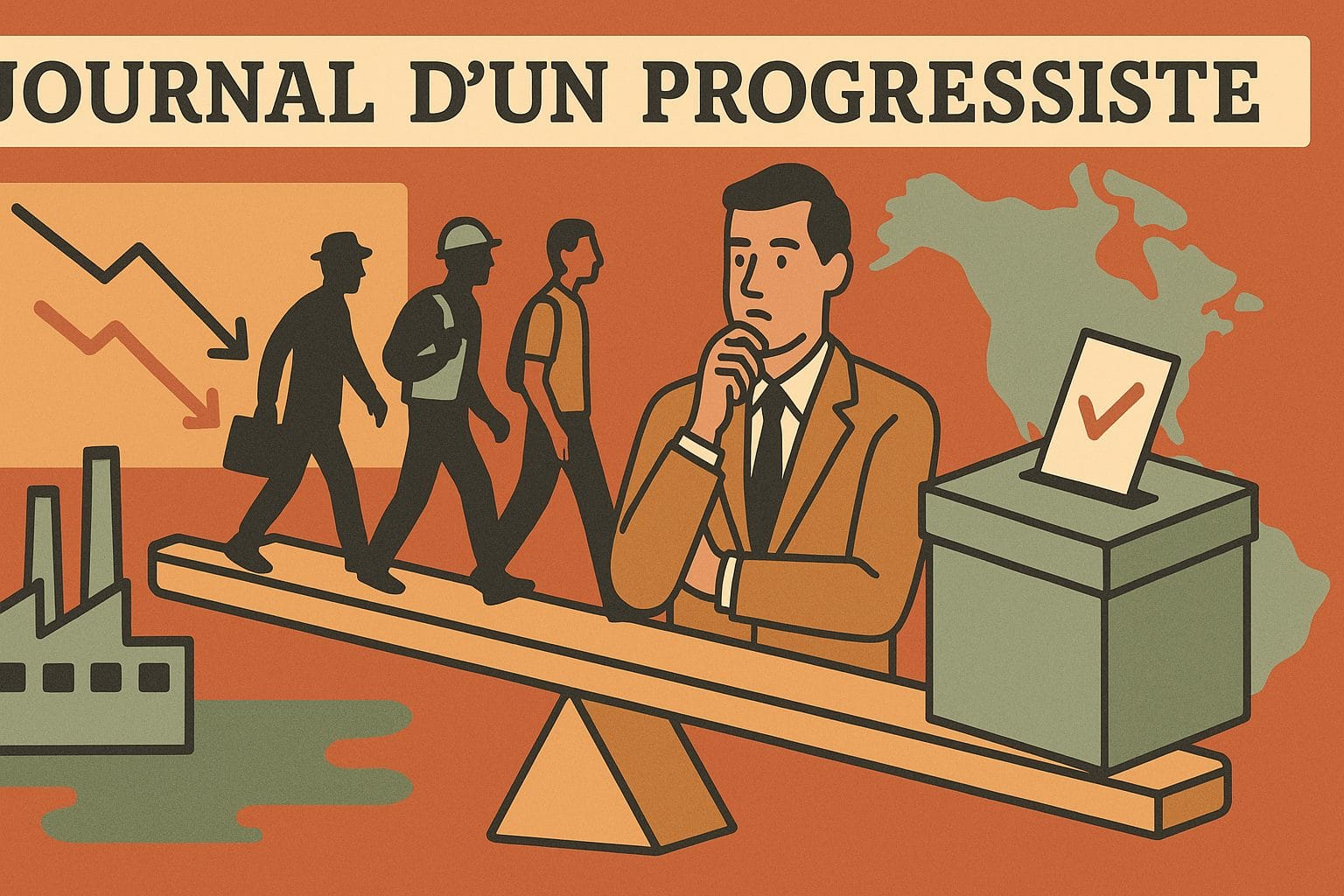
In Central Europe, cohorts born between 1955 and 1965 represent a considerable share of the electorate today. They are close to or have just entered retirement. They have a direct interest in preserving the current parameters of the system. Young people of voting age are both fewer in number, due to the combined effects of lower birth rates and emigration, and less electorally mobilized. The result is an asymmetry of political representation that makes structural reforms difficult to adopt, even when their necessity is documented.
Coalitions governing these countries may depend on electorates sensitive to an increase in the retirement age. The state loses capacity for action precisely where action is most urgent.
The article examines income inequality and aging in Central and Eastern Europe; it should not be cited as evidence of a thesis on the non-technical nature of pension rigidity. The solutions are known. Reference models exist. Obstacles to reform may be institutional and political.
Open Avenues, and the Closing Window
Countries that succeeded in reforming their systems almost all did so within a window of relatively favorable demographics, before pressure reached its peak. Sweden launched its notional accounts in 1998, when the dependency ratio was still favorable. The Netherlands raised the retirement age when the economy was growing and able to absorb the transition. These reforms were not painless, but they were possible because they occurred before the tipping point.
For the Baltic countries and most Central European economies, the window still exists but is closing. A large portion of cohorts born between 1955 and 1965 will reach retirement age between 2020 and the mid-2030s, depending on birth year and national legal age. Aging may reduce the relative number of contributors per retiree, but the absolute and effective evolution of the contributor base depends in particular on employment and migration. Reforming after this point would remain possible in a potentially more constrained political context.
Several avenues are under study or experimentation in the region. Estonia, which already has a three-pillar system since 2002, is examining adjustments to retirement age and better indexation of pensions to inflation. Slovakia has engaged in debate over introducing an automatic stabilization mechanism. Latvia is strengthening its funded second pillar after temporarily suspending it during the 2008 financial crisis.
These adjustments are necessary but probably insufficient without complementary policy on worker retention. The two levers are linked: a more sustainable pension system frees up budgetary resources to finance policies that make countries attractive to young workers—affordable housing, quality public services, continuing education. Without this second lever, pension reform reduces costs but does not rebuild the productive base. Pressure on housing survives demographic stagnation in several of these countries: even where population is declining, young people who stay find inaccessible real estate markets in urban centers.
Demographic developments pose Baltic societies with both actuarial and political challenges. The electorate’s age structure is evolving, while public finances impose trade-offs between social demands. Economic models to address them exist. The difficulty may lie in the capacity of political systems to build intergenerational coalitions.
Nordic examples demonstrate that a system can be both more sustainable and more protective for the most vulnerable retirees, provided the reform is designed to reduce small pension poverty while adjusting overall parameters. It is this dual objective—solvency and protection—that is lacking in most Central European debates, too often reduced to the question of retirement age or replacement rate, without integrating the redistributive dimension.
Sources
- Springer Journal of Population Research, Pension rigidity and demographic pressure in Central and Baltic Europe (2025)
- Bruegel Policy Brief, The demographic divide in Europe (2025), bruegel.org
- SUERF Policy Note, Pension system constraints in the eurozone (2025), suerf.org
- EU-SILC microdata, Poverty rates among retirees, Central and Eastern Europe, 2005-2022, Eurostat
- International Labour Organization, Pension reforms in Central and Eastern Europe, ilo.org