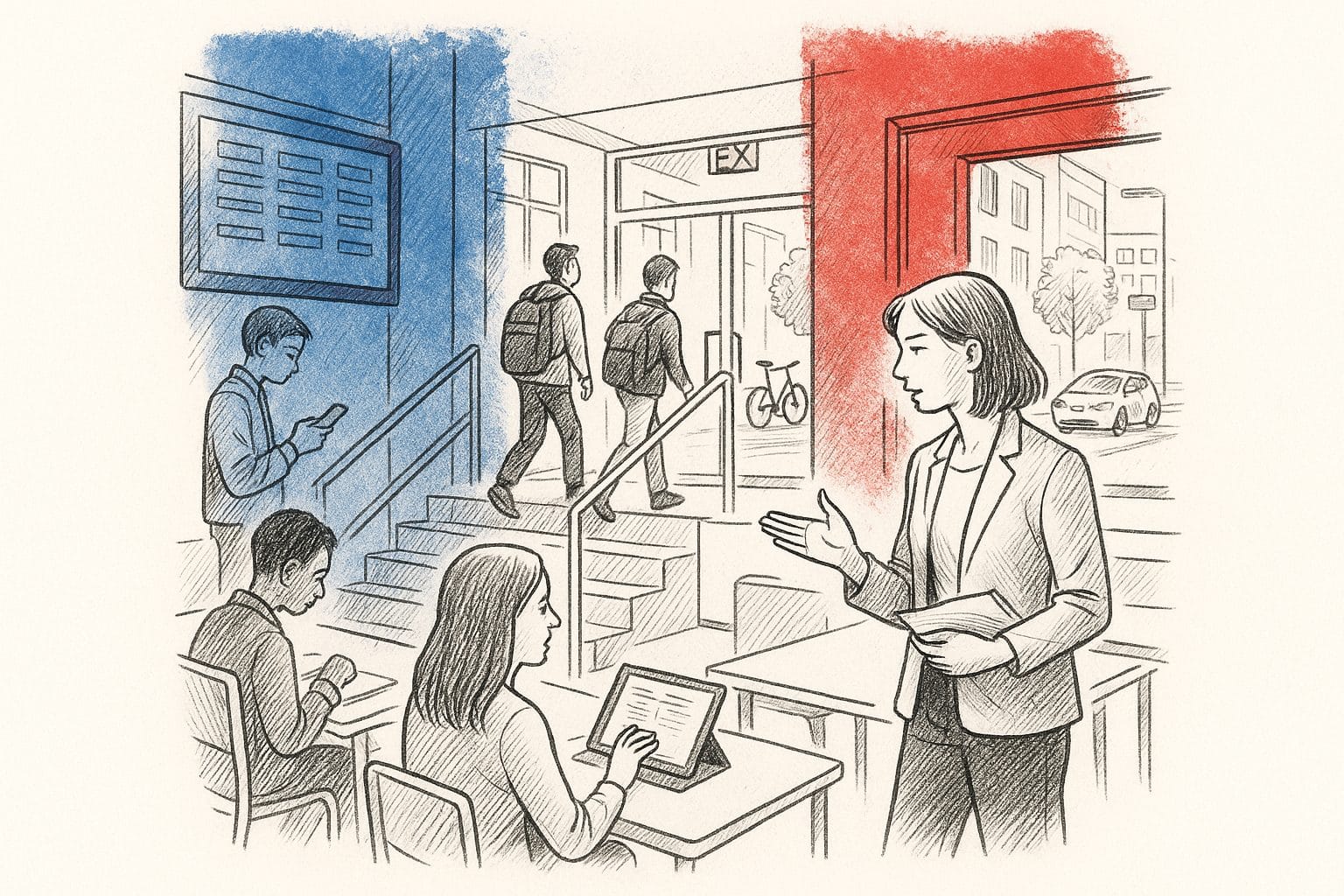
Nordic school models collapse at PISA, and Sweden returns to printed textbooks
Iceland lost 36 points in mathematics and approximately 38 points in reading, though the exact reference period for the latter figure is subject to discussion depending on available OECD sources. Norway declined by approximately 33 points in mathematics, a figure numerically consistent with raw scores 2018-2022 (501→468), even if the corresponding OECD GPS indicator is tied to the 2015-2018 period. Finland, the absolute model for two decades, lost 30 points in reading. These are the countries cited as references by French, Belgian, and German ministers since the 2000s. Their simultaneous collapse in the 2022 PISA rankings deserves more than a footnote.
Sweden drew the most radical conclusion: in 2023, the government decreed the return to printed textbooks in primary schools and ordered a drastic reduction in screen time. It is a public admission. An educational policy that had cost billions of kronor, mobilized generations of teachers, and inspired reforms across Europe has just been abandoned.
The essentials
- Iceland lost 36 points in mathematics and approximately 38 in reading at PISA; Norway approximately 33 points in mathematics; Finland 30 in reading.
- Sweden decided in 2023 to return to printed textbooks in primary school, formally reducing the use of tablets and digital screens.
- The decline in Nordic scores precedes Covid by several years, ruling out the pandemic explanation as the primary cause.
- A growing number of studies document that screen reading produces less deep comprehension than paper reading.
- The open question is this: do countries continuing to invest heavily in school tablets have sufficient evidence to ignore Nordic data?
The decline began before Covid
This is the first and least satisfying explanatory reflex: Covid disrupted everything, students fell behind, scores reflect two years of pandemic. The chronology contradicts this reading.
In Finland, the decline in reading scores has been documented since the 2009 PISA cycle. In Sweden, the decline in mathematics began after 2006. Norway was already recording negative signals before 2015. Covid amplified a dynamic that already existed. It is not its cause.
This detail changes everything in interpretation. If the pandemic explained everything, the remedy would be simple: wait for recovery, invest in academic support, resume the normal course. If the decline is structural, it signals a problem in the pedagogical choices themselves, accumulated over ten to fifteen years. The Nordic countries made similar choices within the same time window: aggressive decentralization, maximum trust granted to teachers, reduction in formal requirements, and aggressive digitization of classrooms. The simultaneity of these choices and the decline invites examining them together.
Sweden is the clearest case. It simultaneously pushed school privatization via one of Europe’s most liberal voucher systems and deployed tablets and digital tools on a scale without equivalent in the region. Swedish results declined on both fronts: equity among students deteriorated, and absolute scores fell. The return to textbooks in 2023 is a response to the second dimension. The first remains unaddressed.
What research says about screen reading
Several meta-analyses comparing text comprehension across different media have been published in recent years. The result is consistent: screen reading produces less deep comprehension than paper reading, particularly for long texts and younger students.
The explanation proposed by researchers combines several mechanisms. On screen, readers spontaneously adopt a skimming strategy: the gaze sweeps rather than follows, eyes search for keywords rather than building linear progression. Paper forces more sustained and sequential attention. For a child learning to read, this difference is not trivial: it is precisely sequence and linearity that build comprehension.
There is a second factor: notifications, hyperlinks, and peripheral solicitations fragment attention on a connected device. Even when the teacher controls the displayed content, the digital interface induces different cognitive behaviors than those induced by a printed page. It is not a question of content but of perceptual environment.
These results do not mean that digital technology has no place in schools. They mean that the implicit hypothesis of 2010s school digitization — replacing paper with screens improves or at least maintains learning — is not confirmed by data. It is a hypothesis that was deployed at large scale before being tested.
Why the Finnish model was credible, and why it remains partially relevant
It is necessary here to avoid a convenient shortcut. Finland did not collapse because its model was illusory. It collapsed because certain elements of that model were weakened, and because other countries imported the most seductive parts while leaving aside the foundations that made them viable.
The Finnish model rested on three distinct pillars. The first: highly selected teachers, very well trained, enjoying real pedagogical autonomy and elevated social status. The second: low evaluative pressure, confidence in the long term, resistance to rankings and permanent comparisons. The third: relative social homogeneity that facilitated equalization of educational pathways.
The first pillar still holds. Training for Finnish teachers remains among the world’s most demanding, and the profession remains selective. The third is in rapid erosion: immigration to Finland has increased, social inequalities have widened, and the school system, designed for a relatively homogeneous society, absorbs these new heterogeneities poorly. This is a real limitation, not an original design fault.
What perhaps most weakened the Finnish model was its own popularity. In becoming a global reference, it was simplified, commercialized, reduced to a few exportable formulas: trust in teachers, no homework, no early grades. These formulas were imported without the conditions that made them viable. France, Germany, Denmark copied the surface without digging into the foundations.
Sweden reverses course, others hesitate
Sweden’s 2023 decision is documented and public. Education Minister Lotta Edholm explicitly linked the return to printed textbooks to PISA data and conclusions from research on screen reading. The government allocated 685 million kronor to fund the purchase of textbooks in primary schools. It is a policy of admission: an error is acknowledged, corrected.
Norway is examining its own results with comparable concern. Norwegian educational authorities launched in 2023 a review of their school digital framework, with particular attention to primary education. Conclusions are pending, but the direction appears similar: more structure, more paper for young students, more targeted and later digitization.
Finland, meanwhile, resists the temptation of radical backtracking more strongly. Finnish authorities emphasize that the decline in their scores remains relative: Finland remains above the OECD average in reading and sciences. The question is whether this resistance reflects a careful reading of the data or difficulty recognizing the erosion of a model that has become identity-based.
At the opposite end of the spectrum, countries like France continue to deploy tablet plans and large-scale school digitization initiatives. The plan for the digital school mobilizes hundreds of millions of euros. Nordic decisions have not yet deflected this trajectory. This gap is striking: countries that pursued the experiment furthest are correcting course, while others accelerate in the same direction.
What the data allows us to conclude, and what it does not say
We must be rigorous about what PISA measures and what it does not. PISA evaluates reading comprehension, mathematical literacy, and sciences at age 15. It is not a measure of creativity, cooperation, the ability to solve open problems, or student well-being. An education system that produces happy, curious, and collaborative students but whose PISA scores decline is not necessarily a failing system.
This nuance is necessary, but it is insufficient to invalidate the Nordic alarm. Reading and mathematics scores at age 15 remain solid predictors of professional insertion, social mobility, and the ability to navigate an increasingly complex economy. A decline of 30 to 38 points over a decade is not a measurement artifact. It is a signal that demands response.
The question of school digitization is a textbook case of a public policy deployed before its effects were documented. In other domains, one would speak of precipitousness. The intuition guiding school digitization was not stupid: today’s children will live in a digital world, they must be prepared for it. But preparing children for a digital world does not necessarily imply that they learn to read on screen at age 7. These two things have been conflated.
A parallel emerges with other domains where technological enthusiasm preceded rigorous evaluation. AI agents deployed in companies without sufficient governance frameworks pose a structurally similar question: can one deploy a technology at large scale before understanding its side effects? In the school case, the side effects are now measurable.
What systems that resist decline are doing
It would be incomplete to stop at diagnosis without examining what works. PISA 2022 is not only the story of Nordic collapses. It is also that of systems that hold steady or progress.
Japan, Korea, Singapore, and Taiwan maintain high mathematics scores. These systems have in common explicit pedagogy, structured textbooks, high instruction time, and maintained formal requirements. They have not renounced teaching fundamentals directly and repeatedly. Their model is not exportable as-is in European societies with different educational cultures and different relationships to authority. But some of their principles are.
Estonia deserves particular mention. A Baltic nation of 1.3 million inhabitants, Estonia figures systematically among Europe’s best education systems at PISA, ahead of Finland in mathematics since 2015. Estonia combined strong investment in digital technology with solid grounding in pedagogical fundamentals. It did not substitute digital for paper: it added it with discernment. This may be the operative distinction that the 2010s neglected.
In France, the Swiss model merits attention. As an article on Swiss learning analyzes, in Switzerland, choosing a career at sixteen is not a failure, and maintains solid scores by combining robust vocational tracks and early academic requirements. The structuring of pathways, even if differentiated, appears to protect disadvantaged students better than permissive indifferentiation.
What these examples have in common is not technophobia. It is attention to sequence: what to learn when, with what resources, in what order. Fundamentals first, digital tools second, at the age when they enrich rather than disrupt.
What French decision-makers are doing with this data
French education officials have access to the same data as their Nordic counterparts. PISA 2022 is public. Research on screen reading is accessible. Sweden’s decision was covered by the international press.
Despite this, French school digitization plans continue. The industrial and political logic behind these choices is understandable: contracts have been signed, equipment delivered, training provided, elected officials have announced investments. Recognizing an error has political and financial costs. It is easier to argue that the French model is different, that French teachers will know how to avoid Nordic pitfalls, or that the next tablets will be better used than previous ones.
This resistance to feedback is a problem in itself, distinct from the pedagogical problem. Education systems that progress are those that honestly evaluate their results and correct accordingly. Sweden did so. The capacity to change course when evidence accumulates is an institutional virtue at least as important as the capacity to innovate.
The real question for France is not whether tablets are good or bad in the abstract. It is what evaluation protocols accompany their deployment, what indicators will trigger a review, and who has the authority and will to act on these indicators. Without these mechanisms, investment in digital technology in French schools remains large-scale experimentation without a control group.
Nordic data took ten to fifteen years to become massive enough to be indisputable. It would be unfortunate to wait as long.
Sources
- Free West Media — “Norway’s Education Reckoning: A Warning” (primary source): https://freewestmedia.com/2026/04/06/norways-education-reckoning-a-warning/
- OECD — PISA 2022 Results (Volume I): https://www.oecd.org/en/publications/pisa-2022-results-volume-i_53f23881-en.html
- Swedish Government — announcement of return to printed textbooks, March 2023 (Skolverket / Swedish Ministry of Education, no direct link — available on the Swedish government website)
- OECD – Iceland Country Note PISA 2022: https://www.oecd.org/en/publications/pisa-2022-results-volume-i-and-ii-country-notes_ed6fbcc5-en/iceland_4e941265-en.html
- OECD Education GPS – Iceland: https://gpseducation.oecd.org/CountryProfile?primaryCountry=ISL&treshold=10&topic=PI
- OECD Education GPS – Norway: https://gpseducation.oecd.org/CountryProfile?primaryCountry=NOR&treshold=10&topic=PI
- Finnish Ministry of Education – PISA 2022: https://okm.fi/en/-/pisa-2022-performance-fell-both-in-finland-and-in-nearly-all-other-oecd-countries
- Swedish Government – Government.se: https://www.government.se/articles/2024/02/government-investing-in-more-reading-time-and-less-screen-time/
- ScienceDirect – PISA performance Finland (2022): https://www.sciencedirect.com/science/article/pii/S0883035522000787
- Frontiers in Education – PISA Achievement in Sweden (2021): https://www.frontiersin.org/journals/education/articles/10.3389/feduc.2021.753347/full