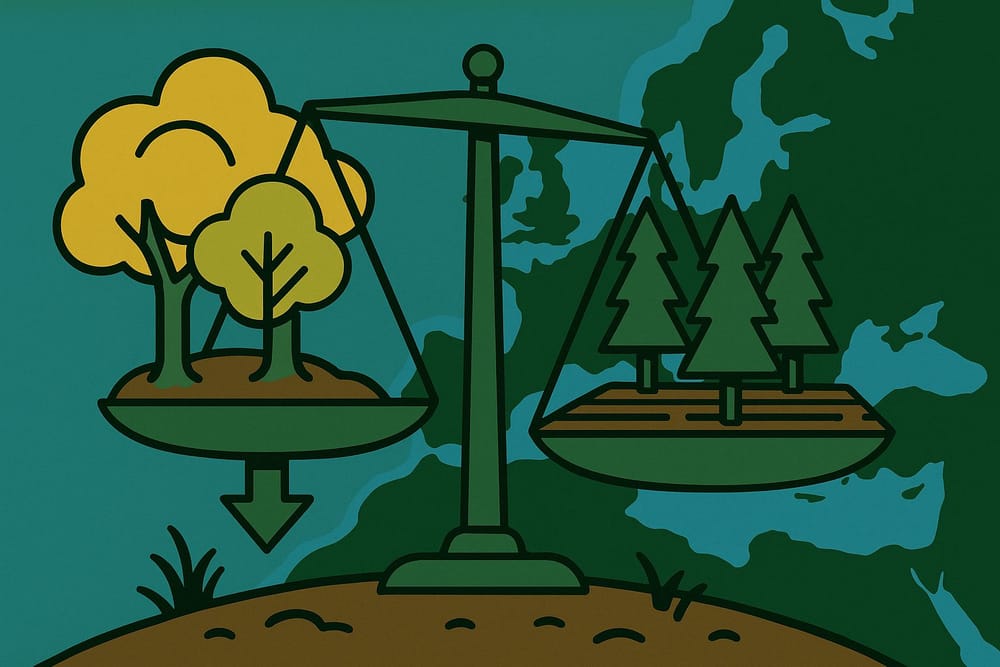
Over ten years, the carbon sink in European forests, including their soils, has diminished by approximately 27%. Homogeneous stands with rapid growth can create trade-offs between living biomass carbon and biodiversity, without evidence that they largely explain this decline. Europe has bet on reforestation as a carbon lever, but fast-rotation monospecific plantations can create trade-offs between short-term sequestration and complex forest structure. A study published in Nature Communications in January 2026 shows that carbon and biodiversity objectives can conflict when only living biomass is prioritized, but they can also converge.
The essentials
- Europe’s forest carbon sink declined by approximately 27% between 2010-2014 and 2020-2022, according to the EEA/FISE; Nature Communications (January 2026) analyzes trade-offs between carbon pools and biodiversity.
- Fast-growing monospecific plantations—pines, spruces, eucalyptus—can maximize short-term sequestration but impoverish the forest structure on which biodiversity depends.
- The central mechanism: removing dead wood, standardizing species and age classes—this eliminates habitats for hundreds of species. Simplified, monospecific structures are generally less resilient to disturbances; however, the effect of dead wood removal depends on context and the risks considered.
- Forest strategy is under implementation review; today’s planting choices lock in European forest composition through the end of the century.
- Alternatives exist—close-to-nature silviculture, mixed forests, ecological continuity—but they raise the question of revising carbon criteria to integrate biodiversity considerations.
European forests sequester less carbon, and the figure is more concerning than it appears
A 27 percent reduction in absorption capacity in ten years: this is the finding reported by the EEA, via the FISE and the European GHG inventory, analyzed in depth by Nature Communications. To put the scale in perspective, European forests represented until recently the continent’s primary terrestrial carbon sink. Their weakening directly compromises the EU’s carbon neutrality objectives for 2050.
Several factors explain this decline. Repeated droughts and heat waves have killed trees, particularly in spruce monocultures in Central and Eastern Europe. Wildfires have increased. But the Nature Communications study points to an important link: certain policies favoring living biomass can promote trade-offs with biodiversity.
Aged and heterogeneous forests—those combining trees of all age classes, decomposing dead wood, multiple species—sequester carbon over the long term and store it sustainably in biomass and soils. Young and uniform plantations capture quickly, but they release CO₂ during harvests, restock slowly, and prove vulnerable to disturbances. The long-term balance can be less favorable than it appears over short horizons.
The effect of plantations on living forest
A forest plantation calibrated for carbon obeys simple logic: choose the species that grows fastest, align it in tight rows, remove dead wood to prevent fires and pests, harvest before growth slows. This logic produces neat landscapes, presentable carbon accounts in the short term, and impoverished biodiversity.
Dead wood is here the clearest signal. In a natural forest, a fallen tree shelters a significant portion of forest species: saproxylic beetles, fungi, lichens, bats, cavity-nesting birds. Removing this wood means eliminating the basic habitat for a substantial share of European forest biodiversity. Yet carbon-certified plantations tend to remove it, sometimes under the guise of sanitary management, sometimes by exploitation logic.
Species uniformity aggravates the phenomenon. A monoculture of Scots pines or spruces offers few varied food resources, reduced vegetation layers, and weak resilience. When the bark beetle attacks or drought sets in, the plantation collapses en masse, sharply reducing its living carbon stock and weakening the sink. Germany and the Czech Republic experienced major degradation of their forest balance between 2018 and 2022, with significant hectares of spruce dying or being felled, transforming the sink into an emissions source.
This phenomenon is not unique to Europe. The JdP documented a similar mechanism in Southeast Asia, where 20 million hectares certified as carbon show sequestration gains on paper but net biodiversity loss on the ground. The European dynamic is part of a broader phenomenon: standardization of carbon objectives tends to standardize ecosystems.
The policy that created the problem
The LULUCF regulation sets quantified annual objectives for net emissions and removals. The combined effect of the CAP, LULUCF, and voluntary credits on short-term sequestration valuations remains complex. Biodiversity, meanwhile, was rarely measured and poorly integrated into the forester’s economic calculations.
The LULUCF regulation, which sets land absorption targets for member states, reasons in tonnes of CO₂ equivalent. It does not set a minimum dead wood level, but it requires accounting for variations in carbon stock in managed forests; it does not prescribe species diversity either. This gap is not an oversight: at the time the text was drafted, integrating biodiversity indicators would have complicated measurement and slowed adoption. The political compromise chose simplicity. The LULUCF framework privileges accounting for GHG flows without directly setting stand composition or structure.
Member states applied this logic with contrasting results. Finland and Sweden, with long silvicultural traditions and abundant natural forests, maintained some ecological continuity. Poland, Hungary, and Romania planted massively in monocultures. Spain and Portugal bet on eucalyptus, an ultra-fast-growing species whose plantations can modify soils and affect local flora depending on site and management. The aggregated result confirms a weakened sink; the state of biodiversity and vulnerability vary by indicators, regions, and forest types.
Concrete effects of close-to-nature silviculture
Alternatives exist and work. Close-to-nature silviculture (CNS), practiced in certain regions of Central and Scandinavian Europe, rests on a different principle: permanently maintain trees of all age classes, retain a proportion of dead wood standing and on the ground, diversify species by favoring local broadleaves. Harvests are selective, never clear-cuts.
Results for biodiversity are clear. The COST EuMIXFOR network studied the hypothesis of biodiversity benefits of mixed forests, though its institutional fact sheet did not demonstrate this precise statistical result. Greater species diversity can increase resilience or resistance to certain disturbances, but the effect is neither universal nor identical for all disturbances.
The carbon question is more nuanced. In the short term, a close-to-nature forest may sequester less than an intensive plantation depending on conditions, because it maintains old trees whose growth slows. Over the long term, old trees store carbon sustainably, complex forest soils accumulate organic carbon, and the forest resists disturbances better.
This long-term accounting poses an immediate political problem: the EU’s carbon objectives are set for 2030 and 2050. A forester switching to CNS today can lose short-term carbon revenue; recognition and payment for long-term benefits remain limited. The regulatory framework does not yet know how to value resilience.
Before 2028, a choice that commits forests through 2100
A review of the forest strategy implementation was envisioned for early 2026 and LULUCF provides for separate regulatory reviews. This revision is a real turning point. A tree planted today will structure the forest landscape through the end of the century: decisions made in 2025-2030 can durably influence European forest composition toward 2100, without determining it alone.
Two directions clash in Brussels debates, though no official quantified scenario has yet been published. The first maintains current logic while tweaking it: keep state-level carbon objectives, add some minimum diversity criteria, and hope adverse effects correct themselves as foresters learn. This is the path of continuity, less costly politically in the short term.
The second redirects criteria: integrate biodiversity indicators into LULUCF calculations, value carbon storage in old forests and dead wood, and adjust aid mechanisms to account for longer time horizons. This path requires modifying measurement horizons and recognition of carbon benefits, which is politically complex in a context where every tenth of a degree matters.
Between these two directions, a third path merits attention: territorial differentiation. Certain zones—residual primary forests, mountain massifs, Natura 2000 areas—would be managed for biodiversity and resilience, without maximum sequestration requirements. Other less sensitive zones would remain under intensive plantation regimes. This zoning approach already exists in theory in the EU’s 2030 biodiversity strategy, which provides for placing 10% of land under strict protection. The issue is whether this principle translates into enforceable forest rules or remains a declarative intention.
The signals to watch are precise: the LULUCF regulation reviews planned at various horizons, the positions of forest member states (Finland, Sweden, Poland, Germany), and the Joint Research Centre’s work on forest biodiversity indicators. If these indicators enter the regulation, monospecific plantations could see their incentives modified, without automatic abolition. A LULUCF centered on tonnes of CO₂e would limit its action on biodiversity, but other European instruments, including forest strategy and nature restoration legislation, also act on forest structure.
Actors seeking a different path
Several institutions and networks are working on concrete solutions without waiting for the Brussels review. Pro Silva Europe, a network of foresters active in twenty-seven countries, spreads close-to-nature silviculture practices and trains managers. Its members manage mixed forests in Central and Scandinavian Europe whose biodiversity and resilience balances are documented. The organization publishes field results that directly feed forest policy debates.
The EU’s LIFE program has funded forest restoration projects for several years, integrating biodiversity and carbon. Certain projects, in Spain, Ireland, and Estonia, test mixes of indigenous species with parallel carbon and biodiversity monitoring protocols. These experiments produce data that could, if integrated into the LULUCF review, modify aid eligibility criteria.
Researchers at several European universities, notably Freiburg, Wageningen, and the University of Helsinki, work on carbon accounting models integrating resilience and biodiversity. Their work explores the potential of mixed forests over long time horizons compared to uniform fast-rotation plantations. This is the key demonstration: if it convinces regulators, it changes the incentive framework.
The Joint Research Centre works on links between forest biodiversity and long-term carbon sequestration, with a timeline to watch. This report will be central to the LULUCF review. Its content and political reception will say much about the direction the EU will take.
European forests can absorb more carbon and harbor more life. But this requires accepting that the two objectives are not measured on the same time horizon and building rules that recognize this lag. The challenge for the coming years is whether Brussels is ready to rework its measurement framework, or whether short-term carbon accounting will continue to orient decisions that commit the century.
Sources
- Nature Communications, January 2026, “European forest carbon sink decline”
- European Environment Agency, Report on the State of European Forests
- Joint Research Centre of the European Union, LULUCF Data and Forests
- JdP, 20 million hectares certified carbon in Southeast Asia but less biodiversity