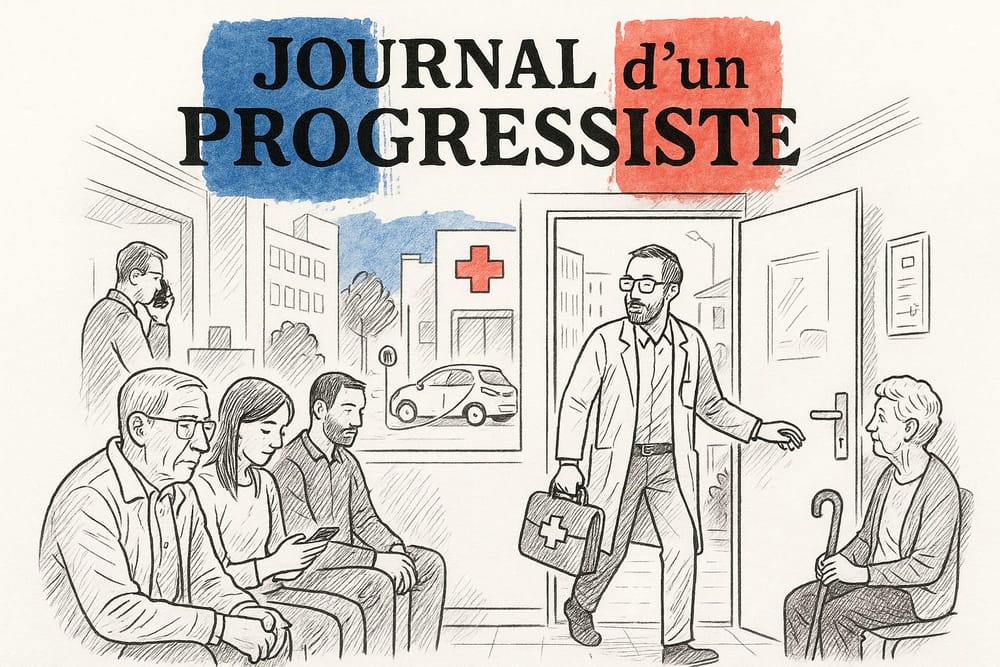
Medical deserts, a decade without doctors to navigate without delay
Six and a half million French people have no declared primary care physician. Eure-et-Loir lost 40% of its general practitioners in fifteen years. The demographic wave of old age arrives between 2030 and 2040, precisely when the trough of medical cohorts from 1993-2000 is deepest. Making any new installation in over-supplied areas conditional on partial practice in medical deserts, and creating autonomous pricing for advanced practice nurses, is the trade-off that 2027 must decide on, before the decade makes waiting irreversible.
Thirty years of numerus clausus, a bill coming due now
In 2024, France has 3.4 doctors per thousand inhabitants [5, 6]. Austria has 5.5, Germany 4.5. France’s position is median within the OECD. But the territorial inequality overlaid on top of it is extreme.
The average density of general practitioners is 145 per 100,000 inhabitants in 2024 [7]. The Hautes-Alpes reaches 298 per 100,000. Eure-et-Loir and Eure remain below 90 per 100,000. A gap greater than a factor of three, on the same national territory, under the same health insurance regime [7].
Eure-et-Loir illustrates the speed of change. In 2010, the department had 117.3 general practitioners per 100,000 inhabitants [7]. In 2025, it has 69.8, meaning forty percent of the medical density has been lost in fifteen years in an already fragile territory [7]. Accessibility to general practitioners deteriorated between 2022 and 2023 across the country, due to the combined effect of a decline in the number of private practitioners and population growth [1].
The localized potential accessibility indicator, calculated by DREES, measures the fit between supply and demand by integrating patient load and age-related needs. In 2024, it identifies 7% of the population in areas of severely insufficient general medicine, or 4.7 million people [4]. It also identifies 55% of the population in insufficient areas, or 36.9 million [4].
The gap between territories is even more stark. In 2022, the 10% of the population best served had access to 5.6 general practitioner consultations per year [7]. The 10% least well served had access to only 1.4 consultation. This gap widened by an additional 5% between 2022 and 2023 [7]. Between 2012 and 2022, doctor numbers grew in already well-supplied territories and fell sharply in already devastated departments [14].
The generating mechanism is the numerus clausus [2]. Established in 1971, it limited entry into medical studies to approximately 8,500 places per year until 1977. It then decreased regularly until 1993, when it reached a minimum of 3,500 places per year.
This threshold was maintained for five years. The shrunken cohorts of 1993-2000 are reaching retirement age today, precisely when the French population is aging. The administrative decision of 1993 produces the medical desert of 2026.
The number of active doctors declined by 2.4% during 2020-2024 [2]. Current levels will not be reached again until 2030, and only in 2035 for general practitioners. Growth will not take off until 2040 [2]. Since 2022, France has lost 2,500 general practitioners, bringing their total number to 99,500 [3]. Projections indicate this decline will continue until 2028, with a critical threshold at 92,500 practitioners [3].
Demand accelerating while supply retreats
By 2030, 25% of the French population will be over 60 [17]. Between 2030 and 2040, the number of people aged 85 and over will increase by 58% [17]. France would have 2.8 million elderly people with loss of autonomy in the early 2050s, compared to just over 2 million in 2021 [17].
The number of people with chronic diseases could grow by 50% by 2050 [18]. Pressure on geriatric consultations and home care mechanically increases.
These projections translate into spending. Population aging would lead to a 1.35% annual increase in outpatient and hospital care costs [10]. A Clariane-Asterès study extends this calculation: aging alone would lead to a 13% increase in health spending by 2050, or 41 billion euros in additional spending, equivalent to the annual budget of the Ministry of Education [18].
The healthcare workers who must handle this wave are precisely those whose training was compressed in the 1990s. Between 150,000 and 200,000 additional jobs would be needed by 2050 to provide basic care to elderly people with loss of autonomy, in institutions and at home [1].
The present consequence is already measurable. In 2024, 35% of UFC-Que Choisir respondents postponed care due to lack of appointments, compared to 27% in 2023 [15]. This postponement affects people unequally.
A person living below the poverty line is 1.6 times more likely to postpone care [14]. The poorest 10% are 2.8 times more affected by diabetes than the wealthiest 10% [14]. Medical desertification and social precarity overlap geographically in the same territories [14].
The Medical Board register is full, available medical time is lacking
The CNOM counts 237,300 active doctors as of January 1, 2024, up 10% from 2010 [3]. This increase masks three structural ruptures.
The first is feminization. In 2024, women represent 51.8% of doctors in regular active practice [3]. New generations, men and women, work fewer hours than their predecessors. This reduces annual working hours per practitioner.
The second is salarization. In 2024, 48.7% of doctors in regular active practice opted for employment, compared to 41.9% in 2010 [3]. This trend is accompanied by concentration in large cities.
The third rupture is actual active practice. In 2010, regular active doctors represented 92.8% of all active doctors [3]. In 2024, this proportion has fallen to 83.9%. What is lacking is available medical time in specific territories. The register itself is already full.
This rupture is worsened by an innovation that has failed to deliver due to lack of appropriate economic conditions. The advanced practice nurse status has existed since 2018. In July 2023, the Court of Accounts issued its assessment: the system involved approximately 1,500 nurses working with 6,500 doctors [11]. The economic model in private practice does not allow APNs to earn a living from their activity.
Everywhere advanced nursing roles have been developed, they improve access to care when medical supply contracts, according to an OECD evaluation covering twelve countries [19]. They also contain costs by taking on some procedures. France has the law and ignores the economic conditions that would make it operational.
Working conditions and professional recognition determine the attractiveness of fragile areas as much as any installation bonus. Healthcare workers leaving under-supplied areas flee isolation, administrative burden, absence of a work collective. The work of Bruno Palier and Christine Erhel on work quality documents this mechanism for sectors with severe shortages [20].
A second lever opens through technology. AI in healthcare produces shared value provided institutions orient its uses toward needs in under-tension areas, as Daron Acemoglu and Simon Johnson emphasize [22]. Teleconsultation, diagnostic support, management of multiple chronic conditions are exactly the tasks where AI can amplify the capacity of a single healthcare worker in a remote territory. Yet tariffs and tools must be designed for this use case rather than for already well-equipped areas.
Regulate installation or endure the decade without care architecture
Financial incentives for installation in under-supplied areas have produced effects too limited relative to their cost to reverse the trend [8]. Subsidizing installation in an area without a healthcare collective, without accessible maternity services, without life infrastructure did not change the calculation of the doctor deciding where to practice. The Court of Accounts confirms this finding in its April 2025 report [10].
Three distinct mechanisms generate the deficit in available medical time. Cohorts were compressed for thirty years [2]. Task-sharing between health professions remains blocked by inadequate economic models [8]. Working conditions in under-supplied areas make the choice to practice there economically and socially unfavorable [2, 8]. Acting on the symptom without addressing these three mechanisms reproduces the deficit.
The first lever, training, has been activated. The 10,000 students trained annually will increase to 12,000 in fall 2025, then 16,000 in 2027, an increase of 70% from 2019 [13]. In 2025, 2,810 doctors established themselves in private practice, compared to 2,130 in 2024, a 32% increase [16].
This rebound is real. It does not reduce the bill from 1993-2000: the effects of ending the numerus clausus will not be felt before 2030 at the earliest. Training alone cannot solve the crisis of the current decade.
Unlocking medical time requires redistribution of procedures. The November 2024 Senate report formulates 38 recommendations [8]. Its central proposal opens direct access to physical therapists for a targeted number of conditions and grants them the right to prescribe imaging and certain anti-inflammatories [8].
APNs exist on paper. They languish for lack of viable economic models in private practice [11]. Autonomous pricing of APN procedures, disconnected from the delegating doctor, is the condition for advanced practice to work in low-density areas.
Territorializing mandatory internships in the second cycle is an immediately activable lever. Doctors predominantly establish themselves where they completed their internships [1, 4]. ISNI, ANEMF and CNOM support acceleration of this territorialization in under-supplied areas. Long-term effects depend on decisions made now about training curricula.
Making new installations in over-abundant areas conditional is the most direct lever. Proposal No. 4 of the 2024 Senate report subordinates installation in over-supplied areas to partial practice in under-supplied areas [8]. This condition has already been implemented for dentists. DREES and the Senate have both determined the measure is feasible for general practitioners [7, 8]. Replacing some unconditional incentives with entry regulation in already well-supplied areas changes the system architecture without constraining permanent practice.
The quality of healthcare work determines retention in the profession and attractiveness of fragile areas, a finding Palier and Erhel establish solidly [20]. Multidisciplinary health centers reconstitute the healthcare collective. This pillar benefits from being coupled with a quality-of-life policy for isolated areas. Equipment aid alone is insufficient.
Budget constraint and the trade-off to be decided by 2027
Budget constraint runs through all this reasoning. ONDAM, the annual envelope for health insurance spending, grew 4.8% per year from 2019 to 2025 [10]. Its share of GDP went from 8.2% to 8.9% over this period [10]. The cumulative annual deficit of the three branches funding this target would nearly double, from 11.8 billion euros in 2024 to 20.1 billion in 2028 [10]. This would lead to rebuilding a social debt of over 70 billion in three years [10].
The Court of Accounts notes nonetheless, in its April 2025 report, that 265,000 hospitalizations for chronic diseases were avoidable in 2017 [10]. Four in five concerned patients aged 65 and over [10]. These hospitalizations cost incomparably more than a general practitioner or APN consultation.
Restoring access to primary care in deserted areas is a budget efficiency measure as much as an equity objective. Lifting organizational blockages that maintain the shortage costs less than compensating for its effects through increased hospital spending. This is precisely the supply-side logic defended by Ezra Klein and Derek Thompson in Abundance [21].
The trade-off posed for 2027 is architectural. Making installation in over-supplied areas conditional on partial practice in medical deserts transfers a private decision into the field of public regulation: this makes territorial distribution possible, at the cost of a constraint on freedom of installation that private-practice doctors contest. Creating autonomous pricing for APNs shifts medical competence toward a profession that can practice in isolated areas: this opens access to primary care, at the cost of questioning medical monopoly over procedure delegation. These two decisions can be made as early as 2027. Deferring to 2030 or beyond means crossing the most difficult decade without architecture.
Sources
[1] DREES, “Demography of health professionals as of January 1, 2023,” Studies and Results, August 2023, https://drees.solidarites-sante.gouv.fr/publications/etudes-et-resultats/un-exercice-de-projection-de-la-demographie-medicale-lhorizon-2020 (accessed 05/09/2026).
[2] DREES, “What recent and future demography for medical and pharmaceutical professions?” DREES Dossiers No. 76, March 2021, https://medias.amf.asso.fr/upload/files/Drees_Demo.pdf (accessed 05/09/2026).
[3] CNOM, “Atlas of Medical Demography,” situation as of January 1, 2025, https://www.gpm.fr/atlas-demographie-medicale-2025/ (accessed 05/09/2026).
[4] DREES, Localized Potential Accessibility Indicator (APL), Research and Survey Program 2024, https://drees.solidarites-sante.gouv.fr/sites/default/files/2024-03/PAT2024.pdf (accessed 05/09/2026).
[5] DREES, “International comparisons of doctor and nurse numbers,” in Health Spending in 2023, 2024 edition, November 2024, https://drees.solidarites-sante.gouv.fr/sites/default/files/2024-11/CNS24%20-%20Fiche%2025%20-%20Comparaisons%20internationales%20des%20effectifs%20de%20m%C3%A9decins%20et%20infirmiers.pdf (accessed 05/09/2026).
[6] OECD, Health at a Glance, health statistics, 2021-2022 data, https://stats.oecd.org/Index.aspx?DataSetCode=HEALTH_STAT (accessed 05/09/2026).
[7] DREES, “Territorial inequalities in general practitioner distribution,” Social Security Policy Evaluation Report, Health, 2024, https://evaluation.securite-sociale.fr/home/maladie/261-inegalites-territoriales-de.html (accessed 05/09/2026).
[8] Senate, Commission on Territorial Development and Sustainable Development, “Territorial inequalities in access to care: fighting fire with fire,” information report No. 137, November 2024, https://www.senat.fr/rap/r24-137/r24-1371.html (accessed 05/09/2026).
[9] Senate, Commission on Social Affairs, Proposed law to improve access to care in territories, opinion No. 574, May 2025, https://www.senat.fr/rap/a24-574/a24-574_mono.html (accessed 05/09/2026).
[10] Court of Accounts, “The National Health Insurance Spending Objective (ONDAM),” report, April 2025, https://www.ccomptes.fr/fr/publications/lobjectif-national-de-depenses-dassurance-maladie-ondam (accessed 05/09/2026).
[11] Court of Accounts, “Advanced practice nurses: necessary evolution, powerful barriers to lift,” flash audit, July 2023, https://www.ccomptes.fr/system/files/2023-07/20230705-Infirmiers-en-pratique-avancee.pdf (accessed 05/09/2026).
[12] National Assembly, report No. 1180, Commission on Social Affairs, 17th legislature, https://www.assemblee-nationale.fr/dyn/17/rapports/cion-soc/l17b1180_rapport-fond.pdf (accessed 05/09/2026).
[13] National Assembly, report No. 1180, Commission on Social Affairs, 17th legislature, https://www.assemblee-nationale.fr/dyn/17/rapports/cion-soc/l17b1180_rapport-fond.pdf (accessed 05/09/2026).
[14] DREES, “The state of health of the French population in light of social inequalities,” DREES Dossiers No. 102, September 2022, https://drees.solidarites-sante.gouv.fr (accessed 05/09/2026).
[15] DREES, “Measuring care postponement is highly sensitive to question wording,” DREES Methods No. 10, August 2023, https://drees.solidarites-sante.gouv.fr/sites/default/files/2023-08/DM10.pdf (accessed 05/09/2026).
[16] Health Insurance, “Observatory of Access to Care,” June 2026, https://data.ameli.fr/explore/dataset/medgen-zones-sous-dotees-infra-annuelle/table/ (accessed 05/09/2026).
[17] INSEE, population projections to 2050, https://www.insee.fr (accessed 05/09/2026).
[18] Clariane / Asterès, “The impact of aging on health spending,” forward-looking study to 2050, 2025, https://www.clariane.com/en/health-and-longevity/health-economy/the-impact-of-ageing-on-health-spending (accessed 05/09/2026).
[19] OECD, “Nurses in Advanced Roles: A Description and Evaluation of Experiences in 12 Developed Countries,” 2010, https://www.oecd.org/content/dam/oecd/fr/publications/reports/2010/07/nurses-in-advanced-roles_g17a1e81/5km4hv77vw47-fr.pdf (accessed 05/09/2026).
[20] Bruno Palier, Christine Erhel, “Working Better,” PUF/Vie des idées, 2025; Bruno Palier, “Health Systems Reform,” PUF/Que sais-je?, 10th edition, 2025.
[21] Ezra Klein, Derek Thompson, “Abundance,” Avid Reader Press, 2025.
[22] Daron Acemoglu, Simon Johnson, “Can A.I. Be Pro-Worker?,” The New Yorker, 2026.