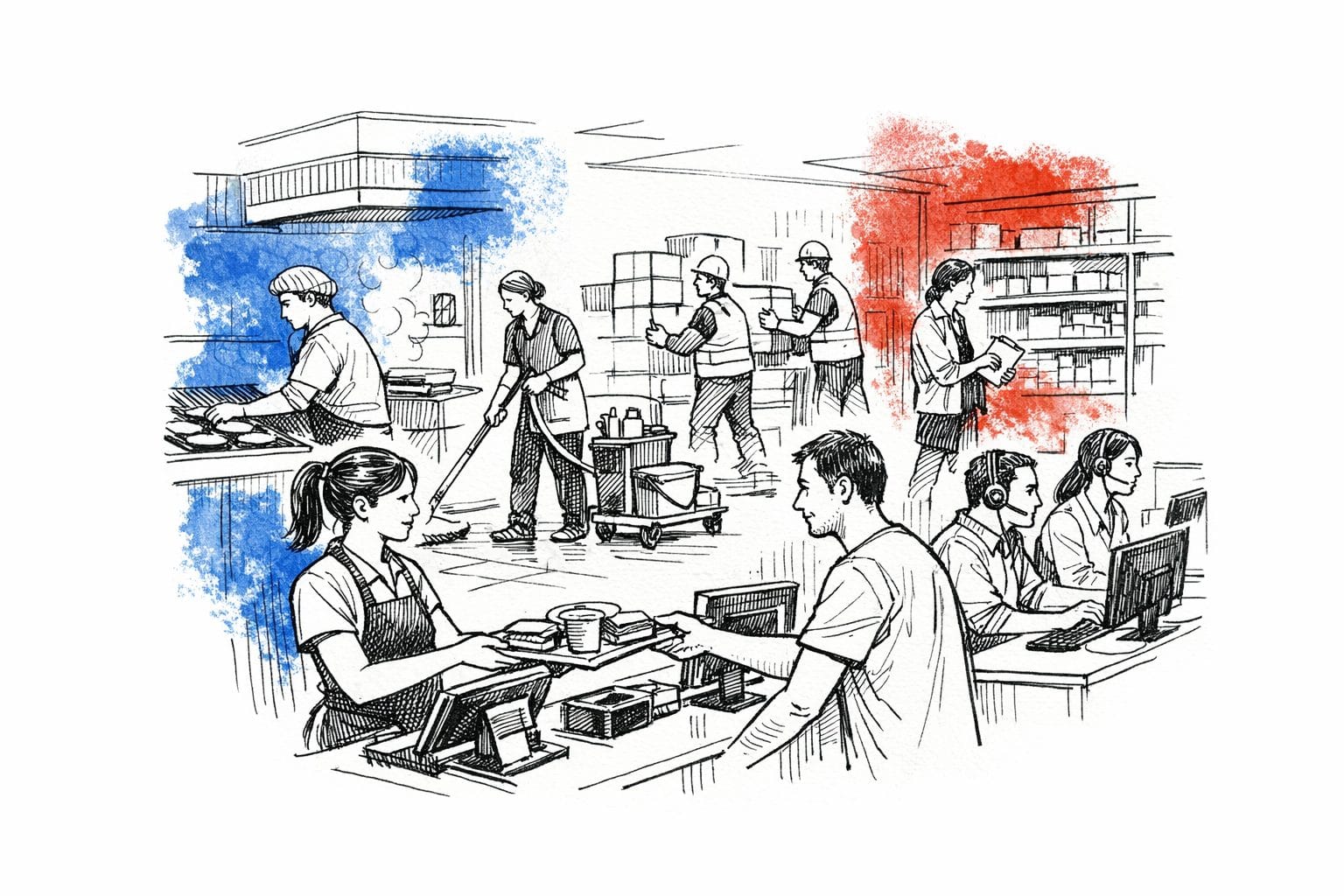
France spends 233 billion euros per year on public procurement. That’s roughly what education, defense, and public health combined cost in the state budget. And a disproportionate share of this sum goes directly to finance factories located outside the national territory.
Sixty percent imported, forty for neighboring countries
France currently imports nearly 60% of the goods included in its public orders. This is the figure that Olivier Lluansi, tasked by the Ministry of Economy in 2023 with a mission on reindustrialization by 2035, put on the table with clarity that stings. Italy and Germany import only 40% of the goods purchased under their public procurement. Twenty percentage points’ gap. On an allocation of 233 billion euros, this gap represents tens of billions in orders that could have fed French SMEs and do not.
This is not a recent accident. Between 2005 and 2014, the share of imports in French public procurement rose from 6.5 to 8.2%. Over the same period, German public procurement did not import any more than in 2005, approximately 7.8%. Deindustrialization therefore has a feedback loop effect: a country that stops producing begins to import more, including for its own public needs, which the Council of Economic Analysis formulated this way in its Focus 058 from 2021: mechanically, when a country deindustrializes, it must increasingly resort to imports to satisfy its demand for manufactured goods.
The mechanism is circular and little discussed. Industry declines. The state buys abroad what it no longer finds at home.
In doing so, it finances foreign supply chains, widens its trade deficit, and deprives its own SMEs of stable demand. The share of manufacturing industry in French added value fell from 25% in 1961 to 11% in 2010. Today, industry represents 13.7% of French GDP, and industrial employment 11.2% of total employment. In Germany, the share reaches 20% of GDP; in Italy, 18%; in Spain, 16%.
The paradox of the public buyer least patriotic of its citizens
French consumers buy more French products than public buyers do. Olivier Lluansi named it with precision: “Made in France is the stowaway passenger of our public policies.” A state that subsidizes reindustrialization with one hand and finances deindustrialization with the other is the exact portrait of what the figures describe.
The paradox is explained by the structure of European law itself. The fundamental principles of public procurement prevent geographic discrimination in contract awards within the European Union; principles stemming from European treaties forbid such discrimination. In plain terms: a public buyer cannot choose a supplier because it is French.
It can favor a social or environmental criterion, but not a productive origin criterion. The United States never renounced this rule: the Buy American Act of 1933 requires the American government to purchase goods produced in the United States in certain circumstances. Since 2024, the threshold of required domestic components has been raised to 65% of the total component cost.
The French problem is therefore not a lack of rhetorical will. It is a real legal constraint—and a way of living with this constraint that does not even exploit available margins. Olivier Lluansi estimates that 15 billion euros of public purchases per year could be redirected annually toward French companies, without modifying European rules.
The margin exists under constant law, in award criteria, execution clauses, total lifecycle cost. It is not being used. But, observes Lluansi, we have remained at the level of political incantation.
France’s total trade deficit reaches 81 billion euros in 2024. Dropping from 60% to 40% imports in public procurement would represent 15 billion euros for French industry, or one-third of the trade deficit in manufactured goods. France has not posted a trade surplus on goods since 2002. Public procurement is not the only lever to remedy this, but it is a lever that the state controls directly, unlike the investment decisions of private companies.
What the revision of European directives makes possible
Law is not fixed. European directives on public procurement are undergoing revision. This is a window that opens once per generation: the last major overhaul dates to 2014. The Senate inquiry commission on public procurement, which submitted its report in July 2025, formulates 67 recommendations aimed at better exploiting the potential of public procurement in service of European economic and digital sovereignty.
Within the framework of this revision, the inquiry commission believes emphasis must be placed on European preference, modeled on the American Buy American Act. This preference should be general, not limited to certain particular sectors. The commission calls for establishing a general principle of European preference in public sector purchases.
This is the heart of the debate for 2027. Dani Rodrik, in his work on industrial policy for employment, stresses that modern industrial policy must go beyond the manufacturing sector alone and industries competitive internationally, and rely less on subsidies and tax incentives than on collaborative interaction between public agencies and companies engaging in trade-offs on the quantity and quality of employment. Public procurement is precisely this type of instrument: a demand commitment, not a subsidy lost forever.
Inscribing European content in directives, or continuing to finance elsewhere
The choice posed for 2027 is architectural. It is not about adjusting a criterion in a call for tenders or “better raising awareness” among public buyers. It is about deciding at what scale the rule is written and what it protects.
France can defend, in the ongoing revision of European directives, the inscription of a European content criterion in supply contracts, first on strategic products identified by the Council of Economic Analysis, the 644 products that French companies import and that are indispensable to the production process, whose dependencies are outside Europe and concentrated among a small number of suppliers. Concretely, this means that for a portion of industrial supply markets, a minimum threshold of value added produced in Europe would become a binding award criterion, not a declaratory preference, but a right inscribed in the directive.
This shift changes the system’s architecture on at least three dimensions. First, who decides: the content criterion would no longer be left to the discretion of each buyer, but defined at the European scale, with a binding constraint. Next, who produces: industrialists would know that public demand will be there for a range of products, which makes capacity investment financeable. Finally, who owns the supply chains: today, a portion of goods purchased by French public procurement is produced by subsidiaries of non-European groups that repatriate added value outside the territory. A content criterion shifts this rent toward producers anchored in Europe.
Jean Tirole and Stéphane Saussier, in their note for the Council of Economic Analysis on the efficiency of public procurement, underline that representing nearly 15% of GDP, public procurement presents a very significant budgetary issue. Yet it is regularly pointed to for its inefficiency and lack of transparency. The content criterion does not solve everything, but it resolves something that neither France 2030 nor subsidies for gigafactories can resolve: it anchors demand, not just supply.
The budgetary constraint is real. A European content criterion may increase the cost of certain public purchases in the short term. The Senate commission itself recognizes that the preference principle has a potential cost, on the American model where a markup of 6 to 12% is tolerated on the price of a foreign offer before preferring a national offer to it. This is a visible cost, which appears in buyers’ budgets. But this cost is today invisible and deferred: each billion euros of public procurement captured by an extra-European supplier is a billion that does not finance salaries, contributions, or production tax in France.
The alternative is known. Continue combining rhetoric about reindustrialization with a public procurement rule that directs spending toward producers with the best price, often located elsewhere. The Senate inquiry commission concluded that public procurement represents potential insufficiently exploited to accelerate the shift of the French and European economy into the era of economic, agricultural, industrial, and digital sovereignty. The question for 2027 is whether this potential will remain a pious wish or become a binding rule negotiated in Brussels.
Sources
[1] OECP / National Council for Public Procurement, “The figures of public markets 2024”, March 2026. https://www.economie.gouv.fr/files/files/directions_services/daj/media-document/Recensement2024-0326DEF.pdf (accessed 30/09/2026).
[2] Olivier Lluansi, reindustrialization mission 2023-2024; summary cited in Banque des territoires, Franceinfo and FO-Métaux. https://www.fo-metaux.fr/actualite/i/95835327/ and https://www.franceinfo.fr/replay-radio/l-interview-eco/industrie-si-nos-acheteurs-publics-etaient-aussi-patriotes-qu-en-allemagne_6778081.html (accessed 30/09/2026).
[3] Olivier Lluansi, Reindustrialize, the challenge of a generation, National Assembly: intervention and minutes, 2025. https://questions.assemblee-nationale.fr/dyn/17/comptes-rendus/cereind/l17cereind2425004_compte-rendu.pdf (accessed 30/09/2026).
[4] Council of Economic Analysis (CAE), Focus no. 058, “Can public procurement be a lever for activity relocation?”, Claudine Desrieux and Kevin Parra Ramirez, April 2021. https://cae-eco.fr/static/pdf/cae-focus058.pdf (accessed 30/09/2026).
[5] Institut Montaigne, “Reindustrialize: a challenge, solutions… and a societal choice”, 2025. https://www.institutmontaigne.org/expressions/reindustrialiser-un-defi-des-solutions-et-un-choix-de-societe (accessed 30/09/2026).
[6] INSEE, national accounts, share of industry in GDP 2024. https://www.insee.fr/fr/statistiques/8673351 (accessed 30/09/2026).
[7] Eurostat, share of industry in GDP by country (Germany, Italy, Spain, France). https://ec.europa.eu/eurostat/statistics-explained/index.php/National_accounts (accessed 30/09/2026).
[8] DG Treasury / DGDDI, results of France’s external trade 2024, trade deficit -81 billion euros. https://www.douane.gouv.fr/actualites/resultats-du-commerce-exterieur-de-la-france-pour-lannee-2024 (accessed 30/09/2026).
[9] Senate, inquiry commission on the costs and effective modalities of public procurement, report no. 830 (2024-2025), “The urgency to act to prevent derailment: Steering public procurement in service of economic sovereignty”, 8 July 2025. https://www.senat.fr/rap/r24-830-1/r24-830-1_mono.html (accessed 30/09/2026).
[10] Council of Economic Analysis, “Resilience and competitiveness: identifying critical dependencies”, 2021. https://www.cae-eco.fr (accessed 30/09/2026).
[11] Dani Rodrik, “An Industrial Policy for Good Jobs”, The Hamilton Project / Brookings, September 2022. https://www.hamiltonproject.org/publication/policy-proposal/an-industrial-policy-for-good-jobs/ (accessed 30/09/2026).
[12] Stéphane Saussier and Jean Tirole, “Strengthening the efficiency of public procurement”, Note of the Council of Economic Analysis, 2015. https://cae-eco.fr/Renforcer-l-efficacite-de-la-commande-publique (accessed 30/09/2026).
[13] Senate, report no. 281 (2024-2025), proposition for a resolution creating the inquiry commission on public procurement, Muriel Jourda, 29 January 2025. https://www.senat.fr/dossier-legislatif/ppr24-252.html (accessed 30/09/2026).