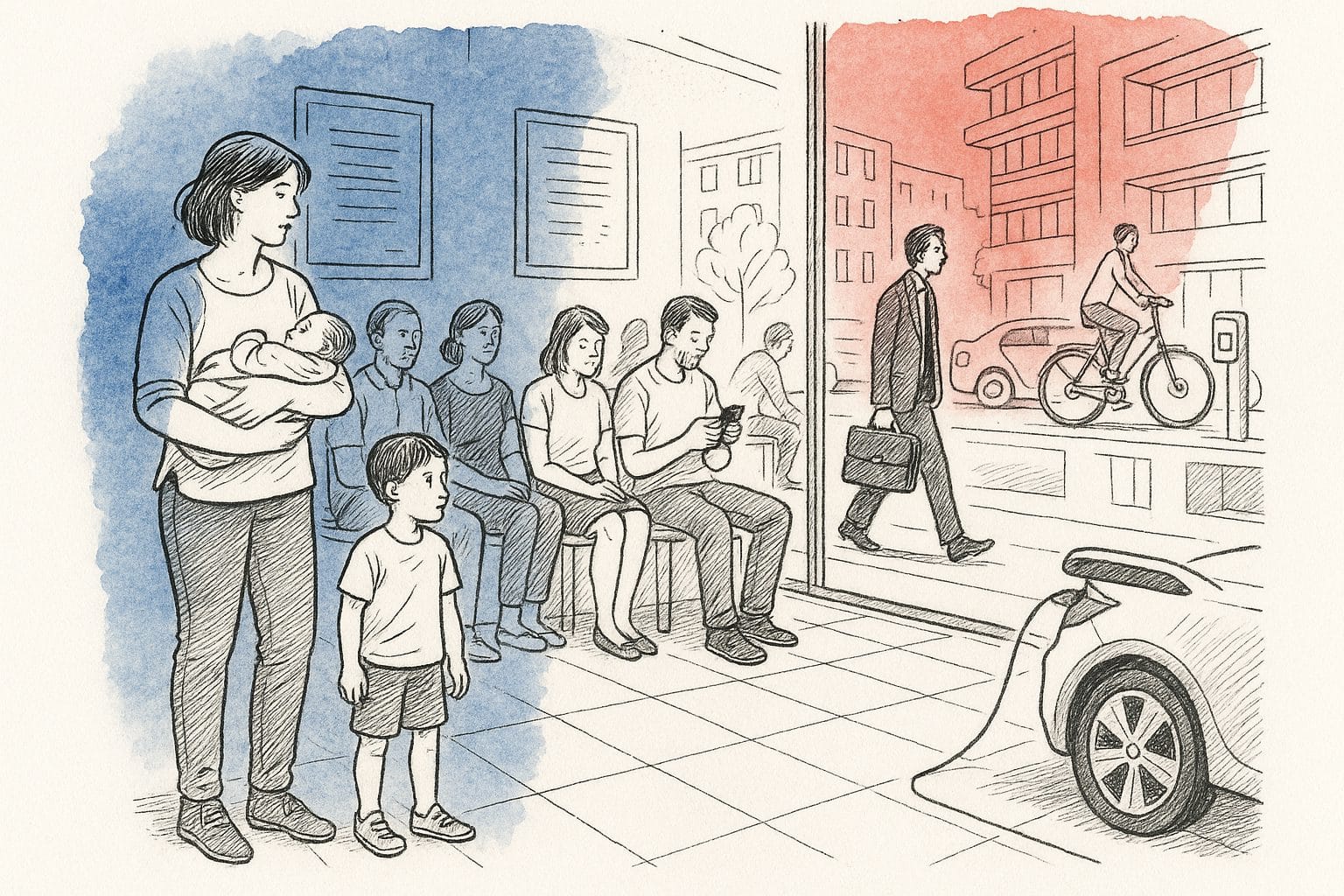
For a private-sector tenant among the poorest 10 percent, rent absorbs 59% of income before any other expense [1]. After housing allowances, it still absorbs 41% [1]. Meanwhile, housing starts have fallen nearly 31% over five years and more than 2.7 million households are waiting for public housing [8, 9]. The choice posed for 2027 is architectural: transfer the right to build to municipalities on every site designated as buildable in tight housing markets, or continue subsidizing demand that supply no longer meets.
Fifty years of divergence between tenants and the rest of society
The weight of rent in tenant income has more than doubled since 1970 [2]. This long-term monitoring, conducted continuously by economist Jacques Friggit at IGEDD, rules out any shortcuts.
The index of rents relative to disposable income per household has risen modestly for the average investor since the 1970s [2]. But the individual tenant is not the average household. His income is below the median. His burden has exploded.
Two mechanisms feed this gap. First, the average quality of housing has improved, which mechanically inflates measured rents. Second, tenants have become poorer relative to the overall population, particularly young people who are overrepresented in the private sector [2]. Today’s private-sector tenant is one who has neither accessed homeownership nor public housing: statistically younger, more precarious, more often alone.
59% of income for the poorest, more than two weeks of work for a studio in Paris
In 2020, the poorest tenants—the bottom 10% by living standards—spent 59.2% of their income on housing [1]. Housing allowances reduce this rate by 18.5 percentage points, to 40.7% [1]. Even after allowances, four out of ten tenants in this group exceed the international overburden threshold, set at 40%.
At the other end of the scale, the 10% of wealthiest households devote only 16.4% of their budget to housing [1]. The gross gap between bottom and top of the scale reaches a factor of 3.6. After allowances, it remains above 2 [1].
In 2022, free-market tenants spent an average of 28% of their income on housing [13]. That is 3 percentage points more than public housing tenants and 1 point more than homeowners still repaying mortgages [13].
The median private-sector salary reached 2,190 euros net per month in 2024 [14]. A share of 28% devoted to rent represents seven to eight days worked per month just for housing.
In Paris in 2026, an employee earning the legal minimum wage had to work 96.2 hours to pay for an average studio of 915 euros [15]. Nearly two and a half weeks for 20 square meters. In Limoges, at the median salary, 38.9 hours were enough to rent a one-bedroom apartment at 500 euros [15]. The share of income devoted to rent there fell to 25.7%, below the recommended threshold of 33%. The gap between the two situations reached 142% [15].
Housing overburden in France in the European mirror
Eurostat measures the share of the population spending more than 40% of disposable income on housing. In 2024, this rate reached 8.2% for the entire European Union [5]. In France, it stood at 20.2% for market-price tenants alone, against 18.6% on average for the euro area [6].
France sits above the European median on rental pressure without reaching the highest levels. For single-person households, the French rate was 19.9% in 2024, against 23.0% in Germany and 38.8% in Denmark [5]. Behind this intermediate position lie deep territorial and income inequalities.
A new housing stock in free fall and increasingly captive tenants
The share of income devoted to rent is a snapshot of stock. The rupture underway touches flows. In 2024, the number of building permits reached its lowest level in fifty years [9]. Over the twelve rolling months to end-November 2025, housing starts remained 30.8% below the average of the five preceding years [9].
This production crisis transforms the structure of the rental market. The number of households waiting for public housing has grown to more than 2.7 million in 2024, a million more in ten years [8]. Fewer than 400,000 public housing units were allocated in 2023, compared with 500,000 in 2015 [8]. Fewer than one in five applicants now receives a positive response within a year.
The consequence is mechanical: hundreds of thousands of modest households shift to the private sector, where rents are freely set at relocation and where their negotiating power is nil.
In 2025, 350,000 people were homeless, against 300,000 in 2020 [8]. National budget effort in favor of housing is historically low, notes the 31st report by the Foundation for Housing the Disadvantaged [8].
The underlying mechanism is identifiable. Between the 2000s and the early 2020s, real estate prices grew far faster than rents, driven by favorable credit conditions: extended loan terms, low rates, rising household real estate debt [2]. The rate increase since 2022 has blocked homeownership access for households who would have exited the rental market. Pressure on rents has been reinforced from the bottom. Today’s captive tenant is in part yesterday’s prevented homeowner.
Housing Allowance (APL), a massive safety net whose structural effect remains limited
Nearly 15.6 billion euros in personal housing allowances were distributed in 2023 [11]. The state finances more than three-quarters of the total envelope, which reached 32.8 billion euros that year [11]. It is one of the heaviest social spending items in the budget.
Tenant housing expenditure, net of allowances, represented 25.2% of their income in 2020 [1]. But part of these allowances is captured by landlords through upward rent adjustments. In 2024, in the Greater Paris Metropolis, 68,000 households in the private rental market still showed a rent burden exceeding 40% after receiving housing allowances [12]. They represented 46% of housing allowance recipients in the private sector on this territory [12]. Assistance is massive; overburden persists for a large portion of its beneficiaries.
When assistance widens tenant purchasing power without increasing supply, it partly feeds land rent rather than consumer purchasing power [1, 11]. Substituting redistribution for a reform of price formation consolidates the imbalance instead of correcting it. This is the trap that Daron Acemoglu and Simon Johnson formalized more broadly on capital gains capture [3].
Rent regulation in Paris, real results on a narrow perimeter
Rent regulation in Paris, in effect since July 2019 with several judicial interruptions, now provides serious evaluation. Between July 1, 2019, and June 30, 2024, it limited rent increases by 5.2% compared with the unregulated scenario [10]. This represents an average savings of 984 euros per year for affected tenants [10].
The effect is stronger for small units. For those under 18 square meters, the decline reached 13.1% [10]. Upon new lease signings, 66% of these studios exceeded the legal ceiling. Over the period July 2023–June 2024, the decline reached 8.2%, against 2.5% in 2019 [10].
This result is real, but its scope remains conditional on implementation and enforcement, which remain marginal at the national scale [10]. Regulation does not address the supply question. Strict regulation without new production can depress rental investment and reduce available stock in the long term. Calibrating regulation to avoid drying up the stock while containing relocation abuses is the central challenge of any national extension.
Transfer the right to build to municipalities or indefinitely finance rent
The landowner in a tight market derives rent from scarcity. Since 2024, urban planning law still gives him the final say on densification in virtually all municipalities [9]. The 32.8 billion euros invested annually by the state [11] arrive in a market whose logic rewards waiting and penalizes housing starts. The 15.6 billion in housing allowance [11] operates in the same logic: part of public spending feeds rent instead of reducing housing burden.
The architectural choice posed for 2027 is this: transfer the right to build to municipalities on every site zoned as buildable in tight markets for more than ten years without implementation. The municipality, or a public land establishment, becomes the primary operator where the market organizes retention. Construction blocks rarely stem from regulatory accidents. They are active protections of existing property owners, as Klein and Thompson documented for American housing markets [4].
This change shifts real costs onto withheld land holders, not tenants or the state budget. Indefinite inaction ceases to be a land value appreciation strategy.
Rent regulation at relocation, whose Paris effect is now measured [10], becomes practicable at large scale because it rests on a growing stock. Personal allowances cease to be partly absorbed by rising rents for lack of competing supply. With more than 2.7 million households waiting [8] and a 30.8% shortfall in housing starts by end-2025 [9], the tacit balance between the state-compensator and property-rentiers has reached its limit. The sequencing is common across the three housing articles in this series: supply first, rent regulation on a growing stock, then APL reorientation afterward.
Sources
[1] SDES (CGDD), “The weight of housing expenses in tenant income in 2020,” 2020 National Housing Survey, publication 2023, https://www.statistiques.developpement-durable.gouv.fr/le-poids-des-depenses-de-logement-dans-le-revenu-des-locataires-en-2020 (accessed 08/09/2026).
[2] IGEDD (Jacques Friggit), “Housing prices, rents and income per household in the long term,” monthly updated file, last version July 2025, https://www.igedd.developpement-durable.gouv.fr/juillet-2025-a4282.html?lang=fr (accessed 08/09/2026).
[3] Daron Acemoglu and Simon Johnson, “Can A.I. Be Pro-Worker?”, The New Yorker, 2026, https://www.newyorker.com/contributors/john-cassidy (accessed 08/09/2026).
[4] Ezra Klein and Derek Thompson, Abundance, 2025, https://en.wikipedia.org/wiki/Abundance_(Klein_and_Thompson_book) (accessed 08/09/2026).
[5] Eurostat, “Living conditions in Europe: housing,” EU-SILC, edition 2024-2025, https://ec.europa.eu/eurostat/statistics-explained/index.php?title=Living_conditions_in_Europe_-_housing (accessed 08/09/2026).
[6] Eurostat via Trading Economics, “Housing cost overburden rate: Tenant, rent at market price: France,” 2024 data, https://tradingeconomics.com/france/housing-cost-overburden-rate-tenant-rent-at-market-price-eurostat-data.html (accessed 08/09/2026).
[7] Foundation for Housing the Disadvantaged, 30th Report on Poor Housing in France 2025, published 4 February 2025, https://www.fondationpourlelogement.fr/30e-rapport-sur-letat-du-mal-logement-en-France-2025/ (accessed 08/09/2026).
[8] Foundation for Housing the Disadvantaged, 31st Report on Poor Housing in France 2026, published 3 February 2026, https://www.dalloz-actualite.fr/flash/rapport-2026-de-fondation-pour-logement-des-defavorises-une-degradation-preoccupante-du-mal-lo (accessed 08/09/2026).
[9] SDES, “Housing construction: results as of end-November 2025 (entire France),” Sitadel data, publication December 2025, https://www.statistiques.developpement-durable.gouv.fr/construction-de-logements-resultats-fin-novembre-2025-france-entiere (accessed 08/09/2026).
[10] City of Paris / OLAP / APUR-CESAER, “Assessment of rent regulation in Paris, 1 July 2019–30 June 2024,” June 2025, https://www.paris.fr/pages/encadrement-des-loyers-les-resultats-sont-la-31465 (accessed 08/09/2026).
[11] DHUP / Ministry of Ecological Transition, “Personal housing allowances: calculation elements 2024,” rights data June 2023 (CNAF-MSA), https://www.ecologie.gouv.fr/sites/default/files/documents/Brochure-bareme-2024-APL.pdf (accessed 08/09/2026).
[12] Paris Region Institute, “Unsustainable rents for a growing share of tenants?”, July 2026, https://www.institutparisregion.fr/societe-et-habitat/habitat-et-logement/chroniques-du-parc-locatif-prive/des-loyers-insoutenables-pour-une-part-croissante-de-locataires/ (accessed 08/09/2026).
[13] INSEE, “Housing: France, social portrait,” 2024 vintage, 2022 SRCV data, https://www.insee.fr/fr/statistiques/8242367?sommaire=8242421 (accessed 08/09/2026).
[14] INSEE, private-sector wages, EQTP series, 2024 data, https://www.statistiques.com/argent/salaires (accessed 08/09/2026).
[15] L’Essentiel de l’éco, “Rent: how many days do you really work to pay your housing?”, January 2026, https://lessentieldeleco.fr/5742-loyer-combien-de-jours-travaillez-vous-vraiment-pour-vous-loger/ (accessed 08/09/2026).