In September 2026, only 27% of containerized traffic had returned to the Suez Canal, according to Sea-Intelligence. A significant share of capacity remains absorbed by the African route via the Cape of Good Hope, lengthening voyages. The returns announced by Maersk are gradual and conditional on assessment of maritime security in the Red Sea.
The essentials
- Only 27% of traffic returned to Suez in September 2026: normalization is slow, partial, and piloted by shipowners (Sea-Intelligence).
- A significant share of capacity remains committed to longer routes via the Cape of Good Hope, increasing effective demand for tonnage and supporting freight rates.
- Maersk announced in September 2026 restructuring of its Asia-Europe services to organize capacity allocation.
- Drought at Panama adds a climate constraint independent of geopolitics: two straits disrupted simultaneously, for different reasons, produce the same effect on shipowners.
- If normalization accelerates in 2027, significant capacity will return to shorter routes and could compress rates: shippers await this moment; shipowners regulate its pace.
Suez at 27%: A Normalization That Cannot Be Decreed
The Suez-Mediterranean route did not close all at once. It emptied gradually from late 2023, when Houthi attacks in the Red Sea pushed shipowners to reroute their vessels toward South Africa. Eighteen months later, the return is equally gradual.
Sea-Intelligence measured in September 2026 that 27% of containerized traffic had resumed the direct route. In September 2026, 73% of the capacity tracked by Sea-Intelligence was not routed via the Red Sea and Suez, lengthening journeys by ten to fourteen days depending on the lines. For shippers exporting from Asia to Europe, these additional days translate into heavier inventory buffers, longer delivery times, and logistics costs that freight rates do not fully capture.
This 27% figure says something else still: the return is being managed. Return to Suez is happening progressively. Routing decisions account for commercial conditions. As long as detours extend voyages, they increase effective demand for capacity and can support rates. A rapid influx of capacity onto shorter routes could press down on rates.
Maersk illustrated this calculation by publishing, on September 14, 2026, a restructuring of its Asia-Europe services—the AE5, AE11, AE12, and ME2 lines, within the Gemini alliance framework. The adjustments target rerouting of certain services via Suez and more efficient transit times, subject to safety conditions. This is portfolio management of capacity, applied to container vessels holding 24,000 boxes.
Panama in Drought: When Climate Plays the Same Role as Geopolitics
On the other side of the world, the Panama Canal experienced its worst drought since its opening in 2024. Lake Gatun, which feeds the locks, saw its level drop to levels that forced the Canal Authority to reduce the number of daily transits and impose draft restrictions.
The result is structurally identical to Suez: vessels forced to reroute, lengthened delays, swollen demand for tonnage. But the cause is radically different. At Suez, it is a geopolitical crisis. At Panama, it is a rainfall deficit linked to variations in the El Niño cycle, aggravated by climate warming. The two disruptions follow distinct logics, with different resolution timelines.
This is precisely the point that changes the nature of the problem. When a single strait is disrupted, actors can anticipate a return to normal tied to a specific event: a ceasefire, a diplomatic agreement, a rainy season. When multiple critical routes experience disruptions simultaneously for distinct reasons, predictability of routes declines. Shippers can no longer plan on a fixed map.
Industry data indicates that global container ship capacity continued to increase in 2024-2026. This potential overcapacity is paradoxically what gives shipowners their leverage: with 2 million TEU absorbed by African detours, real overcapacity on shorter routes is masked. When routes normalize, this capacity will reappear.
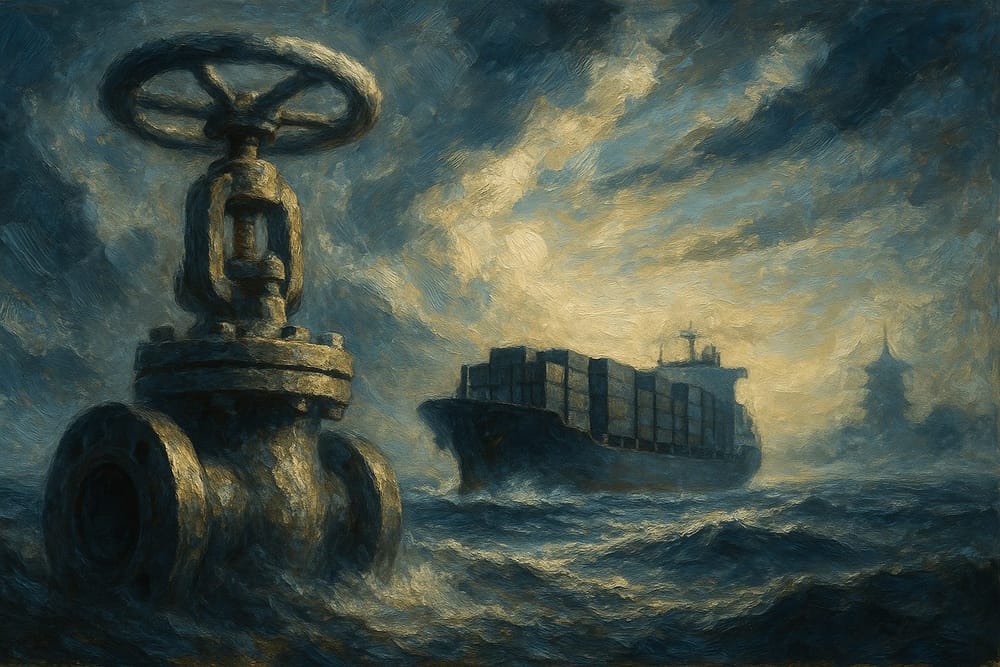
The Supply Valve: How Shipowners Transform Chaos Into Leverage
The mechanism is precise. Shipping companies have learned, since the 2021-2022 crisis, that active capacity management beats chasing volumes. In 2021, when post-lockdown demand had exploded, shipowners posted record profits because supply did not follow. In 2023, when demand had normalized and new ship deliveries had swollen the fleet, freight rates collapsed.
The simultaneous disruptions of Suez and Panama shifted the supply-demand balance. A significant share of global diverted capacity represents an effective reduction on shorter routes. Spot freight rates rebounded. Freight rate indices increased compared to 2023.
The restructuring announced by Maersk on its Asia-Europe lines sits within this logic. By reorganizing certain services, Maersk transfers rotations toward Suez subject to the security situation. It modulates the return gradually. Other major shipowners—MSC, CMA CGM—proceed according to comparable reasoning, each within the framework of its own alliances.
For medium-sized shippers, this system is difficult to absorb. Large industrial groups, with their volumes and annual contracts, can negotiate guaranteed spaces and stable prices. Smaller exporters depend more on the spot market, where rates fluctuate based on shipowner routing decisions. Concentration in the shipping sector—the ten largest shipowners represent more than 85% of global capacity according to Alphaliner—amplifies this power gap. This asymmetry between shippers and shipowners echoes other rebalancings underway in the productive economy, like the reshaping of value chains in the United States analyzed in Factories Return to the United States, But Not the Jobs.
Industrial Location Advantages Are Being Recalculated
Instability in maritime routes alters a calculation that industrialists believed stabilized. The decision to plant a factory in Southeast Asia or maintain production in Europe rests on assumptions about logistics costs. These assumptions include predictable freight, reliable delays, and accessibility to consumer markets.
When these assumptions become uncertain, comparative advantages shift. A factory in Vietnam or India exports to Europe via Suez or via the Cape of Good Hope. If the added cost of the detour persists, and if this cost must be integrated into unit costs structurally rather than cyclically, certain production sites lose relative attractiveness.
Conversely, production zones close to alternative routes gain relevance. Moroccan ports, industrial zones in West Africa, logistics hubs in the Arabian Gulf: all benefit from positional rents when longer routes become the norm rather than the exception. This recomposition is neither spectacular nor rapid, but industrial investment decisions over ten years already integrate these new maps.
UNCTAD has documented in its reports on maritime trade how repeated route disruptions accelerate diversification of supply sources. Industrialists seek to multiply their suppliers and routes, reducing exposure to a single chokepoint. This is a rational response, but it has a cost: shorter and more diversified supply chains are also generally more expensive.
The 2027-2035 Scenarios and the Balance of Power
By 2027, the speed at which the 2 million TEU captive to African routes reintegrate shorter routes will determine power dynamics in the sector, with complex implications for all actors.
In a scenario of rapid normalization, Suez would recover stable traffic levels and capacity would reappear on shorter routes. Freight rates could ease. Shippers would recover negotiating power they have lost since late 2023. Strategies for relocation founded on the rent of detour would lose their economic justification.
In a scenario of prolonged instability, geopolitical and climate disruptions could persist, with sustained effects on rates. Differentiated routings across routes could maintain effective capacity reduction on shorter routes, without formal coordination. Each shipowner decides its routing alone, but collective logic produces the same result: managed supply that supports prices.
This second scenario has consequences for port infrastructure investment. Ports that banked on rapid Suez normalization to calibrate their reception capacity risk finding themselves underused if African routes remain dominant. Ports on alternative routes—Durban, Tanger Med, Salalah in Oman—would conversely have interest in accelerating investments while the positional rent lasts.
The path to progress that would arbitrate between these two trajectories is less technical than political. Regulatory transparency requiring shipowners to publish routing and capacity decisions in real time would reduce information asymmetry between shipowners and shippers. Shippers could thus anticipate capacity movements, reduce spot market exposure, and plan their supply chains with more visibility. This transparency exists partially for freight rates—Drewry and Freightos indices are public—but not for shipowner routing decisions.
The signal to track quarter by quarter is Suez’s share of total traffic. If Suez’s share reaches a significant level of traffic in 2027, the supply-demand balance would begin to reshape. If Suez’s share plateaus well below pre-crisis levels, alternative routes would remain structurally significant. For industrialists making location decisions today over ten years, this signal is worth as much as any competitiveness report on compared wage costs.
Shippers Are Not Passive
It would be inaccurate to present shippers solely as victims of the shipowners’ valve. Several rebalancing dynamics are underway.
Large industrial shippers have accelerated their move to long-term contracts with routing adjustment clauses. They buy predictability rather than low prices, and they benefit when spot rates soar. Platforms like Flexport in the United States or logistics data management tools allow medium-sized shippers to monitor available capacity and compare alternatives in near-real time.
Demand for transparency is also rising from European shippers toward regulators. The European Commission has already examined practices of maritime conferences, commercial groupings of shipowners, since the 2021-2022 crisis. If rates remain high for long, pressure for enhanced monitoring of collective routing decisions will grow.
Alternative infrastructure projects advance slowly but concretely. The transport corridor between India, the Emirates, and Europe, called IMEC, for India-Middle East-Europe Economic Corridor, aims to create a route combining rail and sea that partially bypasses Suez. It remains at stages of agreements in principle, and construction timelines for necessary railway and port infrastructure are measured in decades. But its gestation illustrates that industrial and state actors are beginning to integrate chokepoint instability into their long-term planning.
This type of structural response echoes other profound productive reconfigurations, like the relocation of industrial capacity to the United States whose effects on local employment prove more nuanced than hoped. The geography of physical flows rarely changes fast, but it does change.
The open question for the years ahead is whether international institutions—the International Maritime Organization, United Nations conferences on trade and development—will build frameworks of transparency and regulation equal to a sector that holds a growing share of the global economy between its hands. Or whether the balance will remain, as today, favorable to those who control the valve.
Sources
- Maersk – Structural Changes AE5, AE11, AE12, ME2 Gemini Services (September 14, 2026)
- Sea-Intelligence – Suez routing data, September 2026 (sea-intelligence.com)
- Drewry – World Container Index (WCI), weekly tracking of spot freight rates
- Alphaliner – capacity data and concentration of global container market
- UNCTAD – Review of Maritime Transport, 2024-2025 editions