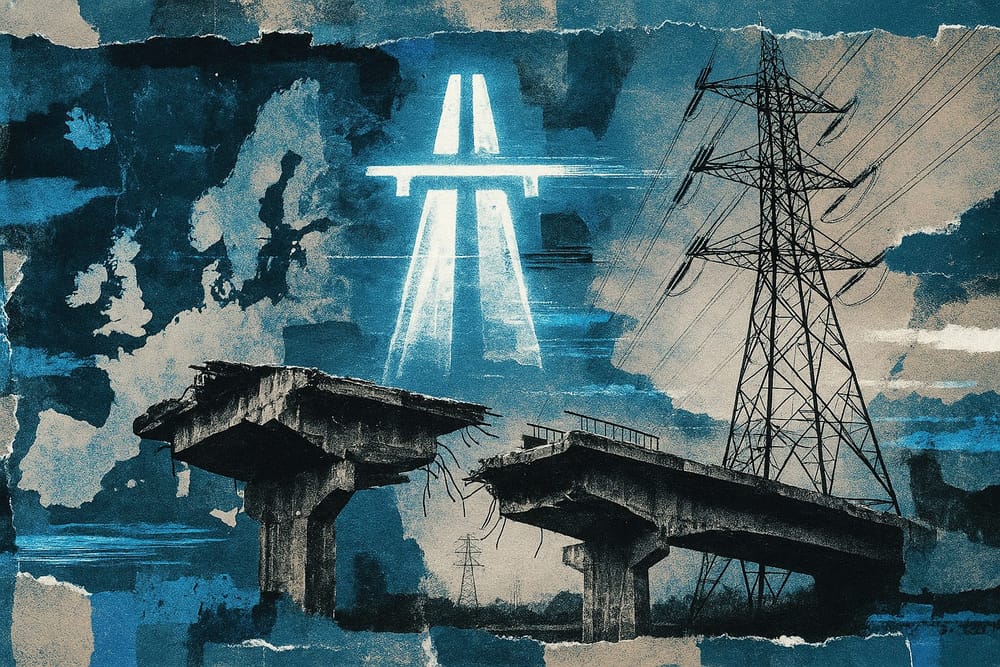
The European Union has transport ambitions and construction site realities. Between the two, there are decades. The European Court of Auditors has just confirmed it once more: the five major transport infrastructure projects for which data are available have recorded on average four additional years of delay since 2020, bringing their average delay to seventeen years compared to the initially planned schedule. This figure is not a technical detail. It is a symptom of a broader problem that conditions the continent’s competitiveness, decarbonization, and cohesion.
The essentials
- Of eight TEN-T projects audited, five show an average delay of seventeen years; since 2020, these five comparable projects have suffered an average of four additional years of delay (ECA Special Report 02/2026).
- The revised TEN-T regulation sets ambitious deadlines for modernizing European infrastructure: 2030 for the core network, 2040 for the extended core and 2050 for the global network. These deadlines are now at risk.
- Delays result notably from complex cross-border coordination and divergent national authorizations, without uniform binding deadlines, without a single point of contact, without automatic and unified sanctions in case of overrun.
- Mario Draghi estimated the investment deficit in Europe at 800 billion euros, of which 450 billion are necessary for energy transition alone. Transport infrastructure constitutes a considerable and structural fraction of this.
- Two scenarios are in contention by 2030: procedural reform with partial transfer of sovereignty to the Union, or institutional inertia that transforms climate commitments into promises without the infrastructure to fulfill them.
What Europe wanted to build
The Trans-European Transport Network covers the main transport infrastructures in Europe, namely railways, inland waterways, maritime routes, and roads. This is, in theory, the backbone of continental mobility. The trans-European network policy rests on the idea that efficient and well-connected infrastructure is vital to the Union’s competitiveness, growth, employment, and prosperity.
The first orientations for the program were adopted in 1996 and modified several times, notably in 2024. Thirty years of common policy. And yet the construction costs of major European transport infrastructure are soaring and the 2030 objective for completing the core network will not be met.
The TEN-T program is multimodal by nature. It aims to facilitate connections between road, rail, and river networks, as well as ports and airports in the member states. But its implementation runs into a fundamental contradiction: ambitions are European; procedures are national.
Seventeen years: what the figure really means
A seventeen-year delay on a cross-border infrastructure project does not mean a construction site has fallen behind. It means a project designed to meet the mobility needs of one decade arrives in the next, sometimes the one after that. The Lyon-Turin section is eighteen years behind initial plans. Rail Baltica, designed to integrate the Baltic countries into the European network, will only have a first phase ready by 2030 according to the latest plan available in November 2025.
The flagship transport infrastructure projects examined suffered from substantial delays, cost increases, poor coordination between member states, and weaknesses in supervision by the Commission. This diagnosis dates from 2020. The 2026 update notes it has not improved.
The average seventeen-year delay corresponds to two Commission mandates, three European budget cycles, and the entire political lifespan of most elected officials who voted on climate commitments. The procedural constraint absorbs political time.
One of the main pillars of TEN-T is to continue transferring passengers and goods from road transport to rail. Yet while cars, trucks, or aircraft can cross EU borders without difficulty, trains, particularly freight trains, are forced to stop at borders, sometimes for hours, to adapt to the requirements of different national systems. Physical and administrative interoperability remains the weak link.
Structural underinvestment, not cyclical
Behind specific project delays lies a deeper trend. Mobilities must meet a triple challenge within a constrained budget: ensuring the performance and resilience of road, rail, or river infrastructure, many of which have suffered from underinvestment for several decades.
In France, this finding was formalized by the “Ambition France Transports” conference in 2025. Upgrading and modernizing national rail, road, and river infrastructure requires an additional investment need of 1.5 billion euros per year starting in 2028 to improve the performance and resilience of the national structuring rail network. France is not an isolated case: it illustrates a trend running across all member states.
Lacking a transport programming law and despite a provision for updating the multi-year expenditure trajectory, there is no longer any real medium-term visibility for state investment in transport infrastructure. The absence of long-term programming is itself a delay factor: projects advance in budgetary fits and starts rather than according to strategic investment logic.
The European dimension of the deficit is no less alarming. The cost of investments needed to complete the TEN-T network is estimated by the European Commission at over 1,500 billion euros by 2050. Its financing is assured, for the most part, by the member states. Yet these states are constrained by their public finances. The circle is vicious.
The promise of modal shift and its material conditions
The European Union has made modal shift — the transfer of freight and passengers from road and air to rail — a pillar of its climate policy. The sustainable mobility strategy sets quantified targets: doubling high-speed rail traffic and rail freight, with tripling of high-speed rail traffic by 2050. These targets require infrastructure that, today, is either missing or saturated.
In an Élucid article reporting his positions, Jean-Marc Jancovici argues that transition is constrained by material conditions: political intentions are worth only what the physical infrastructures supporting them are worth. Applied to TEN-T, the argument is direct. Objectives for developing rail freight depend on the availability and operational capacity of corridors, several of which remain long in the authorization phase. Carbon neutrality requires effective availability of alternative infrastructure; delays in their authorization and commissioning affect the transition.
A competing interpretation exists, carried by voices like those of Ezra Klein and Derek Thompson in their work on abundance and construction blockages. Their thesis is that liberal democracies have progressively stacked appeal rights, impact assessments, and participatory procedures to the point of immobilizing themselves. In this reading, the TEN-T problem is not a failure of political will but an institutional pathology of open societies: each interest group, each resident, each community has won the right to slow down without being forced to accelerate. The solution would then be less political — deciding more firmly — than procedural: redesign the rules of the game so authorization becomes the norm and blockage the exception.
The two readings are not mutually exclusive. Jancovici poses the physical constraint; Klein and Thompson describe the institutional mechanism that aggravates it. Together, they draw a complete diagnosis.
The concrete cost of procedural fragmentation
The Court of Auditors audit examined eight projects. Five of them show an average delay of seventeen years, with four additional years accumulated since 2020. The other three are not without difficulties, but available data on their timeline is less consolidated.
Construction takes time: digging an Alpine tunnel or laying rails over hundreds of kilometers of difficult terrain is a decade-long operation. But projects are not delayed because engineers dig slowly. Delays are associated with divergent national procedures and priorities, uneven cross-border coordination, and in some cases the administrative burden of authorizations.
This cost has a direct economic dimension. An immobilized project generates fixed costs without producing a service. Engineering studies must be updated at each phase: technical conditions, safety standards, and environmental constraints evolve during years of administrative waiting. A project launched in 2005 with the standards of that time must often be revised to incorporate those of 2015, then 2025. The delay feeds on itself.
For the member states themselves, the cost of infrastructure failure is diffuse but real. Each year without Lyon-Turin is freight passing through the Alpine road. Each year without Rail Baltica completed is Baltic countries less well integrated into the continental network. These costs appear in no budget line: they are invisible, borne by the externalities of road congestion and the carbon footprint of goods transport that has not shifted to rail.
The public debt eating into budget margins makes these delays all the more costly: European funding mobilized for TEN-T has a budget lifespan. A project that overruns its time envelope must be refinanced, sometimes renegotiated, always on less favorable terms. The Commission has indeed accepted reimbursement of costs related to delays in starting work, for a total amount of 14.8 million euros financed by the European budget on a single project. This is a cost line no one had foreseen at the time of the decision.
The Grids Package: reform with conditions
The European Commission published in 2025 the Grids Package, a set of measures and proposals aimed mainly at accelerating procedures for energy infrastructure, storage, and charging. The package proposes deadlines and simplifications for certain projects of common interest, but its legislative status remained that of a proposal at the time of publication. The proposed Grids Package provides for limited tacit approval of certain administrative stages, under conditions and excluding environmental decisions; it does not guarantee project approval or an automatic alternative mechanism.
It is a serious reform on paper. It directly addresses the Court of Auditors diagnosis. But its effects remain conditional on two variables that Brussels does not entirely control.
The first is effective transposition and implementation of national obligations provided for in adopted texts. The Grids Package proposes a framework; the states retain control of their internal organization. A state can theoretically comply with the letter of the Grids Package by designating a single point of contact that, in practice, refers back to the same sectoral administrations with the same deadlines. Reform of the point of contact is only worth it if accompanied by reform of the procedures behind it.
The second variable is transposition, administrative capacities, and effective implementation of the rules. A maximum deadline without credible sanction is a pious hope. Yet sanctioning member states for administrative delay on infrastructure projects is politically difficult to implement. The Commission can initiate infringement proceedings, but their duration often exceeds that of the delays they are supposed to correct.
The Transport & Environment report from June 2025 documents this gap between regulatory ambition and operational reality of European rail projects. The most advanced projects are those that have benefited from high-level political coordination between states: Franco-Italian cooperation on Lyon-Turin, for example, progressed when the two governments jointly decided to accelerate. Procedural reform helps; political will remains the primary determinant.
2030-2040: two trajectories and their conditions
The 2030-2040 horizon is the one that will determine whether Europe’s climate commitments were objectives or declarations. On transport infrastructure, two trajectories are plausible.
The first assumes the Grids Package produces real effects. For this to happen, member states would need to accept ceding part of their procedural sovereignty in exchange for easier access to European transition funds. Access conditions to the Cohesion Fund or the CEF — the Connecting Europe Facility — could be reformulated: no longer simply designating a priority project, but demonstrating measurable reduction in authorization timelines over a rolling three-year period. This mechanism exists in other European policy domains: national recovery and resilience plans conditioned disbursements on verifiable structural reforms. Applying it to transport infrastructure is technically feasible.
In this scenario, the average authorization timeline could drop below ten years by 2035, making transport decarbonization plans technically tenable by 2040. Projects currently in advanced authorization phases, those whose impact studies are finalized, could enter construction before 2030. This prospect remains a condition for declared climate objectives to be achievable within the prescribed timeframes.
The second trajectory is that of inertia. Member states marginally adopt Grids Package instruments without modifying their internal procedures. The average timeline, already having risen from eleven to seventeen years in six years, continues to progress. Projects launched in the 2020s arrive in the 2050s, outside the scope of any climate objective declared today. Carbon neutrality commitments remain commitments without real infrastructure to fulfill them.
The audit finds that delays have worsened and new rules will be effective only if actually implemented.
Two signals will allow distinguishing these trajectories before 2030. The first is the average authorization timeline measured in the next Court of Auditors audit: any increase beyond seventeen years confirms inertia; significant decrease signals effective reform. The second is the number of climate infrastructure projects that have obtained complete authorization within five years. Projects completed in this timeframe remain rare. A double-digit figure in 2028 would indicate that something has changed in the states’ mechanics.
Decisions to be made at the European level
Europe is in a position known to federal regimes: it sets common objectives and delegates the means to members. This delegation is a founding political choice. But it creates a structural gap between the pace of European decision-making and the pace of national execution.
TEN-T makes this gap visible and measurable. Seventeen years of average delay on five projects is equivalent to a generation of political objectives not achieved. European corridor coordinators are limited to the role of “facilitators,” and national investment plans in the transport field no longer need to be submitted in advance to the Commission for opinion, but only sent once adopted. Europe comments; the states decide. The Commission can decide on a priority corridor on a Monday; residents, administrative courts, and sectoral ministries of each member state determine the actual date of the first stone.
The necessary reform has been known since the first Court of Auditors audits of these projects. A European accelerated authorization mechanism for cross-border projects, coupled with a maximum deadline, is a serious option. It would require treaty amendment or, at minimum, binding European regulation directly applicable to national procedures, which the current directive does not do. This reform touches on the administrative sovereignty of member states, politically sensitive ground.
But it is a reform whose conditions for success are identifiable. The 2025 Grids Package is a first step in this direction. Effectiveness will depend on actual implementation, including regular feedback on actual authorization timelines and verification of improvements on the ground. Without effective implementation of reforms, authorization delays risk continuing to compromise TEN-T deadlines.
The issue goes beyond the railway sector. The same logic applies to electrical networks necessary for energy transition, hydrogen ports, storage terminals. Electrical infrastructure conditions other transitions, including those that seem a priori far removed from rail: digitization, data centers, embedded systems. Procedural paralysis is a generic problem for European societies facing their infrastructure needs, not a flaw unique to rail corridors. The sustainability, interoperability, and resilience that the revised TEN-T aims to inscribe in concrete are the material conditions for all other transitions. As long as they remain on paper, the continent’s objectives remain declarations.
Sources
- European Court of Auditors, Special Report 02/2026, TEN-T core network corridors: still far from completion: https://www.eca.europa.eu/ECAPublications/SR-2026-02/SR-2026-02_EN.pdf
- Jean-Marc Jancovici, “We won’t be able to save everything”: prepare yourself to choose, Élucid: https://elucid.media/environnement/on-ne-pourra-pas-tout-sauver-preparez-vous-a-choisir-jean-marc-jancovici
- European Commission, Grids Package 2025, Commission proposal on infrastructure permitting procedures (EUR-Lex, 2025)
- Transport & Environment, Rail infrastructure report, June 2025
- “Ambition France Transports” conference, final report, July 2025: https://www.ecologie.gouv.fr/sites/default/files/documents/20250709_Rapport_AFT.pdf
- European Parliament, report on financial activities of the EIB – annual report 2024, June 2025: https://oeil.europarl.europa.eu/oeil/fr/procedure-document-summary/pdf?id=1822187