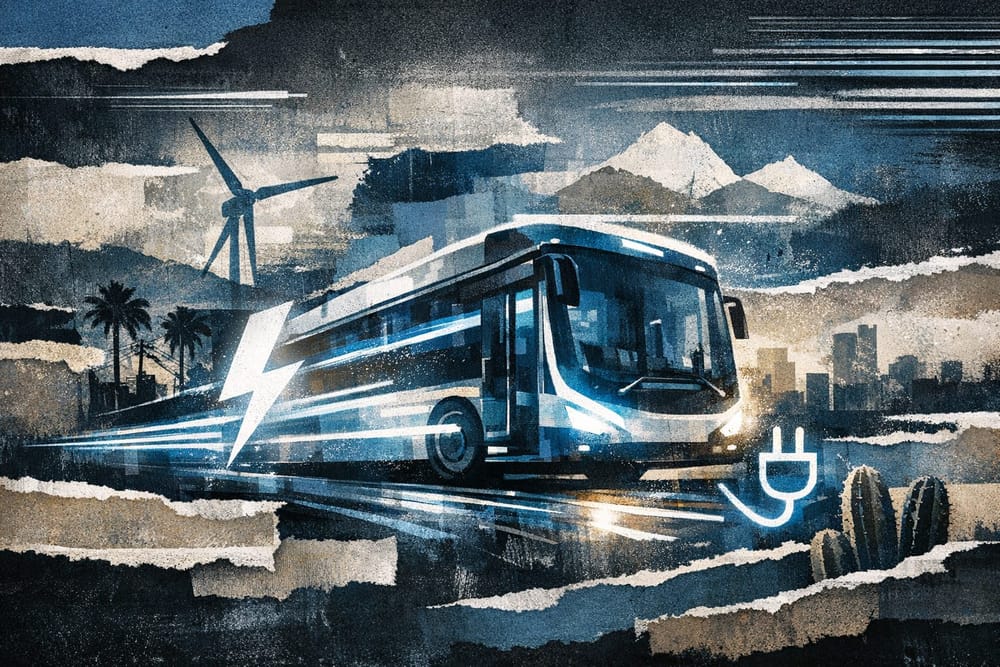
Santiago put its first electric buses into service in 2018. The city now has more than 1,700, making it home to the largest electric public transport fleet outside China. Formal networks in Latin America display a younger fleet than in Europe: average age of 8.4 years versus 11.9 years, according to the Inter-American Development Bank. Informal and semi-formal operators provide more than half of public transport trips in the region.
The essentials
- Santiago and Bogota concentrate Latin America’s largest electric bus fleets, with massive renewals driven by public guarantee and financing mechanisms.
- Informal and semi-formal operators provide more than half of public transport trips in the region.
- Electrifying formal fleets reduces emissions and improves air quality, but can create spatial inequalities in environmental benefits depending on how clean vehicles are distributed.
- Tim Lenton shows that certain transitions self-amplify once they cross a critical threshold; the Latin American electric bus illustrates this mechanism in regulated networks.
- The 2030–2040 decade will be decisive: urbanization continues, and integrating informal operators into the transition will shape the environmental coverage of urban mobility.
Santiago and Bogota found how to finance renewal
The remaining obstacles are organizational and financial.
Financing is a major brake on electrification, alongside other technical, institutional, and regulatory barriers. An electric bus costs two to three times more than a diesel bus to purchase, even though its operating costs over ten years prove competitive. To overcome this barrier, Santiago and Bogota used models that partially separated vehicle ownership or supply from their operation, with different financing arrangements.
In Santiago, the city restructured its network in 2007 under the Transantiago system, then used this contractual framework to impose environmental criteria on new concessions. The contracts secure payments to fleet suppliers or financiers and guarantee that buses remain in the system until debt is repaid, reducing investor risk. IDB Invest provided up to $127 million in long-term financing, with IFC and BancoEstado as co-lenders. Result: more than 1,700 electric buses in service, with an official target of 100% of new additions being electric by 2035 and decarbonization of public passenger transport by 2040.
Bogota followed a similar path with its SITP network, awarding separate contracts for electric bus supply and operation through selection procedures, with fifteen-year operation and maintenance phases. This approach reduces residual risk for operators and reassures lenders. Colombia also mobilized multilateral green funds to lower the cost of capital. These two cities show that large-scale electrification in emerging markets rests on distinct contractual and financial arrangements.
The lesson applies beyond the region. As Tim Lenton observes in his work on positive tipping points, certain technologies—solar, batteries, electric vehicles—see their costs fall as their deployment accelerates. Once a city reaches a critical mass of electric vehicles, maintenance and infrastructure costs decline, making subsequent deployments cheaper. Santiago illustrates this: the first hundred buses required heavy financial engineering; the second thousand followed mechanisms already refined. This self-amplification mechanism appears in formal networks where contracts and financing are structured.
The invisible half of the network
The Santiago and Bogota figures are real and the environmental gains verifiable. But they mask a frontier that IDB data make visible: more than half of the region’s public transport trips are provided by semi-formal or informal services.
Informal and semi-formal operators—minibuses, combis, mototaxis, collectivos—have varying regulatory statuses and restricted access to multilateral financing. These vehicles are old and operate precisely in peripheral neighborhoods where density is insufficient for large formal operators to establish themselves.
The result is a geography of pollution that mirrors the geography of inequality. Central neighborhoods, better covered by formal networks, benefit from the environmental improvements of electrification. Peripheral neighborhoods, dependent on informal operators, record slower environmental gains. This spatial concentration of environmental benefits joins an observation that social policy economists regularly make: reforms to public services first benefit users already connected to regulated networks. The scale of the phenomenon in Latin America stems from the size of the informal sector, which has no comparable equivalent in Europe or North America, and which makes the comparison of fleet ages (8.4 years versus 11.9 years in Europe) less meaningful: the formal fleet is younger, but formal systems cover only about half of public transport trips in the region.
Daron Acemoglu’s reading of how technological gains are captured is useful here. In his work on technology and power, he shows that the gains from innovation distribute according to the institutional structures in place: when these structures favor already-organized actors, gains concentrate. Electrification of formal networks in Latin America follows this pattern: in certain contractualized systems, notably in Santiago and Bogotá, structured contracts facilitate access to financing, while small informal operators face major obstacles in accessing financing and multi-year formal contracts.
What blocks integration of informal operators
Electrification does not cross the border between formal and informal networks because of financial, institutional, and data obstacles that are interdependent.
The first is financial. A small informal operator typically owns one to five vehicles, often bought second-hand and already paid off. Access to investment credit is limited, and existing public guarantee mechanisms are designed for larger operators. The financing mechanisms in Santiago and Bogota assume operators capable of signing multi-year contracts and providing operating data, which poses difficulties for micro-informal operators.
The second obstacle is institutional. Informality is not a stable status: it is a gray zone between tolerated illegality and partial regulation. In several cities, local authorities perceive informal operators as competition for the formal network or as a public order problem, not as a resource to integrate. This posture rules out any supportive policy.
The third is the absence of data. Cities rarely have precise maps of informal flows, travel volumes, or passenger composition. Without this data, designing a progressive integration policy becomes difficult, as does measuring the real environmental gains of extended electrification. A few cities are beginning to use mobile phone data or payment applications to reconstruct these flows; Mexico City and Medellín are leading, but it remains experimental.
These three blockages feed each other. The absence of data complicates the design of tailored financing mechanisms; limited access to financing slows formalization; persistent informality restricts data collection. Breaking this cycle requires political decisions that few cities have implemented at scale.
Two trajectories for the next decade
Latin America will continue to urbanize. By 2050, according to ECLAC, which relays a projection from UNDESA, 89% of Latin America and the Caribbean’s population would live in urban areas, concentrated in already-stressed metropolises. The question of collective transport, its financing, its coverage, its decarbonization, will become more urgent, not less. Two trajectories are emerging.
The first is two-speed electrification. Formal networks continue to renew themselves through contracts and a combination of fare revenues, subsidies, and, in some cases, development financing. Santiago aims for an entirely zero-emission fleet by 2040; this target has not yet been reached. Bogota is extending the model to other corridors. Several capitals—Lima, Mexico City, Buenos Aires—are launching similar programs on a smaller scale.
Meanwhile, informal operators maintain aging fleets, lacking financing mechanisms suited to their scale. Practices in allocating clean vehicles can create spatial inequalities in environmental benefits. Peripheries record slower improvement. This trajectory is the most likely in the short term because it requires the least institutional innovation.
The second trajectory integrates informal operators into the transition. It would envision cities, with support from multilateral lenders, creating vehicle financing mechanisms accessible to micro-operators, linked to their participation in a common data and pricing system. Not complete formalization all at once—too ambitious to be realistic—but progressive integration: an operator who agrees to equip vehicles with a GPS tracker and join a unified payment system could access credit to finance an electric vehicle. The service remains informal in its organization, but the data and vehicles align with regulated standards.
This model would rest on partial precedents. Mobile payment platforms integrated informal micro-merchants into formal financial systems in East Africa by lowering the entry threshold, not by requiring prior formalization, but by offering an immediate service in exchange for exploitable data. Similar logic could apply to transport, provided cities accept treating informal operators as actors in the transition rather than as problems to be solved through formalization.
Two signals would allow tracking which of these trajectories takes hold. The first: the share of daily trips made on electrified lines, measured separately for formal and informal networks. If this gap widens after 2027, the first trajectory dominates. The second: the trend in fine particulate concentrations in areas served exclusively by informal operators. Stagnation would confirm that environmental gains remain geographically concentrated.
The issue is one of design, not just technology
Multilateral lenders—IDB, World Bank, Latin American Development Bank—concentrate their financing on formal networks, which have the administrative and contractual capacities these institutions require. This logic is understandable: it minimizes credit risk and simplifies loan governance. It is also self-reinforcing: by concentrating their financing on contractualized actors, lenders reinforce existing structures and slow institutional change.
A few programs attempt to broaden this frontier. The IDB has financed pilot studies on mapping informal flows in Medellín and Guadalajara. The World Bank has supported digital payment experiments in informal networks in Kenya and Morocco, documenting improvements in data collection. These experiments remain limited in volume compared to investments in formal networks.
One condition could accelerate change: requiring cities receiving international financing for electrification to produce a map of informal trips and a plan for progressive integration before funds are disbursed. This requirement would not condition financing on complete formalization—too distant an objective to be operational—but on knowledge and planning. A city that does not know how its inhabitants travel cannot design an equitable mobility policy.
Europe experienced an analogous version of this problem with financing its railway infrastructure: massive investments were made without ensuring compatibility between national networks, fragmenting benefits. The Latin American risk is symmetric: financing electrification without ensuring equitable coverage of informal zones would produce a clean but incomplete network.
The electric bus moves forward, and it is real. IDB data confirm it; Santiago and Bogota’s fleets show it. Lenton documents a general theoretical framework of self-reinforcing feedbacks; Santiago and Bogota’s electric bus illustrates it in formal networks. It can extend further. But that will require deliberate decisions about who finances, under what conditions, and for whom.
Sources
- Inter-American Development Bank, Funding and Financing of Public Transport in Latin America and the Caribbean (2024)
- ECLAC, Informe urbano de América Latina y el Caribe 2024
- Tim Lenton, Positive Tipping Points: How to Fix the Climate Crisis, Oxford University Press
- Daron Acemoglu & Simon Johnson, Power and Progress: Our Thousand-Year Struggle Over Technology and Prosperity, PublicAffairs, 2023