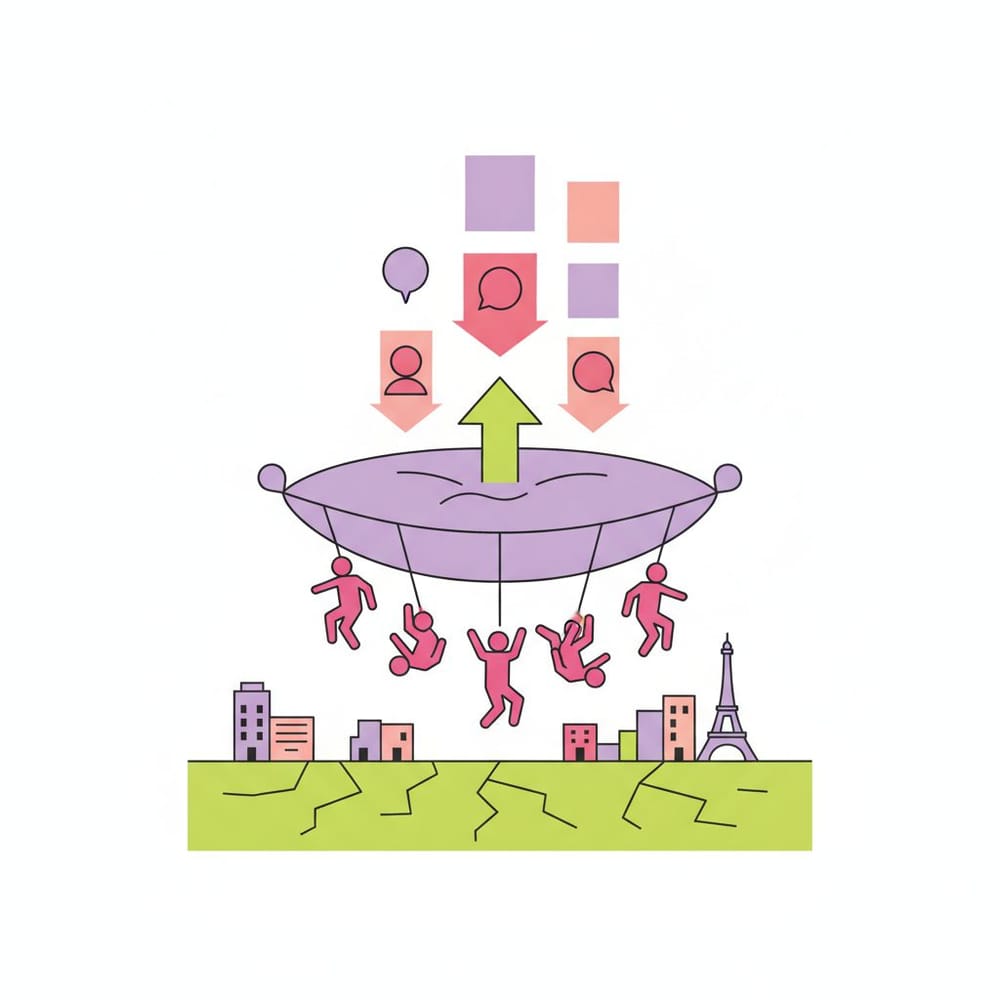
French redistribution delivers on its cushioning promises, but hits a limit that monetary transfers alone cannot overcome. In 2023, solidarity benefits and direct taxes brought the poverty rate down from 21.7% to 15.4%, a reduction of 6.3 percentage points, according to DREES data. Yet 9.8 million people remained below the threshold. The debate shifts in nature: less about how much to spend, more about how to transform a system that cushions into a policy that liberates.
The Essentials
- French redistribution reduces the poverty rate by 6.3 percentage points, from 21.7% to 15.4%, according to DREES (2023).
- Despite this safety net, 9.8 million people remain below the poverty threshold, a sign that monetary transfers have reached their logical ceiling.
- Access to housing, healthcare, transport, and stable employment conditions sustainable exit from poverty, and these dimensions escape monetary benefits alone.
- Dani Rodrik warns against social policy reduced to compensation: investing in accessible and quality jobs is the condition for real mobility.
- French and European experiments test approaches to investing in capacities, but they remain marginal relative to the scale of the issue.
6.3 Percentage Points: What the Figure Masks
The figure is solid and deserves to be read without cynicism. Bringing the poverty rate down from 21.7% to 15.4% represents several million people whose standard of living, at least as measured by income, rises above the threshold. The RSA, housing assistance, family allowances, activity bonuses: the architecture of French social protection produces a measurable effect that few countries of comparable size achieve with such consistency.
But the threshold border is also a statistical border. Rising above it does not mean escaping precarity. Households whose disposable income slightly exceeds the 60% of median living standard threshold remain exposed to the same ruptures: unaffordable rent, untreated dental work, a broken car that cuts off access to employment. DREES itself has for several years distinguished monetary poverty from degraded living conditions, and the two overlap only imperfectly. One can be statistically out of poverty and live in structural vulnerability that benefits do not dispel.
The 9.8 million who remain below the threshold raise yet another question. Some of them do not receive the benefits they are entitled to. Non-uptake of minimum social benefits is estimated at around 30% for the RSA according to DREES and CNAF research. These are millions of people the safety net is designed to catch, and it misses them. The causes vary: complexity of applications, fear of stigma, lack of knowledge of rights, administrative instability.
The system thus suffers from a deficit of accessibility as much as generosity.
Transferred Money Does Not Build Capacities
Economist Dani Rodrik has formalized an intuition that insertion practitioners know empirically: a social policy reduced to monetary compensation does not create the conditions for mobility. In his work on labor markets and globalization, Rodrik distinguishes two logics. The first redistributes gains from a given economic system between winners and losers. The second invests in people’s capacities so they participate in value creation. The first cushions.
The second transforms.
France has built an exceptionally efficient system within the first logic. It invests less in the second. Access to stable housing, to dental and optical care covered, to transport that opens up an employment basin, to training that leads to an accessible job: these are non-monetary goods whose absence perpetuates poverty even when nominal incomes rise. Rodrik would speak of “good jobs”: jobs that are at once accessible, adequately paid, and stable enough to anchor a trajectory. France produces them, but not enough in the zones and sectors where the 9.8 million live.
This reading is not the only one. Philippe Aghion, whose work on Schumpeterian growth shaped part of French economic thought, insists on a different point: growth itself, when properly oriented, is the best mechanism for exiting poverty. From this perspective, what is lacking is not so much the nature of social spending as its financing by an insufficiently productive economy. The debate between the two approaches is not theoretical: it determines whether one relies first on supply-side policies to revive growth and hopes its fruits trickle down, or whether one directly targets the structures blocking individual trajectories. French data inclines toward the second option: while growth in the 1990s and through 2004 did contribute to reducing poverty, since the mid-2000s it has not sufficed to reduce it—its gains remain highly concentrated.
Housing, the Blind Spot of Redistribution
No serious discussion of poverty in France can ignore housing. Housing assistance represents a significant share of social transfers, but has largely fueled rising rents in tight markets, captured by landlords rather than absorbed by tenants. Economist Gabrielle Fack documented this mechanism on French data: a substantial fraction of aid dissolves into prices. The safety net is pierced by the market it is supposed to help navigate.
The result is visible in emergency accommodation figures and in waiting lists for social housing requests. At the end of 2024, approximately 2.767 million households according to the Union sociale pour l’habitat (USH), or even 2.9 million according to the government, were waiting for social housing. The State spends increasing sums to maintain people in a fragile balance between private rent and public aid, without building enough for demand to be absorbed. The 9.8 million below the threshold are not a statistical abstraction: a significant proportion of them live in overcrowded, unsanitary, or remote housing that prevents real professional mobility.
The link between housing and employment is direct. An active person without housing in a dynamic employment basin cannot respond to an offer matching their qualifications. The geography of French poverty concentrates in territories where employment is rare and where modest households are pushed out by real estate markets that have followed the geography of wealth. Research on automation in rural areas and on funding inequality by territory documents it: two-speed France is a cartographically demonstrable reality.
What Works When You Invest in Capacities
Criticism is valuable only if it identifies what works. Several French and European programs show that investing in capacities produces measurable effects, even if they remain under-dimensioned.
Childcare and early childhood services are the most robust example. James Heckman’s work on returns to early investment has been extensively confirmed by French studies. A child from a disadvantaged background who accesses a quality facility from their earliest years reduces their risk of school dropout and increases their chances of stable employment in adulthood. France has developed a significant network of public childcare facilities, but it remains insufficient: coverage rates for children under three leave hundreds of thousands of families without solutions, particularly in rural areas and priority neighborhoods. The plan to create 100,000 additional spots launched under the previous legislature has fallen behind schedule.
Territory Zero Long-Term Unemployment (TZCLD) experiments constitute another example. The principle: hire people durably distanced from employment in job-creation enterprises, financed by redirecting allocations that would have been paid out anyway. The experiment has been extended to around fifty territories. Results on employment are positive, but scaling up remains slow and institutional obstacles numerous. It is a model of investing in capacities rather than simple transfer: you create real employment, not an additional benefit.
Reinforced job-placement support programs, like those France Travail has been developing since its 2024 reform, attempt to go beyond placement to address peripheral obstacles: mobility, childcare, health. Evaluations are still too recent to be definitive, but the orientation is consistent with what research indicates. Access to a dedicated, available advisor trained in complex situations makes a documented difference in several European countries.
The Model Has Reached Its Logical Limit
DREES publishes annual indicators before and after redistribution. They show remarkable stability: for the past fifteen years, the gap between poverty rate before and after redistribution has fluctuated around 6 to 7 percentage points. The safety net holds. But it is not tightening. The rate after redistribution stagnates around 14-15%, despite social spending that has continued to increase in volume.
This stability reveals the logical limit of the model. Increasing transfers without modifying the structures producing poverty produces diminishing returns. You can raise the RSA by 50 euros and see some beneficiaries statistically exit poverty. But if housing remains inaccessible, if dental care remains partially out of reach, if available employment in the living basin is seasonal and under-qualified, the standard of living measured by income does not translate into a sustainable trajectory. The persistent poverty rate, which measures people who remained below the threshold over consecutive years, is even more eloquent: it changes little, because it is often the same people trapped in the same structures.
This question joins a broader debate on French public finances. France lets adjustment happen by default: without explicitly redefining its spending priorities, it maintains a model that absorbs increasing resources without improving its results on social mobility. The challenge is to spend differently, shifting part of cushioning spending toward investment in access structures.
Where the Debate Should Move
France spends approximately 32% of its GDP on social protection, among the highest rates in Europe according to Eurostat data. This level of spending buys a real and documented reduction in monetary poverty. Claiming it serves no purpose would be counterfactual. But it finances primarily transfers rather than services, and emergency services rather than development services.
The debate shift suggested by DREES data leads toward several concrete questions. Can part of housing assistance be conditioned on the actual construction of affordable housing, to prevent subsidies from fueling prices? Can coverage of dental and optical care be expanded so health is no longer a barrier to employment for hundreds of thousands of people? Can transport in low-density areas be financed so geography is no longer destiny? Can reinforced support programs from France Travail be scaled up, rather than maintained as pilot projects?
These questions have no simple ideological answer. They require serious evaluation, honest experimentation, and institutional patience. The horizon is not 2025, nor even 2030: policies investing in capacities produce their effects over a generation’s timespan. This is precisely why it is difficult to finance them within a five-year electoral cycle, and why they remain under-dimensioned everywhere in Europe, not just France.
The French social safety net is real, quantified, and defensible. What it does not do, DREES data show as clearly as what it does: it maintains people above a threshold without always giving them the means to distance themselves from it durably. The question that naturally follows is which actors, which political coalitions, and which institutions are positioned to conduct this shift. Examples exist, in France and elsewhere. Countries have bet on digital identity as infrastructure for access to rights, thereby reducing non-uptake.
Others have bet on universal services as a lever for mobility. France has the data to know where it stands. It has less clearly defined where it wants to go.
Sources
- DREES, Poverty Indicators Before and After Redistribution, 2026, drees.solidarites-sante.gouv.fr
- Dani Rodrik, The Globalization Paradox, Oxford University Press, 2011; and work on industrial policies for employment (Kennedy School of Government, publications 2020-2024)
- Philippe Aghion, work on Schumpeterian growth and inequality, The Power of Creative Destruction, Harvard University Press, 2021
- Gabrielle Fack, « Are Housing Benefit an Effective Way to Redistribute Income ? Evidence from a Natural Experiment in France », Labour Economics, 2006
- Eurostat, Social Protection Statistics, spending as % of GDP, 2024 edition
- Ministry responsible for Housing, social housing request dashboard (SYPLO), data end 2024
- CNAF and DREES, studies on non-uptake of minimum social benefits, syntheses 2021-2023
- Territory Zero Long-Term Unemployment, evaluation reports, editions 2022-2024, tzcld.fr
- INSEE Première n°2063 – Standard of Living and Poverty in 2023, insee.fr
- DREES – Non-uptake of RSA end 2021 (May 2026), drees.solidarites-sante.gouv.fr
- USH – Social Housing Demand end 2024, union-habitat.org
- DREES – Social Protection in France and Europe, 2023 edition, drees.solidarites-sante.gouv.fr
- Fack G. (2005) – Housing Assistance and Rents, Economics and Statistics INSEE, insee.fr
- CNRS Le Journal – Interview Philippe Aghion, Nobel 2025, lejournal.cnrs.fr